"The statement 'The encryption industry has nothing left to build' is a bad argument."
Written by: Pink Brains (@PinkBrains_io)
Translated by: AididiaoJP, Foresight News
Most altcoins will never return to their historical highs in 2021, and most new projects will oscillate below their issuance price for a long time after their TGE, with capital being harsher than ever.
Simply telling stories is no longer enough. Products must have real users, tokens must have real demand and value capture, and growth must be measurable.
Some tracks will continue to grow exponentially, while others will gradually be forgotten by the market.
Below are the top 10 crypto tracks most likely to sustain growth in the second half of 2026 outlined by the Pink Brains team.
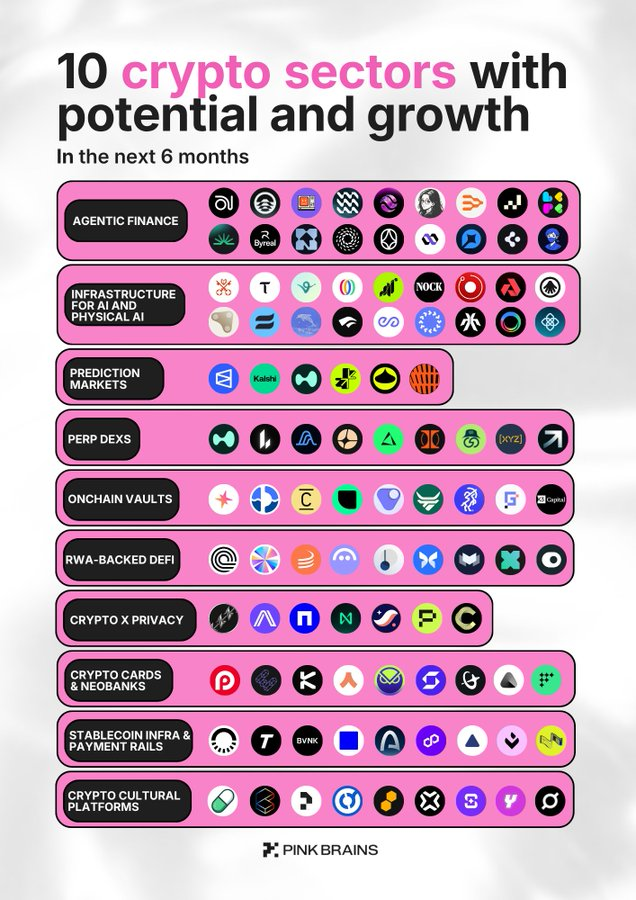
Agentic Finance
During the correction in Q1 2026, the overall decline of "AI Agent tokens" was 80-90%, but performance was highly differentiated: projects with no usage and purely capitalizing on concepts crashed, while projects with real usage stabilized and rebounded. The benchmark for this track is now proof of real usage, rather than branding.
Key shift: Capital is now flowing only to those agents that can truly execute actions, rather than just "chatting" robots.
Why will the second half of 2026 see growth:
Despite the correction, the overall market cap of the AI crypto track still grew from approximately $9 billion in early 2025 to between $22 billion and $27 billion by May 2026.
The infrastructure has matured: Wallet standards like EIP-7702 and Base's AgentKit give agents session-level trading permissions (signature and holding without exposing private keys), unlocking the technology that transforms "chatbots" into "executors."
Open-source models (such as Kimi, DeepSeek, Qwen) significantly reduce inference costs, making large-scale operations of agents a reality.
Frameworks like OpenClaw, Hermes Skills, and MCP give agents memory, tools, applications, and workflow capabilities.
The crypto market operates 24/7, and humans cannot constantly monitor it, while agents can. The future direction is intent-driven automated execution replacing manual trading.
Representative projects:
- @HeyAnonai: Natively supports 18 chains, 360+ MCPs, and 25 DeFi/CEX protocols, capable of executing spot and leveraged trades via prompts.
- @AIWayfinder: Emotion-based cross-chain automated trading strategy agents.
- @bankrbot: All-in-one DeFi terminal, supporting cross-chain exchanges and automated strategies.
- @SurfAI: Research + execution copilots, combining market analysis with automated trading.
- @ethy_agent: Autonomous intelligent assistant that can execute trades, staking, yield and transfers from smart wallets; capable of running expert agents' Alpha strategies.
- @minara: Personal agents supporting stocks, commodities, crypto, Pre-IPO equity on Hyperliquid and Lighter.
- @Cod3xOrg: Event-driven trading engine with updatable algorithm strategies.
- @SynthdataCo: Stock/crypto/commodity prediction intelligence (Bittensor SN50).
- @0xbeepit: AgentFi protocol, featuring prediction markets, yields, and automated trading.
- @HeySorinAI: Research/trading, with desktop app and custom alerts (@SaharaAI).
- @byreal_io: Agent-native DEX on Solana, Byreal Perps Skills provides automated trading strategies for agents.
- @Zyfai_: Yield farming agent across 38+ pools, searching for the best risk-adjusted returns.
- @fere_ai: AI assistant for cross-chain, meme coins, prediction markets, and DeFi.
- @autodotfun_: Trading assistant for spot, perpetual, and prediction markets.
- @gizatechxyz: Autonomous financial intelligence capable of assessing markets and executing on your behalf.
- @Infinit_Labs: AI x DeFi one-stop app that can research, create, and execute financial intentions using AI.
- @get_truenorth: The first agent broker to help build your own professional trading desk.
- @coinvestai: Direct trading through ChatGPT and Claude (@liquidtrading), aggregating trading terminals from Hyperliquid, Solana, and Polymarket.
- @senpi_ai: Hyperliquid agent providing pre-built trading strategies for OpenClaw, portable to Claude Code, OpenAI Codex, GitHub Copilot, Cursor, and more.
Crypto Infrastructure for AI and Physical AI (Picks and Shovels)
This is a typical "selling shovels" track, performing better than agent tokens in Q1 due to its measurable value.
The DePIN sector had a market cap of approximately $9.4 billion in early 2026, with monthly on-chain revenue around $150 million in January, as users are genuinely paying for storage, computing, and data. The narrative has shifted from "AI hype" to quantifiable metrics like "compute utilization" and "inference costs vs AWS."
Why will the second half of 2026 see growth:
The GPU supply-demand gap continues to widen, with Render connecting to NVIDIA Blackwell (B200), reaching $38 million in on-chain revenue in January; Bittensor's Q1 on-chain AI service revenue reached $43 million and has moved past its halving into a scarcity phase; Virtuals excel in agent issuance and monetization. Physical AI (humanoid robots) is seen by Morgan Stanley as a multi-trillion dollar market before 2050, with on-chain capital accelerating its inflow.
Representative projects:
- @AskVenice: Private, uncensored AI inference.
- @opentensor: Incentive network for compute and data, with 120+ specialized subnetworks competing to provide inference, training, and data, rewarded with $TAO.
- @virtuals_io: Protocol for creating/monetizing agents and physical AI, one of the strongest income stories in this track.
- @openmind_agi: Software stack for robots/physical AI.
- @FabricFND: Research and public infrastructure for smart machines.
- @grass: Decentralized web data scraping network for AI training.
- @nockchain: Lightweight proofs/verifiable computation.
- @rendernetwork: Distributed GPU rendering + AI inference, supported by revenue, Blackwell ready.
- @akashnet: Decentralized computing market.
- @AlloraNetwork: Self-improving decentralized inference network.
- @GoKiteAI: Payment/identity tracks for agents.
- @TargonCompute: Bittensor SN4, confidential GPU computation and verifiable inference using Intel TEE.
- @dphnAI: Developing uncensored models and distributed inference in collaboration with Venice, Hugging Face downloads exceed 5 million per month.
- @chutes_ai: Bittensor SN64, serverless "instant-on" model hosting, costing only a small fraction of AWS, is a leading OpenRouter provider.
- @peaq: L1 for DePIN and machine economy, providing identity and payment solutions for interconnected devices.
- @openservai: Agent infrastructure for enterprises, governments, and the autonomous economy.
- @xmaquina: Capital market for humanoid robots and physical AI projects built with $DEUS.
- @OpenGradient: L1 for "open intelligence" supporting verifiable AI workflows, persistent memory, and user-owned data.
Prediction Markets
This is a typical case of "real use cases beat narratives."
Monthly trading volume soared from below $5 billion in mid-2025 to a new high of $28.4 billion by May 2026. Kalshi's trading volume surpassed Polymarket in 2026, while Polymarket still maintained a lead in user numbers (over 678K unique users in April).
Why will the second half of 2026 see growth:
Regulatory barriers have significantly cleared. The CFTC withdrew restrictive proposals and issued a no-action letter to Polymarket; ICE/NYSE plans to invest up to $2 billion, with a valuation of $8 billion. The 2026 World Cup is expected to drive $2.5 billion in trading volume. Sports have become a major transaction engine, and the downside risks in binary contracts are limited, attracting a substantial amount of hedge funds.
Representative projects:
- @Polymarket: Largest user base in crypto-native markets; rebuilt matching engine, introducing new collateral token (Polymarket USD), strongest on political, crypto, and breaking news events.
- @Kalshi: CFTC regulated, now the leader in trading volume; dominant in sports and macro contracts; supported by deep institutional market making.
- @Hyperliquid HIP-4: On-chain prediction primitives built into the Hyperliquid stack.
- @trylimitless: Largest prediction market on Base.
- @Rain__Protocol, @opinionlabsxyz: On-chain prediction venues on Arbitrum and BNB Chain, experimenting with continuous/tokenized markets.
Perpetual Contract DEXs
Original perpetual DEX transaction volume has retreated from its peak in October 2025, with a 30-day transaction volume of about $629 billion in April, and the latest data is mixed.
However, RWA perpetuals are the biggest highlight, with Hyperliquid's market share rising to about 44%, and RWA open interest reaching a record $2.65 billion in May, doubling in two months.
Why will the second half of 2026 see growth:
New projects like TradeXYZ and Ventuals are advancing HIP-3; traditional exchanges like Coinbase and Binance are exploring on-chain pre-IPO stocks, indices, commodities, and forex markets. The advantage of 24/7 crypto trading is vividly illustrated in weekend geopolitical events.
Representative projects:
- @Hyperliquid: Deepest on-chain order book with slippage below 1bps on large BTC/ETH trades; RWA perpetual leader.
- @Lighter_xyz: High-performance Perp DEX, leading in RWA derivatives share in early 2026.
- @variational_io: RFQ perpetual with loss return, financed $50 million, planning to launch 100+ RWA perpetual markets.
- @Ostium: DEX focused on synthetic RWA (54+ pairs: commodities, forex, indices, stocks); monthly transactions around $6 billion, with about 97% on Arbitrum being non-crypto assets.
- @edgeX_exchange: Privacy-first Perp DEX, mobile-first, with the highest pre-TGE revenue on EDGE Chain.
- @grvt_io: ZK validium L3, privacy-first CLOB perpetual.
Onchain Vaults
"Vaulted finance" has become the mainstream method for on-chain yield. In April 2026, the TVL of DeFi lending was approximately $75-80 billion, up over 50% from early 2025. Morpho is a benchmark, having surpassed $10 billion TVL, with its curated vault system becoming a standard.
Why will the second half of 2026 see growth:
Most users want yield rather than executing themselves. Institutions are also more willing to accept DeFi products due to transparency and publicly available performance records. On-chain vaults are becoming the asset management layer of the crypto world.
RWA-supported DeFi
This track currently has the strongest structure in the market, continuing to grow even as most sectors contract. In April 2026, the total value of tokenized RWA was approximately $27.65 billion, with U.S. Treasury bonds, commodities, and asset-backed credit leading the way.
Why will the second half of 2026 see growth:
Regulatory frameworks are accelerating, with WisdomTree receiving SEC approval for 24/7 trading and immediate USDC settlement; tokenized private credit has grown 180% year-on-year. Protocols using tokenized RWA for lending and yield trading on-chain will experience an explosion of composability.
Crypto Privacy
The standout performer from the last cycle. Zcash surged 860% in Q4 2025, and Grayscale's Q4 report indicated that the privacy sector performed best in an overall negative yield environment, with an application for a ZEC spot ETF already filed.
Why will the second half of 2026 see growth:
Advancements in ML de-anonymization tools have weakened the effect of traditional coin mixing privacy, while demand for strong cryptographic privacy such as ZK has risen; Zcash's shielded pool ratio has reached 59%; NEAR Intents transaction volume exceeded $10 billion; Venice will extend privacy into the AI inference domain.
Crypto Cards and New Banks
This is the hardest metric for fake adoption. In March 2026, monthly transaction volume for crypto cards was about $607 million, growing sixfold over 18 months, with a cumulative total of $6.5 billion.
Why will the second half of 2026 see growth:
The demand for stablecoin savings, remittance, and inflation hedging remains strong in emerging markets (Southeast Asia, Latin America, Africa); TradFi is accelerating its entry, with Visa, Mastercard, Stripe, Nubank, and others all deploying.
Stablecoin Infrastructure and Payment Tracks
The real focus of institutional funds. In 2025, the annual settlement volume of stablecoins exceeded $33 trillion, surpassing Visa. In 2026, the emphasis is on vertical integration and "stablecoin chains."
Why will the second half of 2026 see growth:
Stripe+Paradigm launched Tempo; Circle raised $222 million for Arc at a valuation of $3 billion, with over 100 institutions including Visa, BlackRock, and HSBC participating. Enterprise-grade integration is accelerating.
Crypto Culture Platforms
This may not sound serious, but the business models are extremely efficient. Pumpfun has accumulated nearly $1 billion in protocol revenue, with DEX trading volume at $88 billion; Courtyard tokenized Pokémon had monthly transactions of $124.5 million, with an annualized revenue of about $200 million.
Why will the second half of 2026 see growth:
Tokenized collectibles have extended from NFTs to become a viable RWA subclass, with physical redemption mechanisms verifying on-chain pricing; on-chain RNG has made GambleFi verifiable.
Conclusion
"There’s nothing left to build in crypto" is a bad argument.
We already have powerful primitives such as stablecoins, prediction markets, perpetual contracts, tokenized stocks, NFTs, DePIN, and more. Creating entirely new primitives is becoming increasingly difficult, but the opportunity to build excellent applications based on existing primitives remains vast.
The difference now lies in: real use cases are measurable, rather than relying on promotion; the old playbook is to buy narratives early, while the new playbook is to discover real usage early.
免责声明:本文章仅代表作者个人观点,不代表本平台的立场和观点。本文章仅供信息分享,不构成对任何人的任何投资建议。用户与作者之间的任何争议,与本平台无关。如网页中刊载的文章或图片涉及侵权,请提供相关的权利证明和身份证明发送邮件到support@aicoin.com,本平台相关工作人员将会进行核查。


