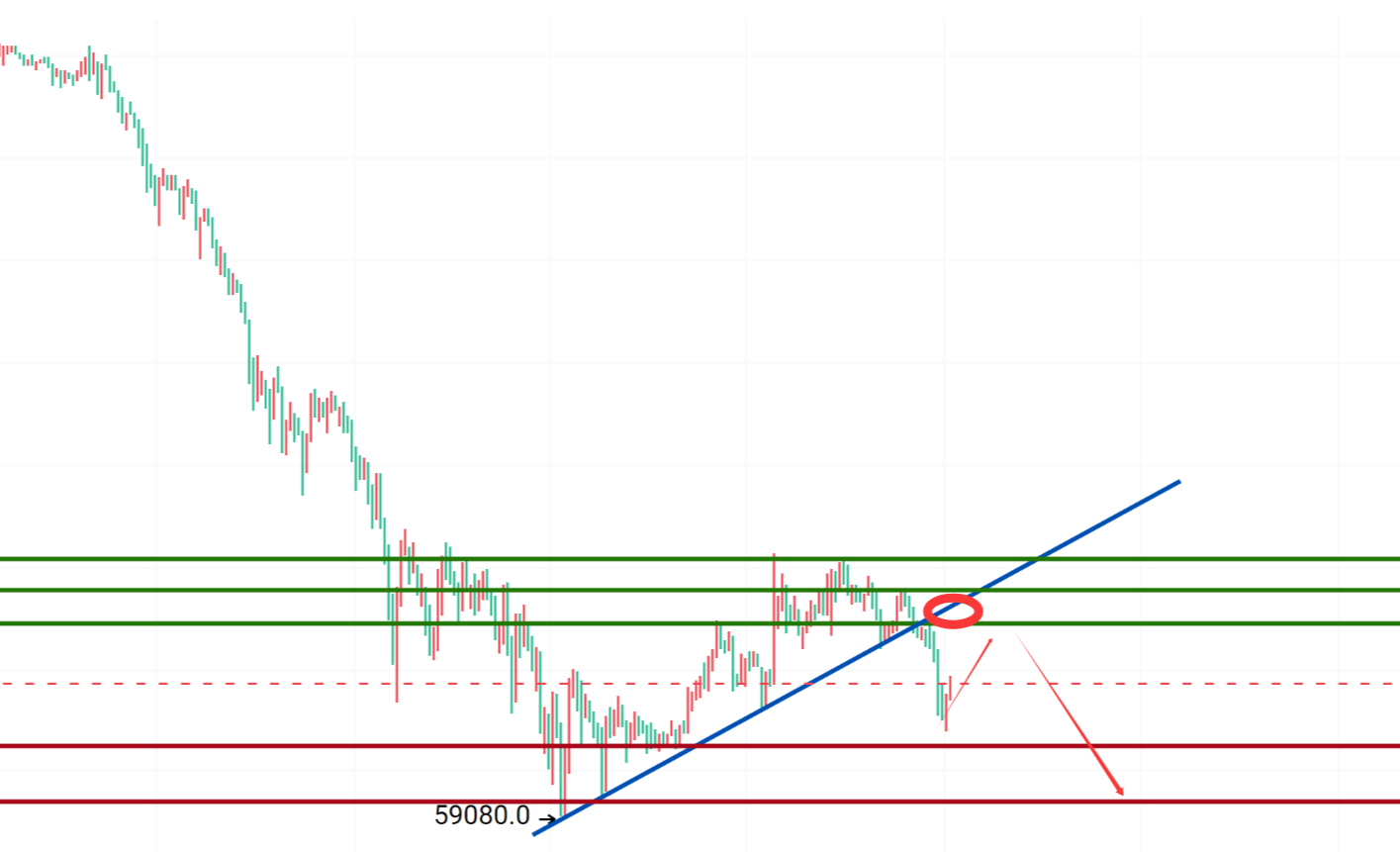
Before this round of intense fluctuations, Garrett Jin had just won over 11.2 million dollars in profit from a precise ZEC short, and like a big winner at the poker table, he did not choose to leave but pushed his chips further—turning around and opening a ZEC long position with about 2 times leverage on HyperLiquid, totaling about 27,300 ZEC, while simultaneously betting on a BTC long position with about 5 times leverage. When the market is favorable, such a combination amplifies victory, but when prices suddenly reverse around June 9, 2026, it turns into amplified pain. According to AiCoin data, about 351 million dollars in global derivative market liquidations occurred in the past 24 hours, with long positions accounting for the vast majority, including approximately 104 million dollars in BTC liquidations and about 77.49 million dollars in ETH liquidations. Garrett Jin's BTC long was also caught up in this deleveraging storm, with current unrealized losses exceeding 18.46 million dollars. The old refrain of "Bitcoin is dead" is once again replayed on social media, panic emotions amplify alongside the liquidation numbers, but voices on the other end emphasize the timeline: CZ publicly wrote, "Bitcoin won’t 'die' for too long; don’t panic," and Kraken's co-CEO assessed that almost all traditional financial service institutions will offer assets like Bitcoin and Ethereum to clients, viewing them as one of the main themes for 2026. Thus, on one side, high-leverage longs represented by Garrett Jin suffer enormous unrealized losses in a sudden price change, while on the other, institutional progress, although slow, steadily moves forward—these two sharply contrasting confidence curves intertwine in the same market.
From Shorting to Being Trapped in Longs
Garrett Jin is repeatedly mentioned among the protagonists of this storm, one important reason being that he carries multiple yet-to-be-verified labels—there are claims in the market associating him with Bitcoin OG "10/11" and even speculating that he may be acting as an agent for a former founder of a trading platform or a specific major player, but these more specific identity recognitions currently lack publicly verifiable evidence and can only remain at the level of "rumors." Being placed alongside "10/11" already indicates that he is viewed by some traders as a representative of someone who "understands crypto and dares to gamble."
According to AiCoin data, before 2026, he first made over 11.2 million dollars in profit by shorting ZEC in the derivatives market, completing the first act that drew the attention of onlookers. However, what came next was not a withdrawal but a front-line reversal on HyperLiquid: with the chips accumulated from this success, he opened a ZEC long position with about 2 times leverage, totaling about 27,300 ZEC; meanwhile, he also carried a BTC long position with about 5 times leverage, which saw unrealized losses exceed 18.46 million dollars amid a sharp market drop around June 9, 2026. The overall risk exposure quickly shifted from conservative short-profit to aggressive long-trap. For external observers, this drastic shift from profiting in shorts to heavily invested longs vividly exposes the double-edged sword attribute of high leverage: in the same round of fluctuations, it can amplify profits and, when prices reverse, compress the recently won bullets into unbearable unrealized losses. This sudden turn from profiting in shorts to being trapped in longs itself is a clear footnote on how high-leverage trading can push winners toward the edge of a cliff within a volatility cycle.
351 Million in Liquidations: Collective Pain for Leveraged Longs
Zooming out from Garrett Jin’s personal account to the entire market, the severity of this round of intense fluctuations becomes clearer. According to market data statistics, about 351 million dollars were liquidated in the global crypto derivatives market within the past 24 hours, primarily consisting of long position liquidations; just BTC alone saw about 104 million dollars liquidated, and ETH about 77.49 million dollars, making it the absolute protagonist of this wave of forced liquidations. In the face of such numbers, Garrett Jin's approximately 18.46 million dollars in unrealized losses on his BTC long is no longer just an individual's story of “betting big,” but rather embedded in a broader backdrop of collective suffering among leveraged longs: those positioned on the long side are being forcibly liquidated layer by layer by the market from different leverage multiples and entry points.
Each similar concentrated liquidation leaves deeper emotional cracks beyond price charts. The rhetoric of "Bitcoin is dead" tends to play out almost cyclically at such junctures, and this is no exception—price drops and continuous long liquidations are viewed by pessimists as "irrefutable evidence" of a narrative ending; while for those still holding positions, the paper losses intertwine with public ridicule, creating a sense of psychological pressure akin to being besieged. In such an emotional arena, Garrett Jin’s 18.46 million dollars in unrealized losses is more like an enlarged mirror reflecting the brutally harsh reality of collective pressure on longs in this extreme market.
The Gambling Mentality Exposed by HyperLiquid Positions
According to publicly available data from HyperLiquid, after successfully shorting ZEC for over 11.2 million dollars in profit, Garrett Jin effectively pushed his chips back to the poker table: this time, he bet on a ZEC long with approximately 2 times leverage, totaling about 27,300 ZEC, concentrating on a single variety, placing the position itself in a high-risk exposure state. Unlike traditional traders who typically diversify and hedge, this resembles a single-line bet—immediately after making money from a decline, he turns to the other side of the same asset, betting that the market has hit “panic overkill,” expecting a retaliatory rebound next.
Even more aggressively, on top of this, he added a BTC long position with about 5 times leverage, with current unrealized losses exceeding 18.46 million dollars, while public materials did not provide a precise accumulation range, allowing for only a rough judgment that this was a highly focused long bet in both time and direction. The combination of a 2 times leverage ZEC long with a 5 times leverage BTC long easily brings to mind a typical "bottom-fishing reversal" strategy: using a high-volatility asset like ZEC to amplify yield elasticity and using BTC to anchor the core faith exposure. In an environment where about 351 million dollars of liquidations occurred across the network in 24 hours and long positions became the primary victims, this highly concentrated high-leverage structure magnifies each price fluctuation into drastic swings in account net value, pulling one person's emotional curve into a roller coaster of synchronized oscillation with the market. In this highly transparent and highly leveraged structure, it's not just the account net value being amplified, but emotions and beliefs themselves are also pushed onto leverage.
Reassurance and Game Behind “Bitcoin Won't Die for Too Long”
As prices plummet and about 351 million dollars are liquidated across the network within 24 hours, where longs became the main victims, familiar "Bitcoin is dead" obituaries begin to appear densely again in the public discourse. At this emotional critical point, CZ threw out the phrase, "Bitcoin won’t 'die' for too long; don’t panic," which is not only a direct rebuttal to the "dead" rhetoric but also a typical industry leader's reassurance—using vague yet firm terms like “cycles” and “won’t be long” to frame current agony within a long-term narrative, reminding people that this is not an end but just another round of cleansing.
This reassuring discourse confronts the pessimistic narrative of "Bitcoin is dead" in every round of intense adjustment, historically often accompanied by concentrated liquidations of leverage and price volatility. For traders like Garrett Jin, who have bet their direction on a BTC long of about 5 times leverage, hearing "won't die for too long" at a moment when losses exceed 18.46 million dollars can easily be interpreted as an endorsement of their own faith: it alleviates the psychological pressure of liquidation, but it may also delay the decision to cut losses, causing high-leverage longs to remain longer in volatility and expose themselves to greater extreme risks. Currently, there is no public evidence showing a direct coordination relationship between CZ's statements and any specific trader or single position; this appears more like an emotional mobilization directed at all participants. Because of the lack of specificity, each high-leverage long could interpret this statement as a veiled hint towards their own positions, thus continuing to amplify account risks amidst the pull of panic and comfort.
Wall Street Accelerates Entry Amidst Short-Term Violent Dislocation
On another timeline, the market is telling a completely opposite story. Kraken co-CEO David Ripley assesses that almost all traditional financial service institutions will offer clients crypto assets including Bitcoin and Ethereum, viewing this as a major theme for 2026. He also mentioned that the proliferation of tokenized tools anchored to fiat currencies, such as on-chain settlement tokens, has proven investors' willingness to hold traditional asset versions based on blockchain. Thus, a stark contrast emerges: on one side, according to AiCoin data, about 351 million dollars in derivatives positions were liquidated within 24 hours, Garrett Jin's BTC long suffered an individual unrealized loss exceeding 18.46 million dollars, with emotions swinging between "dead" and "going all in to bottom-fish"; on the other side, traditional financial institutions have not noticeably hit the brakes on their strategies involving crypto assets and tokenized products, as Wall Street's product line is slowly yet steadily extending onto the chain. What will be truly worth tracking next is whether leverage usage will cool significantly after this deep retracement, whether traditional institutions will accelerate the rollout of related products, and whether behaviors like Garrett Jin’s of concentrating high-multiple longs in a single account will continue to occur frequently. These variables will together shape the dominant forces in the "Bitcoin confidence war" in the coming years.
Join our community, let's discuss and grow stronger together!
AiCoin Exclusive Hyperliquid Benefits: https://app.hyperliquid.xyz/join/AICOIN88
AiCoin Exclusive Aster Benefits: https://www.asterdex.com/zh-CN/referral/9C50e2
On-chain Telegram community: https://t.me/AiCoinWhaleData
On-chain community: https://www.aicoin.com/link/chat?cid=N6OVMor5g
AiCoin On-chain Twitter: https://x.com/aicoinwhaledata
免责声明:本文章仅代表作者个人观点,不代表本平台的立场和观点。本文章仅供信息分享,不构成对任何人的任何投资建议。用户与作者之间的任何争议,与本平台无关。如网页中刊载的文章或图片涉及侵权,请提供相关的权利证明和身份证明发送邮件到support@aicoin.com,本平台相关工作人员将会进行核查。