_This article is from: _Aevo co-founder Ken Chan
Translation|Odaily Planet Daily (@OdailyChina); Translator|Azuma (@azumaeth)_
Editor's Note: This weekend, an article by Aevo co-founder and CTO Ken Chan (@kenchangh) went viral online, titled “I Wasted 8 Years of My Life in Crypto.”
Ken Chan's attitude in the article is extremely negative. He believes the industry has lost its idealism and has turned into the largest and most participated super casino in human history, feeling disgusted that he once contributed to this casino. Although we do not agree with Ken Chan's views, and many practitioners have voiced their rebuttals after the article went viral, it objectively reveals the deep-seated issues of faith confusion and value collapse currently present in the industry.
Below is the original text by Ken Chan, translated by Odaily Planet Daily.
Initial Motivation
When I was a teenager, I was already a politically motivated person. Among all the books that made me increasingly radical, the most influential were actually the works of Ayn Rand (such as "The Fountainhead" and "Atlas Shrugged"). In 2016, I was an idealistic libertarian and even donated to Gary Johnson. Besides my firm belief in Randism, I also enjoyed computer programming, so cryptocurrency was a natural fit for me. The spirit of cypherpunk attracted me. The idea of Bitcoin as a private wealth bank fascinated me — the ability to carry a billion dollars in your head across borders has always been an incredibly powerful concept for me.
However, over time, I felt I had lost my original purpose in the crypto industry. After fully immersing myself in this field, the alluring initial calls about the transformative power of cryptocurrency gradually faded. I became disillusioned with the target users and the real beneficiaries. I completely misunderstood who the real users of cryptocurrency were and mistook propaganda for reality. Cryptocurrency claimed to decentralize the financial system, and I bought into it completely, but in fact, it was just a super system for speculation and gambling, merely a mirror of the real economy.
Reality hit me like a truck. I was not building a new financial system; I was building a casino, a casino that does not call itself a casino, but it is the largest, always-online casino created by our generation, with countless participants. Part of me hoped to at least feel proud of having dedicated my entire twenties to building this casino, but another part felt I had completely wasted my youth in my twenties. I wasted my life on this — but at least, I made quite a bit of money from it.
Watch What They Do, Not What They Say
Cryptocurrency is a confusing thing. On one hand, you hear promoters say they want to completely replace the existing financial system with an on-chain system. I can completely imagine such a world — where your bank account only holds USDC or Bitcoin, and you can transfer a billion dollars to anyone in the world in seconds. That vision is still powerful, and I still agree with it.
But the incentive mechanisms have completely distorted the trajectory of reality. In practice, all market participants are eager to throw money into funding the next so-called "Layer 1" (Aptos, Sui, Sei, ICP, etc.). The only winner of the Layer 1 war in 2020 was Solana, which generated a strong speculative drive to compete for the fourth position (after Bitcoin, Ethereum, Solana??), supporting hundreds of billions in market capitalization.
But did this really push us toward an ideal new financial system? Despite VCs writing five-thousand-word articles trying to convince you, the answer is no. This did not create a new system; in fact, it burned through everyone's (both retail and VC) funds, making everyone in the new system poorer.
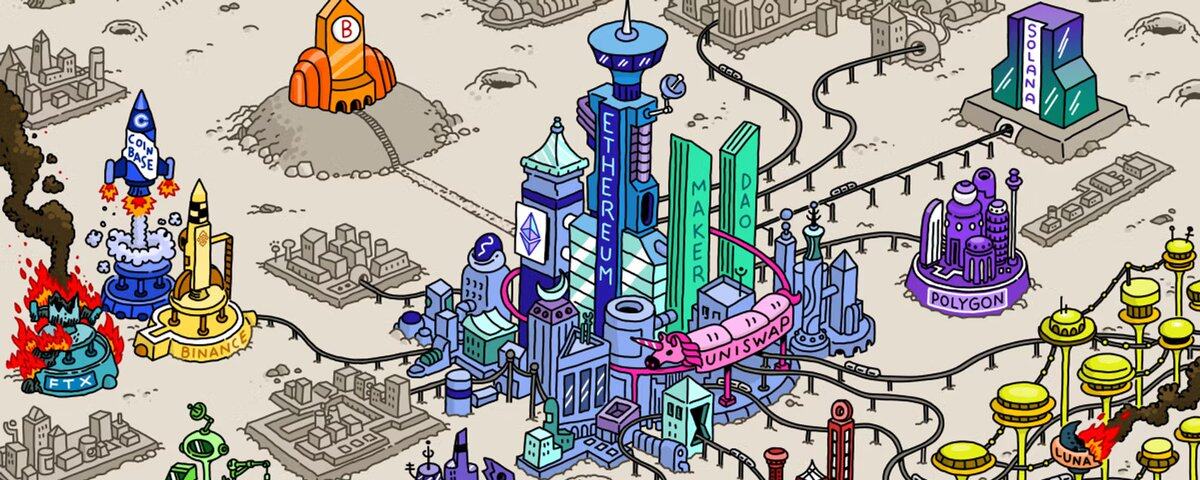
I am not targeting Layer 1. I can cite countless similar examples: spot DEXs, perpetual contract DEXs, prediction markets, meme platforms, etc. The frenzied competition in these tracks does not substantively foster a better financial system. Contrary to what VCs say, we do not need to build a casino on Mars.
The Gambling of Economic Models
If I said I joined the crypto industry without any financial motivation, that would be a lie. As a reader, you might think it’s a bit hypocritical that I decided to exit the industry after making enough money. Yes, maybe I am indeed hypocritical, but perhaps I am just disgusted by my contribution to this financialized and gamified quagmire.
Normalizing the zero-sum behavior of "quickly making money off each other" is not a way to create long-term wealth. It may seem like it, but it is not. Eight years in the crypto space have completely destroyed my ability to identify sustainable business models. Here, you can make money without successful businesses or products. This industry has a long list of high-market-cap tokens with zero users — this completely contradicts the operational logic of the real world. If you want to bring value to customers, rather than just gambling + entertainment (which is what casinos do), these zero-sum business models simply do not work.
Conclusion
I once thought "financial nihilism" was a cute and harmless concept. I thought it was fine to keep introducing zero-sum games to the next generation. I have no doubt that Bitcoin will one day rise to a million dollars, but that has nothing to do with the financial games the industry is creating.
This industry mindset is extremely toxic, and I believe it will lead to a long-term collapse of social mobility for the younger generation. You can already see it happening, and we must have the courage to resist these meaningless games.
CMS Holdings once said: “Are you here to make money? Or to prove you are right?”
This time, I choose to prove I am right.
免责声明:本文章仅代表作者个人观点,不代表本平台的立场和观点。本文章仅供信息分享,不构成对任何人的任何投资建议。用户与作者之间的任何争议,与本平台无关。如网页中刊载的文章或图片涉及侵权,请提供相关的权利证明和身份证明发送邮件到support@aicoin.com,本平台相关工作人员将会进行核查。