Author: momo, ChainCatcher
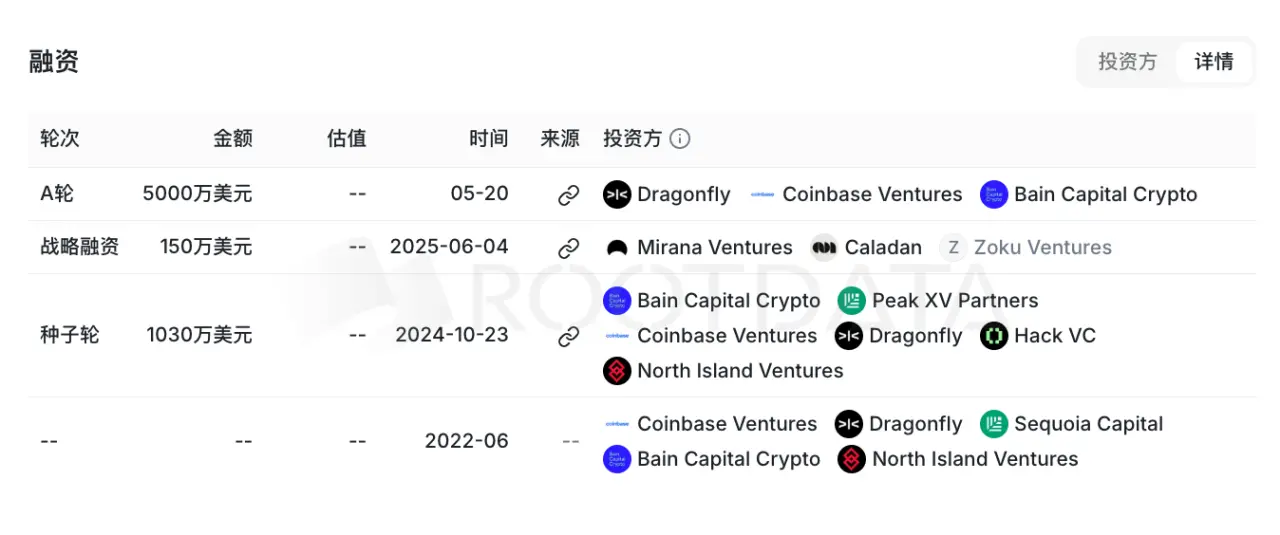
Recently, the decentralized derivatives trading platform Variational announced the completion of a $50 million Series A financing led by Dragonfly. Including the previous three rounds of financing,Variational has raised a total of $61.8 million. The investment lineup behind it is quite luxurious, besides Dragonfly, it also includes Sequoia Capital, Coinbase Ventures, Bain Capital Crypto, Hack VC and other well-known institutions.
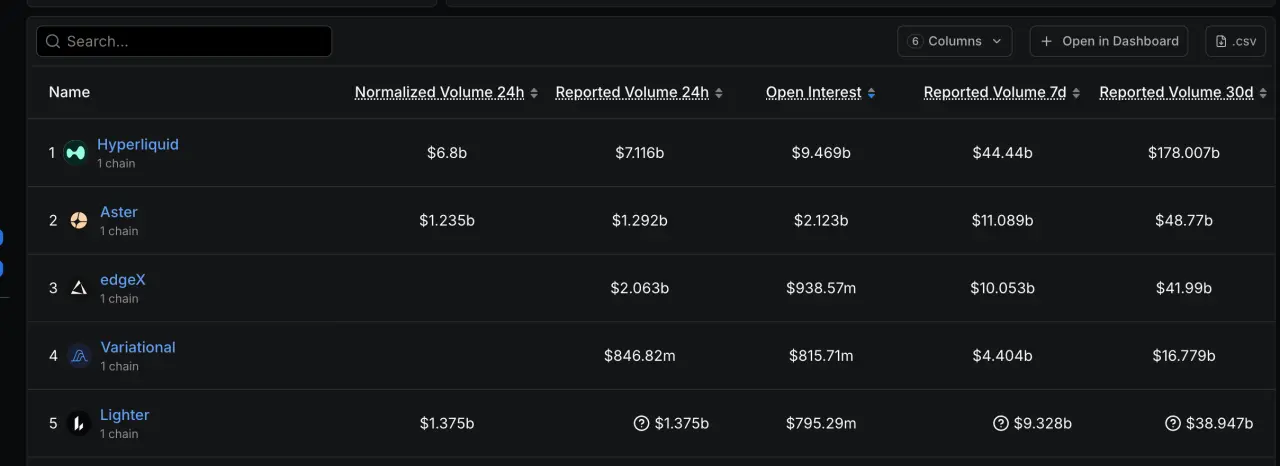
According to data from DeFiLlama, the open interest (OI) on Variational has exceeded $810 million, which still has a significant gap with $9.4 billion of Hyperliquid, but OI currently ranks fourth among on-chain derivatives protocols.
In the highly competitive decentralized derivatives track,Variational is able to continuously attract top institutional bets. What is the team background? What are the differentiated paths? This article provides a brief overview.
What is the team's background?
Looking at the team's background and entrepreneurial experience,Variational and Hyperliquid have many similarities, both are prestigious school graduates, coming from quantitative trading backgrounds, after founding quantitative funds, they transitioned to building on-chain derivatives platforms.
However, unlike Hyperliquid's early mysterious and anonymous team's approach,Variational disclosed the founding team's background and entrepreneurial experience in its white paper.
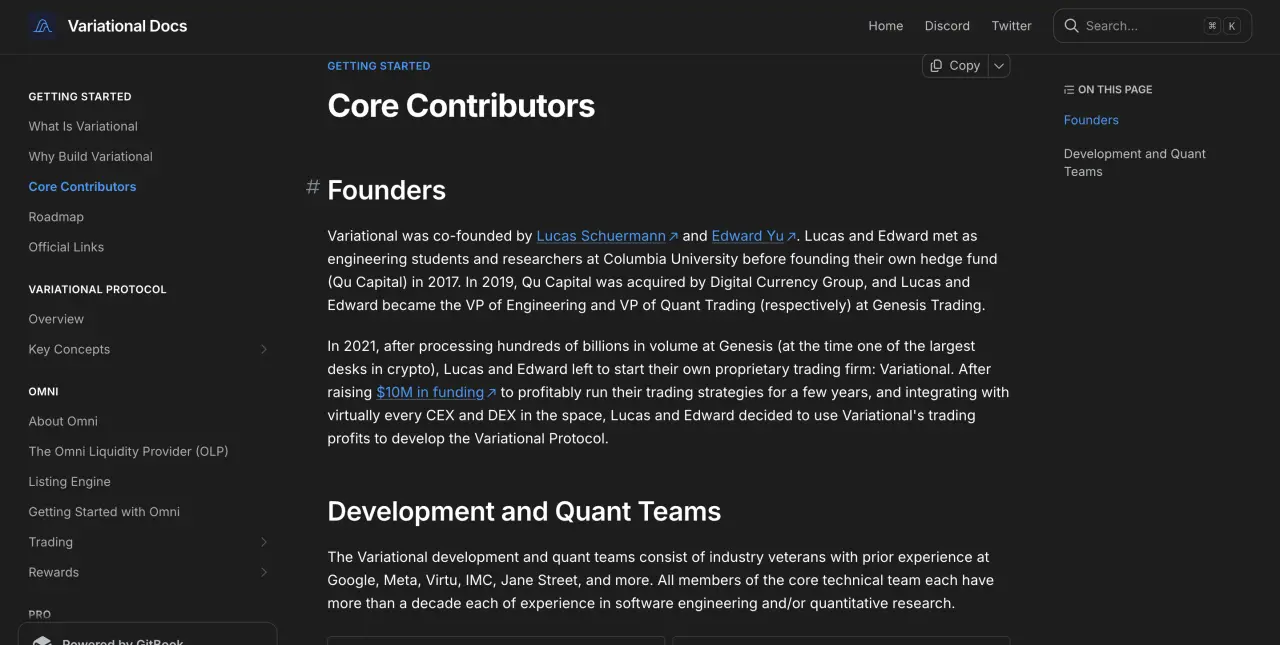
Variational was co-founded by Lucas Schuermann and Edward Yu , with CEO Lucas graduating from Columbia University and primarily responsible for trading system engineering architecture; Edward Yu is a quantitative analyst with a Chinese background. The two met while studying and conducting research in the engineering department at Columbia University and co-founded the quantitative hedge fund Qu Capital in 2017.
In 2019, Qu Capital was acquired by Digital Currency Group . Subsequently, the two joined Genesis Trading: Lucas served as the vice president of engineering, while Edward Yu was the vice president of quantitative trading.
According to the introduction in the white paper, before leaving Genesis in 2021, their team had already handled transactions worth hundreds of billions of dollars. After leaving, they established their proprietary trading firm Variational and completed a $10 million financing.
In the following years, the team operated proprietary trading strategies while completing transaction interface integrations with mainstream CEX and DEX . Afterwards, the team began to develop and operate the Variational Protocol based on their trading business and system experience.
In addition, Variational 's development and quantitative team members also come from Google, Meta, Virtu Financial, IMC Trading, Jane Street and other technology and quantitative institutions. The white paper states that core technology team members generally have over ten years of software engineering or quantitative research experience.
What are the product features? How does it differ from Hyperliquid?
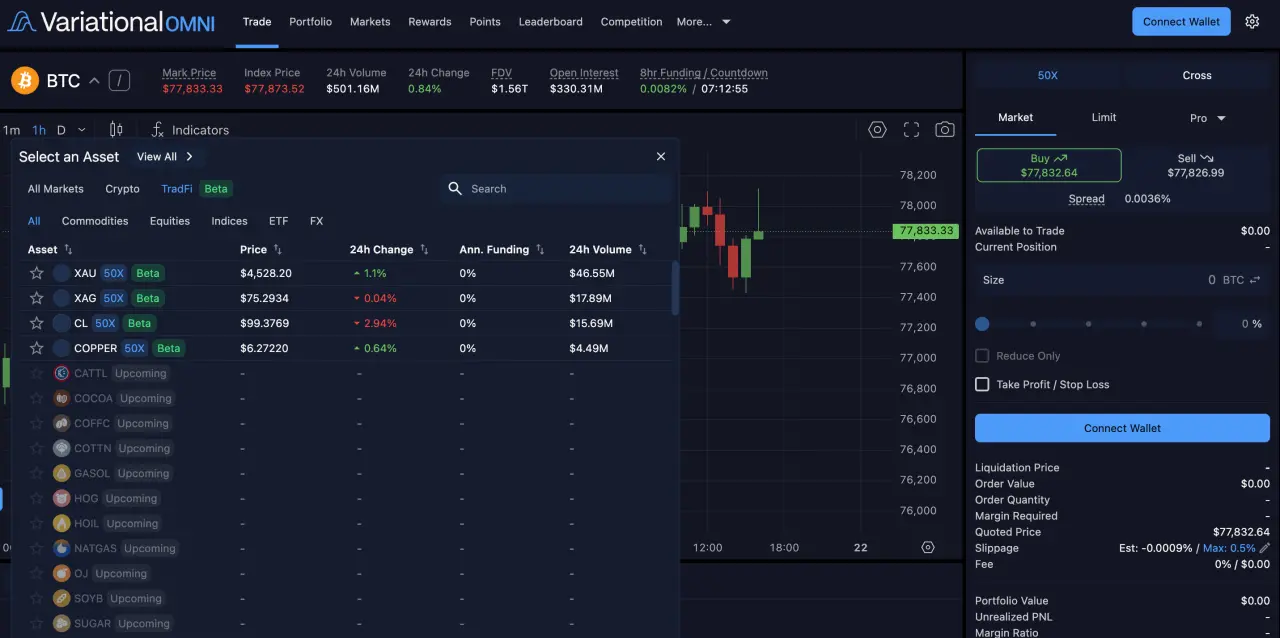
From the Variational trading interface, the differences from Hyperliquid are not very significant. The platform has launched approximately 450 trading pairs, primarily covering cryptocurrencies and TradFi, offering users up to 50 times leverage trading capability. The TradFi sector is currently in the Beta testing phase, and according to the official disclosure, the TradFi market will launch over 100 trading pairs.
However, Variational stated in its press release that it has a clearly differentiated positioning from Hyperliquid.
Variational mentioned that its model is more like a brokerage, rather than another Hyperliquid-style exchange. Its target users are not limited to crypto-native traders, but rather aim to provide a trading experience for on-chain derivatives that is closer to traditional markets through zero-fee trading and liquidity aggregation.
Currently, Variational operates on Arbitrum, utilizing a dual product line model. The Omni version primarily targets retail users, positioning itself as a perpetual contract trading product aggregating liquidity from multiple sources, while the Pro version is aimed at institutional off-chain derivatives trading.
The biggest difference from Hyperliquid is in the order matching and liquidity mechanism. Hyperliquid relies on its own L1 chain and a public central limit order book (CLOB), with market makers or the HLP treasury competing for quotes. Traders need to pay Maker/Taker fees. In contrast, Variational adopts a RFQ (Request for Quote) model, using a single liquidity provider as the counterparty, not relying on on-chain internal market making, but real-time aggregating external liquidity from CEX, DEX, over-the-counter channels and traditional financial market makers, and managing risks through hedging.
The reason for choosing this differentiated path is that Variational CEO Lucas believes that on-chain liquidity still lags far behind traditional trading venues like CME, and that the order book model has a “cold start” problem. By aggregating liquidity externally, there is no need to rebuild liquidity from scratch on-chain.
What stage is it currently in? What are the participation opportunities?
Variational is currently still in the Pre-TGE stage, and the $VAR token has not yet been issued. The project originally planned to conduct TGE in Q1 2025, but it has been postponed, and the official timeline for the new TGE has not yet been announced.
In December 2025, Variational launched the Omni Points points system. The official statement indicates that 50% of the $VAR supply will be used for community incentives, distributed gradually through various mechanisms such as Points, rather than a one-time airdrop.
In terms of points, a total of 3 million Points have been retrospectively issued to early users, and points will be distributed every Friday, calculated based on the trading snapshot from the previous week. The points program will conclude no later than Q3 2026.
Currently, the main participation opportunity is to conduct perpetual contract trading on the Omni platform, with trading volume being the core factor for earning points. Holding positions and referring others can also yield additional points bonuses.
免责声明:本文章仅代表作者个人观点,不代表本平台的立场和观点。本文章仅供信息分享,不构成对任何人的任何投资建议。用户与作者之间的任何争议,与本平台无关。如网页中刊载的文章或图片涉及侵权,请提供相关的权利证明和身份证明发送邮件到support@aicoin.com,本平台相关工作人员将会进行核查。


