As the Christmas holiday approaches, global financial markets enter the traditional "Christmas rally" period. However, during this seemingly calm trading week, a series of significant events will determine the market's direction at the year's end.
Will Trump announce the Federal Reserve Chair nominee during the Christmas period? This has become the market's most focused topic. Current predictions show that Kevin Hassett, Director of the National Economic Council, has a nomination probability of about 54%, former Federal Reserve Governor Kevin Warsh about 21%, and Federal Reserve Governor Christopher Waller about 14%.
At the same time, the U.S. Q3 GDP data will test the effectiveness of previous interest rate cuts, while Bank of Japan Governor Kazuo Ueda's speech may provide clues for Japan's monetary policy in 2026.
1. Christmas Rally
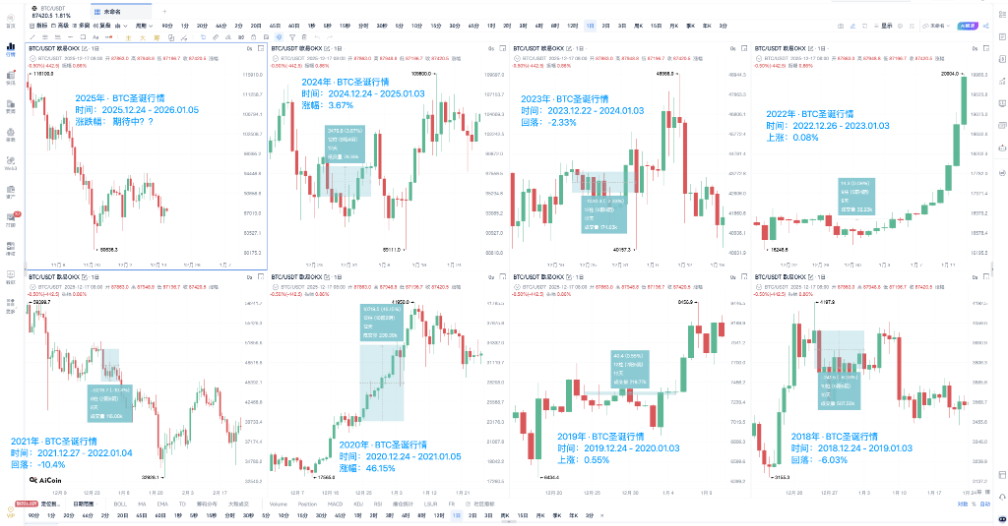
Looking back at the historical Christmas rally of Bitcoin, data reveals the truth behind this seasonal phenomenon. Over the past seven years, Bitcoin's performance during the Christmas period has shown a high degree of differentiation, with the probabilities of rising and falling being roughly equal, with a rise probability of about 57%. The performance of BTC during the past 7 complete Christmas-New Year cycles (approximately from December 24 to January 3-5 of the following year) is as follows:
● 2024 (2024.12.24 → 2025.01.03): +3.67% (slight increase)
● 2023 (2023.12.22 → 2024.01.03): -2.33% (slight decrease)
● 2022 (2022.12.26 → 2023.01.03): +0.08% (basically flat)
● 2021 (2021.12.27 → 2022.01.04): -10.4% (significant decrease)
● 2020 (2020.12.24 → 2021.01.05): +46.15% (super surge)
● 2019 (2019.12.24 → 2020.01.03): +0.55% (slight increase)
● 2018 (2018.12.24 → 2019.01.03): -6.03% (slight decrease)
2. Federal Reserve Leadership Contest
The nomination of the Federal Reserve Chair is undoubtedly the focal point of global markets this week. Whether the Trump administration will announce the nominee during the Christmas period has become a hot topic of discussion. Currently, the three main candidates have different policy inclinations, which may lead to varying monetary policy directions.
● Kevin Hassett, as the Director of the National Economic Council, has a close relationship with the Trump administration, and the market expects his nomination could lead to Federal Reserve policies being more aligned with the government's economic goals.
● Former Federal Reserve Governor Kevin Warsh is known for his hawkish stance; if nominated, it could mean a quicker shift towards tightening monetary policy.
● Current Federal Reserve Governor Christopher Waller is viewed as a centrist, and his nomination could imply continuity in policy.
This leadership change coincides with a critical moment for the U.S. economy. Since the Federal Reserve began cutting interest rates, the market has been closely monitoring the effects of the policy, and the monetary policy philosophy of the new chair will directly impact the interest rate path in 2026.
3. U.S. Economic Health Report
The preliminary annualized quarterly rate of U.S. real GDP for Q3, to be released on Tuesday, is an important test of the effectiveness of previous interest rate cuts.
● The preliminary quarterly rate of real personal consumption expenditures for Q3 can reflect the health of the consumption sector, which accounts for about 70% of the U.S. economy. The core PCE price index annualized quarterly rate is the inflation indicator most closely watched by the Federal Reserve, directly related to future interest rate decisions.
● The release of this data has been delayed due to a previous 43-day government shutdown. Last week, the U.S. unemployment rate for November rose to 4.6%, the highest level since September 2021. Investors are eager to use this data to assess whether signs of economic slowdown provide room for further interest rate cuts by the Federal Reserve.
● The market currently shows a divergence pattern of "soft data hardening, hard data softening." The University of Michigan Consumer Sentiment Index has rebounded from a low of 52.2 in April. However, actual economic data such as retail sales and structural issues in the labor market show signs of weakness.
4. Canadian Monetary Policy Outlook
On Wednesday, the Bank of Canada will release the minutes of its monetary policy meeting, providing the market with more clues about the country's economic outlook and policy direction.
● The Bank of Canada maintained the target overnight rate at 2.25% during its December 2025 meeting. The central bank stated in October that the policy rate is basically appropriate. This stance has been maintained against the backdrop of a 2.6% GDP growth in Q3 and improvements in the labor market.
● In terms of inflation, the October CPI has slowed to 2.2%, but core inflation indicators remain in the range of 2.5% to 3%. Decision-makers pointed out that global uncertainties persist, and tariff pressures and unstable trade may continue to lead to quarterly fluctuations in GDP.
● If inflation and economic activity align roughly with the October forecast, the management committee believes the current policy rate can keep inflation around 2%. Citigroup economists expect the Bank of Canada to maintain interest rates and policy guidance unchanged in the short term.
5. Japan's Monetary Policy Shift
● Bank of Japan Governor Kazuo Ueda will deliver a speech at the Japan Business Federation on Thursday, and the market is eager to gain insights into Japan's monetary policy direction for 2026.
● The context of Ueda's speech is quite significant. Last week, the Bank of Japan raised the benchmark interest rate by 25 basis points to 0.75%, the highest level in 30 years. Ueda stated that this decision was based on the "increasing likelihood of achieving economic outlooks."
● The market is particularly focused on this speech, as Japan had remained inactive after the new Prime Minister, Sanae Takaichi, took office, only resuming interest rate hikes last week. Additionally, Japan will release November unemployment rate data, providing more basis for assessing economic conditions.
6. U.S. Labor Market and Tariff Impact
The number of initial jobless claims in the U.S. for the week ending December 20, to be released on Wednesday, is a high-frequency indicator for observing the health of the labor market. Although surface data appears acceptable, there are structural issues in the employment market.
● While 147,000 new non-farm jobs were added in June, half of these came from government hiring, and the private sector's job creation capacity is relatively limited. The impact of tariff policies on the labor market is gradually becoming evident.
● The impact of tariff shocks on the economy shows phased characteristics. The investment side has already shown signs of fatigue, with companies generally adopting cautious strategies in the face of policy uncertainty, cutting capital expenditures.
● The impact on the consumption side is expected to gradually emerge in the second half of the year, as the negative effects of tariff policies on corporate production costs, job positions, and income levels transmit to the labor market, potentially further impacting household consumption capacity.

Global markets are holding their breath for the announcement of the Federal Reserve Chair nominee, and traders are already prepared for various possibilities. If Hassett is nominated, the market may expect a more accommodative monetary policy; if Warsh wins, then be ready for a potentially more hawkish policy shift.
The U.S. Q3 GDP and personal consumption data will directly showcase the health of the economy. Even if the data is robust, the market still needs to pay attention to whether consumption growth is sustainable and whether the core PCE price index is moving towards the Federal Reserve's 2% target.
As the Christmas bells draw near, global financial markets will enter a new 2026 with these economic data and policy signals after a brief market closure.
Join our community to discuss and grow stronger together!
Official Telegram community: https://t.me/aicoincn
AiCoin Chinese Twitter: https://x.com/AiCoinzh
OKX benefits group: https://aicoin.com/link/chat?cid=l61eM4owQ
Binance benefits group: https://aicoin.com/link/chat?cid=ynr7d1P6Z
免责声明:本文章仅代表作者个人观点,不代表本平台的立场和观点。本文章仅供信息分享,不构成对任何人的任何投资建议。用户与作者之间的任何争议,与本平台无关。如网页中刊载的文章或图片涉及侵权,请提供相关的权利证明和身份证明发送邮件到support@aicoin.com,本平台相关工作人员将会进行核查。


