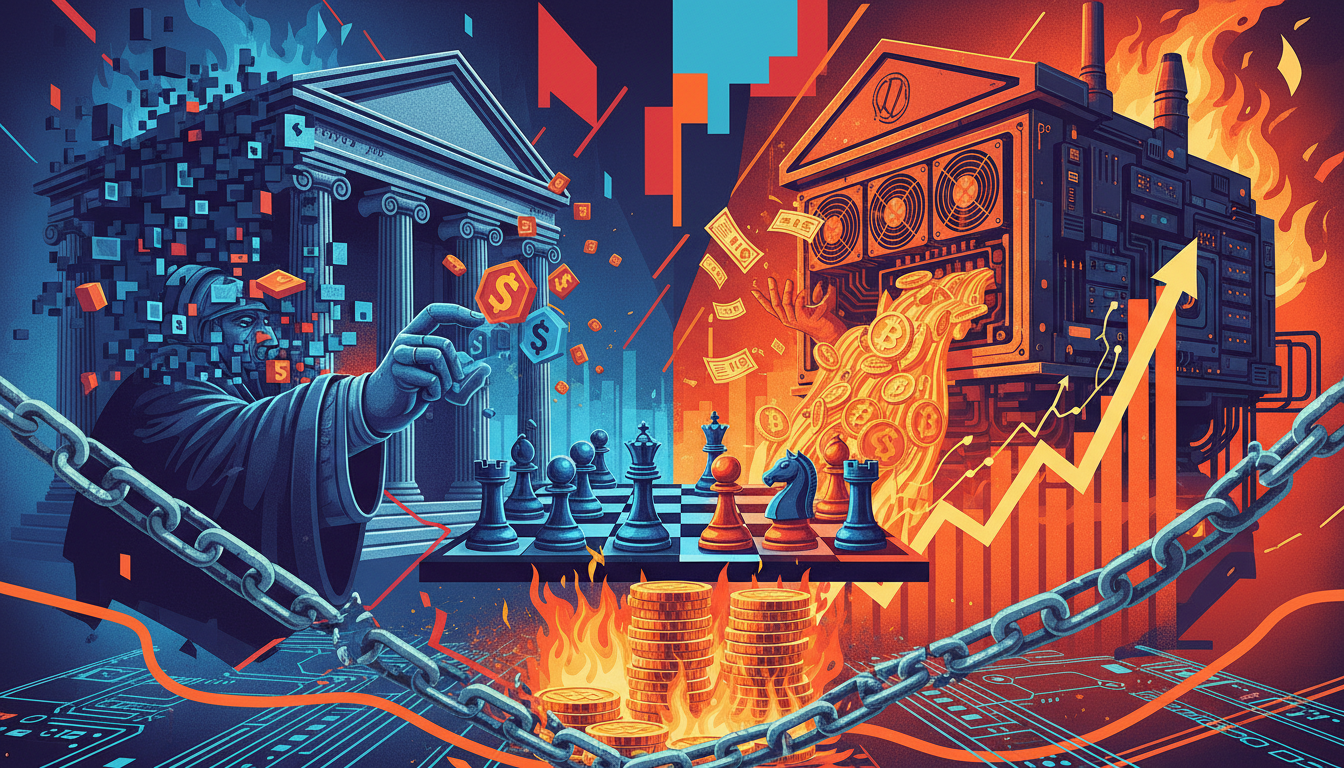
On January 15, 2026, at 8:00 AM UTC+8, Larry Fink, the CEO of global asset management giant BlackRock, once again threw out a macro perspective that sparked market debate: he directly linked the long-term power of artificial intelligence with the rationale for Federal Reserve interest rate cuts, publicly stating, “If you believe in the power of AI, then there is ample reason for rate cuts.” In traditional macro narratives, AI is often described as a super engine that will reshape productivity and profitability over the next decade, yet it is simultaneously accompanied by concerns about whether there is currently a bubble, inflationary pressures, and policy path choices. This article will revolve around this time point, starting from a Wall Street perspective, connecting Fink's remarks, market expectations for rate cuts, the approximately 5% one-day drop in WTI crude oil to $58.77 per barrel, and the flow of funds into crypto assets, particularly ETFs, with the narrative of “new banks,” observing how capital rewrites its risk preferences and valuation frameworks between the retreat of the old energy cycle and the surge of the AI wave.
Fink's AI–Rate Cut Chain Reaction
In his public statement on January 15, 2026, Fink tied technological advancement and monetary policy together in an unprecedented way with the phrase, “If you believe in the power of AI, then there is ample reason for rate cuts.” This statement is recorded in publicly reported sources and continues the narrative inertia that BlackRock and its management team have previously emphasized: “AI is the core force reshaping the economy.” Unlike traditional macro analysis, which derives interest rates from indicators such as inflation, employment, and output gaps, Fink attempts to argue from the perspective of longer-term productivity and profitability expectations, reverse-justifying the current rationale for “pre-financing” future growth.
In this implicit logical chain, AI is seen as an infrastructure that can significantly enhance overall societal productivity, thereby boosting the medium- to long-term outlook for corporate profits. If investors recognize this structural dividend, they will be willing to pay a higher valuation premium for growth assets, which in turn requires looser financial conditions to support the repricing of the valuation system. Under this narrative, rate cuts are no longer just a passive response to short-term macro pressures but an active allocation to reserve discount space for AI-driven future growth. In other words, the interest rate curve is incorporated into the script of the technology cycle, becoming a key variable supporting capital expenditure, research investment, and the prices of risk assets.
The conflict lies in the fact that the macro world does not automatically make way for technological optimism. There is a clear tension between the long-term dividend narrative of AI and the real-world constraints of inflation and concerns about asset price bubbles. On one hand, AI-related companies and conceptual assets have gained significant premiums in recent times, and the market's optimistic expectations for future cash flows have already been priced in, making “further rate cuts supporting valuations” appear to some observers more like a reinforcement of risk appetite rather than a calm assessment of economic fundamentals. On the other hand, the responsibility of monetary authorities is to balance price stability with growth targets, meaning that directly embedding long-term productivity assumptions into current interest rate decisions entails taking on the policy endorsement responsibility for unfulfilled technological advancements. This reverse argument from AI dividends to the rationale for rate cuts reinforces the interdependence between the “tech bull market” and “loose monetary policy,” while also amplifying voices concerned about short-term bubbles and medium- to long-term policy missteps.
Observing the Divergence of Old Energy and New Stories from the 5% Drop in Oil
In contrast to the heat surrounding AI-related assets, the volatility of traditional energy prices is telling a different narrative path. According to data from a single market source, on that day, WTI crude oil fell approximately 5.0%, closing at $58.77 per barrel, becoming a particularly striking fragment for macro traders observing risk sentiment. Oil prices are typically seen as a comprehensive reflection of real economic demand and supply shocks; when prices plummet sharply in a short time, it often indicates a significant revision in market expectations for current or future real demand. However, this time, the pullback in oil did not simultaneously trigger a large-scale cooling of innovative assets; AI and some tech stocks continued to attract capital, and the risk sentiment in the crypto market did not experience a complete freeze.
This performance difference creates an intriguing divergence scenario. On one side, old cycle assets represented by oil are under pressure, with prices particularly sensitive to economic slowdown or weak demand; on the other side, future growth assets represented by AI, cloud computing, high-performance computing power, and related software services continue to attract capital, with the market more willing to assign high multiples to “forward earnings.” This divergence challenges traditional macro narratives: under the classic framework, if economic downward pressure increases and energy demand weakens, risk assets as a whole would be affected, yet capital now shows relative “indifference” to the cooling of real demand, instead focusing more on the potential efficiency gains and profit margins brought by AI.
From a longer-term perspective, the coexistence of falling oil prices and high valuations for AI assets reinforces the impression that “capital is paying for the future rather than the present.” The marginal demand slowdown in the real economy and the warming of the long-term tech narrative have torn open a temporal gap between macro data and financial asset prices. To some extent, Fink's argument about the rationale for rate cuts supported by AI exploits this gap: if real growth temporarily slows, while technological dividends are expected to manifest over a longer cycle, then accelerating capital allocation to new technologies through looser financial conditions is packaged as a choice of “buying the future with policy.” This also means that if the pace of AI implementation falls short of expectations, or if the retreat in old energy prices points to a deeper collapse in demand, the current prepayment for future growth could quickly turn into regret over a bubble burst.
ETF Fund Flows and High Beta Bets Under the AI Narrative
Alongside the structural differentiation of macro assets, there is a redistribution of risk capital across different markets. According to a single source, on a particular trading day, cryptocurrency ETFs recorded net inflows; although this figure does not constitute precise official statistics, it is sufficient to illustrate the thermometer effect of capital direction. Driven by expectations of rate cuts and the long-term dividend narrative of AI, the market is re-evaluating those high beta assets that are highly sensitive to liquidity and risk appetite, with crypto ETFs becoming an important barometer for observing risk sentiment in this process. The positive or amplified inflow data indicates that some investors are willing to continue amplifying their bets on future price elasticity against a backdrop of ongoing macro uncertainty.
Expectations of rate cuts inherently lower the opportunity cost of capital, and when this expectation overlaps with the narrative of AI driving productivity improvements and long-term economic growth, high-volatility assets are no longer just “speculative targets” but are repackaged as leveraged tools to capture the new cycle. Crypto ETFs, through standardized product forms and compliance frameworks, externalize this risk appetite into measurable capital flow indicators. Meanwhile, institutional research firms like Ark Invest provide multi-scenario long-term forecasts for Bitcoin prices by 2030—though specific figures are beyond the scope of this article—offering a “grand narrative coordinate system” for this bet: within this system, today’s price fluctuations are interpreted as noise on the path to long-term targets, while the potentially high price ranges in the future are seen as discounted results of technological, institutional, and adoption rate evolution.
The willingness of mainstream institutions to publicly discuss the multi-scenario paths of assets like Bitcoin around 2030 itself indicates that long-term narratives are being formally incorporated into asset allocation dialogues. When this trend intersects with Fink's “AI–rate cut” logic, the movement of funds along the risk curve gains clearer narrative support: rate cuts release discount space for risk assets, while AI and crypto technology form the imaginative boundaries of future financial infrastructure and value storage. Each turn of ETF fund flows illustrates, on a micro level, the process of this grand story being accepted or questioned.
The Intersection of the New Bank Dream in the Crypto Industry and AI Infrastructure
Beyond asset prices and fund flows, the business models within the crypto industry are also attempting to connect with the AI narrative. According to industry research materials, there is a trend in the crypto space towards transforming into “new bank” services, with a number of institutions attempting to replace certain functions of traditional finance with one-stop services such as trading, custody, lending, and payments. However, research firm Messari has criticized crypto cards and payment products for being “severely homogenized,” pointing out that the marginal effects of the old model on user growth and revenue expansion are weakening. When basic financial tools become similar, the competition for the existing market becomes difficult to sustain a new valuation story.
In this context, AI is increasingly seen as the next competitive focus for the transformation of new banks. Whether it is risk control systems for anti-money laundering and fraud detection, automated compliance review processes, user profiling based on on-chain and off-chain data integration, or intelligent investment advice for small and medium clients, AI infrastructure could become a key differentiator. If new banks can build high barriers in this area, they can not only enhance their risk control levels and operational efficiency but also transform the originally “homogenized” cards and payment shells into distribution terminals that carry data and algorithms through more refined pricing and services.
The real movement of funds has begun to signal this. According to a single source, DDC Enterprise completed an increase of 200 BTC, although the specific buying time, cost, and trading arrangements have not been disclosed, this action is still interpreted by some observers as part of institutions continuing to increase their stakes in crypto assets, betting on the long-term story of “AI + financial infrastructure.” On one hand, holding mainstream crypto assets like BTC is seen as a basic exposure to participate in the next generation of financial systems; on the other hand, the new banking business and AI capability building around these assets are expected to shape new profit models in the coming years. Even if all of this is still in the early experimental stage, the act of increasing holdings itself has already provided some endorsement at the capital level for the idea of “deep binding of AI and crypto finance.”
When AI is Written into the Macro Script, How Do Crypto and Traditional Assets Rearrange Their Seats?
In summary, Fink's proposed AI–rate cut logic does not truly impact the market by providing a specific policy timetable, but rather attempts to rewrite the relationship between future growth and interest rates. Within this framework, technological advancement is endowed with the authority to explain the trajectory of interest rates: higher forward productivity and profit expectations are used to justify the legitimacy of maintaining or restarting easing today, thereby providing a macro narrative shield for current high valuations. For crypto assets, tech stocks, and other high beta varieties, this adds a branch path of “early discounting of technological dividends” outside the traditional “economic downturn—asset pressure” logic.
The approximately 5% one-day drop in WTI crude oil and its price of $58.77 per barrel, the phase of net inflows into crypto ETFs, and the exploration of “new bank” businesses towards AI infrastructure together outline the profile of capital being squeezed out of the old cycle and concentrated in the new financial narrative. Old energy and traditional commodities are under pressure due to demand concerns, while assets and business models centered around AI and crypto networks absorb more risk appetite through their imagination of future efficiency and institutional innovation. This rearrangement of seats is not completed overnight, but leaves visible traces in the oil price curve, ETF fund data, and institutional accumulation actions.
However, it must be emphasized that judgments surrounding “AI is not in a bubble,” “the U.S. economy will grow above trend in the coming years,” and “the current macro environment has provided a basis for easing policies” are still classified as unverified viewpoints due to a lack of sufficiently transparent data support. While it is exciting to write AI into the macro script, it simultaneously concentrates market risk exposure on two sensitive points: first, whether the speed of AI application and the degree of profit realization are sufficient to support current or even higher valuation levels; second, whether monetary and fiscal policies have enough adjustment space when faced with technological dividends falling short of expectations. For crypto assets, this means being wary of a new round of bubbles forming under the dual optimism of AI and rate cuts, as well as guarding against the potential for severe repricing when policy path deviations and real growth fluctuations overlap. The triangular relationship between technology, interest rates, and risk assets is being rewritten, but a new equilibrium is still far from being reached.
Join our community to discuss and become stronger together!
Official Telegram community: https://t.me/aicoincn
AiCoin Chinese Twitter: https://x.com/AiCoinzh
OKX Benefits Group: https://aicoin.com/link/chat?cid=l61eM4owQ
Binance Benefits Group: https://aicoin.com/link/chat?cid=ynr7d1P6Z
免责声明:本文章仅代表作者个人观点,不代表本平台的立场和观点。本文章仅供信息分享,不构成对任何人的任何投资建议。用户与作者之间的任何争议,与本平台无关。如网页中刊载的文章或图片涉及侵权,请提供相关的权利证明和身份证明发送邮件到support@aicoin.com,本平台相关工作人员将会进行核查。