Written by: Cointelegraph
Translated by: AididiaoJP, Foresight News
Backtesting data and forward-looking models show that using a dollar-cost averaging strategy to buy Bitcoin is the best way to invest in BTC. Will this method still work in the next bull market?
In the past 5 months, Bitcoin has experienced a 50% drop, and smart investors will adjust their strategies during such bear markets and pullbacks. This strategy, known as dollar-cost averaging (DCA), involves regularly investing a fixed amount regardless of market conditions.
Through historical market cycle data and BTC price forward simulations, we can see more clearly how this robust investment method performs under different entry times and investment cycles.
Five-Year Dollar-Cost Averaging in Bitcoin Yields Considerable Net Returns
Starting in January 2021, by investing $250 weekly in Bitcoin, the total investment after five years would be $67,500. According to DCA simulation data, this strategy purchased a total of 1.65097905 BTC at an average purchase price of $40,884.
At the current price of nearly $71,000, these 1.65097905 BTC would be worth approximately $120,500, yielding a profit of $53,000 (a 76% increase). When Bitcoin reaches $100,000, these holdings would be worth about $165,000; and at the cycle peak in October 2025, close to $126,000, the holdings could be valued at $208,000.
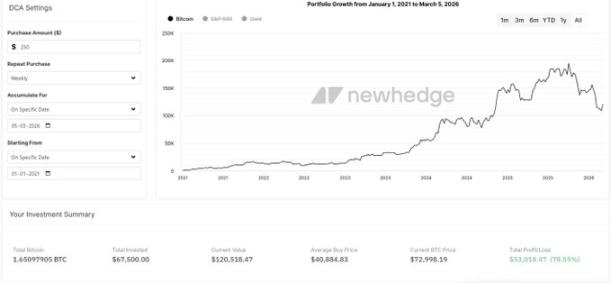
DCA Cycle of Bitcoin from 2021 to 2026 Source: Newhedge
Now let's look at a shorter investment cycle to see the impact of entry timing on early returns. Starting from January 2024 with a weekly investment of $250, the total investment would be $28,500, accumulating to 0.36863166 BTC at an average purchase price of $77,312.
At the current price of $71,000, these Bitcoins would be worth approximately $26,909, resulting in an unrealized loss of 6%. When the price reaches $100,000, the holdings would be valued at $36,863; when the cycle peak reaches $126,000, the holdings' value would rise to $46,448.
In February of this year, Swan Bitcoin analyst Adam Livingston compared the returns of investing in BTC and the S&P 500 index over the past five years on the X platform. By investing $100 weekly, BTC ultimately yielded $42,508, while the S&P 500 index yielded $37,470, with returns of 62.9% and 43.6%, respectively.
Livingston pointed out that although Bitcoin's price is highly volatile, historical data shows that maintaining a dollar-cost averaging strategy during downturns results in higher long-term returns.
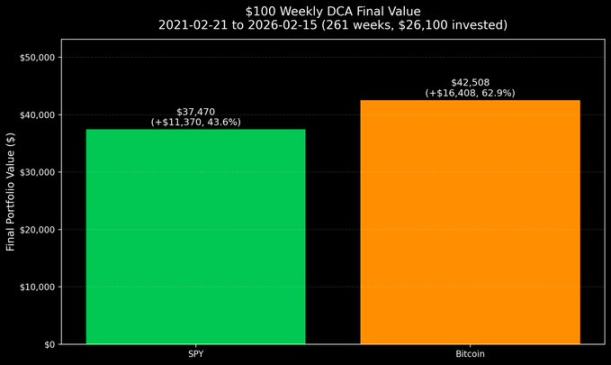
Comparison of Weekly $100 DCA in BTC vs. the S&P 500 Index Source: Adam Livingston/X
Long-Term Models: Time is Key
Forward-looking simulation studies also tested the effects of dollar-cost averaging starting in 2026. From January 2026, investing $250 weekly until March 2030 would result in a total investment of approximately $54,250.
The price forecast is based on Bitcoin's long-term power-law growth curve (tracking the relationship between Bitcoin’s historical price and time on a logarithmic scale). This model generates an upward support band and a median trend line that corresponds closely with previous market cycles.
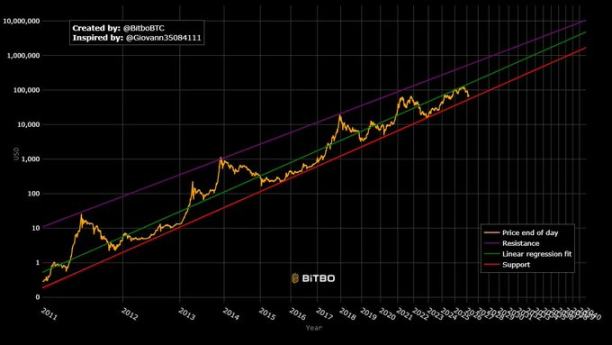
Bitcoin Power-Law Growth Curve Source: Bitbo.io
According to this model, analysts estimate that by 2028, the long-term trend support level may break through $100,000, which serves as the basic assumption for future DCA modeling. Mock simulations by Bitcoin Well show that by March 2030, the median price estimates at approximately $430,000.
Considering potential price deviations, the model also incorporated upper and lower boundaries of the power-law channel, providing a lower estimate (about $274,000) and a higher estimate (about $900,000).
Based on these assumptions, dollar-cost averaging for four years could accumulate approximately 0.30 BTC:
- If the BTC price is $274,000, the holding would be worth about $82,200.
- If the BTC price is $430,000 (the median estimate), the holding would be worth about $129,000.
- If the BTC price is $900,000, the holding would be worth about $270,000.
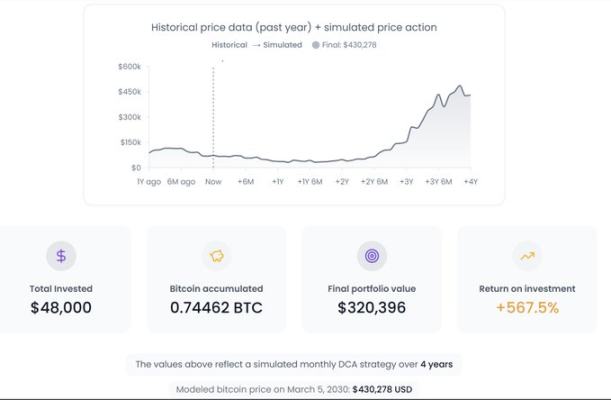
DCA Investment Results as of March 2030 Source: Bitcoin Well
In November 2025, Bitcoin researcher Sminston With conducted a study using a similar predictive model to test the impact of entry timing on long-term returns. The results showed that even if the purchase price was 20% higher than the then-current price of $94,000, and the selling price was 20% lower than the predicted median price of 2035, the remaining holdings would still yield nearly 300% after ten years.
In this simulation, the final total assets amounted to 7.7 times the initial investment.
The study concluded: the timing of entry will influence the level of returns, but long-term holding is the key to determining the size of returns.
免责声明:本文章仅代表作者个人观点,不代表本平台的立场和观点。本文章仅供信息分享,不构成对任何人的任何投资建议。用户与作者之间的任何争议,与本平台无关。如网页中刊载的文章或图片涉及侵权,请提供相关的权利证明和身份证明发送邮件到support@aicoin.com,本平台相关工作人员将会进行核查。


