Author: Liang Yu
Editor: Zhao Yidan
On March 6, the fourth session of the 14th National People's Congress Economic Theme Press Conference was held as scheduled. In response to a question from the Shanghai Securities Journal regarding the China Securities Regulatory Commission's next steps to prevent risks and strengthen regulation, Chairman Wu Qing elaborated on the regulatory approach. He stated that the China Securities Regulatory Commission will focus on strengthening regulation of new types of businesses. The overall consideration is to pursue benefits while avoiding harm, regulate development, ensure effective supervision, and strictly control risks. The main measures include: emphasizing fairness principles, deepening and refining the supervision of high-frequency quantitative trading. Issuing regulatory measures for derivatives trading, supporting legal and compliant risk management activities, and limiting excessive speculation according to rules. Strengthening the regulation of real-world asset (RWA) tokenization, maintaining the principle of "strict prohibition domestically, strict regulation overseas," establishing and improving the regulatory system and rules for crypto assets, and severely cracking down on behaviors that violate regulations under the guise of RWA.
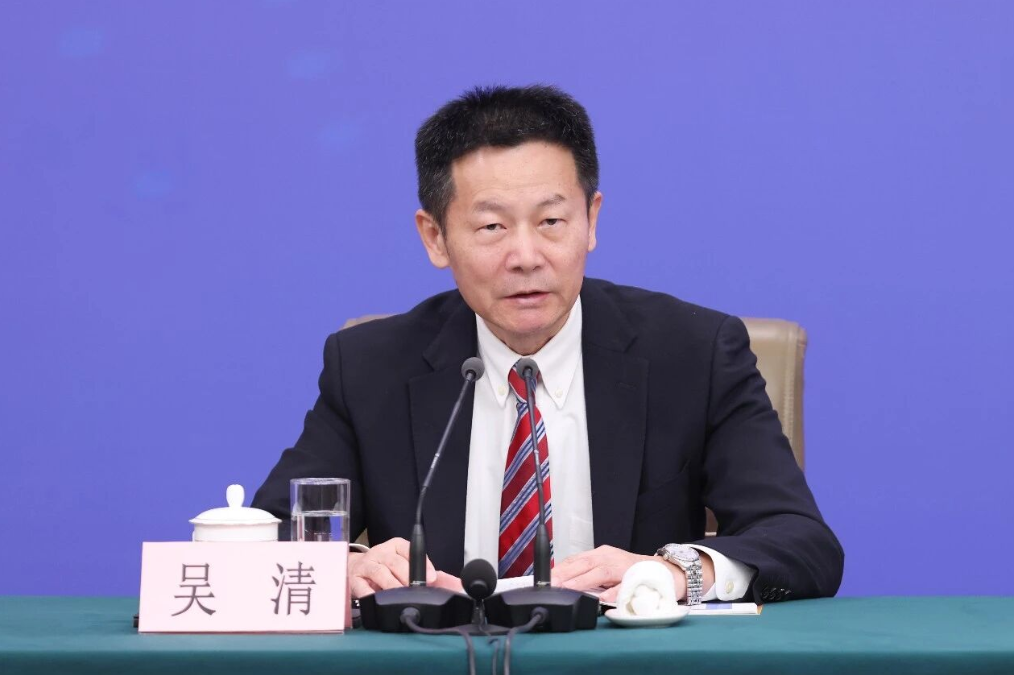
Wu Qing particularly emphasized the need to build a sound regulatory system and rules to firmly establish a "breakwater" against risks in the capital market. This statement quickly created ripples in the fields of financial technology and digital assets.
Just over a month ago, the People’s Bank of China, the China Securities Regulatory Commission, and eight other departments jointly issued a notice titled "Further Preventing and Addressing Risks Related to Virtual Currencies," which for the first time clearly defined the official definition of real-world asset (RWA) tokenization and established the core principle of "strict prohibition domestically, strict regulation overseas." From the joint issuance by eight departments to the emphasis made by the chairman of the China Securities Regulatory Commission at the press conference, the regulatory attitude towards this emerging field has become clear.
For the RWA track, is this a "resting mark" for development, or a "starting gun" for a new round of regulation? What behaviors are prohibited "within the breakwater"? Is there any room for compliant exploration "beyond the breakwater"?
1. What exactly does the "breakwater" need to prevent?
To understand the regulatory attitude, it is first necessary to clarify a core question: What exactly is RWA tokenization?
According to the notice issued by the eight departments, the official definition provided is: using cryptographic technology and distributed ledgers or similar technology to convert ownership, income rights, etc., of assets into tokens (certificates) or other rights that have token-like characteristics, and to conduct activities of issuance and trading. This definition covers the complete chain from technical realization to financial behavior.
On this basis, the regulation has established the principle of "strict prohibition domestically, strict regulation overseas." The notice clearly states that engaging in RWA tokenization activities domestically, as well as providing related intermediary, information technology services, etc., suspected of illegal token issuance, unauthorized public securities issuance, illegal securities and futures business operations, illegal fundraising, and other illegal financial activities, should be prohibited.
This means that any issuance, trading, and related services of RWA tokens targeting the domestic public are legally deemed illegal financial activities. This is not the first time the regulatory authority has flagged such behaviors. As early as 2017, regulatory authorities explicitly prohibited initial coin offerings; in 2021, it was further clarified that activities related to virtual currencies fall under illegal financial activities. This statement regarding RWA can be seen as a natural continuation of this regulatory logic.
However, it is worth noting that the notice simultaneously leaves a "window": except for relevant business activities conducted in reliance on specific financial infrastructures that are approved by the competent business authorities in accordance with laws and regulations. The existence of this exception implies that regulation is not a one-size-fits-all approach to RWA technology per se but sets strict preconditions for "who issues, who operates, and whether it is regulated."
Wu Qing's statements at the press conference further refined the regulatory focus. He particularly mentioned the need to "severely crack down on behaviors that use the name of RWA to engage in illegal speculation and financial activities." The keyword in this phrase is "in the name of RWA." In other words, the regulation targets those who engage in illegal financial activities under the guise of the RWA concept, rather than the RWA technology itself.
At the same time, for the behavior of foreign institutions providing services to domestic entities, the regulation also delineates a red line: foreign units and individuals must not illegally provide services related to real-world asset tokenization to domestic entities in any form. This means that even if a project is registered overseas and issued overseas, as long as its service target involves domestic entities, it still faces compliance risks.
From policy texts to high-level statements, the consistent message from the regulatory authority is clear: RWA tokenization as a new type of financial form must be included within the existing regulatory framework and cannot become a legal vacuum. Those who attempt to profit from concept hype in a regulatory vacuum are precisely the primary targets of the "breakwater" to be prevented.
2. Why has the regulatory authority chosen this time to "draw the sword"?
The regulatory authority's intensive statements did not come out of nowhere. Since entering 2026, regulatory departments in various places have continuously issued risk warnings pointing to illegal financial activities under the banners of virtual currencies, RWA, and so on.
On January 16, the Hebei Financial Regulatory Bureau issued a risk warning about illegal financial activities, pointing out that illegal financial activities often wear various guises, under the banners of pensions, cultural tourism, cloud farming, RWA, etc. On January 30, the Yichun Municipal Market Supervision Administration of Heilongjiang Province issued a warning against illegal financial risk, similarly listing RWA alongside new concepts such as blockchain, virtual currency, and consumption rebate apps, warning that criminals exploit these concepts to carry out illegal financial activities.
These risk warnings are not simply vague statements. In an article released by the Hunan Branch of the People's Bank of China at the end of January, the typical tricks of virtual currency investment scams were detailed: enticing users to fake platforms through high yields, inducing them to invest large sums through small rebates, and finally setting obstacles in the withdrawal phase and disappearing with the funds. The article used the case of a resident named Wang, who was lured by so-called "bitcoin investment platforms with annual returns of 50%", which often turn out to be just a string of numbers in the background; once attempting to withdraw large amounts, one encounters "system maintenance" or disappears customer service.
What is even more concerning is that some criminals have begun to use RWA as a new "cloak." The Hebei Financial Regulatory Bureau pointed out in its risk warning that illegal financial activities are constantly innovating their tricks, some criminals use "high returns and capital preservation" or "quick profit" as bait to entice and deceive the public into participating in illegal fundraising, online scams, and financial pyramids. RWA, as an emerging concept, is relatively unfamiliar to ordinary investors and can easily be packaged by criminals as a "frontier investment opportunity" to mislead them.
From within the industry, there are indeed some project parties using the RWA concept for illegal promotion. Some projects claim to have overseas physical assets supporting them, issuing so-called "tokenized securities," but are unable to provide clear asset verification and legal safeguards. Some projects even directly approach the domestic public for fundraising, promising high returns, which has already crossed the red line of illegal fundraising.
Shi Zihan, a lawyer at Beijing Dacheng Law Firm and a special expert at Zhejiang University City College School of Law, stated in a media interview that once investors discover they may be caught in a virtual currency investment scam, they should gather promotional materials, investment agreements, payment records, WeChat chat records, and other evidence, and report to public security with investors in similar situations. This indicates that judicial crackdowns on such illegal activities are on the way.
From the regulatory perspective, there are at least three considerations for "drawing the sword" at this time. The first is to protect investors. Looking back at past lessons, from the P2P crash to the speculation of air coins, many unsophisticated retail investors have suffered greatly under the lure of high-yield rhetoric. RWA involves the complex structure of cross-border and cross-market, making it even more difficult for ordinary investors to identify risks; proactively building a "breakwater" is a necessary protective measure.
The second is to prevent financial risks. The essence of RWA is to combine real-world assets with digital technology; if divorced from the real value of the实体经济 and engaged in excessive financial leverage operations through tokenization, the risks may impact the traditional financial system through complicated transmission chains. Wu Qing's mention of "limiting excessive speculation" reflects this consideration.
The third is to establish regulatory expectations. As reflected in the notice from the eight departments, regulation does not prohibit RWA technology itself but seeks to establish clear regulatory boundaries for this emerging business. Within the boundaries, compliant exploration can progress in an orderly fashion; outside the boundaries, illegal and violative behaviors will be severely punished. This "combination of loosening and tightening" approach helps avoid the industry falling into a cycle of "chaos when released, dead when managed."
3. Under regulation, where are the Chinese opportunities for RWA?
If one looks at a broader perspective, it is found that while the mainland regulatory departments clarify their stance of "strict prohibition domestically," Hong Kong SAR's RWA practice is welcoming substantive breakthroughs.
In late February, Hong Kong's first RWA real estate project was officially approved. Derlin Holdings Group announced that its two RWA tokenization products have received regulatory approval from the Hong Kong Securities and Futures Commission as "non-objection," allowing the implementation of related business plans. This means that after months of communication, the Hong Kong Securities and Futures Commission has given a green light for this business model.
The underlying assets approved include two major parts: one is a limited partnership fund holding Derlin Tower in Central, Hong Kong, and the other is a limited partnership fund investing in private equity projects Animoca Brands. Derlin Tower is located on Wellington Street in the core business district of Central, Hong Kong, about five minutes’ walk from the International Finance Centre. Derlin Holdings purchased all units and the naming rights for the top five floors for over HKD 280 million in 2023. This is the first time that physical assets in Hong Kong's core business district are presented in tokenized form to qualified investors.
On the specific implementation level, Derlin Securities will act as the proposed token distributor, establishing necessary operational infrastructure and product listing processes; Derlin Digital Family Office will act as the investment manager, working with tokenization solution provider Asseto to issue tokenized rights for the relevant funds using blockchain technology.
William Li, a partner at Derlin Holdings, stated in an interview with Caijing that the project communicated deeply with the Hong Kong Securities and Futures Commission from scratch, undergoing months of review to receive the "non-objection response." "This is not just the approval of a single product; it is the recognition of the RWA business model by regulators, which can be further advanced."
The significance of this case lies in its demonstration of the feasible path for RWA compliance under a strict regulatory framework. The tokenization guidelines issued by the Hong Kong Securities and Futures Commission require that tokenized products must adhere to existing licensing systems, ensuring investor protection measures are in place. The Derlin project was approved for advancement precisely because it relied on licensed institutions, targeted qualified investors, and strictly adhered to disclosure requirements.
This pattern of "strict regulation in the mainland, exploratory in Hong Kong" actually forms a strategic complement. The regulatory guidance in the mainland emphasizes risk prevention and clear boundaries, while Hong Kong allows compliant institutions to explore with qualified clients under the licensing regulation and investor protection framework. The latest RWA product models, technological standards, and risk management plans can be first tested in Hong Kong, with their successes and failures providing references for future policies in the mainland and other regions.
So, under the context of "strict prohibition" in the mainland, is there still room for compliant participation in the RWA field?
From the policy text perspective, the expression in the notice from the eight departments stating "except for relevant business activities conducted in reliance on specific financial infrastructures approved by the competent business authorities in accordance with laws and regulations" leaves theoretical space for compliant exploration. This means that if it meets regulatory requirements, obtains approval from business authorities, and relies on compliant financial infrastructure, relevant RWA explorations are not an absolute prohibition.
From a practical direction, there are at least three possible paths. The first is the technological innovation that serves financing for real enterprises. Under the current securities law framework, using blockchain technology to enhance the transparency and circulation efficiency of non-standard assets such as supply chain financing and financial leasing belongs to business process optimization rather than issuing securities tokens, thus the policy risk is relatively controllable. The core of this exploration lies in not crossing the red line of "issuance and trading targeting the public."
The second is an internal and external linkage centered on Hong Kong. Mainland institutions can collaborate with licensed institutions in Hong Kong to issue compliant RWA products to professional investors. This operation must strictly adhere to the firewall principle of "no funds leaving the country, no assets entering the country," ensuring no fundraising from the domestic public and no trading services provided domestically. Existing regulatory frameworks and judicial recognition arrangements in Hong Kong provide a foundation for such collaborations.
The third path is taking on the role of "water seller" for technology export. Since issuing tokens is prohibited, providing RWA-related technical solutions, smart contract audits, and asset custody services to compliant financial institutions will become a policy risk-free blue ocean market. The mainland has a rich pool of technical talent and mature blockchain development capabilities, giving it a competitive advantage in this area.
It is crucial to emphasize that the exploration of these paths must be based on strict compliance and regulatory communication, and should not encourage public participation in speculation. As Li Xiaojia recently emphasized regarding RWA, tokenization should not lower the risks of underlying real-world assets. This statement points to the essence of the problem: no matter how innovative the technology is, the quality of the assets, the cash flow of the assets, and the legal verification of the assets always determine the investment value.
From the joint issuance by eight departments to the chairman of the China Securities Regulatory Commission's statements during the two sessions, the "breakwater" delineated by regulators for RWA tokenization is already clearly visible. This "breakwater" both blocks the turbulent waves of illegal acts under the guise of concepts and provides a stable docking and operational environment for compliant exploration within the harbor.
For practitioners, the key now is not to complain about overly strict regulation but to re-examine: what real value can RWA technology create for which types of physical assets under the existing legal framework? Should they continue to operate in gray areas, trying to circumvent regulation; or should they return to the essence of serving the real economy, seeking innovative space under compliance? The answer is self-evident.
The "breakwater" is not a "resting mark." On the contrary, it points the way forward for the industry: only those innovations that are included in the regulatory perspective, serve the real economy, and endure risk testing can truly sail towards broader seas. Those who attempt to bypass the "breakwater" and venture into the storm will ultimately be swallowed by the waves.
(RWA Research Institute reminds: The discussion in this article regarding future paths for RWA is based on logical deductions of the existing regulatory framework. Any explorations related to RWA must be conducted within the scope permitted by national laws and regulations and financial regulatory authorities. Currently, the mainland maintains a high-pressure stance against any token issuance and financing activities targeting the unspecified public; practitioners must adhere to compliance bottom lines and avoid legal risks.)
References:
· "Multiple Regions Warn Against Illegal Virtual Currency Activities; RWA Becomes New 'Cloak' of Illegal Fundraising"
· "Chairman of the China Securities Regulatory Commission, Wu Qing, Answers Questions from Our Reporter at the Economic Theme Press Conference of the 14th National People's Congress, Explaining 'Capital Market Risk Prevention and Strong Regulation' Key Work"
· "Hong Kong Approves First Real Estate RWA Project; Derlin Holdings Takes the Lead"
免责声明:本文章仅代表作者个人观点,不代表本平台的立场和观点。本文章仅供信息分享,不构成对任何人的任何投资建议。用户与作者之间的任何争议,与本平台无关。如网页中刊载的文章或图片涉及侵权,请提供相关的权利证明和身份证明发送邮件到support@aicoin.com,本平台相关工作人员将会进行核查。


