Source: Nvidia
Compiled by: BitpushNews
Artificial Intelligence is one of the most powerful forces shaping the world today. It is not a clever application or a single model; it is an infrastructure like electricity and the internet.

AI runs on real hardware, real energy, and real economics. It ingests raw materials and transforms them into intelligence on a massive scale. Every company will use it. Every country will build it.
To understand why AI is developing this way, it helps to examine the fundamental changes happening in the field of computing from first principles.
From Pre-recorded Software to Real-time Intelligence
For most of computing history, software has been pre-recorded. Humans describe an algorithm. The computer executes it. Data had to be carefully structured, stored in tables, and retrieved through precise queries. SQL became indispensable because it made that world feasible.
AI has broken this mold.
For the first time, we have computers that can understand unstructured information. They can look at images, read text, listen to sounds, and comprehend meaning. They can infer context and intention. Most importantly, they can generate intelligence in real time.
Every response is newly created. Every answer depends on the context you provide. This is not software retrieving stored instructions. This is software reasoning and generating intelligence on demand.
Because intelligence is generated in real time, the entire computational stack underneath must be reinvented.
AI as Infrastructure
When you view AI from an industrial perspective, it can be broken down into a five-layer stack.
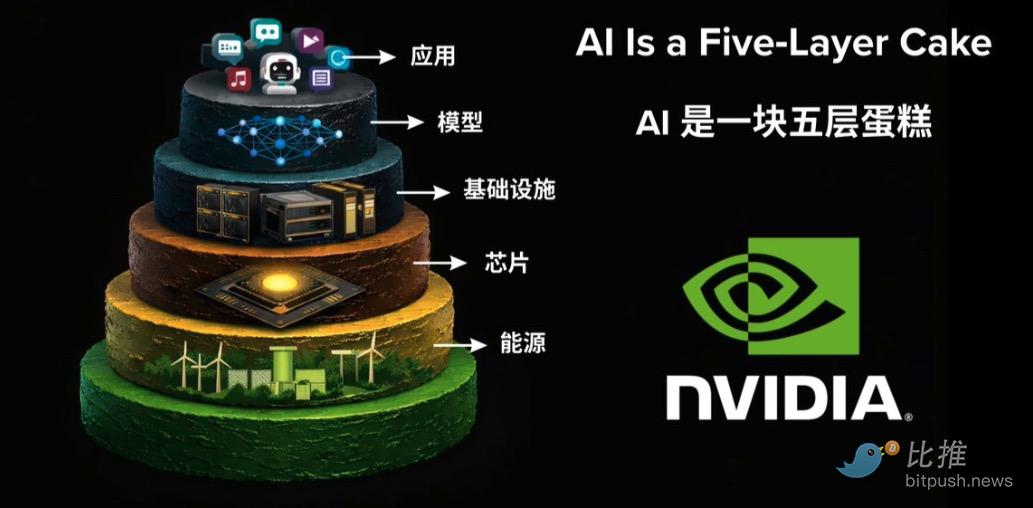
Energy
The bottom layer is energy. Real-time generated intelligence requires real-time generated energy. Every generated token is the result of electronic movement, heat management, and energy converted into computation. There is no abstract layer beneath this. Energy is the first principle of AI infrastructure, and it is a hard constraint on how much intelligence a system can produce.
Chips
Above energy are the chips. These processors are designed to efficiently convert energy into computation on a massive scale. AI workloads require tremendous parallelism, high-bandwidth memory, and fast interconnects. Advances in the chip layer determine how quickly AI can scale and how cheap intelligence can become.
Infrastructure
Above chips is the infrastructure. This includes land, power delivery, cooling, buildings, networks, and systems that orchestrate tens of thousands of processors into a single machine. These systems are AI factories. They are not designed to store information. They are designed to manufacture intelligence.
Models
Above infrastructure are the models. AI models understand multiple forms of information: language, biology, chemistry, physics, finance, medicine, and the physical world itself. Language models are just one class among them. Some of the most transformative work is being done in protein AI, chemical AI, physical simulation, robotics, and autonomous systems.
Applications
The top layer is applications, where economic value is created. Drug discovery platforms. Industrial robots. Legal assistants. Autonomous vehicles. An autonomous vehicle is an AI application embodied in a machine. A humanoid robot is an AI application embodied in a body. The same stack. Different outcomes.
This is the five-layer cake:
Energy ⇒ Chips ⇒ Infrastructure ⇒ Models ⇒ Applications.
Every successful application pulls on every layer beneath it, extending down to the power plants that sustain its life.
We are just beginning this construction. We have only invested hundreds of billions of dollars. We still need to build trillions of dollars' worth of infrastructure.
Globally, we are seeing chip factories, computer assembly plants, and AI factories being built at an unprecedented scale. This is becoming the largest infrastructure build in human history.
The workforce needed to support this construction is immense. AI factories need electricians, plumbers, pipeline assemblers, steelworkers, network technicians, installers, and operators.
These are skilled jobs with high pay that are currently in high demand. You do not need a PhD in computer science to participate in this transformation.
Meanwhile, AI is driving productivity across the entire knowledge economy. Take radiology as an example. AI now assists in interpreting scanned images, yet the demand for radiologists continues to grow. This is not a paradox.
The purpose of a radiologist is to care for patients. Interpreting scanned images is just one of many tasks. As AI takes on more routine work, radiologists can focus on judgment, communication, and care. Hospitals become more efficient. They serve more patients. They hire more staff.
Productivity creates capacity. Capacity creates growth.
What Has Changed in the Past Year?
In the past year, AI has crossed a significant threshold. Models have become good enough for widespread use. Reasoning capabilities have improved. Hallucinations have decreased. Grounding has significantly improved. For the first time, AI-based applications are beginning to generate real economic value.
Applications in drug discovery, logistics, customer service, software development, and manufacturing have shown strong product-market fit. These applications strongly pull on every layer beneath them.
Open-source models play a critical role here. Most models in the world are free. Researchers, startups, enterprises, and entire nations rely on open models to engage in advanced AI development. When open models reach the frontier level, they do not just change software. They activate demand across the entire stack.
DeepSeek-R1 is a powerful example. By making a powerful reasoning model widely available, it accelerates the adoption of the application layer and increases demand for training, infrastructure, chips, and energy beneath it.
What Does This Mean?
When you view AI as critical infrastructure, its implications become clear.
AI starts with a transformer large language model. But it is much more than that. It is an industrial revolution that reshapes how energy is produced and consumed, how factories are built, how work is organized, and how economies grow.
AI factories are being built because intelligence is now generated in real-time. Chips are being redesigned because efficiency determines how quickly intelligence can scale. Energy is becoming central because it sets the limits on how much intelligence can be produced. Applications are accelerating because the underlying models have crossed the threshold of being useful at scale.
Each layer reinforces the others.
That is why the scale of construction is so large. That is why it touches so many industries simultaneously. That is also why it will not be confined to a single nation or a single field. Every company will use AI. Every country will build it.
We are still in the early stages. Most of the infrastructure does not yet exist. Most of the workforce has yet to be trained. Most of the opportunities have yet to be realized.
But the direction is clear.
AI is becoming the infrastructure of the modern world. And the choices we make now, how fast we build, how broadly we participate, and how responsibly we deploy, will shape the character of this era.
免责声明:本文章仅代表作者个人观点,不代表本平台的立场和观点。本文章仅供信息分享,不构成对任何人的任何投资建议。用户与作者之间的任何争议,与本平台无关。如网页中刊载的文章或图片涉及侵权,请提供相关的权利证明和身份证明发送邮件到support@aicoin.com,本平台相关工作人员将会进行核查。


