Elon Musk is going to make chips himself. Not designing, as Tesla has been developing chips for seven years. This time it is manufacturing. He announced an investment of about $25 billion to build a super chip factory named Terafab, with a goal of 2nm process, producing 100,000 wafers per month, putting logic chips, memory, and advanced packaging all in the same facility.
The reason behind this is not complicated. Tesla's appetite for computing power has grown so large that external foundries cannot keep up. Each generation of autonomous driving chips increases computing power by three to five times, with mass production of the Optimus robot and Robotaxi imminent, while the capacity of wafers with the world's most advanced process has already been claimed by Apple, Qualcomm, and NVIDIA. Signing foundry contracts to secure capacity is only a stopgap measure; building a factory is the ultimate solution.
$25 billion. In other industries, this amount could buy an entire supply chain. In semiconductor manufacturing, it is not even enough to build a standard 2nm wafer fab.
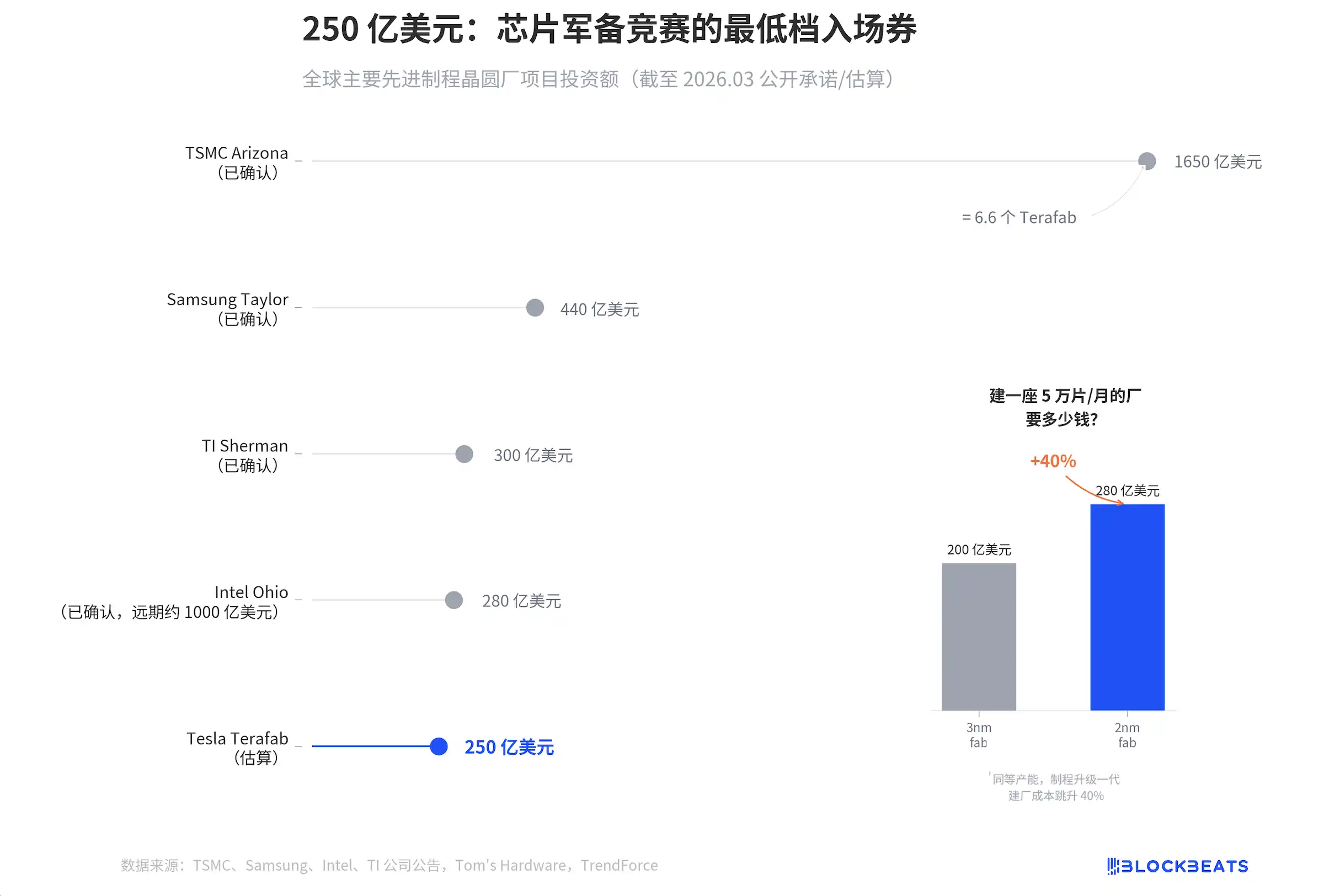
According to company announcements and industry media reports, the world's largest chip foundry TSMC's Arizona plant has a total investment of $165 billion, Samsung's Taylor plant $44 billion, analog chip leader Texas Instruments (TI) Sherman plant $30 billion, and Intel Ohio $28 billion. Tesla ranks last. Moreover, according to estimates by multiple media outlets such as Tom's Hardware, its $25 billion is just external estimates, and Musk himself has not confirmed an exact figure.
More critically is the small image on the right. Industry research institutions estimate that building a factory to produce 50,000 wafers per month with 3nm process requires $20 billion, while a 2nm process requires $28 billion. The cost of building a factory jumps directly by 40% from 3nm to 2nm.
Tesla aims to achieve a monthly production of 100,000 wafers of 2nm using $25 billion. According to industry standards, even a single 50,000 wafers/month 2nm fab requires $28 billion. Tesla plans to accomplish the work of two fabs and a packaging plant with less than the cost of one standard fab. This is not a budget; it is a wish list.
But what truly takes one's breath away about Terafab is not the money, but the production capacity target.
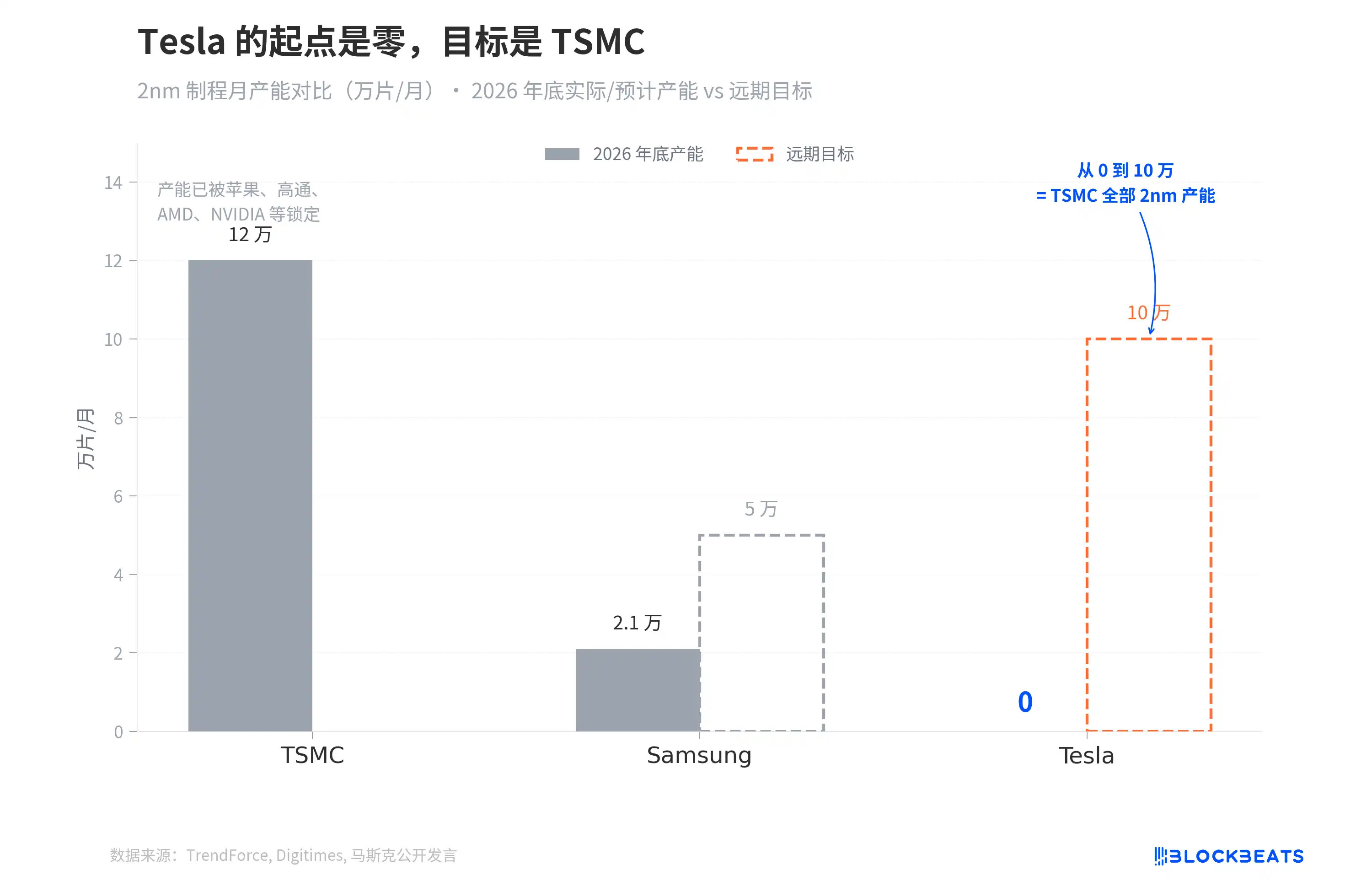
According to data from industry research firm TrendForce, TSMC's 2nm capacity is expected to reach 100,000 to 130,000 wafers per month by the end of 2026, but this number has already been locked in by Apple, Qualcomm, AMD, and NVIDIA. According to Digitimes, Samsung's 2nm capacity is only 21,000 wafers per month, with a long-term goal of 50,000.
Tesla's starting point is zero. The target is 100,000.
Going from 0 to 100,000 wafers per month means starting from scratch to catch up with TSMC's entire production capacity at the world's most advanced process. TSMC began construction in Arizona in 2021, taking three and a half years to enable the mass production of its first 4nm fab. TSMC has already accumulated thirty years of manufacturing experience in Taiwan.
Tesla's car manufacturing speed is indeed faster than everyone expected. However, the margin for error in wafer manufacturing and vehicle manufacturing is not on the same scale. A flaw in a car can lead to a recall, while a defect on a wafer means thousands of chips will be scrapped.
To understand why Terafab is set to emerge in 2026, one must look at a longer timeline.
In 2019, Tesla's chief architect for autonomous driving chips, Jim Keller, led the team to deliver HW3. This was Tesla's first fully self-developed autonomous driving chip, produced by Samsung's 14nm process, with 144 TOPS. In 2023, HW4 was upgraded to Samsung's 7nm process, tripling the computing power. According to TrendForce, the AI5 in 2026 is projected to jump to 3nm and 2nm dual-line foundry, aiming for 2000 to 2500 TOPS of computing power, with GPU and ISP completely separated to optimize the chip solely for transformer inference.
Each generation's performance increases by three to five times. But the foundry strategy is also evolving simultaneously. From HW3's "only find Samsung" to AI5's "dual-line hedge with TSMC and Samsung," and then to AI6. According to reports from TechCrunch and Bloomberg, the AI6 has signed a $16.5 billion long-term contract with Samsung to secure capacity until 2033.
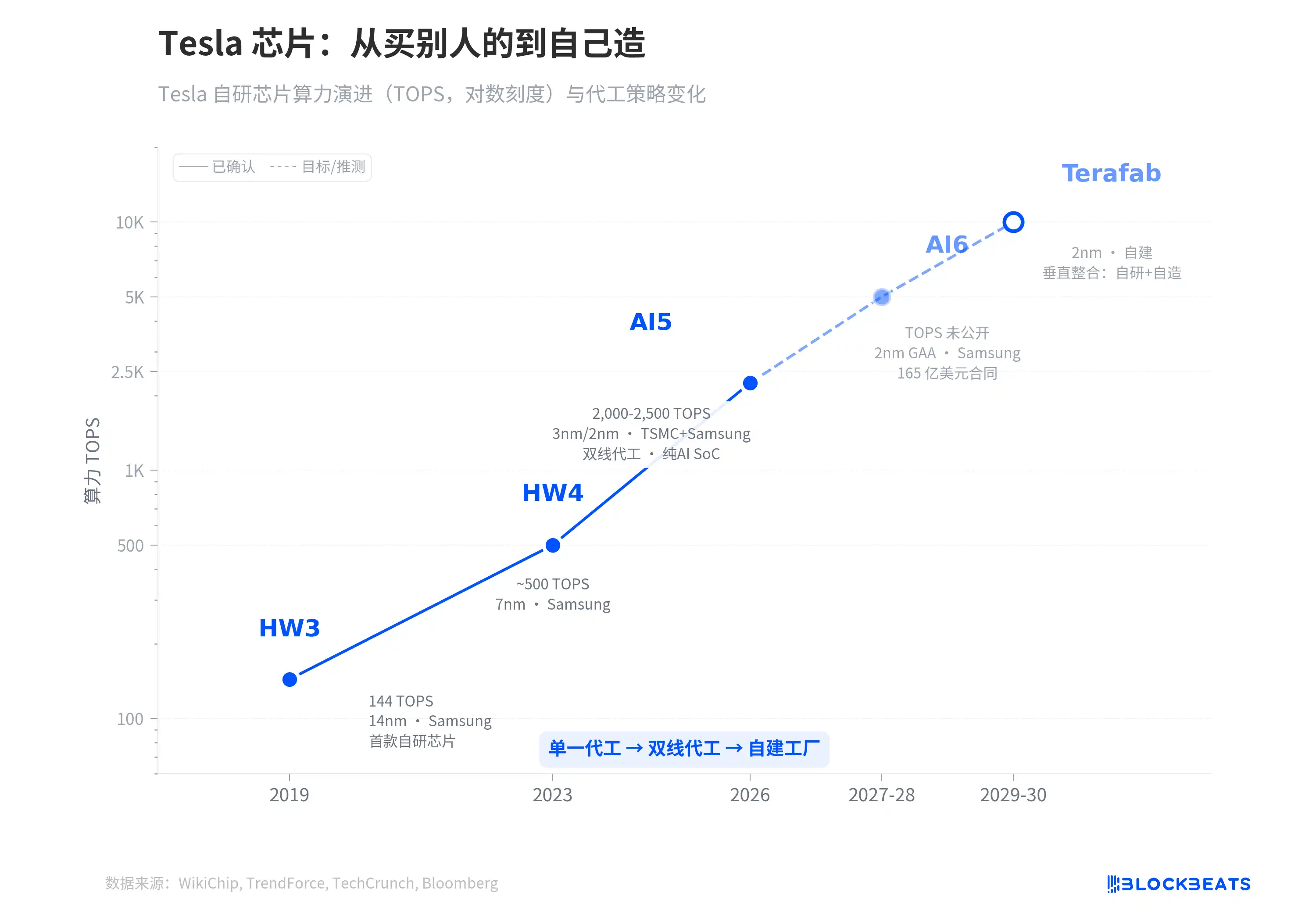
Terafab is a natural extension of this line. According to Tom's Hardware, last year's AI6 contract essentially revived Samsung's Taylor factory, which was shelved due to "lack of customers." When your chip demand is large enough to support someone else's wafer factory, the next question is, why not build your own.
The dotted segment on the graph does not specify the exact TOPS for AI6 and Terafab because the specifications for these two generations have not yet been publicly disclosed. But the trend direction is clear. The computing power curve for Tesla chips is exponential, and dependency on foundries has reached a critical point that must be addressed.
The remaining question is time.
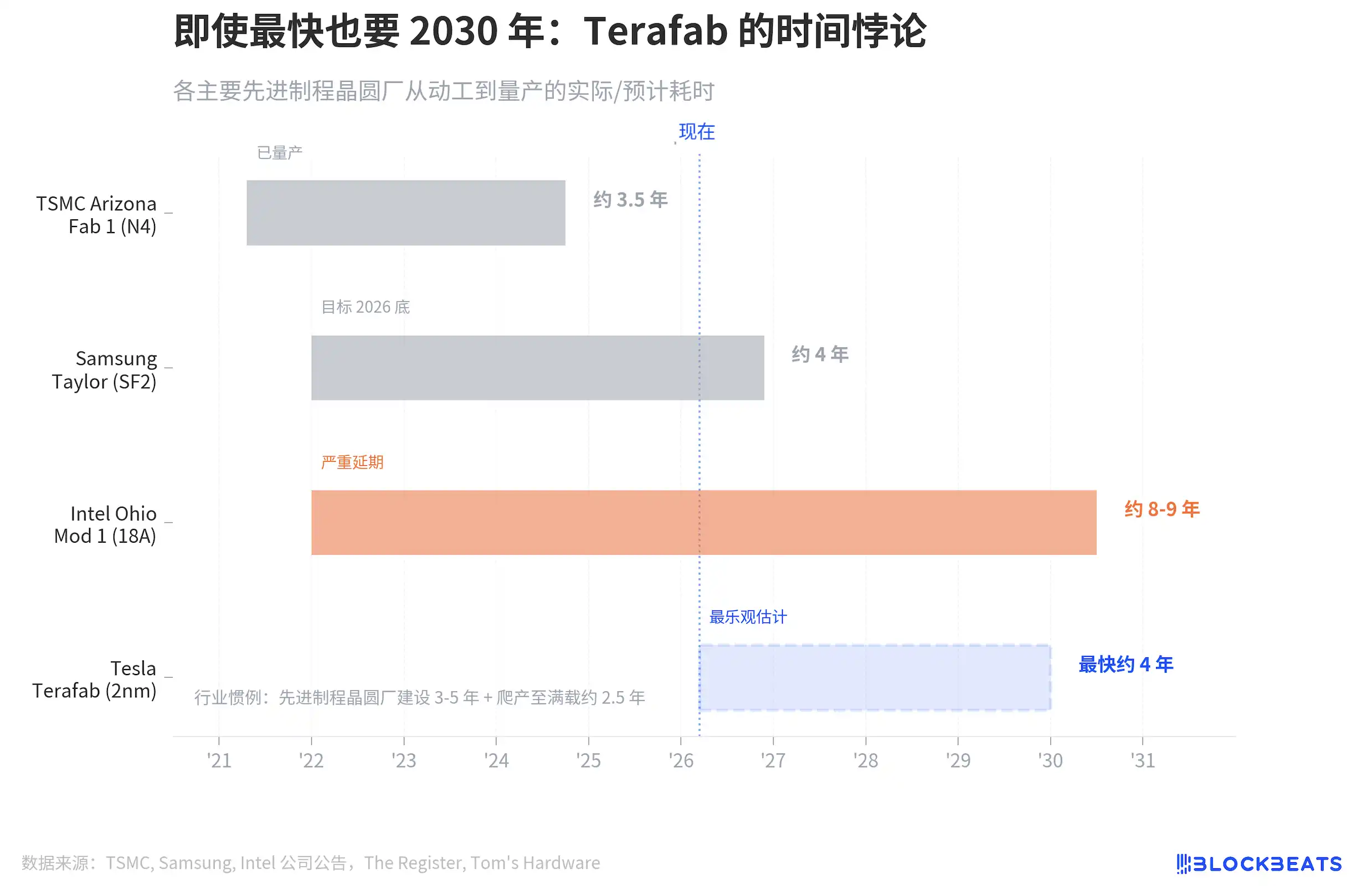
TSMC's Arizona Fab 1 took about 3.5 years from groundbreaking to mass production, the fastest in the industry, but TSMC has thirty years of manufacturing accumulation. Samsung's Taylor took about 4 years, with a stoppage in between due to lack of customers. According to The Register, Intel Ohio is the worst case, starting construction in 2022, and is now delayed until 2030 to 2031.
Industry practices involve 3 to 5 years for construction, plus an additional 2.5 years for ramping up to full capacity. Even using TSMC's pace for Tesla, Terafab would not produce chips until the end of 2029 at the earliest.
This just happens to coincide with Tesla's computing power bottleneck timeframe. AI5's dual-line foundry can support until 2027 to 2028, while AI6's Samsung contract covers until 2033. However, if the mass production scale of the Optimus robot and Robotaxi explodes as Musk plans in 2029, external foundry capacity may likely fall short. Terafab does not need to output chips by 2026; it needs to be ready by 2030.
Musk has also openly discussed the possibility of collaborating with Intel. Intel has its most advanced 18A process (equivalent to the industry's 2nm level) and idle capacity urgently in need of external customers, while Tesla has clear chip demands and the funds. If this line runs smoothly, Terafab will not be something built from scratch by one person, but a marriage where each side gets what they need.
$25 billion does not buy much certainty in chip manufacturing. But it does buy a ticket to enter the game. A ticket that allows Tesla to go from the largest chip buyer to a chip manufacturing player. Looking back at this graph three years from now, it will either be the starting point of Tesla's vertical integration strategy, or Musk's most expensive pipe dream.
免责声明:本文章仅代表作者个人观点,不代表本平台的立场和观点。本文章仅供信息分享,不构成对任何人的任何投资建议。用户与作者之间的任何争议,与本平台无关。如网页中刊载的文章或图片涉及侵权,请提供相关的权利证明和身份证明发送邮件到support@aicoin.com,本平台相关工作人员将会进行核查。


