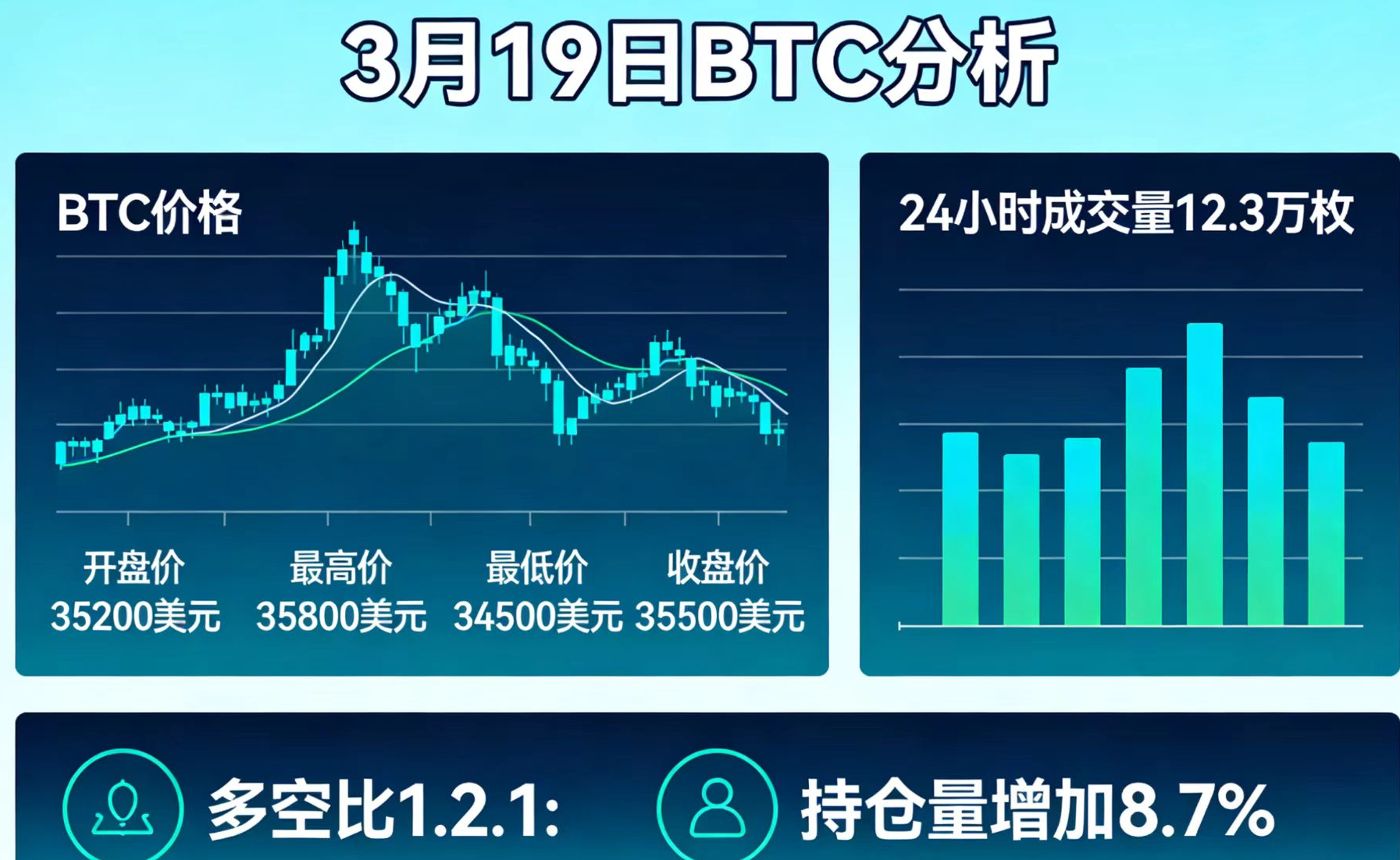
As of 19 March 2026, at 8:00 AM UTC+8, the Bitcoin price was reported at $71,103.24, with a decline of 4.28% over the past 24 hours, briefly falling below the $71,000 mark during the trading day. During the same time window, multiple signals emerged in the market, including large withdrawals by institutions, layoffs and contractions in public chains, and payment giants introducing new AI technologies: on one side, BlackRock's massive reduction in positions drew attention, while on the other side, Visa released an AI payment CLI tool, Algorand announced layoffs, and tokenized stocks rapidly increased on-chain. This article will analyze price fluctuations, institutional behavior, and the expansion of tokenized assets, examining how funding is reshaping new preferences against the backdrop of intertwined geopolitical and macroeconomic factors.
Bitcoin Volume Correction Under the Shadow of Iranian Attacks
On 19 March 2026, Bitcoin showed a significant correction after fluctuating at previous highs, with a price of $71,103.24 at the time of writing, down 4.28% for the day, technically re-testing support below $71,000. The rise in geopolitical risks, especially the uncertainties brought about by events related to the Iranian attacks, resonated with the current overall bearish sentiment in the crypto market, causing risk assets to weaken simultaneously, amplifying short-term volatility.
On a macro level, the Federal Reserve's policy orientation of maintaining a 3.4% interest rate center keeps the expectation of "high rates lasting longer" suppressing risk appetite; at the same time, factors such as the attacks on Qatari gas facilities raise the energy geopolitical risk premium, heightening concerns in the market regarding future costs and inflation, causing both traditional and crypto risk assets to face valuation compression pressures. Under this combination of shocks, Bitcoin's "digital gold" narrative has not fully transitioned into safe-haven buying but instead reflects more of a passive pricing of liquidity and interest rate environments.
In the context of intertwined safe-haven logic and cash-out demands, the volatility of short-term crypto assets has significantly increased, with high-leverage and high-Beta varieties facing more concentrated sell pressure. However, from a medium- to long-term perspective, the main factors that still dominate Bitcoin pricing are interest rate paths, institutional allocation rhythms, and the evolution of spot/ETF structures. The current geopolitical noise tends to accelerate rhythms rather than rewrite logic. In other words, the current correction is more a rebalancing of macro and geopolitical uncertainties, insufficient to declare a fundamental disruption of the long-term narrative.
BlackRock Withdraws 8,435 BTC: A Funding Signal
During the same period of price correction and weakening market sentiment, BlackRock's related address was monitored withdrawing a total of 8,435 BTC, corresponding to an asset scale of approximately $618.05 million, which is particularly notable during a time of overall crypto market cap pressure. As an important participant in ETFs and institutional allocations, BlackRock's large on-chain inflows and outflows are often interpreted as strategic signals, and this continuous Bitcoin withdrawal naturally attracted market attention.
It is important to emphasize that, from an on-chain perspective, the only objectivity we can confirm is the fact that assets have left custodial/trading accounts. The funds may have been transferred to self-custody cold wallets, over-the-counter settlement accounts, internal reorganization addresses, or used for potential hedging and structured strategy deployments. However, due to the lack of public data on subsequent flows and uses, any direct qualitative judgment equating this with "reducing positions," "liquidating," or "increasing other assets" lacks a basis.
Therefore, between the single large withdrawal and the long-term institutional allocation logic, there remains a significant information gap, which needs to be corroborated with the future ETF subscription and redemption scale, product holding changes, and public financial reports/roadshow information. If subsequent ETF shares continue to net outflow and further selling pressure is detected on-chain, then the explanation of "reducing crypto exposure" will be more convincing; conversely, if subscriptions and holdings remain stable or even increase, this operation is more likely just an optimization of the custodial structure or internal fund migration. This uncertainty itself is also a significant part of the current institutional game.
AI Meets Payment Network: Visa's New Entry
Payment giant Visa announced the launch of AI payment CLI tools, providing a standardized entry for developers and quantitative trading teams to integrate payment and automated interactions in a command-line environment. With this tool, strategy teams can invoke Visa's network capabilities without having to build complex frontends or develop complete payment processes, thus coupling payments, settlements, and strategy execution more closely within existing development environments.
From a potential impact perspective, this CLI is expected to lower technical barriers in multiple scenarios: first, strategy trading and market-making teams can embed settlements and fund scheduling directly into quant scripts, shortening the link from strategy signals to fund flows; second, in cross-platform settlements, cross-border payments and payment scenarios related to on-chain assets, developers can more conveniently utilize traditional payment networks as "underlying pipes," enhancing fund turnover efficiency; third, for projects attempting to bring on-chain yields and tokenized assets back into real-world consumption and settlement, such tools have the potential to serve as a connecting layer between both sides.
However, currently, there is no available hard data on the actual adoption rate, invocation frequency, or the transaction volume contributed by this tool, making it impossible to evaluate the substantial transformation of its impact on the revenue structure of payment networks, the ecosystem of quantitative trading, or the flow patterns of on-chain/off-chain funds. Hence, this analysis can only remain at the levels of tool positioning and potential market space projection: amidst a trend where institutions, quant teams, and developers increasingly pursue "deep integration of fund flows and computational logic," this tool provides a new interface, yet still awaits subsequent data to verify its disruptiveness.
Algorand Lays Off 25%: Survival Pressure
The Algorand Foundation announced a 25% layoff, officially explaining it as a measure to "cope with the uncertain global macroeconomic environment." This statement actually reflects the dual pressures of costs and growth that public chain ecosystems face in the current cycle. With the Federal Reserve maintaining the 3.4% interest rate center, and higher yields being attainable on risk-free or low-risk assets, the tolerance of marginal funds for high-volatility crypto projects declines, pushing capital to prefer assets with more stable cash flows or those linked to real-world yield, tightening the financing and valuation environment for on-chain native projects.
In this context, public chain projects like Algorand have no choice but to control the cash outflow speed through layoffs and reductions in market and operational expenditures, trying to extend the project's "runway" in an environment of slowing incremental funds. This means they may face side effects in the short term such as reduced iteration pace, decreased support for ecological projects, and contracting developer incentives, impacting their competitive capability in the public chain landscape.
From a longer-term perspective, if layoffs can significantly reduce fixed costs and enhance capital efficiency, allowing the project to maintain basic technical maintenance and ecological survival during the downturn, this is, in fact, a relatively pragmatic adjustment path. For holders and developers, the short-term need is to be wary of the emotional and valuation pressures brought by declining ecological activity; however, if the project can retain key R&D teams and core infrastructure after cutting costs, it may have a relative advantage in "surviving to the next cycle" when the macro environment and liquidity improve.
Tokenized Stocks Skyrocket from Less Than 100 Million to 4 Billion
Compared to the pressure on crypto spot markets, tokenized stocks are showing a completely opposite trajectory of accelerated expansion. According to briefing data, since the beginning of 2025, when the total scale was less than $100 million, the current total size of tokenized stocks has broken through $4 billion, achieving a magnitude expansion in a short period. This growth reflects the trend of funds migrating towards products "anchored to real assets" within the same risk spectrum on the same chain, rather than simply withdrawing from the on-chain world.
On the one hand, as the volatility of high Beta assets such as Bitcoin increases and some public chain ecosystems face layoffs and contractions, some funds choose to withdraw from traditional crypto spot markets, reducing exposure to purely sentiment and narrative-driven assets; on the other hand, these funds have not entirely flowed back into traditional financial accounts off-chain, but are configuring with tokenization channels linked to real stocks, bonds, or other assets, experiencing liquidity and portfolio management on-chain, while enjoying cash flow and valuation logic more directly related to the real economy.
This structural migration objectively reinforces the degree of interlinkage between the crypto market and traditional stock markets, interest rates, and regulatory environments: the larger the scale of tokenized stocks, the higher their sensitivity to traditional market fluctuations and policy changes, leading on-chain asset prices to more directly reflect macro interest rate expectations, corporate profit cycles, and regulatory policy adjustments. For investors, this not only provides a new asset allocation tool but also means that the crypto market will become increasingly difficult to operate independently from macro and regulatory cycles.
From Safe-Haven to Restructuring Assets: The Logic of Fund Repricing
In summary, the rise in Iranian attacks and energy risks has mainly amplified volatility and emotional outbursts in the short term, while what truly determines medium- to long-term pricing are still structural factors such as interest rate paths, institutional allocation rhythms, and the development of tokenized assets. As long as the Federal Reserve maintains the 3.4% interest rate central for a sustained period and the actual policy turning point does not arrive, the overall valuation ceiling for risk assets will be suppressed, and crypto assets can only seek relative return opportunities within this framework.
The large withdrawals by BlackRock, Algorand's 25% layoffs, and the expansion of tokenized stocks from less than $100 million to $4 billion all point to a common direction: purely relying on narratives and volatility regarding high Beta assets is being reevaluated by some funds, with more funding switching to assets with cash flow, real asset anchoring, or clearer institutional environments. Funds are not simply "leaving crypto," but redistributing between crypto and traditional assets, as well as among different asset types on-chain.
In light of the current incomplete data, investors need to remain restrained when interpreting these signals, avoiding seeing a single large withdrawal or a single project layoff as the entirety of a trend. A more actionable approach is to continuously track the evolution of three key indicators: first, the ETF and related product subscription and redemption data, to assess whether institutional exposure overall is expanding or contracting; second, the scale and variety structure of tokenized products, to observe whether funds are continuously migrating towards real asset anchors; third, the macro interest rate expectations, particularly the timing and magnitude of policy turning points. Only when these three indicators exhibit turning points in direction could we anticipate a genuine shift in asset pricing and capital layout logic.
Join our community to discuss and become stronger together!
Official Telegram community: https://t.me/aicoincn
AiCoin Chinese Twitter: https://x.com/AiCoinzh
OKX benefits group: https://aicoin.com/link/chat?cid=l61eM4owQ
Binance benefits group: https://aicoin.com/link/chat?cid=ynr7d1P6Z
免责声明:本文章仅代表作者个人观点,不代表本平台的立场和观点。本文章仅供信息分享,不构成对任何人的任何投资建议。用户与作者之间的任何争议,与本平台无关。如网页中刊载的文章或图片涉及侵权,请提供相关的权利证明和身份证明发送邮件到support@aicoin.com,本平台相关工作人员将会进行核查。