In the past period, discussions around RWA (Real World Assets) on-chain have mainly focused on one question: which assets can be brought onto the chain. Whether gold, government bonds, or various real-world assets, the core logic revolves around "mapping"—transforming real assets into on-chain certificates. However, as the market gradually advances, a more specific question begins to emerge: can these assets exist on-chain in the long term and operate continuously in a verifiable manner?
When assets are no longer short-term holding instruments but need to form a long-term structure on-chain, merely "mapping" is not enough. Whether the reserve status is clear, how token supply changes, and how custody and operational costs are reflected, begin to become key factors affecting asset stability.
In this context, the mechanism framework built around "how assets operate on-chain" is becoming an important component of RWA infrastructure. Among them, the FRS (Fungible Reserve Standard) constructed by Matrixdock is a structural response to this question.
FRS: A Mechanism Framework for Encoding Asset Economic Properties
FRS is not a single product issuance model, but a mechanism framework that encodes the economic properties of reserve assets into the token structure. Its focus is not on "how to issue tokens" but on continuously maintaining the deterministic relationship between reserve assets, token supply, and operational costs on-chain.
In the FRS framework:
- The correspondence between the tokens and the underlying reserve assets is explicitly defined at the mechanism level and is verifiable.
- The economic properties of the assets (including custody and operational costs) are continuously reflected on-chain through systematic mechanisms.
- Costs are structurally reflected on-chain through established rules rather than charged separately in the form of external fees.
- The overall structure does not include management fees or profit extraction, only reflecting the actual costs incurred from asset custody and operations.
Specifically, this mechanism continuously reflects asset costs over time by adjusting "the quantity of assets corresponding to each unit token," thereby reflecting holding costs without changing the quantity held by users. This design means that on-chain assets are no longer static "mapping results" but become a structured system that operates continuously according to established rules. In this sense, FRS is closer to a standardized operational mechanism for on-chain reserve assets rather than a single product framework.
From Gold to Silver: The Mechanism Logic Behind Asset Expansion
In the traditional financial system, gold has long played a core role as a reserve asset, and its value anchoring attribute makes it one of the first precious metal assets to enter on-chain structures.
In contrast, silver, influenced by both investment demand and industrial cycles, exhibits more pronounced volatility and cyclical characteristics. This also means that, in the absence of a unified mechanism, the on-chain integration of such assets often faces higher uncertainty. The stronger the asset volatility, the higher the requirements for constraint and verification mechanisms for its on-chain structure.
The role of FRS is to provide a unified structural foundation in this process: regardless of how asset characteristics change, their operational logic on-chain remains consistent. Under this framework, asset expansion is no longer just an increase in targets but rather:
- Introducing reserve assets with different attributes under a unified mechanism.
- Enhancing the diversity of asset portfolios under the premise of structural consistency.
Thus, the evolution from gold to silver is not merely an expansion at the asset level, but a continuation at the mechanism level.
XAGm: An Implementation of FRS in Silver Assets
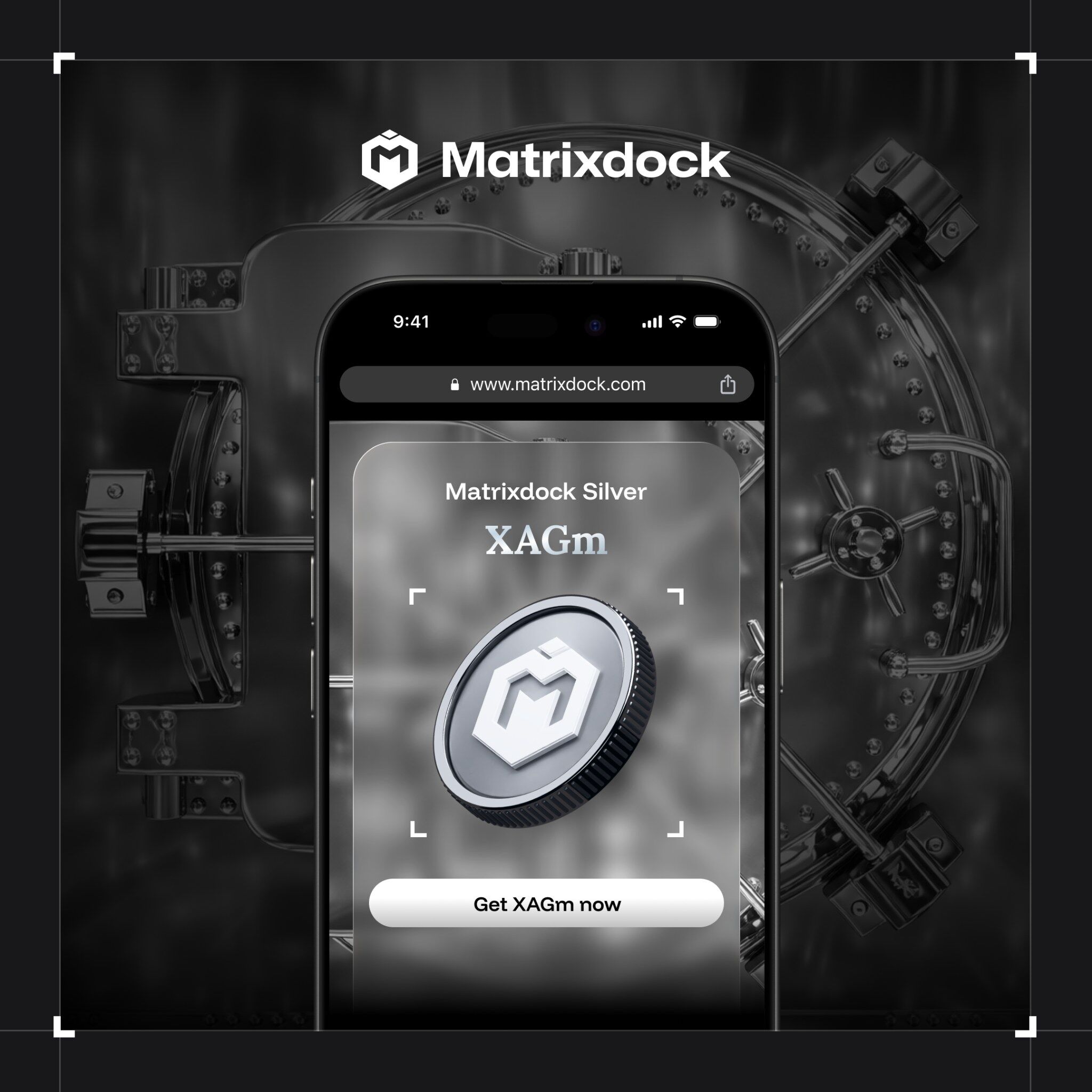
Under the FRS framework, Matrixdock has launched the silver token XAGm, as a further practice of this mechanism in precious metal assets.
From a specific implementation perspective, XAGm operates silver assets under the FRS mechanism, rather than merely mapping physical silver on-chain. Its underlying asset is fully physically allocated silver and uses silver bars that comply with LBMA Good Delivery standards, stored by institutional-grade vaults. However, under the FRS framework, the key to silver is not that it is "on-chain," but how its economic properties are continuously encoded into the on-chain structure.
In this mechanism, the operation of silver assets is reflected as:
- The configuration status of reserve assets has clear boundaries on-chain and can be independently verified through established means.
- The quantity of silver corresponding to each unit token is adjusted over time according to predetermined rules, continuously reflecting asset costs over time.
- The total supply of tokens maintains a deterministic relationship with the underlying silver reserves through mechanistic adjustments.
- The custody and operational costs of silver are not charged in the form of external fees but are continuously reflected on-chain through preset rules.
In this process, silver is no longer just represented as an on-chain asset but continuously reflects its economic properties within the mechanism. Therefore, the significance of XAGm is not just to bring silver on-chain, but under the FRS mechanism, it provides a specific paradigm for how silver assets can be structured and operated.
Reserve Layer: From Asset Collection to Structural System
Under the FRS framework, reserve assets no longer exist in the form of a "single target," but gradually form a structural system with internal logic.
This system (i.e., Reserve Layer as defined by Matrixdock) can be understood as:
- Composed of multiple high-quality reserve assets.
- Operating under a unified mechanism.
- Collectively providing value support and liquidity foundation for on-chain financial activities.
In this structure:
- Gold serves a relatively stable value anchoring function.
- Silver introduces cyclicality and trading activity.
- Different assets are organized into a portfolio with consistent operational logic through the FRS mechanism.
This transformation means that the significance of reserve assets is no longer only in the "assets themselves," but in their structural position and operational method.
The development of RWA is entering a new stage. The act of bringing assets on-chain no longer constitutes the main hurdle; the real challenge lies in how to ensure these assets can exist on-chain for the long term and operate continuously in a verifiable manner.
FRS, as a mechanism framework constructed by Matrixdock, offers a path to convert real assets into on-chain structural units. As more assets are brought onto the chain under this framework, a reserve asset system based on "mechanism" is gradually taking shape.
免责声明:本文章仅代表作者个人观点,不代表本平台的立场和观点。本文章仅供信息分享,不构成对任何人的任何投资建议。用户与作者之间的任何争议,与本平台无关。如网页中刊载的文章或图片涉及侵权,请提供相关的权利证明和身份证明发送邮件到support@aicoin.com,本平台相关工作人员将会进行核查。


