Source: All-In Podcast
Organizer: Felix, PANews
This week, the NVIDIA GTC 2026 conference, as a global event in the technology sector, saw participation from nearly every industry, technological companies, and AI companies, with NVIDIA's founder and CEO Jensen Huang also delivering a keynote speech.
During the four-day event, Huang participated in an All-In Podcast interview on site at GTC, discussing NVIDIA's future, physical AI, the rise of agents, the explosive growth of reasoning capabilities, the AI public relations crisis, and more. PANews has summarized the interview, and below are some highlights from the conversation.
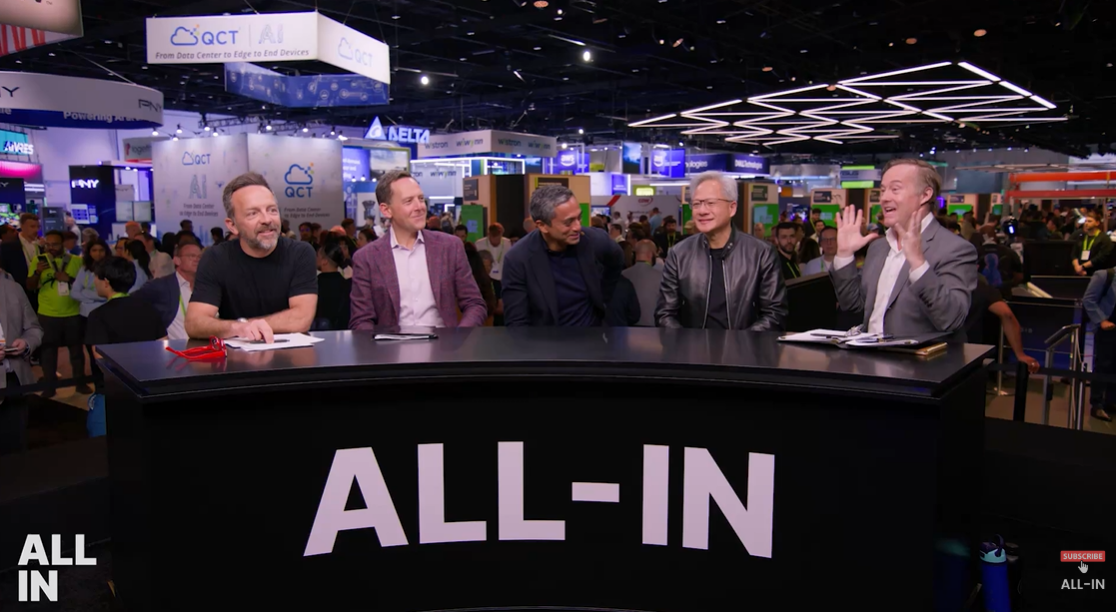
Host: One of the best announcements of the past year was the acquisition of Groq. Did you realize that Chamath (one of the podcast hosts, CEO of Social Capital) would be extremely frustrated at that time?
(PANews Note: Social Capital is an early investor in Groq, and the frustration does not stem from losing money but from personal character and investment style: happiest before milestone events occur, not afterwards.)
Jensen Huang: I sensed it long ago; after all, we are friends with Chamath and deal with him every week. The two weeks of closing the acquisition were indeed uncomfortable. In fact, many of our strategies had already been made public years ago. Two and a half years ago, I introduced the AI factory operating system "Dynamo." Dynamo is a machine invented by Siemens that turns water into electricity, which powered the last industrial revolution's factories. I think it’s a perfect name for the operating system of the factories in the next industrial revolution. Inside Dynamo, the underlying technology is "decoupled reasoning." Today's reasoning processing is an extremely complex computational problem that involves large-scale mathematical operations of various shapes and sizes. Our idea is to decouple the processing so that some parts run on certain GPUs and others on different GPUs, achieving heterogeneous computing. Nowadays, NVIDIA's computing is distributed across GPUs, CPUs, switches, and network processors, and now with Groq added, the aim is to place the right workloads on the right chips. We have evolved from a GPU company into an AI factory company.
Host: You said on stage that 25% of data center space should be allocated to Groq and similar processors. How does the industry view this idea? What do you think people's reactions will be?
Jensen Huang: When we added this technology, the industry was shifting from processing large language models to processing agents. Running agents requires access to working memory, long-term memory, and various tools, which puts tremendous demands on storage. There are various models in data centers, such as ultra-large models, small models, diffusion models, autoregressive models, etc. We developed the Vera Rubin architecture to run this extremely diversified workload. Our potential market size (TAM) has therefore increased by about 33% to 50%. A large portion of the increase will include storage processors (Blue Field), Groq processors, CPUs, and network processors. All of these will work together to drive the AI revolution with "agent" computers.
Host: What about embedded applications? For example, if my daughter's teddy bear wants to talk to her, will it include custom ASICs, or will there be different development tools for edge and embedded applications?
Jensen Huang: Overall, solving this problem requires three computers to work together. The first is for training and developing AI models. The second is to evaluate robots (like cars, robots, etc.) in a virtual environment that follows the laws of physics. The third is the edge computer, which can be a computer in a self-driving car, a robot, or a small computer inside a teddy bear. Additionally, we are working to transform the $2 trillion telecom base station industry into part of the AI infrastructure, meaning that future radio base stations will become edge devices. So all three of these basic computers are necessary.
Host: You once predicted that reasoning demands would explode by 1000-fold or even 1 billion-fold. Now there are voices saying that the reasoning factories you've built cost as much as $40-50 billion, while competitors only need $25-30 billion. Do you think customers will be willing to pay that extra premium? Will this affect your market share?
Jensen Huang: Absolutely do not equate the cost of building a data center with the cost of generating tokens. I can prove that a $50 billion factory can generate you the lowest-cost tokens because our production efficiency is extremely high. Even in terms of costs, the basic costs of land, electricity, storage, networking, servers, and cooling (around $20 billion) are fixed. If you factor these in, the difference in GPU prices averages out to the total cost, meaning it could just be a difference between $50 billion and $40 billion, which is not a large percentage. But the throughput provided by our $50 billion data center is ten times that of other solutions. In this industry, if your technology does not keep up with development, then even if the chips are given away for free, it still won't be cheap enough.
Host: As the CEO of the world's highest market cap company (expected revenue of $350 billion next year), how do you make decisions, gather information, and determine which fields to double down on or exit?
Jensen Huang: Defining vision and strategy is the CEO's primary job. We mainly rely on top computer scientists and technologists inside and outside the company to provide information, but it must be us who shape the future. The standard for assessing a new direction is: is it unprecedented and extremely difficult? If something is easy to do, there will be countless competitors; if it is extremely difficult and aligns perfectly with our company's unique "superpower," that's the intersection we are looking for. Because it is unprecedented and highly challenging, there will inevitably be a lot of pain and hardship in the process, so you better enjoy that journey.
Host: Regarding long-tail businesses, can you talk about the long-term viability and explosion curve in directions like space data centers, automotive ADAS, or biology?
Jensen Huang: First is physical AI. The tech industry has the first opportunity to solve a $50 trillion traditional industry that has been minimally permeated by technology. We started this ten years ago, and now we are seeing an explosion; it has already become a nearly $10 billion business for us annually, growing exponentially. Second is digital biology. We are very close to the "ChatGPT moment" in digital biology. Within the next 2 to 5 years, we will be able to use AI to represent and understand the dynamics of genes, proteins, and cells, which will revolutionize the healthcare industry, and agriculture is also on the verge of an explosion.
Host: We see many enthusiasts and innovators obsessed with desktop open-source agent systems like "OpenClaw." What does this grassroots open-source agent movement mean for you and the industry?
Jensen Huang: There have been three significant turning points over the past two years: the first is that ChatGPT democratized generative AI; the second is that reasoning-capable models allow AI to not only answer questions but also provide more practical answers; the third is revolutionary agent systems emerging within the industry, such as "Claude Code." However, Claude Code was initially only for enterprises until OpenClaw appeared, which made the public truly realize what AI agents can do. More importantly, these systems fundamentally reshape the computing model. They have short-term memory (cache), can manage resources, schedule tasks, create sub-agents to solve problems, and run various applications (skills) through APIs. These elements define a computer. This means we now have for the first time a blueprint for an open-source personal AI computer that can operate anywhere, which will become the operating system of modern computing. Of course, software with such elevated privileges needs proper governance; we have committed many engineers to work with Peter Steinberger (founder of OpenClaw) to ensure that agents are well-governed in terms of security and privacy.
Host: Does the speed of this paradigm shift in AI make recent AI regulatory proposals seem meaningless? Regarding the panic triggered by AI, like some of the PR storms related to Anthropic, if you were a board member at Anthropic, what advice would you give their team to change public perception?
Jensen Huang: We need to continually educate policymakers on the current state of technology: AI is merely computer software; it is not an alien organism, has no consciousness, and is not "something we know nothing about," as some people claim. We cannot allow doomsday theories and extremism to dictate policy. But policies cannot be made too quickly ahead of technology either. The biggest national security concern right now is when we hesitate to use AI out of fear, anger, or paranoia, other countries are actively adopting this technology.
As for Anthropic, they have excellent technology and a commendable focus on security and prevention. Warning people about the potential of technology is good, but "scaring them" is not. As technology leaders, our words carry immense weight because our industry is crucial to national security and social structures, so when forecasting the future, we need to be humble, more balanced, moderate, and thoughtful, avoiding extreme catastrophic statements without evidence.
Host: We really need to promote AI more aggressively. When it comes to the productivity boost from the explosion of agents, there is currently debate about whether there is a return on investment (ROI) for AI. When seeing the explosion of OpenAI and Anthropic, do you think our revenue scale can keep pace with the expansion of intelligence levels?
Jensen Huang: Looking around, you can find representatives from Anthropico and OpenAI, but in reality, 99% of AI companies are participating, and neither Anthropico nor OpenAI is one of them. Currently, OpenAI is the most popular, followed by open-source models, with Anthropico coming in third, indicating that the AI ecosystem is very large and diverse. From generative AI to reasoning AI, the computation amount has increased 100-fold; from reasoning to agent AI, the computation may increase another 100-fold. People are willing to pay for information, but they are more willing to pay for "getting the work done." Agent systems can effectively help software engineers complete their tasks. Therefore, when you increase the computation by 10,000 times, the consumption could increase by 100 times. Our current scaling expansion is just beginning.
Host: In your speech, you mentioned that NVIDIA is paying a large amount of token costs for engineering teams. Roughly estimate, does each engineer need about 75,000 tokens? Are you now spending $1-2 billion a year buying tokens for engineering teams? What level of efficiency will these engineers reach in two to three years?
Jensen Huang: Let's do a thought experiment: assume you pay a top-notch software engineer or AI researcher a $500,000 annual salary, and if at the end of the year they tell you they only spent $5,000 on tokens, I would be very upset. If that $500,000 salaried engineer has not consumed at least $250,000 worth of tokens, I would be deeply shocked and concerned. It’s like a chip designer refusing to use CAD tools and insisting on drawing with paper and pen instead. This is also about equipping these outstanding knowledge workers with "super" capabilities, much like how LeBron spends $1 million a year on body maintenance.
The future paradigm shift is that notions like "this is too hard," "this takes too long," "this requires too many people" will completely disappear. The bottleneck of work will purely depend on your creativity. Future programming will no longer be about writing code but about crafting ideas, architectures, and specifications. We will organize teams, define what constitutes a good outcome, guide how to assess, and brainstorm and iterate with agents. I believe every engineer will have hundreds of agent assistants.
Host: We have seen incredible efficiencies at many technical levels, such as the CEO spending 90 minutes over the weekend using Claude and agents to replace an entire software stack or using Auto Research to complete doctoral-level research that previously took seven years in just 30 minutes. Does this mean the enterprise IT software industry will be destroyed?
Jensen Huang: OpenClaw is incredible because its timing perfectly aligns with breakthroughs in large language models and the new capabilities of models using tools. Some say the enterprise IT software industry will be destroyed, but there is another perspective: in the past, enterprise software was limited by the number of employees, whereas in the future, there will be hundreds of times more agents using these tools. They will utilize SQL, vector databases, Blender, Photoshop, or CAD tools because these tools perform well and serve as the "pipeline" connecting humans with the outcomes of their work. I need AI to return work results back into tools like Synopsis or Cadence because that’s how I can control and verify them.
Host: Recently, the crypto project Bit Tensor successfully trained a 4 billion parameter LLaMA model in a distributed manner. What do you think about the ultimate form of open-source models? Will decentralized computing power and fully open-source approaches be the mainstream in the future?
Jensen Huang: We need both proprietary models as first-class products and open-source models; both coexist. Because models are a technology, not a product or service. For the average consumer, using experiences like ChatGPT, Claude, or Gemini with different services is great. However, all industries in the world need to entrench specialized knowledge in models they can fully control, and this can only be achieved through open-source models. Almost all the startups we invest in are now adopting an "open-source first" strategy, transitioning gradually to proprietary models.
Host: Last year, the Biden administration's policies restricted the global spread of AI. Now with a new president in office, how would you evaluate our performance in spreading American AI technology globally?
Jensen Huang: President Trump wanted American industry and technology to maintain leadership in the world, to win, and to become the richest country. At one point, NVIDIA dropped 95% of its share in China and now has a market share of 0%. President Trump wanted us to return to that market. We have applied through Secretary Lutnick and received licenses for sales to related companies, and we have received purchase orders and are in the process of restarting the supply chain.
From a national security standpoint, when we lose control over micro motors, rare earth minerals, telecom networks, or energy, national security is compromised; I do not want the AI industry to follow in the footsteps of those industries. We cannot expect the entire world to use a single generic AI model, but we can aim for a "American technology stack" that includes chips, systems, and platforms to capture 90% of the global market share, allowing countries around the world to build public or private AI applications that fit their societies based on that framework, and that is the outcome we seek.
Host: You have many partners in the self-driving field, such as Mercedes and Uber. Are you planning to create an open-source platform like Android, or a closed ecosystem like Tesla's iOS?
Jensen Huang: We believe that all mobile objects will achieve varying degrees of automation in the future. We do not want to manufacture cars ourselves but want to empower every car company worldwide to produce self-driving vehicles. Therefore, we have built training computers, simulation computers, in-vehicle evaluation computers, and the world’s first reasoning-capable self-driving operating system, which can break down complex scenarios into simple ones similarly to humans. Through vertical optimization and horizontal innovation, we allow customers to decide for themselves: someone like Musk (Tesla) may only buy our training computers, while other customers may wish to purchase our complete hardware and software system. Our attitude is to solve problems, regardless of how customers choose to collaborate with us; we warmly welcome all approaches.
Host: Many large clients, such as Google and Amazon, are also developing their own AI chips in an attempt to compete with you, while Wall Street analysts predict that your growth rate will drop to 7% by 2029 and you will lose market share. What are your thoughts on this?
Jensen Huang: We are a company that builds all stacks and foundational models for AI, and we are the only company that collaborates with all AI companies worldwide. They never show me what they are making, but I always show them what I am making. As long as we run fast, buying NVIDIA products remains the most economical choice. NVIDIA is the only architecture that can be deployed in any cloud, local servers, vehicles, or even space. About 40% of our business customers do not want to buy chips; they want to build AI infrastructure and need the complete CUDA stack, which we have full-stack capability to provide. Therefore, NVIDIA’s market share has actually increased, for example, AWS just announced it will purchase 1 million chips in the coming years, and Meta and Anthropic are also shifting towards NVIDIA.
As for Wall Street analysts, they fundamentally do not understand the immense scale and breadth of AI. They rely on stereotypes and do not believe that a market can grow from $5 trillion to $15 trillion. Most people think AI is only concentrated among the top five cloud service providers, but AI's influence will be much greater than what OpenAI or Anthropic currently demonstrate; NVIDIA is no longer just solving chip production but rather dealing with extremely complex AI infrastructure problems.
Host: Can you explain your business in space data centers to non-professionals?
Jensen Huang: We must prioritize solving problems on Earth, but we should also prepare for space where abundant energy exists. The primary challenge lies in heat dissipation: in space, you cannot rely on conduction and convection for heat dissipation, only on radiation, which requires a huge surface area; however, space has ample room. We have already entered space, with radiation-resistant CUDA devices doing AI image processing on global satellites. Many imaging tasks can be completed directly in space without needing to be sent back to Earth. Exploring the architecture of space data centers will take time, but we have ample time to explore.
Host: The healthcare systems are extremely bloated; how can AI break through regulation and truly make an impact in this field?
Jensen Huang: In the healthcare sector, we are primarily involved in three areas: first is AI biology: used for drug discovery, predicting and understanding biological behaviors through AI. Second is AI agents: companies like Hippocratic are developing assistants to aid diagnosis, which significantly changes our interaction with doctors. Lastly is physical AI, which understands the laws of physics for robotic surgery. In the future, every instrument in hospitals (ultrasound, CT, etc.) will be embedded with safe OpenClaw agents to interact in new ways with patients, nurses, and doctors.
Host: The humanoid robotics industry has experienced a "lost decade"; now we see Musk's Optimus and the impressive performance of Chinese companies. How far are robots from entering our lives?
Jensen Huang: The U.S. actually invented this industry a long time ago, but we entered the market too early and were exhausted before the enabling technology (AI brains) arrived five years later. But now the brain technology is in place. From the proof of the existence of high-functioning beings to the actual rollout of practical products usually only takes 2 to 3 cycles, meaning within approximately 3 to 5 years, we will see robots everywhere.
China's strength is very powerful, their microelectronics, motors, rare earths, and magnet technology are world-class, which is also the foundation of the robotics industry. To a significant extent, the global robotics industry will deeply depend on China's ecosystem and supply chain. Robots will solve labor shortages; we might even use virtual reality to manipulate robots at home to help with chores or as our advance labor force for interstellar migration (such as to the Moon, Mars).
Host: Anthropic CEO Dario predicts that by 2030, non-infrastructure AI applications (models and agents) revenues will reach trillions of dollars. In the future, how will companies in the software application layer establish a moat? Facing inevitable unemployment (such as drivers), what learning advice do you have for the young people entering society?
Jensen Huang: I think Dario's prediction is very conservative; they will do even better. He hasn't considered that in the future, every enterprise software company will become a value-added reseller (VAR) for these foundational large models (like Anthropic, OpenAI), which will greatly expand the market.
The real moat for the application layer is deep specialization. General cloud models will connect to software companies’ agent systems, but you must train specialized sub-agents using your own data. Connect your agents with customers as early as possible; the flywheel effect in specialized fields will accelerate, and software platforms have the opportunity to become experts in vertical fields. Regarding employment, work will indeed change; some jobs will be eliminated, but many new jobs will also be created. For example, after the widespread use of self-driving cars, existing drivers may become "mobility assistants" to help you with baggage or arrange hotel itineraries. Just as the autopilot of airplanes has created more demand for pilots.
My advice to young people is: deeply cultivate science and mathematics while also valuing language skills. Because language is the ultimate programming language for AI. Furthermore, regardless of what education you receive, you must become proficient using AI. When deep learning first started, experts predicted radiologists would become unemployed. But today, 10 years later, computer vision has been 100% integrated into healthcare platforms, and the demand for radiologists has instead surged. As scanning speeds increase, hospitals can see more patients, revenues increase, thus hiring more doctors. Similarly, improved productivity will make nations wealthier, allowing for more teachers to be placed in classrooms, complemented by AI creating personalized courses for each student, and every student needs excellent teachers. In the face of AI, we do not need to spread doomsday scenarios evoking fear; we have the autonomy to choose how to use this technology to create a beautiful future.
Related reading: The AI industry also has its own Satoshi—Jensen Huang
免责声明:本文章仅代表作者个人观点,不代表本平台的立场和观点。本文章仅供信息分享,不构成对任何人的任何投资建议。用户与作者之间的任何争议,与本平台无关。如网页中刊载的文章或图片涉及侵权,请提供相关的权利证明和身份证明发送邮件到support@aicoin.com,本平台相关工作人员将会进行核查。


