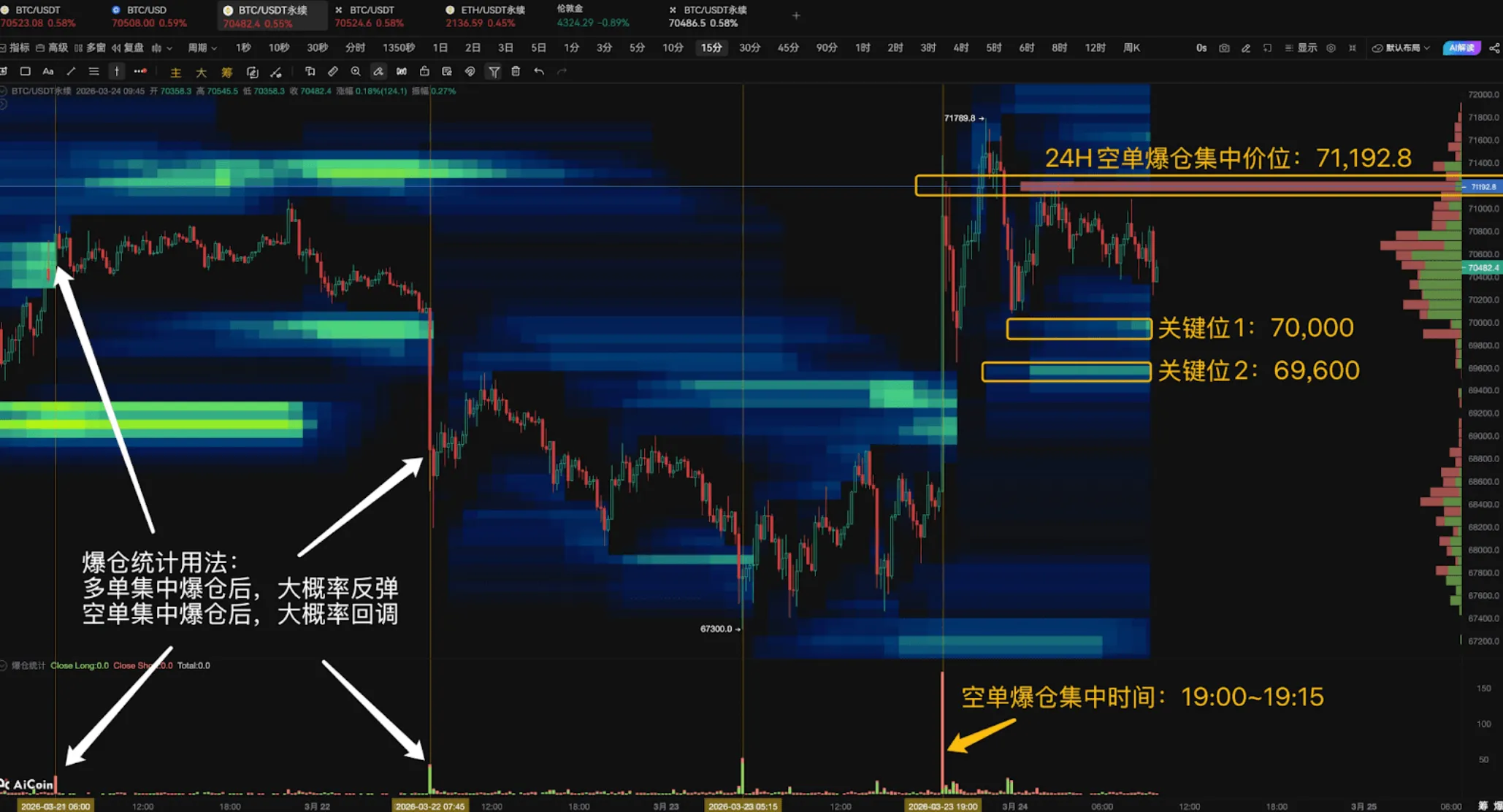
From March 24 to 25 in the East 8 Time Zone, the situation between the U.S. and Iran tightened again, macro uncertainties rose, and global risk assets faced potential impact expectations, with market sentiment clearly leaning towards caution and risk aversion. In such an external environment, Bitcoin did not experience panic selling; instead, it fluctuated within the range of $67,000–$72,000, with prices generally staying above $70,000. This performance has been interpreted by many crypto media outlets as a validation of its safe-haven properties and price resilience: amidst the geopolitical clouds and macro noise, Bitcoin not only withstood pressure but also recorded an increase of nearly 1% within a 24-hour period, reinforcing its narrative as "digital gold."
Geopolitical Tensions Rise but Cannot Suppress Prices
In late March, signals indicating an escalation in U.S.-Iran confrontations continued to accumulate, and concerns about the Middle East situation possibly spilling over into broader geopolitical conflicts intensified, leading to a rise in risk aversion. Traditional financial markets typically adjust expectations in response to such risks: the volatility of risk assets may increase, and funds may shift their preferences towards cash, government bonds, and precious metals as traditional safe-haven assets, resulting in an overall cooling of risk appetite.
In this emotional backdrop, Bitcoin should have suffered more severe selling pressures according to traditional risk asset logic, especially after the previous round of significant gains, with the market generally worried that any external negative news might trigger profit-taking or even a waterfall correction from high positions. However, as of March 25, Bitcoin still recorded an increase of nearly 1% over a 24-hour period, with multiple market media outlets like Rhythm, TechFlow, and Planet Daily presenting similar data ranges.
This performance sharply contrasts with the intuition of many traders who previously believed that "geopolitical escalation = high position sell-off." The anticipated one-sided downward movement did not occur; instead, there was high-level fluctuation around the $70,000 mark, where prices repeatedly tested but never clearly broke. The geopolitical tensions did not crush the coin price; rather, they provided a real pressure test for Bitcoin's safe-haven narrative to some extent.
Fluctuations Above $70,000 Become a Confidence Anchor
From a specific price range perspective, from March 24 to 25, Bitcoin operated within the range of $67,000–$72,000, showing a relatively narrow range-bound fluctuation pattern. Market data indicates that despite frequent ups and downs, trading activity within this range remained high, with both bulls and bears continuously vying around key price points, while short-term capital did not show signs of an overall retreat in "volume and price shrinkage."
Several crypto media outlets, in their post-market commentary, regarded "staying above $70,000" as a key signal—not only because it's a round number but also as an anchor for emotion and confidence. For many medium- to long-term participants, as long as $70,000 is not effectively broken down, it can be interpreted as Bitcoin being in a strong consolidation phase, rather than entering the prelude of a trending bear market. This consensus itself will, in turn, support the psychological defense line at this price level.
Behind the high-level sideways movement is an ongoing tug-of-war between bulls and bears: on one hand, short-term bulls are reluctant to easily push the price higher in the absence of new macro benefits, choosing to sell high and buy low within the range; on the other hand, long-term funds have not shown signs of a systematic exit, as the mainstream view still sees the current volatility as a normal consolidation in the trend rather than a signal of a top reversal. The long-term holdings are not in a hurry to sell, allowing for quick absorption of every dip, maintaining an orderly fluctuation structure within the range.
After Interest Rate Cut Expectations Peak, Safe-Haven Demand Steps In
From a longer-term macro perspective, the expectation of interest rate cuts by the Federal Reserve has been fully priced in by the market over the past few months. Whether from the dot plot signals or marginal changes in inflation and employment data, easing expectations have largely been reflected in asset prices. In this context, simply relying on the narrative of "there will be future cuts" is causing marginal new buying pressure for Bitcoin to weaken, as the benefits of monetary easing gradually enter a diminishing stage.
When traditional macro benefits have been fully priced, the market naturally seeks new stories and drivers to explain price resilience and subsequent potential. At this point, geopolitical risks, such as the rising U.S.-Iran situation, begin to take over, becoming one of the "new mainlines" driving Bitcoin's narrative. Compared to a relatively predictable interest rate path, geopolitical conflicts are more sudden and nonlinear, and the demand for safe-haven assets is often more direct and emotional.
In this process, the narrative of Bitcoin as "digital gold" and its actual price performance have mutually reinforced each other. On one hand, investors establish intuitive associations between news headlines and price candlesticks—every time geopolitical uncertainty rises, if Bitcoin can hold key support or even rise slightly, it is viewed as a confirmation of its safe-haven function; on the other hand, this increasingly reinforced signal attracts more funds to prioritize the allocation of Bitcoin in similar situations, further consolidating its role as a "safe-haven asset" in future geopolitical events.
Regulatory Shadows and Sovereign Sell-Off Rumors Have Not Truly Altered the Market
Alongside geopolitical risks, there are theoretical downturns brought about by regulatory environments and sovereign fund movements. In recent years, regulatory scrutiny of dollar-denominated on-chain payment tools has been tightening, with related discussions frequently appearing on the policy and media agenda, causing some participants to worry that a more stringent compliance framework will compress the survival space of the crypto ecosystem. At the same time, market rumors occasionally suggest that sovereign funds might reduce their holdings in crypto-related assets, adding a layer of shadow to the sentiment.
According to traditional logic, stricter regulations and expectations of sovereign sell-offs should dampen risk appetite, prompting funds on the scene to actively deleverage and reduce positions, creating downward pressure on prices. However, during the market period from March 24 to 25, Bitcoin did not exhibit the textbook-like severe corrections; prices continued to oscillate within the aforementioned range, reflecting more a digestion of news rather than a trend-based collapse.
A key variable behind this is the increase in long-term funds and institutional participation. When more medium- and long-term funds view Bitcoin as part of their asset allocation rather than just a short-term speculative tool, short-term regulatory shifts and sell-off rumors are more likely treated as "noise." Institutional investors are more systematic in their risk management and allocation ratios, not likely to flee en masse due to a single rumor; this more stable holding structure is counteracting the impact of short-term emotional fluctuations on prices, allowing Bitcoin to maintain a relatively stable center amidst complex narratives.
From the CLARITY Act to the Institutional Struggle for Digital Sovereignty
Under regulatory topics, the CLARITY Act has become a focal point of market discussion. According to insights from 10x Research, if this act is implemented, it could provide certain structural benefits for compliant dollar asset issuers like Circle within regulatory frameworks—this viewpoint emphasizes building a more robust bridge between compliant dollar assets and the crypto ecosystem through clear and predictable rules, aiming to reduce compliance uncertainties and unleash expectations for institutional dividends.
From a broader perspective, the combination of U.S.-led compliant dollar assets and crypto assets is viewed by numerous researchers as a process that simultaneously features "institutional arbitrage" and "institutional upgrades": on one hand, the credit of the dollar and the U.S. financial regulatory system provide endorsement for on-chain assets; on the other hand, crypto infrastructure offers a new platform for the circulation efficiency of dollars in the global digital environment. The overlay of the two is seen as an extension of the consensus between Wall Street and Washington.
In contrast, the push for sovereign digital currency routes is advancing in other regions. Taking Hong Kong as an example, it has been reported that approximately 80,000 digital renminbi wallets have been accumulated in local pilot programs, demonstrating the concrete progress of sovereign digital currencies in real-world scenarios. Although this data does not have a direct correlation with short-term fluctuations in Bitcoin prices, it highlights another parallel narrative: on one side, decentralized assets represented by Bitcoin reinforce the logic of "digital gold" and safety; on the other side, sovereign digital currencies like digital renminbi accelerate the expansion of digital sovereignty boundaries, with both paths engaging in a long-term struggle at the institutional and narrative levels.
Safe-Haven Narrative Accelerates Formation but Volatility Is Far from Over
Considering the current situation, Bitcoin is demonstrating resilience at high levels amidst the intertwining tensions of U.S.-Iran tensions and macro policy expectations: it has neither lost upward momentum due to weakening rate cut expectations nor experienced significant sell-offs in the geopolitical risk and regulatory noise. The stable oscillation above $70,000 is becoming a key window for the market to observe Bitcoin's "hardness," and price behavior is providing practical support for its safe-haven and value storage narratives to some extent.
At the same time, it is essential to note that Bitcoin's pricing is being pulled in multiple directions: on one hand, the demand for safety and the "digital gold" narrative are continuously strengthened under geopolitical clouds; on the other hand, regulatory reshaping, the advancement of sovereign digital currencies, and sovereign fund movements are all attempting to rewrite the positioning of crypto assets in the global financial system. These variables will not provide clear answers in the short term but will gradually shape a new equilibrium through repeated fluctuations and feedback from policies and events.
Looking ahead, key variables that investors need to continue tracking include: the evolution paths of geopolitical situations like the U.S.-Iran conflict, the actual rollout pace of Federal Reserve policies, and the regulatory processes regarding crypto and digital assets in the U.S. and other major jurisdictions. The formation of the safe-haven narrative does not mean that price volatility will converge; rather, under the joint effects of structural capital and institutional struggles, Bitcoin may still experience significant upward movements and pullbacks. When viewing it as a long-term allocation tool, it is crucial to remain cautious not to overestimate its "universal insurance" function during spikes in short-term safe-haven sentiment, nor to easily dismiss its long-term role in the new financial system after a single pullback.
Join our community to discuss and become stronger together!
Official Telegram Community: https://t.me/aicoincn
AiCoin Chinese Twitter: https://x.com/AiCoinzh
OKX Benefit Group: https://aicoin.com/link/chat?cid=l61eM4owQ
Binance Benefit Group: https://aicoin.com/link/chat?cid=ynr7d1P6Z
免责声明:本文章仅代表作者个人观点,不代表本平台的立场和观点。本文章仅供信息分享,不构成对任何人的任何投资建议。用户与作者之间的任何争议,与本平台无关。如网页中刊载的文章或图片涉及侵权,请提供相关的权利证明和身份证明发送邮件到support@aicoin.com,本平台相关工作人员将会进行核查。