Article | Lin Wanwan
On April 17, 2026, the AI funding circle became excited again.
A screenshot circulated wildly in the investor community, revealing that the implied valuation of Anthropic had quietly crossed a line on secondary markets and derivatives platforms like Caplight and Ventuals: $1 trillion.
Briefly but truly, it surpassed OpenAI.
There was no official announcement, no press release, no CEO Dario Amodei standing up to say anything; it was just the Pre-IPO market voting on its own.
Investors were thrilled to see the revenue curve; Anthropic's annualized revenue jumped from $9 billion at the end of 2025 to $30 billion in four months, a rise of 233%, and then they began spreading the word: the AI leader has changed.
First, let’s clarify something. Anthropic's latest official post-funding valuation is $380 billion after completing its G round in February 2026. Several venture capital firms subsequently quoted $800 billion or higher, but Anthropic has yet to accept.
That $1 trillion is an implied figure on secondary market platforms.
On almost the same day, another piece of news emerged from Hangzhou.
DeepSeek is planning its first external financing since its establishment, with a target valuation exceeding $10 billion and plans to raise at least $300 million. The first time in three years.
One company is being chased by capital, reaching the trillion-dollar threshold. The other has kept capital at bay for three years and then chose what it believed was the right moment to open the door slightly.
Reading these two pieces of news together reveals the same thing: this spring, the two most important AI companies from two countries have reached the boundaries of their respective paths.
A Lineup List from Anthropic
First, let’s talk about Anthropic.
On February 13, 2026, Anthropic completed its G round financing, raising a total of $30 billion with a post-money valuation of $380 billion. The leading investors included Singapore's GIC and the hedge fund Coatue, with joint investors like Blackstone, Goldman Sachs, JPMorgan Chase, the Qatar Investment Authority, Temasek, and NVIDIA committing up to $10 billion, while Microsoft offered up to $5 billion.
Read over this list: Singapore sovereign fund, Qatar sovereign fund, America's largest investment bank, NVIDIA, Microsoft.
This is a lineup list. Global capital is voting with real money: the voice of AI should stay in the United States, in the hands of this company.
Two months later, the report card arrived.
According to monitored data from corporate spending management platform Ramp, in March 2026, a staggering 73% of new funds for enterprises purchasing AI services went to Anthropic, while OpenAI’s share dropped to 27%. Just 10 weeks prior, both companies were in a 50:50 stalemate.
The core weapon is Claude Code, with an annualized revenue exceeding $2.5 billion, more than doubling since the beginning of 2026, and the number of enterprise subscription users has quadrupled.
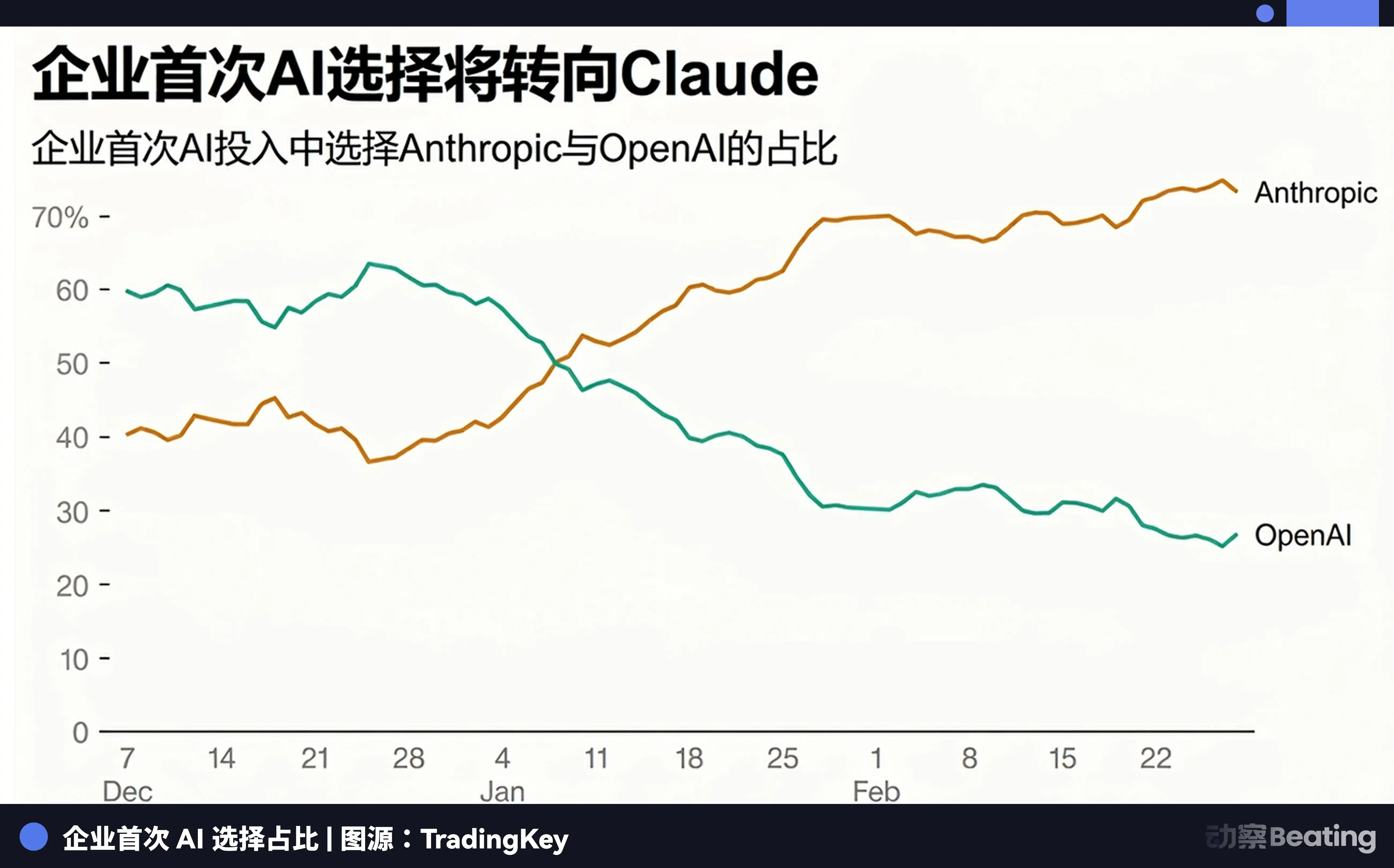
This reversal can be understood this way. OpenAI is building a consumer-facing Disney, relying on foot traffic to sell tickets. Anthropic is building a toll road leading to enterprise core systems, charging higher tolls than ticket prices, and once vehicles are on the road, they are unlikely to change lanes easily.
Just a few days after Anthropic announced its lead, an internal memo written by OpenAI's Chief Revenue Officer Denise Dresser was leaked, accusing Anthropic of using the "gross method" to inflate its revenue by about $8 billion.
When customers purchase services through platforms like AWS and Google Cloud, Anthropic accounts for the total amount paid by customers as revenue, including the portion that needs to be shared with cloud service providers. If this portion is excluded, Anthropic's true revenue is about $22 billion, not exceeding OpenAI's $25 billion.
The wording of this document resembles two former colleagues revealing each other's shortcomings.
Understanding this memo requires some context. Anthropic’s private market valuation is about $600 billion, which is a considerable premium over its last round of financing, while the secondary market valuation for OpenAI is about $765 billion, which is a discount of about 10% compared to the last round of financing. The old employer is starting to feel pressure in the capital market, and sending out this document serves to attack the opponent and stabilize its own position.
Then, there is that discordant number amidst the celebration. Anthropic expects to turn a profit by 2027. With an annualized revenue of $30 billion and a valuation of $380 billion, every round of financing sets a record, but profit is still in the future. The higher the valuation, the greater the investor expectations, the faster the burn rate, and the more urgent the next round of financing becomes. Anthropic cannot proactively break this cycle; it can only maintain itself by running fast enough. This is its invisible wall.
Meanwhile, DeepSeek Has Kept the Entire Investment Community Waiting for Three Years
Now let’s discuss Liang Wenfeng.
After R1 exploded in popularity, the entire Chinese investment circle was in chaos. Zhu Xiaohu, who just said he "doesn't believe in startup companies doing large models," publicly stated that the price was no longer too important; the key was participation. Tencent executives went, Alibaba executives went, various VCs came in succession.
Rumors of Alibaba investing $1 billion surfaced, followed by rumors of $700 million in the C round, one after another, all of which were refuted.
Liang Wenfeng kept the entire investment community waiting outside for three years.
His reason is one sentence: "There is no financing plan in the short term. The issue we face has never been money, but the ban on high-end chips."
Huanfang Quantitative invested 3 billion yuan in DeepSeek's first phase of research and development, relying entirely on profits from quantitative private equity. He really doesn't lack money; what he lacks is chips, and financing cannot solve the chip problem.
As for why he does not accept investment, he has another concern: external investors might interfere with company decisions.
Reading Liang Wenfeng's experience reveals a consistent thread. Born in 1985 in Zhanjiang, Guangdong, educated at Zhejiang University in Information and Electronic Engineering, he immediately entered quantitative investment after graduation, founding Huanfang Quantitative in 2015. In 2019, he personally invested nearly 200 million yuan to build the computing cluster "Firefly No. 1," equipped with 1,100 GPUs.
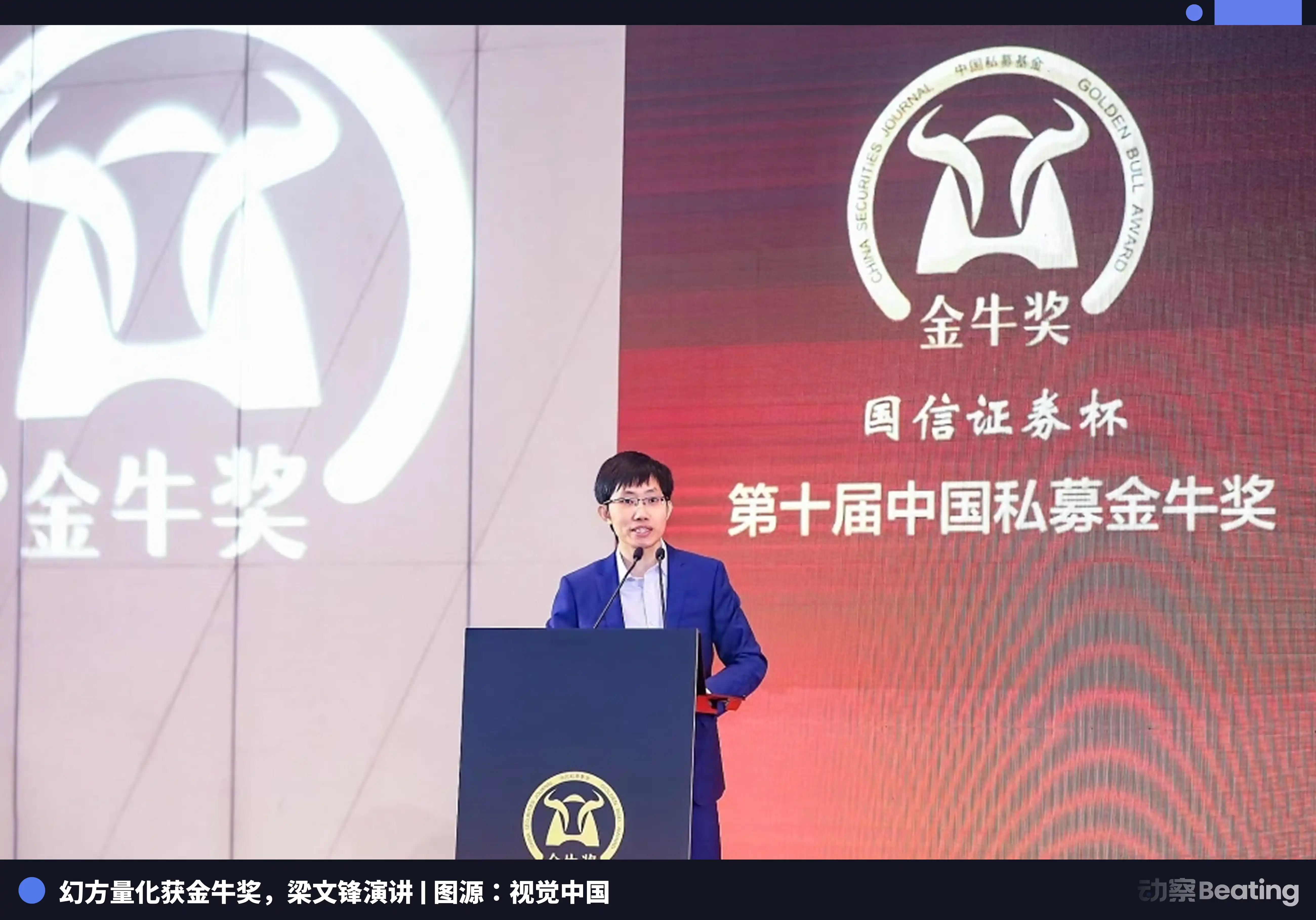
Upon the release of the A100, he was among the first in the Asia-Pacific region to acquire chips, and in 2021, he invested another 1 billion to build "Firefly No. 2," equipped with about 10,000 A100s. In 2023, he shifted computing power to develop large models, founding DeepSeek.
He approaches every task with an engineer's preconditioned judgment: prepare the tools first, then get to work. Refusing financing is one of his tools.
But now, this tool is starting to malfunction.
DeepSeek's absolute value for salaries is not low, but it cannot match the equity incentives and valuation premiums of market giants like ByteDance, Alibaba, and Tencent. Liang Wenfeng has begun to push for company valuation work, clarifying option pricing to give the team more certainty.
Without external financing, there is no market valuation and no option value. For a top engineer, working at DeepSeek means you might be changing the world, but you cannot present a piece of equity proof that can translate into wealth.
In January 2026, Zhitu rang its bell on the Hong Kong Stock Exchange, followed closely by MiniMax going public, while options for peers are being realized, and DeepSeek's talent pressure is becoming increasingly real.
Another issue is being forced out: DeepSeek and Huanfang executives are still discussing whether the company should transition from “mainly focusing on research” to “establishing a business that generates considerable revenue and eventually profits.” This discussion itself is a crack in the door.
This first external financing targets a valuation exceeding $10 billion, while the company was valued at approximately $3.4 billion in 2025. If financing is completed, the valuation will achieve severalfold leaps. $300 million against a $10 billion valuation means a dilution ratio of less than 3%. This number is extremely restrained, like a person feeling the door handle before opening it, confirming there is no danger, then gently pushing it open.
Liang Wenfeng has earned the greatest bargaining chip by staying independent for three years. He opens the door when he feels most confident.
Two Civilizations at the AI Table
Putting these two stories together reveals a dark line.
Anthropic's G round investors, Singapore’s GIC, Qatar Investment Authority, Blackstone, Goldman Sachs, NVIDIA, Microsoft.
Behind this list is a complete logic: the voice of AI should remain in the United States, and "safe and trustworthy" AI is the next infrastructure, with every penny coming in betting on this judgment.
DeepSeek's first external financing includes potential investors like Alibaba and state-owned funds from top domestic institutions; this is the first time Chinese capital has publicly priced a leading AI research institution. The bet is on another logic: technological autonomy, open-source ecology, and local computing power.
Two lists, placed on the same table, reflect two civilizations placing their respective bets.
Closed-source and open-source represent two different power structures in this game.
Anthropic remains fully closed-source, relying on a trust premium from enterprises; each active user can generate $211 in revenue. What it sells is not just model capability but a sense of reassurance endorsed by experts; you don't need to understand it, just believe in it.
Liang Wenfeng states that open-source "is more of a culture than a commercial behavior; contributing to open-source earns us respect." The former concentrates the definition of "what is good AI" in the hands of a few, while the latter hands it over to global developers for discussion.
These are two political claims about the future of AI.
However, both companies are actually facing the same question: when you reach a sufficient size, what do you have to prove your worth?
Anthropic's answer is revenue growth and enterprise clients, but profits will have to wait until 2027, while its old employer is still nearby picking at it. The answer for DeepSeek is yet to take shape.
Conclusion
This competition has no referee yet.
Anthropic’s valuation is surging towards a trillion, but profitability is expected around 2027. How long are the world's smartest sovereign funds and top investment banks willing to wait? The history of AI is short enough that no one has witnessed how such a large company soft-lands, nor has anyone seen how it falls hard—everyone is groping in the dark, but the postures vary.
DeepSeek’s issue is the cost of choice. After financing, with external shareholders involved, how long can Liang Wenfeng maintain the independence he has always safeguarded? Once the door is opened, no founder has fully controlled what will come in after the door is opened.
Dario Amodei positions himself as "an explorer searching for a third path between the rapid ascent to heaven and a fall into hell." Those close to Liang Wenfeng say that AGI is his ultimate goal, and money and commercialization are not priorities.
Both believe they are doing something more important than financing.
The capital market does not believe in faith; it believes in profit statements.
Three years, or five years later, when we come back to review this bill: did the company that once surged toward a trillion prove it was worth that valuation? Did the company that exchanged three years of independence for respect and then decided to take the first step maintain its original intentions?
Both paths have not yet been completed.
免责声明:本文章仅代表作者个人观点,不代表本平台的立场和观点。本文章仅供信息分享,不构成对任何人的任何投资建议。用户与作者之间的任何争议,与本平台无关。如网页中刊载的文章或图片涉及侵权,请提供相关的权利证明和身份证明发送邮件到support@aicoin.com,本平台相关工作人员将会进行核查。


