Written by: Oluwapelumi Adejumo
Translated by: Luffy, Foresight News
Leading prediction markets platforms Kalshi and Polymarket are eager to launch high-leverage crypto derivatives; meanwhile, federal and state regulators in the U.S. are fiercely battling in court over whether these products are illegal gambling or legitimate financial instruments.
In the past year, these prediction market platforms have become known for allowing users to bet on various real-world events. Now, they are ready to launch perpetual contracts (a type of complex contract without an expiration date that allows traders to amplify exposure using borrowed funds), thus blurring the lines between niche prediction platforms and fully functional crypto asset exchanges.
This transformation significantly expands their potential user base, but also amplifies the legal risks for the platforms.
Perpetual Contracts Drive Prediction Platforms to Around-the-Clock Trading
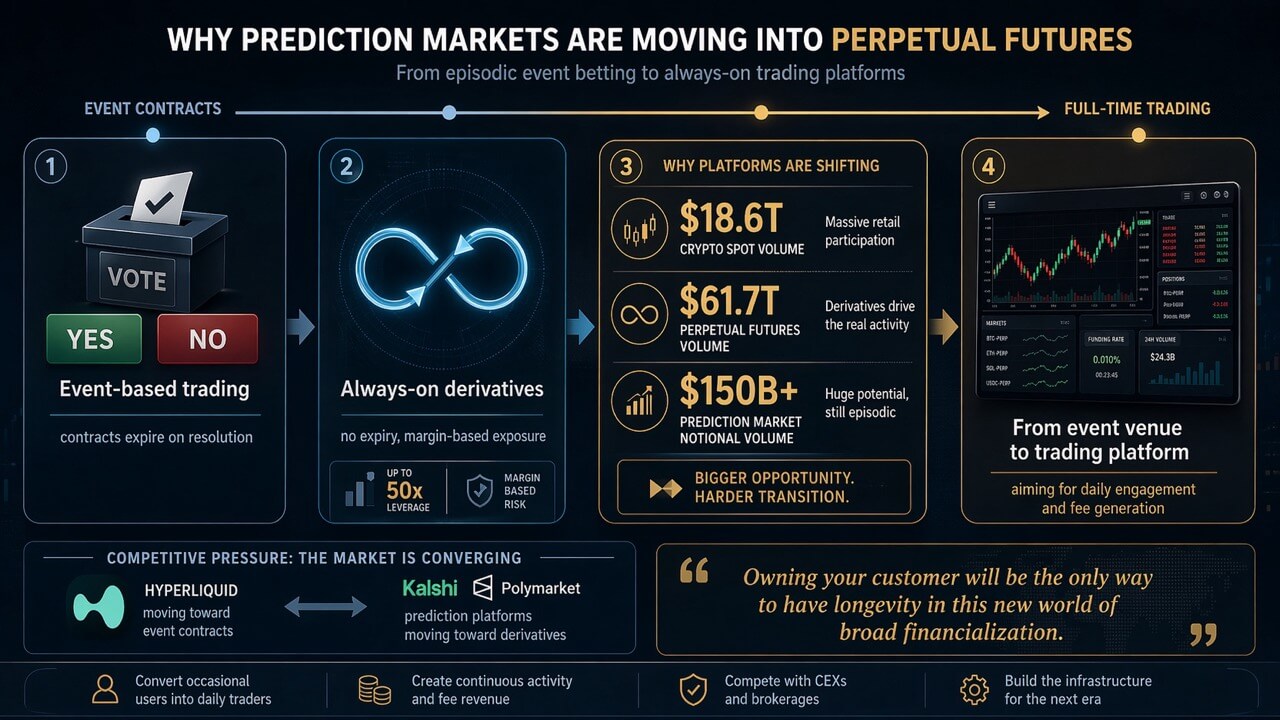
In the past, platforms like Kalshi operated on an event-driven model: traffic and trading volume surged during pivotal moments like presidential debates and sports finals, then quickly declined once the event results were determined.
In these markets, users buy binary "yes/no" shares, and the contracts settle after the events conclude. Perpetual contracts fundamentally change this business model. With no expiration date, traders can hold positions indefinitely as long as they meet ongoing margin requirements.
These tools typically allow users to bet with up to 50x leverage, attracting aggressive speculators seeking quick returns from small price fluctuations. By launching such derivatives, Polymarket and Kalshi are abandoning their singular event contract business and directly competing with centralized exchanges. The core strategy of both platforms is to convert users who occasionally participate in political betting into high-frequency traders on a daily basis.
Kalshi has clearly announced its move into the perpetual contract space, while Polymarket's specific roadmap remains undisclosed, including which assets will be launched and whether access for U.S. users will be restricted.
Why Are Prediction Platforms Turning to Perpetual Contracts?
The core reason for shifting to this new feature lies in the fundamental market structure.
Traditional spot trading has declined from the previous cycle's frenzied peaks, with last year's trading volume at $18.6 trillion, while the trading volume for perpetual contracts was over three times that. According to CryptoQuant data, the global trading volume of crypto perpetual contracts reached $61.7 trillion last year.
The vast disparity in trading volumes shapes corporate strategy. Platforms realize that to maintain user engagement during low volatility periods, they must offer tools that allow users to short, hedge portfolios, and use leverage.
Despite the prediction markets currently attracting considerable funds, with nominal total trading volume surpassing $150 billion, the intermittent nature of event contracts does not compare with the continuous fee income of high-activity derivatives markets.
Additionally, the boundaries of the broader fintech industry are rapidly dissolving: centralized platforms like Robinhood, Coinbase, and Gemini are all introducing event contract products.
Mo Shaikh, co-founder of Aptos blockchain, pointed out that financial applications tend to integrate, citing the expansion of traditional platforms like PayPal as examples. However, he warned that forcing different user groups into a single application rarely succeeds smoothly.
"Traders, gamblers, long-term investors, payment users; their needs are completely different," Shaikh stated, noting that real value lies in managing the underlying infrastructure: "Clearing, liquidity, identity, settlement, data; even if the front end remains decentralized, these layers can still be unified."
Meanwhile, the transformation of prediction platforms also has a defensive nature.
Decentralized exchange Hyperliquid is a leading player in the perpetual contracts space and recently announced plans to launch its own event contracts, entering the prediction markets arena.
As a result, there is a division in the market regarding who has the strategic advantage in this territorial battle.
Jiani Chen, head of growth at the Solana Foundation, believes from a technical differentiation perspective that it is easier for decentralized derivatives exchanges to add prediction market functions than for prediction platforms to build complex futures trading engines. However, Kyle Samani, chairman of Forward Industries, downplays the technical barriers, suggesting that customer acquisition is the real bottleneck for digital asset platforms. He stated, "Launching liquidity for prediction markets and acquiring ordinary users is much more challenging. Kalshi's perpetual contracts will be a massive hit."
Legal Controversy: Is It Gambling?
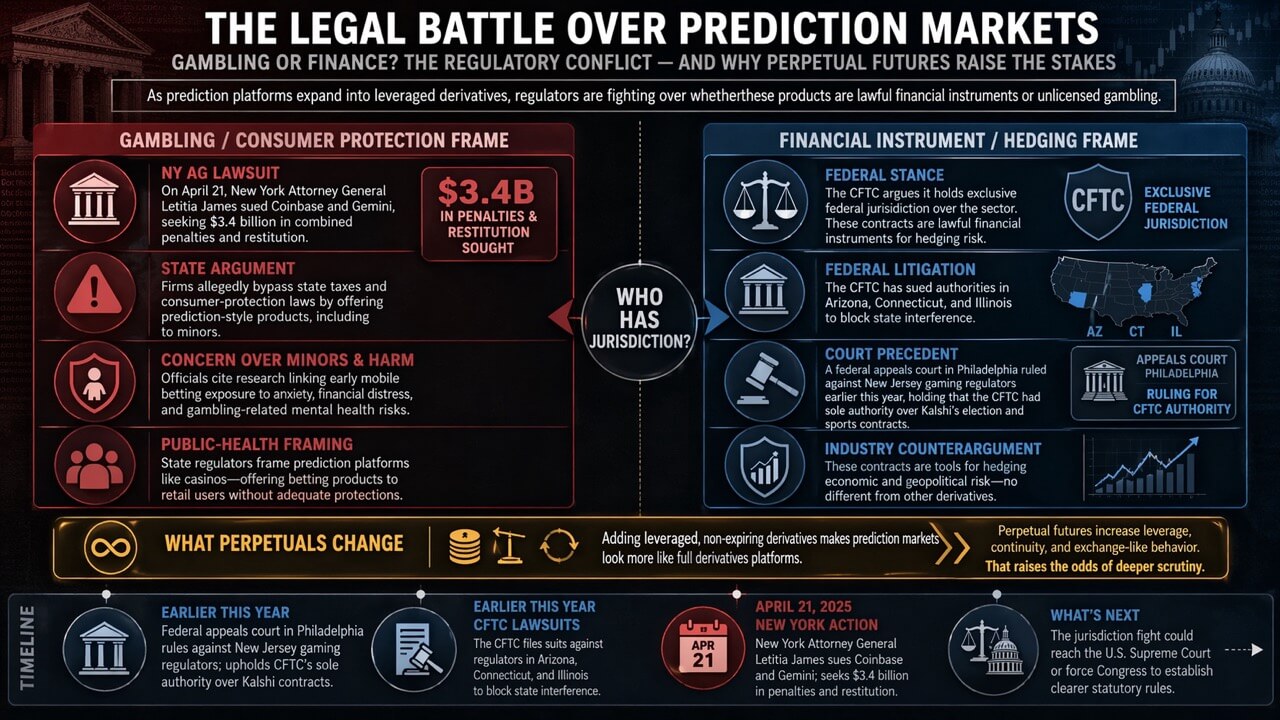
Aggressive product expansion coincides with a survival-threatening legal threat, as state regulators are working together to classify prediction platforms as unlicensed casinos, refusing to acknowledge that event contracts are complex financial instruments.
On April 21, New York Attorney General Letitia James launched a massive lawsuit against Coinbase and Gemini, seeking a total of $3.4 billion in fines and damages. James accused these companies of offering prediction markets to retail investors (including minors) while bypassing state taxes and consumer protection laws.
State officials cited research from the National Institutes of Health suggesting that early exposure to mobile betting is associated with increased risks of anxiety and financial difficulties; they also referenced data from the American Psychological Association indicating that gambling addiction is accompanied by severe mental health risks.
James stated, "Gambling by any other name is still gambling, and it is not exempt from state laws and constitutional regulations."
The industry firmly opposes the "gambling" label, arguing that these contracts are essential tools for hedging geopolitical and economic risks.
The U.S. Commodity Futures Trading Commission (CFTC) supports this position, advocating for exclusive federal regulatory authority over the industry. To prevent state intervention, federal agencies have recently filed lawsuits against regulators in Arizona, Connecticut, and Illinois.
The judicial system has begun to untangle the jurisdictional conflicts. A federal appellate court in Philadelphia ruled earlier this year that New Jersey's gaming regulators lost a case, determining that the CFTC has exclusive regulatory authority over Kalshi's election and sports-related contracts.
A series of lawsuits reflect that companies launching new derivatives must navigate a highly fragmented regulatory environment.
Larger Market, Larger Regulatory Target
Moving into perpetual contracts will further establish prediction markets as part of mainstream financial infrastructure rather than a niche in online speculation. This shift has attracted the attention of traditional finance: Intercontinental Exchange (ICE), the parent company of the New York Stock Exchange, recently invested $2 billion in Polymarket, signaling that large institutions see the commercial value of event pricing platforms.
Supporters of this model argue that prediction markets serve both as forecasting tools and trading venues. In highly liquid markets, the Blair score, a key metric for measuring probability accuracy, can settle as low as 0.0247 before settlement, meaning that with increased capital and participation, pricing errors will narrow significantly. Industry estimates also indicate that about 10% of proprietary trading firms are active in the event contract market, some for hedging macro and policy risks.
The combination of data value and trading activity explains why platforms are eager to expand their product matrix.
Rob Hadick, managing partner at Dragonfly, candidly elucidates the commercial logic: "In this fully financialized new world, having users is the only way to survive long term."
However, not everyone believes that perpetual contracts are the obvious next step.
Alex Momot, CEO and co-founder of Peanut Trade, told CryptoSlate that the current trend seems more like a response to tightening regulatory pressures rather than a sustainable product strategy. He pointed out that regulators in some jurisdictions are cracking down on prediction markets, so these operators seem to be gravitating towards a model with clearer rules and lower defined gambling risks, akin to crypto exchanges.
Momot believes the buffering effect of this strategy is limited. In his view, the deeper issue is liquidity. Without sufficient depth, even the most promising use cases, including hedging real event risks, struggle to scale.
He stated that a more robust long-term path could be index products, market aggregation, and cross-event liquidity pools, bringing prediction markets closer to traditional derivatives or synthetic exposure.
This perspective reflects the industry's current core conflict: one side views perpetual contracts as the fastest way to boost trading volume and retain users between major events; the other believes this is merely a tactical detour, with the real challenge being to build deeper and more resilient liquidity.
Regardless, legal risks are on the rise. Dyma Budorin, founder and CEO of CORE3, stated that the integration of prediction and derivatives markets is likely to invite stricter scrutiny from regulators.
"What we are really seeing is that markets are moving towards perpetual contract behavior, but without the accompanying risk controls. If this trend continues, regulators will no longer view prediction markets as harmless forecasting tools; they will see them as derivative platforms operating in violation of regulations."
The lawsuit in New York is set to make jurisdictional disputes a core issue for the industry's future. This game may ultimately be appealed to the U.S. Supreme Court or force Congress to establish a clearer legal framework.
Until then, prediction platform operators seem willing to continue expanding amid uncertainty, betting that the commercial gains from perpetual futures are worth the legal risks.
免责声明:本文章仅代表作者个人观点,不代表本平台的立场和观点。本文章仅供信息分享,不构成对任何人的任何投资建议。用户与作者之间的任何争议,与本平台无关。如网页中刊载的文章或图片涉及侵权,请提供相关的权利证明和身份证明发送邮件到support@aicoin.com,本平台相关工作人员将会进行核查。


