Over the past month, Bitcoin's movement seems to be sending a signal: when Strategy enters the market, BTC can find support; conversely, once Strategy temporarily exits, the market quickly weakens.
Last week, the company spent $2.54 billion to buy 34,164 BTC, bringing its total holdings to 815,061 BTC. Strategy's TWAP strategy injected genuine spot demand into the market, while the market remains in wait-and-see mode: at the critical resistance level close to $80,000, whether the current trend can stabilize independently is in question.
Looking back to March, after the ex-dividend week, Strategy clearly slowed its pace of BTC purchases, which in turn dragged down BTC's price. The only reason BTC was able to stabilize its price was entirely because of Strategy propping it up. The future trend will entirely depend on whether this buying interest persists after the end of the ex-dividend window.
The trend in March has already exposed some risks. Strategy frantically bought during the window period but then retreated, and BTC's price plummeted almost immediately. Entering the ex-dividend post-cycle in April, the situation is similar. Now the real question is whether once the ex-dividend window closes, Strategy will continue to buy.
If April can avoid repeating March's "post-ex-dividend weakness," the bullish logic will be much stronger. If not, it will merely be last month's old routine.
Core Summary (TL;DR)
- Marginal Buyers: Strategy is the largest marginal buyer in the market. The recent rebound during U.S. trading hours proves that Bitcoin's gains over the past month are largely driven by it.
- March's Script: Strategy made significant BTC purchases before the ex-dividend window of $STRC, but BTC prices plummeted in the following two weeks.
- April's Difference: As of April 22, BTC has yet to experience the post-ex-dividend weakness, remaining strong around $77,500.
- Key Signal: The upcoming 8-K document (due April 27) is critical as it will determine whether Strategy continues to buy after the ex-dividend window closes.
- Long-term Risk: Strategy's high dividend yield of 11.5% poses significant costs. If capital markets tighten, they may be forced to sell BTC or dilute shares to fund themselves.
Bitcoin's Largest Marginal Buyer: Strategy
Over the past month, nearly all BTC gains were realized during U.S. trading hours. This is partly due to the spot ETF, but more so from Strategy's buying pressure. The best perspective to understand this wave of market action should not be the vague "risk-on" rebound, but rather viewed as a concentrated bullish sentiment supported by ETF fund flows. Daily data from Farside shows a net inflow of around $1 billion, highlighting real market demand.
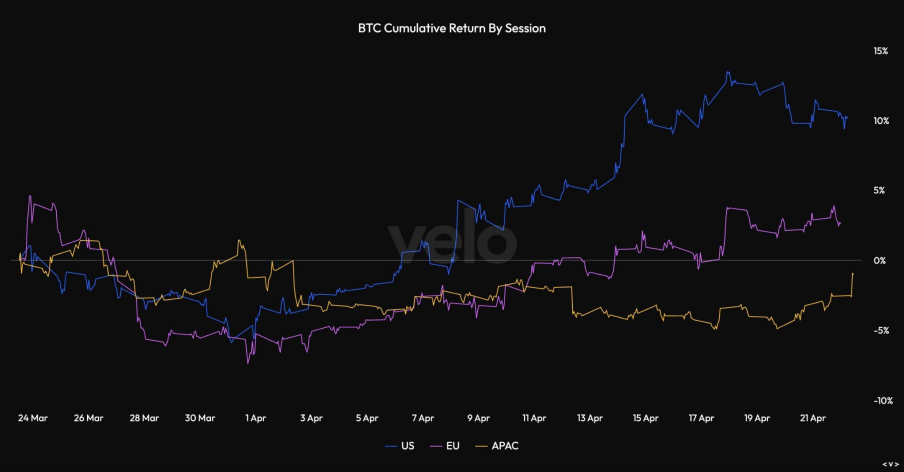
However, this alone is not enough to fully explain the market's movement. In the week ending April 19, Strategy's $2.54 billion in buying exceeded the net inflow of the ETF. This confirms a more reasonable interpretation: it's not that the "ETF was absent," but that both the ETF and Strategy were buying, and Strategy's buying scale was substantial enough to become one of the most critical marginal buyers in the market, perfectly aligning with the trading hours chart. Since nearly all gains occurred during U.S. trading hours, and one of the largest buyers put in $2.54 billion, it is evident that Strategy's absolute influence on BTC prices is significant.
The Real Test of Rebound After the Ex-Dividend Date
In March, Strategy made aggressive BTC purchases during $STRC's ex-dividend window, but BTC prices sharply fell in the following two weeks. In the week ending March 22, demand for $STRC plummeted from $1.18 billion to only $76.5 million. The ATM (At-The-Market) issuance activity for MSTR common stock also dropped to zero. By the week ending March 29, total ATM revenue went to zero. This was also the first time in 13 weeks that Strategy completely avoided purchasing any BTC.
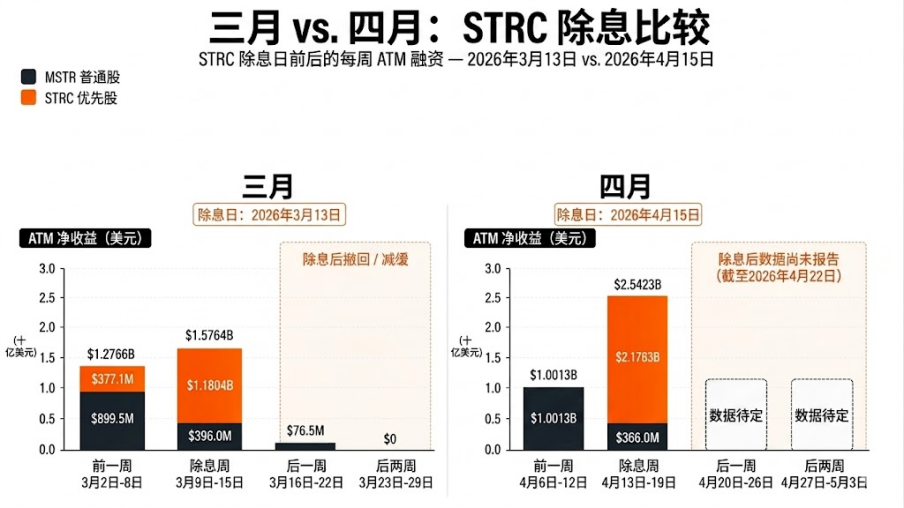
Strategy's two weeks of silence, accompanied by the concurrent drop in BTC prices, is the clearest case demonstrating Strategy's decisive impact on BTC price movements. BTC steadily declined to just over $70,000, touching approximately $70,400 on March 20 and around $70,600 on March 23. The market reflects reality: when STRC ceases issuance and MSTR common stock does not fill that gap, buying pressure will significantly weaken.
Therefore, the core question now is whether April will repeat March's "hangover" or break this curse.
The next 8-K document (due April 27) will cover the situation through April 26. If the issuance of STRC falls to only the range of error again and the ATM for MSTR common stock continues to stagnate near zero, then April will merely be an enlarged version of March rather than a genuine paradigm shift. However, if STRC remains active and the MSTR common stock ATM reaches a substantial scale (over $150 million), then the script would indeed change.
April is Critical Because BTC Remains Strong
April 15, 2026, is the ex-dividend date for $STRC, and its annualized dividend yield remains at 11.50%. In the week ending April 19, Strategy raised $2.5 billion and bought 34,164 BTC, releasing extremely large demand. However, the real highlight is BTC's performance thereafter: unlike in March, BTC did not immediately experience a price drop.
We can say that Strategy has changed the market dynamics. But the upcoming document is much more important than the last one. If the usual "post-ex-dividend weakness" appears again, then April may just be a replay of March's market. If it does not occur, the market must seriously consider one point: Strategy is not just buying during the window period but is supporting BTC over a longer time frame.
Will Buying Continue?
This is the part that traders genuinely care about.
Simply noting that Strategy bought a lot of BTC last week will not lead to profits. What truly matters is whether this buying will continue once the pure ex-dividend logic has run its course.
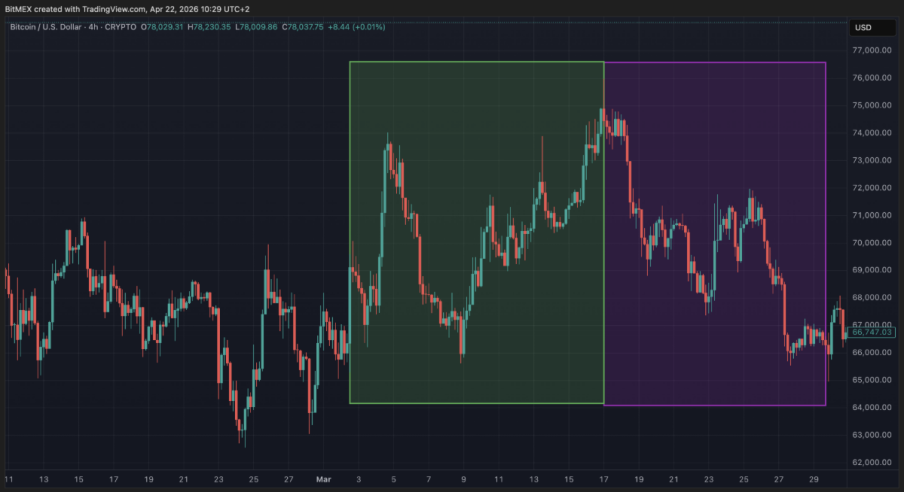
The experience from March teaches us that merely having a strong ex-dividend week is not enough. Strategy purchased 22,337 BTC during the report period ending March 15, but basically went silent in the following two weeks, and BTC's price weakened accordingly.
April's performance indicates that there is still a possibility for change because Strategy bought more—34,164 BTC—and BTC's market has not repeated the declines of March.
The logic here is very straightforward. If the next 8-K document shows significant buying after the ex-dividend date, the market must assume that this buying interest remains active. If it shows that issuance drops sharply again, it suggests that March's performance is their fixed operation mode rather than a coincidence.
Why We Are Bullish Now—But Concerns Remain for the Future
As of April 2026, STRC's annualized dividend yield is as high as 11.50%. As long as the market is willing to pay for this structure, and BTC prices cooperate with a rise, this is not a problem. However, if BTC stagnates and capital markets become less generous, matters could become quite difficult.
While this is a medium-term issue and not the current trading logic, risks do exist objectively. This flywheel can only operate flawlessly when BTC is rising and investors have a strong appetite.
Therefore, the pure understanding framework is: As long as Strategy is still buying, it is bullish for BTC, but this does not mean that its capital structure is without risk. For now, the market only needs to focus on the first half of this sentence.
Final Conclusion
Recently, BTC's movement looks like a market supported by an unusually super marginal buyer. March has already shown us what will happen when this buyer disappears. When Strategy's $STRC ceased capital raising in the first two weeks post-ex-dividend, April's price movements could likely repeat that pattern.
Thus, the correct way to interpret the current market is not to be bogged down by the latest headlines of buying numbers, but to ask a simpler question: Once the obvious window period ends, will Strategy still be bidding to buy BTC?
If the answer is affirmative, BTC is likely to continue finding support. If the answer is negative, then BTC will soon experience the "loss of the largest visible marginal buying support." If it can still continue to rise at that point, it would be an unambiguous ultimate bullish signal.
免责声明:本文章仅代表作者个人观点,不代表本平台的立场和观点。本文章仅供信息分享,不构成对任何人的任何投资建议。用户与作者之间的任何争议,与本平台无关。如网页中刊载的文章或图片涉及侵权,请提供相关的权利证明和身份证明发送邮件到support@aicoin.com,本平台相关工作人员将会进行核查。


