Charts
DataOn-chain
VIP
Market Cap
API
Rankings
CoinOSNew
CoinClaw🦞
Language
  • 简体中文
  • 繁体中文
  • English
Leader in global market data applications, committed to providing valuable information more efficiently.

Features

  • Real-time Data
  • Special Features
  • AI Grid

Services

  • News
  • Open Data(API)
  • Institutional Services

Downloads

  • Desktop
  • Android
  • iOS

Contact Us

  • Chat Room
  • Business Email
  • Official Email
  • Official Verification

Join Community

  • Telegram
  • Twitter
  • Discord

© Copyright 2013-2026. All rights reserved.

简体繁體English
|Legacy

VanEck Mid-April 2026 Bitcoin ChainCheck

CN
VanEck
Follow
1 hour ago
AI summarizes in 5 seconds.

撰文:Patrick Bush

原文:《VanEck Mid-April 2026 Bitcoin ChainCheck》

Please note that VanEck has exposure to bitcoin.

Key Takeaways

  • Volatility cools as ceasefire calms markets: BTC realized volatility dropped from 56% to 41% as US-Iran tensions eased, while the 7-day average funding rate turned negative to -1.8%, its lowest reading since 2023.
  • Negative funding rates have historically signaled strong forward returns: Since 2020, 30-day BTC returns during negative funding periods averaged +11.5% versus +4.5% overall, with a 77% hit rate. Sub -5% funding has produced +19.4% returns on 30-day horizons.
  • Hash rate drawdowns add a second bullish signal: Hash rate has declined to the 16th percentile over 30 days, marking the densest concentration of episodes since China’s 2021 mining ban. In 6 of 7 past drawdowns, BTC was higher 90 days later with a median gain of +37.7%.

Weekly Bitcoin ETP Flows (USD)

Weekly Bitcoin ETP Flows (USD)

Weekly Bitcoin ETP Flows (USD)

Source: Glassnode as of 4/15/2026. Past performance is not a guarantee of future results. Not intended as a recommendation to buy or sell any securities named herein.

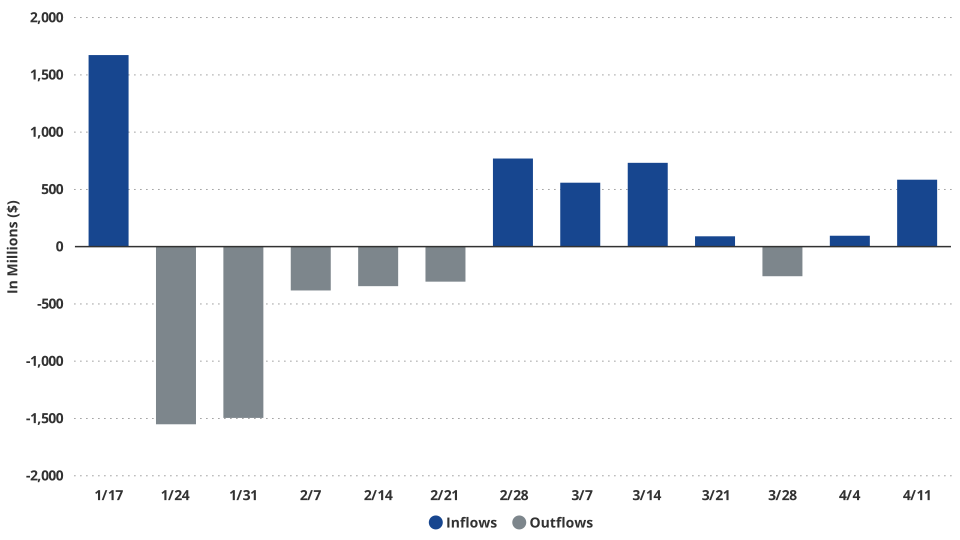
Following 5 consecutive weeks of outflows from 1/24 through 2/21 totaling roughly -$4B , spot bitcoin ETP flows reversed in late February and have been net positive in 6 of the last 7 weeks through 4/11.

Funding Rates Turn Negative: A Contrarian Buy Signal

Bitcoin price action was energetic over the past 30 days, with several 20% drawdowns and rallies amid the US-Iran conflict. As a ceasefire materialized, BTC realized volatility tumbled from a period high of ~56% to settle around ~41% . Low sentiment on bitcoin pressured the 30-day moving average (MA) annualized funding rate (FR) to 2.1% , down from 2.7% 30 days earlier. The funding rate now stands at the 10 th percentile since November 2020. On a shorter timeframe, the 7-day MA bitcoin funding rate turned negative, hitting its lowest levels since 2023 at (-1.8%).

Examining instances since 2020 where 7-day bitcoin funding rates turned negative, there is a substantial uplift in average returns as well as a higher probability of positive returns across 30-day, 60-day, 90-day, and 180-day horizons. The mean return uplift for negative FR periods was +630 basis points (bps) , and the data show this uplift scales inversely with the depth of negative funding.

For context, the mean 30-day BTC return since 2020 is +4.5% , while the mean 30-day return for negative FR periods was +11.5% with a 77% hit rate. When bitcoin funding dropped below -5% annualized, BTC showed a +19.4% return ( +1,400 bps uplift) on 30-day periods and a +70% return ( +2,900 bps uplift) on 180-day horizons. Negative FR days produced 19 of the top 50 180-day return periods since 2020, despite occurring only 13.6% of the time. Five of the top 10 single-day BTC returns occurred after purchasing during negative funding periods, as did 10 of the top 20.

Source: VanEck Research, Glassnode as of 4/15/2026. Past performance is not a guarantee of future results. Not intended as a recommendation to buy or sell any securities named herein.

Options Positioning: Hedging at Peak Bearishness

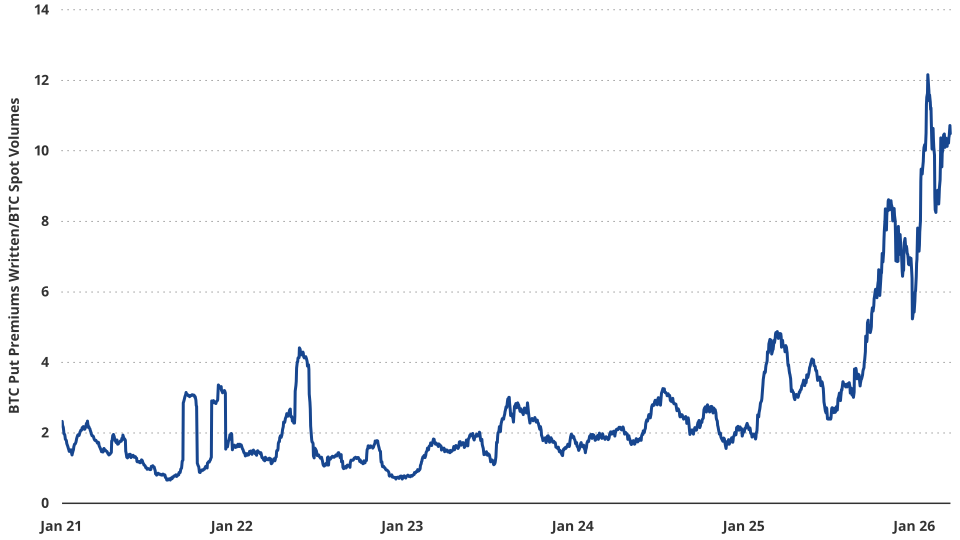
Put premiums reached all-time highs over the last 30 days, reflecting a peak in hedging and bearish positioning. On a relative basis, put premiums paid as a share of BTC spot volume surged +120% year-over-year to reach 10 bps and was up +21% versus the prior 30-day period. On an absolute basis, the 7-day MA for put premiums paid is up +19% month-over-month, but has come down -71% since its peak on 3/30. While peak absolute bearishness may have passed, investors remain meaningfully bearish on BTC in relative terms.

Put Premiums to Spot Volume More Than 6x Higher Than April 2024

Put Premiums to Spot Volume More Than 6x Higher Than April 2024

Put Premiums to Spot Volume More Than 6x Higher Than April 2024

Source: Glassnode as of 4/17/2026. Past performance is not a guarantee of future results. Not intended as a recommendation to buy or sell any securities named herein.

Onchain Activity and Long-Term Holder Behavior

Bitcoin network onchain activity was generally lower over the past 30 days. Daily transactions surged +22% month-over-month to 545k , reaching the 96 th percentile all-time. Despite that jump in volume, daily active addresses slipped -3% month-over-month (51st percentile), while new addresses were down -2% month-over-month. Transfer volume recorded $48.5B /day (81stpercentile), down -5% month-over-month as positioning flux dropped alongside volatility declines.

The share of active supply in the last 180 days dipped -160 bps to 28.4% (34th percentile), suggesting an increasing tendency toward holder dormancy. Average daily fees dropped -5% month-over-month to ~$169k (49thpercentile) and are down -66% year-over-year, while mean transaction fees fell -22% month-over-month to $0.31 (48thpercentile), well below the $1.27 level from a year ago.

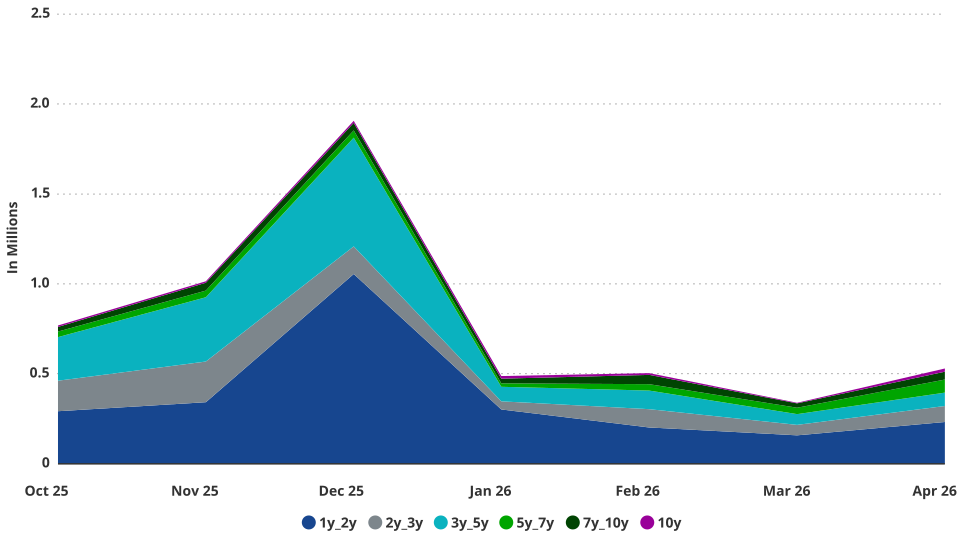
Spent Volume Ticked Up for All Long-Term Holders in April m/m

Spent Volume Ticked Up for All Long-Term Holders in April m/m

Spent Volume Ticked Up for All Long-Term Holders in April m/m

Source: Glassnode as of 4/17/2026. Past performance is not a guarantee of future results. Not intended as a recommendation to buy or sell any securities named herein.

Note: Many assume “spent volumes” are a good proxy for BTC sales. However, not all long-dormant coin movements represent selling. Some transfers are sent to quantum-resistant addresses, others are contributions to digital asset treasuries (DATs), and some reflect routine wallet maintenance.

The most recent 30-day period shows a broad rebound in spent volume across all holding cohorts. The younger end of the long-term holders (1y-2y, 2y-3y, 3y-5y) sent more bitcoin, up +47% , +52% , and +26% month-over-month respectively, but their activity was -22% , -24% , and -71% below their 12-month averages. Over the past 4 weeks, the 3y-5y group sent the second-smallest amount of bitcoin since December 2023. As spikes in transfer volumes in the 3y-5y group tend to coincide with 4-year cycle traders, it is logical to see these figures pare back as prices wind down and the cycle resets.

Longer-term supply holders increased transfer activity over the last 30 days. The 5y-7y, 7y-10y, and 10y+ segments sent 72k , 45k , and 18k BTC in the trailing 30-day period, amounting to +67% , +87% , and +285% above each group’s respective 12-month average. The longest-term holders, the 7y-10y and the 10y+, respectively reached the 85 th and 90 th percentiles of transfer activity over the past four years.

Difficulty Rate Volatility Hits Highest Level Since 2021 China Mining Ban

Difficulty Rate Volatility Hits Highest Level Since 2021 China Mining Ban

Difficulty Rate Volatility Hits Highest Level Since 2021 China Mining Ban

Source: Glassnode as of 4/20/2026. Past performance is not a guarantee of future results. Not intended as a recommendation to buy or sell any securities named herein.

Mining Dynamics: Hash Rate Drawdown Signals Bullish Setup

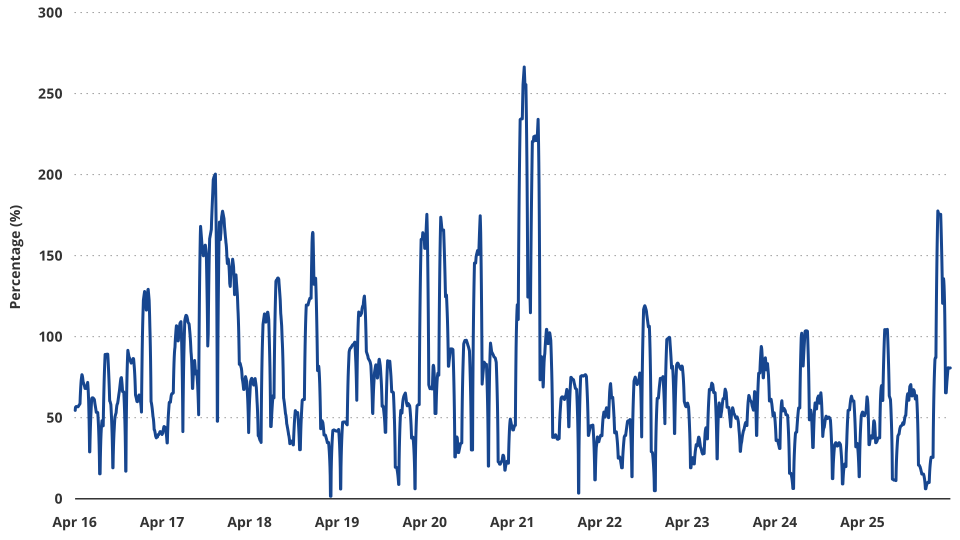
Over the past few months, hash rate and Bitcoin network mining difficulty dropped asymmetrically, with difficulty falling further than hash rate. While this may signal network churn, it is typically associated with above-average forward returns for bitcoin. The 30-day change in hash rate MA has declined to the 16 th percentile over 30 days and 9 th percentile over 90 days, while the change in difficulty MA is even weaker at the 5 th and 6 th percentiles respectively. More striking is the clustering: 3 sustained hash rate decline episodes have occurred in just the past 5 months (December 2025, January-February 2026, March-April 2026). This is the densest concentration of drops since China’s mining ban in 2021.

In absolute terms, both metrics remain well below their recent peaks. The hash rate 30-day MA currently sits at 985.5 EH/s , down -7.5% from its all-time high of 1,065.7 EH/s set in late November 2025. Difficulty has declined -10.5% below its November 2025 peaks. Difficulty falling more than hash rate generally reflects the algorithm’s lagging adjustment mechanism and miner volatility. As marginal miners exited through 3 successive episodes, difficulty stepped down in discrete two-week resets and has not yet re-equilibrated to the recovering hash rate.

Encouragingly, the most recent episodes are shorter and shallower. The January-February 2026 episode lasted 31 days with a peak change in hash rate of -10.9% , while the March-April 2026 episode lasted just 16 days with a peak decline of -6.7% , ending on April 15, 2026. Across the 7 completed sustained decline episodes on record (excluding the 3 most recent, which lack sufficient forward data), the difficulty adjustment mechanism has acted as a stabilizer, giving surviving miners margin relief that encourages long-term hash rate growth.

In 6 of those 7 hash rate drawdown episodes, BTC price was higher 90 days after the episode ended, with a median gain of +37.7% ( +2,000 bps uplift). Over 180 days, the median return was +63.1% ( +2,190 bps uplift), ranging from -3.5% in June 2022 (the only loss in the dataset) to +199.3% in October 2020.

Stepping back, we have identified two strong bullish indicators based on historical data. Both mining rate drawdowns and negative funding rates have been associated with strong forward BTC returns. As such, we have become increasingly bullish on bitcoin.

Frequently Asked Questions

What is the Bitcoin funding rate, and why does it matter?

The Bitcoin funding rate is the periodic payment exchanged between long and short traders in perpetual futures contracts, reflecting whether bullish or bearish positioning dominates. Negative funding rates indicate short traders are paying longs, historically a contrarian signal. Since 2020, 30-day BTC returns during negative funding periods have averaged +11.5% versus +4.5% overall.

What does a drop in Bitcoin hash rate mean for the network and price?

A drop in hash rate typically indicates that marginal miners are turning off rigs as profitability compresses. While it may signal short-term network stress, historical data show that sustained hash rate drawdowns have been associated with above-average forward BTC returns. In 6 of 7 completed drawdown episodes since 2017, BTC was higher 90 days later, with a median gain of +37.7%.

Why do long-term Bitcoin holders’ spending patterns matter?

Spent volume by long-term holder cohorts can signal cyclical selling pressure or accumulation. Younger long-term holders (1y-5y) often correlate with 4-year cycle activity, while the longest-term cohorts (7y-10y, 10y+) rarely transact. When older cohorts increase spending, it can indicate profit-taking from some of the most seasoned bitcoin investors, though not all long-dormant movements represent selling.

To receive more Digital Assets insights, sign up in our subscription center .

免责声明:本文章仅代表作者个人观点,不代表本平台的立场和观点。本文章仅供信息分享,不构成对任何人的任何投资建议。用户与作者之间的任何争议,与本平台无关。如网页中刊载的文章或图片涉及侵权,请提供相关的权利证明和身份证明发送邮件到support@aicoin.com,本平台相关工作人员将会进行核查。

|
|
APP
Windows
Mac
Share To

X

Telegram

Facebook

Reddit

CopyLink

|
|
APP
Windows
Mac
Share To

X

Telegram

Facebook

Reddit

CopyLink

Selected Articles by VanEck

1 month ago
Bitcoin vs. Ethereum in 2026: Comparison & Outlook
1 month ago
Avalanche 201: The Institutional Platform
1 month ago
Investing in Digital Assets Without Full Crypto Exposure
View More

Table of Contents

|
|
APP
Windows
Mac
Share To

X

Telegram

Facebook

Reddit

CopyLink

Related Articles

avatar
avatarDecrypt
32 minutes ago
DeepSeek V4 Is Here—Its Pro Version Costs 98% Less Than GPT 5.5 Pro
avatar
avatarDecrypt
41 minutes ago
Amazon Web Services Marketplace Adds Chainlink Crypto Oracle Services
avatar
avatarDecrypt
1 hour ago
US Soldier Was Blocked on Kalshi Before Taking Maduro Bets to Polymarket
avatar
avatarcoindesk
1 hour ago
Trump\\\'s DOJ drops probe that stood in way of president\\\'s pick to run Federal Reserve
APP
Windows
Mac

X

Telegram

Facebook

Reddit

CopyLink