At the Hong Kong Web3 Carnival, Vitalik Buterin inevitably brought up the age-old question: what exactly should Ethereum become?
In fact, over the past few years, the crypto industry has long been accustomed to discussing public chain competition through performance metrics, such as whose TPS is higher, whose confirmation speed is faster, whose gas is lower, and hence is more easily understood as the "next generation infrastructure," and so on....
But by 2026, whether it's Ethereum or new public chains, what everyone is facing is no longer just internal topics like DeFi, NFT, L2 scaling, and on-chain finance—AI coding is rapidly siphoning everything away, and advancements in formal verification and zero-knowledge proofs are also quite evident.
All of this indicates that the world faced by public chains is undergoing new changes, so do we still need a public infrastructure that everyone can verify, can exit from, can self-host, and is not controlled by a single point?
And how has Ethereum thought about and prepared for this?
1. What exactly is Ethereum meant for: Bulletin Board and Computing
"Ethereum is not meant to compete with high-frequency trading platforms, Ethereum is not meant to be the fastest chain, Ethereum is designed to be a secure chain, a decentralized chain, a chain that will always be online, a chain you can always rely on." In this speech, Vitalik reinterpreted the value of Ethereum with two very basic concepts: first, Ethereum is like a "public bulletin board"; second, Ethereum provides "computing" capability.
These two simple concepts not only reflect the new positioning direction of Ethereum we have been elaborating on recently, but also nearly summarize the fundamental reason why Ethereum is distinct from ordinary internet services.
The so-called public bulletin board is not an abstract metaphor; it means that applications can publish messages on Ethereum, and everyone can see the content and order of the messages published—these messages can be transactions, hash values, encrypted data, or any other information that needs to be publicly committed, ordered, and verified (see further reading "From 'Global Computer / Settlement Layer' to 'Bulletin Board': What Ethereum and Vitalik Want to Achieve?").
This is also the fundamental difference between Ethereum and ordinary servers. Servers can be faster, cheaper, and more efficient, but they usually require users to trust that the operators will not tamper with records, will not refuse service, and will not shut down the system at critical moments; what Ethereum aims to provide is this ability.
Computing refers to Ethereum allowing people to create shared digital objects controlled by code, which can be ERC-20 tokens, NFTs, ENS names, or DAOs, on-chain organizations, financial protocols, or other more complex applications.
So, by 2026, if we only use "performance" to understand Ethereum, or simply compare it to new public chains using TPS, gas costs, and confirmation speed, it’s easy to miss the real problems Ethereum is going to tackle next.
The focus of public chain scaling in the coming years is no longer merely "making the chain faster," but rather how to continue retaining verifiability, decentralization, and user self-sovereignty in more complex application scenarios. In other words, scaling is not to transform Ethereum into another centralized high-performance system but to allow more applications to run without sacrificing underlying trust assumptions.
This is also the key reason Vitalik has recently re-evaluated L2.
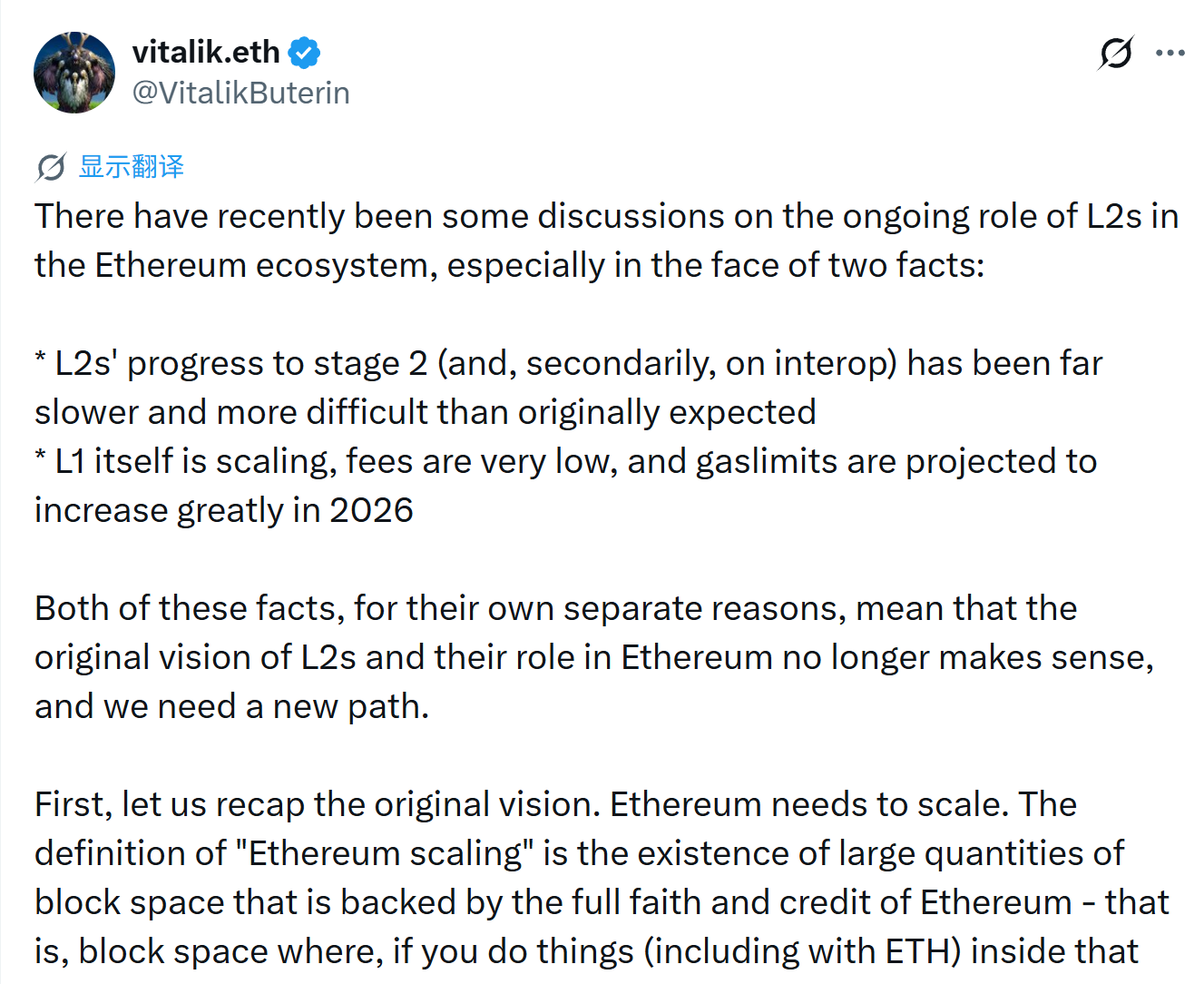
To put it simply, he feels that the market has traditionally viewed L2 as a scaling tool for Ethereum, like when the mainnet becomes expensive and congested, more transactions are migrated to L2. But now the phased historical mission of L2 has been accomplished; it should not be limited to merely "diverting transactions" but must become the frontier for Ethereum to expand into more application scenarios.
This judgment is especially crucial for today's Ethereum ecosystem.
In recent years, the market has often simplified L2 as "a cheaper Ethereum." But within Vitalik's framework, L2 is not just a straightforward alternative layer, but a functional expansion built around Ethereum's public infrastructure layer. L1 undertakes the most critical roles of commitment, settlement, data publishing, and verification, while L2 and off-chain systems provide higher frequency, more flexible, and privacy-friendly execution capabilities tailored to specific application scenarios.
This is also why Vitalik is reluctant to make "being the fastest" Ethereum's primary goal.
Speed is indeed important, but if the cost of speed is that ordinary users cannot operate nodes, cannot verify states, and cannot protect themselves when the system goes wrong, then this chain will gradually turn into a less efficient centralized service.
For Ethereum, speed is just an experience issue; security and decentralization are the reasons for its existence.
2. In the AI era, Ethereum's value will instead be magnified
One of the most noteworthy points in this speech is that Vitalik did not regard AI merely as an external hot topic but placed it within the technical context of Ethereum's future roadmap.
For instance, the Ethereum community has begun to experiment with using AI to generate code proofs, used to demonstrate that the software version running Ethereum possesses the characteristics it should have. Two years ago, this would have been quite difficult, but the rapid development of AI is making software security verification easier.
Behind this corresponds to a very real issue: as the assets, identities, organizations, and rules carried by blockchain increase, the cost of code vulnerabilities also rises. If AI can help developers discover vulnerabilities, generate proofs, and assist with formal verification, then it becomes not just an efficiency tool at the application layer but also part of protocol security engineering (see further reading "As Hackers Use AI 'More Efficiently', How Does the Arms Race of 'Spear and Shield' in Web3 Upgrade?").
However, the deeper impact of AI on Ethereum extends not only to the developer side but also to the user side, particularly in changing the way ordinary users interact with digital systems.
It is well-known that in the past few decades, human-computer interaction has undergone several changes. Initially, users interacted with computers via command lines, and only a few technically skilled individuals could truly use complex systems. Later, the proliferation of graphical interfaces and mobile apps enabled ordinary users to perform actions through buttons, pages, and menus.
Now, AI is pushing interaction towards natural language; users no longer need to understand every step; they simply need to state their goals, and the system may automatically break down the paths, invoke tools, and complete the execution.
This change will have a greater impact in Web3.
Today, when a user wants to complete a cross-chain DeFi operation, they often need to choose the network, confirm gas, authorize contracts, execute swaps, bridge assets, and deposit into protocols, with each step requiring signatures and risking errors. In the future, if AI agents become important gateways for wallets and on-chain applications, users may only need to say: "Convert part of my ETH into stablecoins and deposit it into a yield protocol following a low-risk strategy." The remaining path planning, protocol selection, transaction simulation, and execution might all be handled by intelligent agents.
This sounds like it would greatly lower the barrier to use; however, problems arise. After all, when users no longer personally click every step, how do they confirm that the AI agent does not overstep its bounds? How do they know that the chosen path is not malicious? How do they maintain the ability to revoke, verify, and self-protect without sacrificing the experience?
This is where the value of Ethereum is being re-magnified.
AI can make operations more natural, but natural language itself does not bring trust. A smarter interface, if it still operates behind an unverifiable black box system, means that users are simply shifting from "trusting the platform" to "trusting the model," while Ethereum offers a more fitting foundational infrastructure of trust in the AI era.
Furthermore, this actually makes the role of wallets more important. So, the wallets of the future may no longer just be a "signing tool" or "asset list," but will gradually become the permission management layer between users, AI agents, on-chain applications, identity systems, and payment networks, as users will need to define boundaries through wallets, such as which operations can be executed automatically, which operations require double confirmation, which assets cannot be called, and which authorizations need to be checked and cleaned up periodically.
3. CROPS: From Foundation Charter to Community Covenant
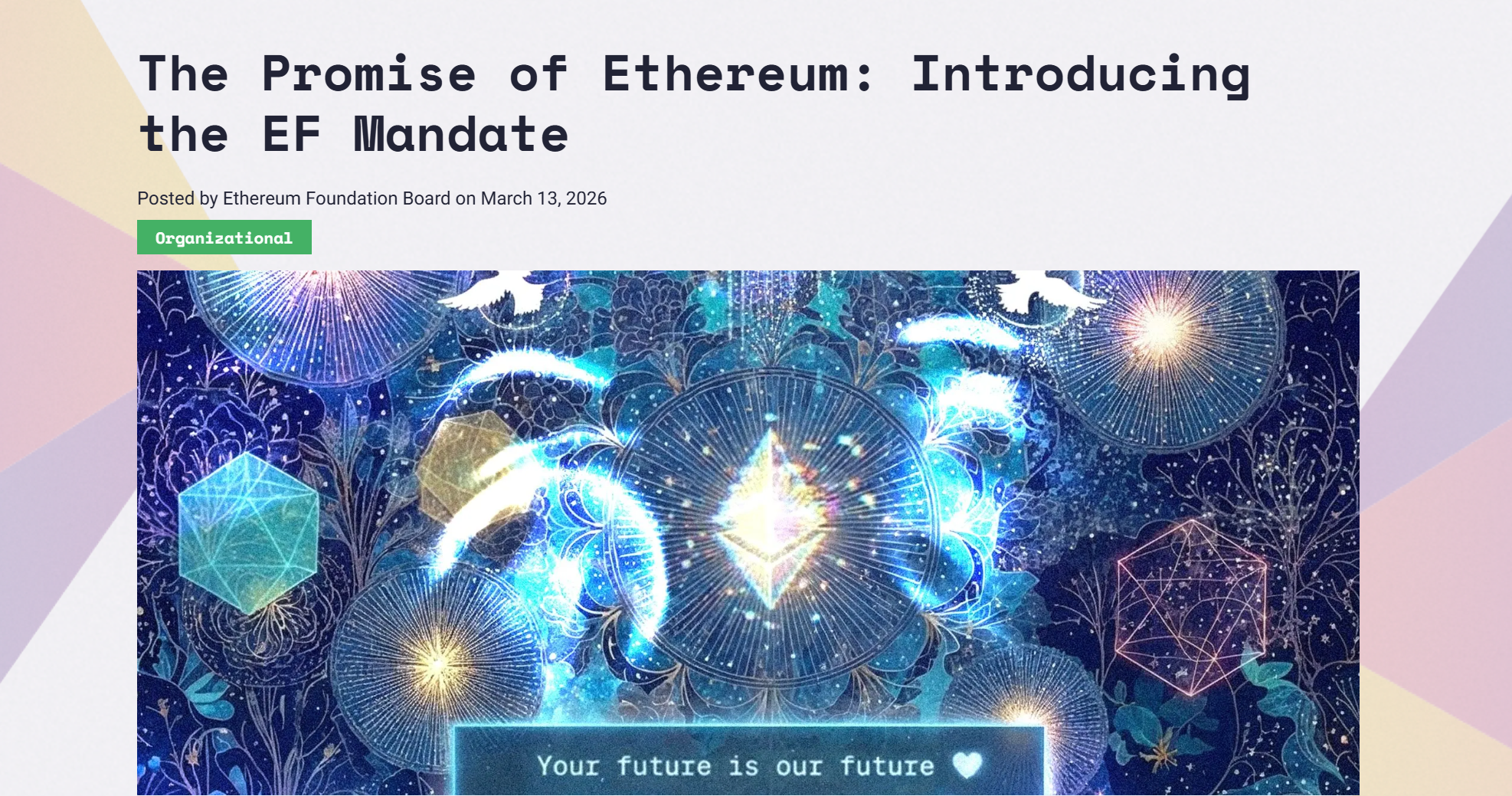
Interestingly, just before Vitalik reinterpreted Ethereum from the protocol roadmap perspective, the Ethereum Foundation also released the EF Mandate, marking a formal confirmation of this route on the value layer.
This Mandate document proposes that the ultimate reason for Ethereum's existence is to protect users' self-sovereignty—allowing users to independently control their assets, identities, actions, and choices without relying on any centralized intermediary.
Around this point, the EF Mandate introduces an acronym "CROPS," which stands for Censorship Resistance, Open Source, Privacy, and Security. In the foundation's expression, Ethereum must first maintain these four attributes; without these, Ethereum loses its reasons to be used, built upon, and defended.
Objectively, the terms censorship resistance, open source, privacy, and security are not new in the Web3 context; they have been repeatedly discussed since the inception of the crypto industry. However, emphasizing them today has taken on a very significant change in meaning.
After all, early discussions in the crypto industry around these values aimed more to oppose centralized platforms and financial intermediaries, whereas today, these values face new challenges in the AI era. The EF Mandate mentions that future centralization may not necessarily manifest as a platform forcibly controlling you but could represent situations where you do not even know how a system (especially AI) makes decisions on your behalf.
For instance, when recommendation algorithms determine the content you see, when AI assistants filter information for you, when intelligent agents execute transactions on your behalf, and when identities, assets, and data are all encapsulated by interfaces, users' sovereignty may be implicitly diluted in the experience of "greater convenience."
So, Ethereum's decentralization should not merely be understood as a matter of node count, client diversity, or consensus mechanisms; it should be understood as a decentralized system where no single entity can easily change the rules, wherein users can verify system states, developers can construct freely, applications can be publicly audited, and assets and identities need not be wholly entrusted to platforms.
Vitalik also emphasized that decentralization is not a feature of Ethereum, but rather the very reason for Ethereum's existence, for if decentralization is lost, Ethereum is merely a less efficient centralized service. This statement also explains why the Ethereum community continues to stress that "everyone is a Builder."
- In the Web2 era, most users were merely consumers of products. Platforms defined rules, and users accepted them; platforms changed interfaces, and users adapted; platforms shut down services, and users could only migrate or abandon;
- But in the Ethereum ecosystem, builders are not just a small group of core developers but include wallet developers, DApp developers, node operators, researchers, educators, auditors, community contributors, and even every ordinary user who carefully manages their private keys, learns about on-chain security, and participates in governance discussions;
This means that CROPS should not remain merely a slogan; it needs to be implemented through specific products and actions. For example, for a wallet like imToken, security is not just a prompt but a complete suite of experiences including mnemonic phrase management, risk alerts, DApp authorization management, transaction parsing, phishing detection, and more.
Final Thoughts
Returning to Vitalik's speech at the Hong Kong Web3 Carnival, it superficially discusses the technical roadmap for the next five years: scaling, zkEVM, post-quantum security, formal verification, privacy, block construction, account abstraction, zkVM, and so on.
However, on a deeper level, it is actually addressing a value question: when the entire industry is pursuing faster and cheaper solutions, what should Ethereum optimize for?
The answer should not be to forego performance or reject experience, but to make it easier for ordinary users to use on-chain applications while serving self-sovereignty, security, verifiability, and fair participation, rather than exchanging these for short-term efficiency.
The AI era will exacerbate this issue.
From this perspective, what may truly matter in the next phase for Ethereum is not whether it can become the fastest chain, but whether it can continue being the most trustworthy, the easiest to verify, and the least reliant on single-point authority public infrastructure.
免责声明:本文章仅代表作者个人观点,不代表本平台的立场和观点。本文章仅供信息分享,不构成对任何人的任何投资建议。用户与作者之间的任何争议,与本平台无关。如网页中刊载的文章或图片涉及侵权,请提供相关的权利证明和身份证明发送邮件到support@aicoin.com,本平台相关工作人员将会进行核查。


