Charts
DataOn-chain
VIP
Market Cap
API
Rankings
CoinOSNew
CoinClaw🦞
Language
  • 简体中文
  • 繁体中文
  • English
Leader in global market data applications, committed to providing valuable information more efficiently.

Features

  • Real-time Data
  • Special Features
  • AI Grid

Services

  • News
  • Open Data(API)
  • Institutional Services

Downloads

  • Desktop
  • Android
  • iOS

Contact Us

  • Chat Room
  • Business Email
  • Official Email
  • Official Verification

Join Community

  • Telegram
  • Twitter
  • Discord

© Copyright 2013-2026. All rights reserved.

简体繁體English
|Legacy

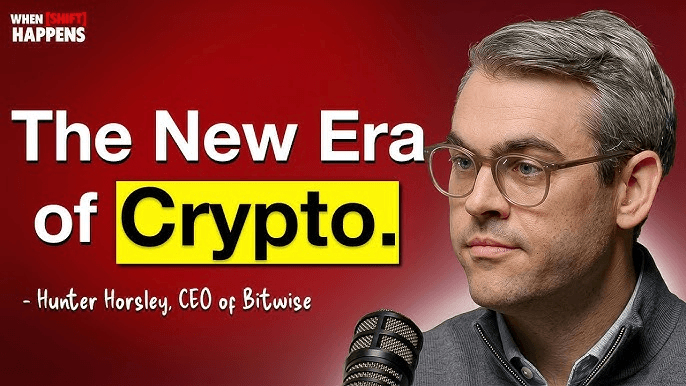
Interview with Bitwise Founder: The Greatest Bull Market Moment in Cryptocurrency History is Happening

CN
白话区块链
Follow
18 days ago
AI summarizes in 5 seconds.
2026 New Chapter of Cryptocurrency: Software Devours the World, Cryptocurrency Devours the Capital Market

Author: When Shift Happens

2026 New Chapter of Cryptocurrency: Software Devours the World, Cryptocurrency Devours the Capital Market

1. The Internet Moment of Financial Services: When 400 Trillion Assets Seek New Outlets

Host (Kevin): “There has never been a more convincing time to be bullish. To me, this is the most exciting turning point. The pace of change is accelerating and a massive dimension is that every business and financial institution will enter this field in some form over the next 12 months. Today, we welcome Hunter Horsley, co-founder and CEO of Bitwise Asset Management. Bitwise is the world's leading crypto asset management firm with over 70 investment solutions.” Hunter, you once said that “cryptocurrency will devour the capital market”; what is the logic behind this judgment?

Hunter Horsley: “That really sounds like a thought I've had. Let's put it in a larger historical context. The internet came in the late 90s, and people started trying online retail, when Amazon was just a book-selling website, and people even worried about transmitting credit card information online. Then eBay appeared, and people mocked it as frivolous, saying it was just for trading Beanie Babies. But ten years later, we woke up to find that the internet had completely dominated retail. The media industry is similar, transitioning from print newspapers to today’s user-generated content.”

“In my view, there are a few areas that have not yet been completely reshaped by the internet, with the largest being financial services. Finally, public blockchains have created the necessary infrastructure for the internet to genuinely pour into financial services. I believe this process will happen much faster than people expect. 2026 is absolutely a new chapter for cryptocurrencies.”

Host (Kevin): “You mentioned this ‘devouring’ process; how is it manifested in specific market sizes?”

Hunter Horsley: “Many people will ask: Is Bitcoin too expensive at 80,000, 100,000, or even 150,000 dollars? Have I missed the boat? My answer is: It depends on your perspective. Stepping back, what is Bitcoin competing against?”

“There is approximately 400 trillion dollars in currencies and assets in the world, and those who control these assets continuously seek investment portfolios that can achieve their goals. They use tools like real estate (about 100 trillion dollars), global equities (about 100 trillion dollars), fixed income, etc. Now there is a new option on the menu worth 2 trillion dollars called Bitcoin. Meanwhile, this 400 trillion dollar ‘pie’ is still expanding. As our CIO Matt Hougan pointed out, 20 years ago gold was only 3 trillion, now it's 10 times that.”

“The total addressable market (TAM) for cryptocurrencies is growing, and Bitcoin's share of that is also increasing. This is a dual growth logic. When people start questioning whether the stocks, bonds, and other tools used over the past 20 years are still suitable for the next decade, the trend of moving towards ‘alternative investments’ becomes unstoppable. In this high-level view, discussions about short-term targets of 80,000 or 100,000 seem trivial compared to the possibility of assets expanding tenfold or more.”

2. Institutional Acceleration from "0 to 500 Miles": Regulatory Turning Points and Bank Anxiety

Host (Kevin): “You are at the frontier of an institution like Bitwise. What trends do you observe in the institution, and why do you remain so optimistic about the future?”

Hunter Horsley: “In the seven or eight years since Bitwise was founded, I have never seen a moment more bullish than now. I can share an anecdote. Last week, we were with one of the largest banks in America, and a senior executive shared that their management has instructed the bank to ‘accelerate from 0 to 500 miles per hour’ in the cryptocurrency field.”

“You can imagine, I have never seen a bank achieve such sweeping acceleration in any line of business. Banks are typically extremely conservative; it usually takes them years just to go from 0 to 10. This sense of urgency reflects the moment we are in: things have fundamentally changed. Another bank we work with has issued a ‘100-day mandate’ to some departments to formulate a complete cryptocurrency roadmap. The banks, as the most critical financial infrastructure, have concluded that cryptocurrency is extremely important and urgent.”

Host (Kevin): “We are now having this conversation in San Francisco. Many people discuss the decline of San Francisco, yet I still feel there is something irreplaceable about the energy here. What do you think is the core advantage of building a company like Bitwise in Silicon Valley?”

Hunter Horsley: “San Francisco is not just a place; it is a community built on a ‘web of trust’. In many places, systems run on credit scores or contracts, but in Silicon Valley, systems run on the trust and reputations of people. This trust allows things to move very quickly; there is often only a ‘one hop’ connection between you and anyone you want to reach.”

“For instance, my former boss Abishal, who is the founder of Electric Capital. He wrote us checks before Bitwise had really taken off when Hong and I were still drafting it. He is a top performer who connected us to this remarkable network in Silicon Valley. This kind of network allows the right people to find each other quickly and to facilitate significant events.”

Host (Kevin): “I completely agree. This culture in San Francisco seems to tolerate ‘eccentricity’ at a high level. Recently, I was at a café in Palo Alto and saw a guy with a robot on his table, working on a laptop and had a note saying ‘I’m fundraising’. In other cities, people might think he’s crazy or even attempt to steal his robot. But in Silicon Valley, it’s viewed as ‘cool’, and he may really get funding because of it.”

Hunter Horsley: “Exactly! This is the ‘hippie side’ of San Francisco. There’s a legacy of ‘The Summer of Love’, a spirit from Burning Man. As Bill Gurley once said, the core of Silicon Valley culture is anti-establishment. The tech community sees itself as independent and not part of the establishment, leading new ideas into life.”

“Steve Jobs' famous quote, ‘It’s better to be a pirate than to join the navy,’ perfectly embodies this spirit: whatever the current circumstances, everything can be discussed, and if there’s a better version, let’s go implement it. The term ‘alternative’ sounds confrontational to the establishment, but in Silicon Valley, it’s a positive term. This cultural backdrop aligns perfectly with the spirit of cryptocurrencies.”

Host (Kevin): “You mentioned the sense of trust, which is also interesting. Bitwise has been established for seven years; as a founder, how do you explain your success? Do you see yourself as the kind of ‘autistic genius’ founder Brian Armstrong talks about, or more of an ADHD-type crazy founder, or a strong operator?”

Hunter Horsley: “To be honest, I don’t think I am any of those. I often feel that many founders are quite extraordinary and geniuses in their own right. I don’t see myself as that kind of person. But I do believe that the most important thing for a business like Bitwise is establishing trust.”

“If you are building a rocket, you really need a genius in a field you cannot imagine; but if you are assuming money with others to manage, trusting them to do so is what matters. I once spoke with a prominent individual who manages hundreds of billions, and he shared a story indicating that at its core, ‘people only do business with those they like and trust.’ The trust that Bitwise has built over seven years, especially during market turbulence, is a strong point.”

3. The 400 Trillion Dollar Chess Game: What Advantages Does Bitcoin Have?

Host (Kevin): “Let’s get back to the market. The price of Bitcoin is causing a lot of fear; at 80,000, 100,000, or even 150,000 dollars… people feel lost. How would you respond to those who think it’s ‘too expensive’?”

Hunter Horsley: “I think many questions depend on how you view the issue. Let’s pull back the perspective: what is Bitcoin really competing against? What is its background?”

“Currently, there are about 400 trillion dollars of money and assets globally. The individuals and institutions that hold these assets are trying to park their money into investments that can achieve their goals. They may want asset appreciation or to store value defensively. The primary tools they currently use are real estate (about 100 trillion), global equities (about 100 trillion), fixed income, etc. Now, a new option has appeared on the menu, worth 2 trillion dollars: Bitcoin.”

Host (Kevin): “That ratio is indeed stark.”

Hunter Horsley: “Yes. And this 400 trillion is still expanding. This is something many in the crypto space do not actively disclose. I talked with our CIO Matt Hougan, who explained why the soaring value of gold is beneficial for Bitcoin. Twenty years ago, gold had a total market cap of only about 3 trillion, and now it is ten times that. This indicates that the ‘pie’ has gotten bigger.”

“In the investment world, this is called ‘alternative investment’. As interest rates have dropped, dollars in fixed income have lost their earnings, and they need to find new ‘parking spots’. As long as Bitcoin proves to be a viable, lasting, and legitimate option, the debate on 80,000 or 100,000 dollars is actually trivial within this 400 trillion dollar realm. Matt even believes it’s reasonable for Bitcoin to reach millions of dollars; he suggested a figure of 650 thousand.”

Host (Kevin): “That’s indeed an exciting figure. You also mentioned a striking observation in your previous article: people have overestimated Bitcoin's usefulness as a payment method in the past decade but underestimated its potential in the next decade. What is the logic in between?”

Hunter Horsley: “It’s a sequencing issue. Building a house requires laying a foundation first. For Bitcoin as a new technology to be accepted as a payment method, it first has to be acknowledged for its ‘value’.”

“Over the past 15 to 20 years, the world has been engaged in a public debate about whether Bitcoin has value. We are getting closer to achieving consensus. Once value is recognized, payment examples will naturally arise. If you don’t think it’s valuable, you certainly won’t use it for transactions. Therefore, I believe the explosion of payment use will actually come in the future.”

Host (Kevin): “This also relates to the generational power shift.”

Hunter Horsley: “Exactly. This is another underappreciated structural tailwind. Schwab’s survey shows that Millennials and Generation X ranked their preferences for Bitcoin at the top, while Baby Boomers ranked it at the bottom. Now, the oldest of Generation X is over 50, and they’re starting to take over institutions.”

“I can give you a specific example. Recently I received a call from a CFO of a company that just raised 2 billion dollars in cash, wanting to discuss putting Bitcoin on their balance sheet. Companies like Figma that went public this summer have already allocated 4% of their assets into Bitcoin through our ETF. In this CFO’s conversation, there was no ‘explanation about mining’ or ‘what if things get volatile’; he efficiently concluded that if he had a large amount of cash to store long-term, Bitcoin was the option. He simply wanted to know how to operate. When this generation takes charge, decision-making will become intuitive.”

4. The Rise of the New Wealth Class: From Art to the Political Landscape

Host (Kevin): “Many people chatted over coffee in Singapore about an insightful topic: cryptocurrency is creating a new ‘wealth elite class’. This class not only has wealth but also possesses a completely different value system. How will this fundamentally change the world?”

Hunter Horsley: “This is the most exciting part. The only constant in this world is that it is constantly changing. In the mid-19th century, the first railroads that occupied America created a huge wealthy class. Behind the mansions in San Francisco are names like Stanford, Crocker, Hopkins, and Huntington. They became wealthy through their participation in structural opportunities of that era, and then influenced the world by establishing Stanford University and supporting various arts and politics.”

“Cryptocurrency is now creating such a new class. NFTs are an early, albeit closed revelation. Traditional wealthy individuals spend 30 million dollars to buy a shark preserved in formaldehyde (Damien Hirst's work), and the world regards this as normal—it’s contemporary art. Yet when trendy new rich individuals spend 20,000 dollars to buy a ‘fat penguin’ or a ‘bored ape’, the world finds it absurd. But ultimately, it’s all the same—a new community expressing their existence through art.”

Host (Kevin): “And this class is beginning to show influence in politics, right?”

Hunter Horsley: “Absolutely. In the 2024 U.S. elections, the crypto industry demonstrated unprecedented unity. With frustrations over the previous administration's response, this community attracted more funding than any other industry in the U.S. The candidates supported by the organization Fairshake performed extraordinarily well.”

“This shows the world: this community not only has resources but also clear political views. Just like Wall Street, the tech world, and real estate moguls, crypto celebrities now have a seat at the table. They will use their money to support the vision of how they believe the world should operate. Currently, the impact of crypto wealth is still small compared to its potential scale in the future; you can imagine the extent of this power a decade from now.”

Host (Kevin): “Yes, even brands like Hermes are starting to do NFT projects because they realize that the new wealthy class has different preferences and priorities.”

5. Conclusion: How to Position Yourself in the Great Pandemic Shift?

Host (Kevin): “Thank you, Hunter. Finally, for those aged 25 to 50 who want to understand this field but do not wish to chase market changes every day, what final messages would you like to share?”

Hunter Horsley: “I have three core messages. The first is about shifting perspectives: if you don’t perceive that ‘this is the most incredible moment for cryptocurrency,’ it might mean your information sources or those around you have misled you. This is indeed happening and will change the world.”

“Secondly, understand the cultural shifts that ‘mainstreaming’ brings. Early adopters focus on L2 storage and CPU GHz. But entering the mainstream means simplification. Most people buying personal computers just care about ‘is it fast?’ without noting how many cores it has. Cryptocurrency is transitioning from ‘geek hobbies’ to ‘mainstream investment’. This means incremental investors may not be on Twitter and might not even be aware of the 17th asset besides Bitcoin. They think in quarters, not hours.”

“Finally, stay optimistic. No matter which specific chain you support, the whole field is a billion dollar ecosystem. Having the entire cryptocurrency ecosystem perform well is the best for the specific asset you care about.”

Host (Kevin): “Well said. We have interviewed many people on this program, like Ben from Bybit or Jeff from Hyperliquid. It feels like we are building a ‘70s music archive,’ capturing stories of future superstars before they rise.”

Hunter Horsley: “Yes, I appreciate what you are doing. For many, it’s incredibly difficult to build a mental model from fragmented Twitter information. However, if someone can sit down and watch 20 hours of your interviews, they can import a great deal of dense, valuable information.”

“Build each fundamental belief, rather than chasing the latest features or clickbait. You know why you dollar-cost-average, you know why this field can withstand market turbulence; this sense of belief based on foundational knowledge is invaluable.”

Host (Kevin): “Thank you so much, Hunter. This has been a delightful conversation.”

Hunter Horsley: “I enjoyed it too. Thank you, Kevin.”

This article link: https://www.hellobtc.com/kp/du/05/6306.html

Source: https://www.youtube.com/watch?v=p9GTSvTrqYw

免责声明:本文章仅代表作者个人观点,不代表本平台的立场和观点。本文章仅供信息分享,不构成对任何人的任何投资建议。用户与作者之间的任何争议,与本平台无关。如网页中刊载的文章或图片涉及侵权,请提供相关的权利证明和身份证明发送邮件到support@aicoin.com,本平台相关工作人员将会进行核查。

|
|
APP
Windows
Mac
Share To

X

Telegram

Facebook

Reddit

CopyLink

|
|
APP
Windows
Mac
Share To

X

Telegram

Facebook

Reddit

CopyLink

Selected Articles by 白话区块链

6 hours ago
Exclusive Interview with Multicoin Founder: Why Do We Dare to Invest Heavily in "Dead" Privacy Coins?
1 day ago
Milestone victory of cryptocurrency
9 days ago
Exclusive Interview with Zhao Changpeng (CZ): "The Freedom of Money," Imprisonment Years and the Vast Ocean of Cryptocurrency
View More

Table of Contents

|
|
APP
Windows
Mac
Share To

X

Telegram

Facebook

Reddit

CopyLink

Related Articles

avatar
avatar链捕手
5 hours ago
Baiqing Wang founder: We have transitioned from being leaders in AI to being a guiding party in AI.
avatar
avatarPANews
5 hours ago
From market makers withdrawing investment to CME applying pressure, is Hyperliquid evolving or exiting?
avatar
avatarForesight News
6 hours ago
Can Wash reverse the rise of US debt interest rates?
avatar
avatar白话区块链
6 hours ago
Exclusive Interview with Multicoin Founder: Why Do We Dare to Invest Heavily in "Dead" Privacy Coins?
avatar
avatarPANews
6 hours ago
SpaceX Strikes IPO: A Capital Feast That Could Reshape the Landscape of AI and Crypto
APP
Windows
Mac

X

Telegram

Facebook

Reddit

CopyLink