
Author: Lu Chunfeng, Phoenix Technology "Fengyan Observation"
Editor: Dong Yuqing

Abstract: A financial report not only ignited AMD's stock price but also redefined the "aligning line" of the global supply chain. As AI computing power becomes the most expensive and certain growth engine, in the Chinese supply chain, some are passively "sharing the pie," while others are beginning to be marginalized. The issue is not whether there is a market, but whether you stand on the chain of computing power.
AMD Finally Stands at the Center Stage of History
On May 5, after U.S. stock trading, semiconductor company AMD released its financial report for the first quarter of fiscal year 2026, which directly ignited market sentiment—after-hours stock prices soared over20%, and the market value skyrocketed107.8billion dollars in a day. This long-awaited spotlight moment once again placed this previously suppressed chip giant at the center of the AI computing power stage.
If we only look at the surface, this is almost an impeccable financial report: total revenue of 10.253 billion dollars, up 38% year-on-year, exceeding Wall Street's previous expectation of 9.89 billion dollars, reaching a historical high for the same period;
net profit of 1.383 billion dollars, surging 95% year-on-year. An almost doubling growth rate has directly shaken off the growth ceiling of traditional hardware manufacturers; GAAP gross margin skyrocketed to 53%, up 3 percentage points from the same period in 2025, with a significant increase in the proportion of high-margin AI-related products, highlighting profitability.
But if we only dwell on the exceeding expectations, we will miss the truly valuable information in this financial report. In fact, this is not just a simple performance recovery, but a clear path switch.
For many years, AMD's core label has always been "CPU manufacturer": battling with Intel in the PC and server CPU fields, achieving a market share reversal through architectural innovation and process outsourcing. However, the latest financial report reveals a different story—it is transitioning from a "general computing provider" to an "AI computing power participant."
This track has always been the most expensive and crowded segment of the entire semiconductor supply chain.
At this time last year, AMD was still in a follower position in the AI field, and the climb of the MI300 series was still in a difficult period. This year's financial report reveals a completely different story: revenue from data center business was 5.8 billion dollars, surging 57% year-on-year, and for the first time exceeded the combined revenue of PC and gaming businesses, accounting for 56.6% of total revenue.
Simply put, over half of AMD's current revenue relies on AI and data centers.
AMD's chairman and CEO, Su Zifeng, released a more positive signal during the earnings call—AI inference and intelligent agent AI are driving strong demand for high-performance CPUs and accelerators, with Q2 revenue guidance median reaching 11.2 billion dollars (market expectation of 10.5 billion dollars), which means a year-on-year growth rate of about 46%.
She raised the company's potential market size for server CPUs in 2030 significantly to 120 billion dollars, with the expected compound annual growth rate increased from 18% to over 35%. This is the strongest bullish signal regarding the entire AI infrastructure cycle.
But the problem is indeed buried here.
The remarkable growth at hand is essentially highly tied to a variable: the AI capital expenditure cycle. From the financial report, it shows that almost the only driving force for AMD's growth is the AI-related business, and other business growth rates are significantly lower than that of the data center segment. For example, demand on the PC side is still recovering but lacks new breakout points, while the gaming business is still weak, lacking both new console cycle drivers and high-growth narratives.
This means that this financial report is essentially a "single asset bet"; AMD is not experiencing a comprehensive recovery but is betting everything on AI.
In the past month, AMD has set a record for 12 consecutive gains, the longest consecutive rising period for AMD since 2005. In the past 30 days, its stock price has surged over 106%, and its market value has surpassed 687 billion dollars.
A double-edged sword has been quietly held by AMD.
What Does This Financial Report Mean for the Chinese Supply Chain?
AMD's financial report has awakened the global computing power market. On May 6, A-share GPU stocks exploded, with Haiguang Information once rising by 16.15%, exceeding a market value of 800 billion; Cambrian increased by 7.32%. On May 7, the computing power market continued, and Cambrian opened with further gains, with a market value surpassing 784 billion.
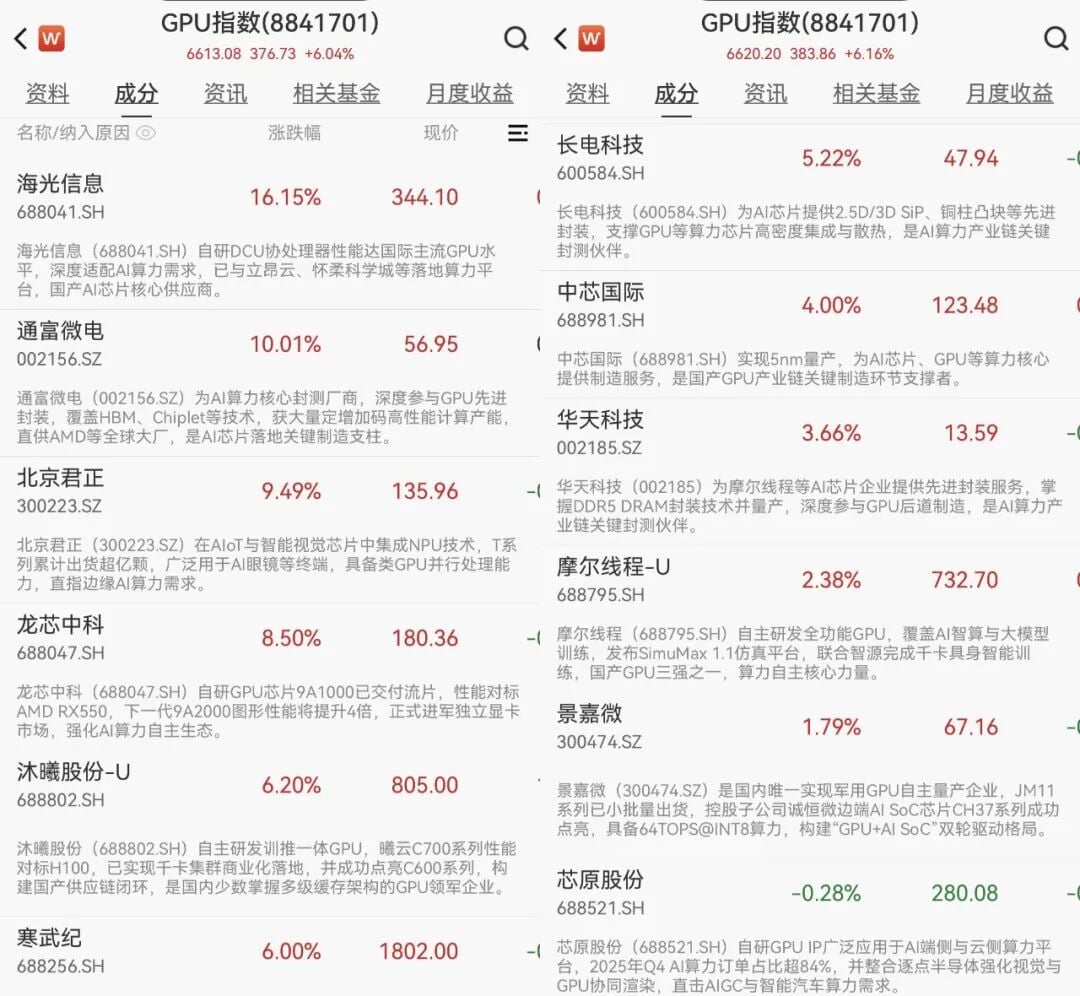
Image | Source from Wind
If we place this financial report in a larger coordinate system, its significance is not just about "how much AMD earned." Based on AMD's position in the global AI computing power chain, it is more like a high-frequency indicator in the stage of AI computing power diffusion. It is not the source of demand but is the first to feel the change in demand.
The core signal conveyed by this quarterly report is very clear: the weight of CPUs in the AI market is continuously rising. As the tasks performed by AI are becoming increasingly complex, requiring both "inference" and "agent task execution," a large amount of CPU is needed for scheduling, data movement, and parallel processing. This directly breaks through the ceiling of CPUs.
Su Zifeng stated that in the deployment of AI infrastructure, the ratio of CPUs to GPUs is shifting from the past 1:4 or 1:8 to close to 1:1, and in some high-density agent scenarios, the number of CPUs may even exceed that of GPUs.
Coupling with the business progress of GPU customers, AMD is very confident in achieving billions in annual revenue from data center AI by 2027.
This also means that AMD's rise is not the same path as NVIDIA's. It will also drive a plethora of opportunities in the Chinese supply chain.
If we break down AI computing power, it essentially is an "infrastructure project": chips, servers, networks, connections, heat dissipation, and each link needs to expand.
Within this chain, the role of Chinese enterprises mainly focuses on "selling water."
The most direct beneficiaries are related aspects of computing power infrastructure: optical modules (evolving from 800G to 1.6T), PCBs and high-speed connections, server OEMs and supporting manufacturing, etc. The logic is simple—AMD's expansion is not just a victory for one company but an uptrend in global computing power demand.
For example, when the shipping volume of AMD GPUs doubles, the orders received by packaging and PCB suppliers grow synchronously. Tongfu Microelectronics is the only unavoidable core target among them. As AMD's largest packaging and testing supplier globally, Tongfu Microelectronics undertakes over 80% of AMD's CPU/GPU/AI chip (MI300/400, EPYC) packaging orders. This led to Tongfu Microelectronics also surging on May 6, hitting the daily limit, and on May 7, it opened with more than 6% rise.
The Chinese supply chain is stuck at "the layer with the strongest certainty"—not determining the direction, but as long as expansion occurs, there will definitely be orders. The characteristics of such opportunities are not sensational but stable; they do not determine standards but bind scales.
However, at the same time, some domestic GPU manufacturers may face being squeezed. In the past, AMD entered the inference market with better cost-performance and a more open ecosystem; its MI300X accelerator is priced at 15,000 dollars with 192GB of memory, while the H100's 80GB memory is priced as high as 32,000 dollars, showing significant price advantages. The Instinct MI450 directly competes with NVIDIA's Rubin.
It is worth mentioning that in the first quarter of this year, when Jensen Huang repeatedly emphasized that NVIDIA did not generate revenue in the Chinese market, third-party reports indicated that AMD had around 100 million dollars in MI308 product sales to the Chinese market in the first quarter. This cost-performance offensive has effectively compressed the window for domestic GPUs to gain market share under domestic substitution scenarios.
But the question is, how long can this frenzy last?
The current market enthusiasm for the AI computing power chain often evokes memories of the "chip shortage wave" of 2021-2022—at that time, there was a global capacity shortage, various chip prices surged, and the performance and stock prices of companies in the supply chain resonated, with the entire industry immersed in optimistic sentiments of insufficient supply.
However, the script suddenly took a downward turn afterward. With the decline in terminal demand and inventory reversal, many chip prices plummeted, forcing companies in the supply chain into a brutal inventory correction cycle, with both performance and valuation under pressure.
Currently, the difference between the AI super cycle and that year’s structure is that AI demand is not driven by short-term inventory replenishment but supported by real workload migration and application explosion, theoretically having a deeper industrial foundation for sustainability. However, historical inertia cannot be ignored—periodic expansions and capacity mismatches are persistent inherent risks in all super cycles.
AMD currently relies almost entirely on data center and AI business to drive growth, with traditional businesses like gaming and embedded systems still weak. This structure of a single asset bet means that once the pace of AI capital expenditure slows, the decline in the company's revenue growth and profit elasticity will be much more severe than that of traditional multi-engine growth companies.
For A-shares, the logical chain is equally fragile. The "computing power chain" that the market is hyping today must withstand quarterly report verification; if the excessive reactions do not translate into real performance improvements, valuation corrections will be inevitable. AI has not cooled down, but the tech market cannot sail smoothly all the time.
The stunning growth observed today in AMD is essentially no longer a strong recovery but a structural excitement highly concentrated in a single sub-segment, which is precisely a sharp double-edged sword.
免责声明:本文章仅代表作者个人观点,不代表本平台的立场和观点。本文章仅供信息分享,不构成对任何人的任何投资建议。用户与作者之间的任何争议,与本平台无关。如网页中刊载的文章或图片涉及侵权,请提供相关的权利证明和身份证明发送邮件到support@aicoin.com,本平台相关工作人员将会进行核查。


