Summary
•In a bear market or in a market with strong expectations of a decline, going long on put options (Long Put) is a typical strategy with limited losses and strong downside profit elasticity.
•Compared to directly shorting the spot market, the biggest advantage of going long on put options is that the maximum loss is predetermined, and investors only need to bear the premium cost.
•This strategy is suitable not only for expressing a clear bearish view but also for conducting phased risk hedging when there are existing long positions in the portfolio.
•Going long on put options is not simply "betting on the direction"; its success also depends on the magnitude of the price decline, the timing of the decline, and changes in market volatility.
•In a bear market environment, this strategy is more suitable for phases where "prices are expected to decline quickly" and not suitable for blindly chasing short positions during high volatility and excessive option premiums.
Introduction
In a bear market environment, investors often face a real question: if they believe the market will decline further, how should they participate in this downturn?
The most direct way is of course to sell the spot, or short through tools like margin trading, perpetual contracts, etc. However, these methods often come with higher capital occupation, more complex risk control requirements, and in some cases, can face theoretically unlimited loss risks. For investors who do not wish to bear excessive tail risks, shorting, although clear in direction, may not be the easiest method to execute in the long term.
This is also the significant meaning of put options. Buying a put option essentially means paying a fixed cost to acquire the right to sell an asset at a pre-agreed price during a specified future period. Investors are not obligated to exercise this right, but once the market does decline, this right becomes more valuable.
Therefore, going long on put options is essentially a strategy of "exchanging limited costs for downside profit elasticity." It has offensive properties, as profits can quickly amplify during market downturns; it also has defensive properties, as even if the judgment is wrong, the maximum loss is locked in at the initial premium paid.
Long Put Option Strategy
1.1 Strategy Characteristics
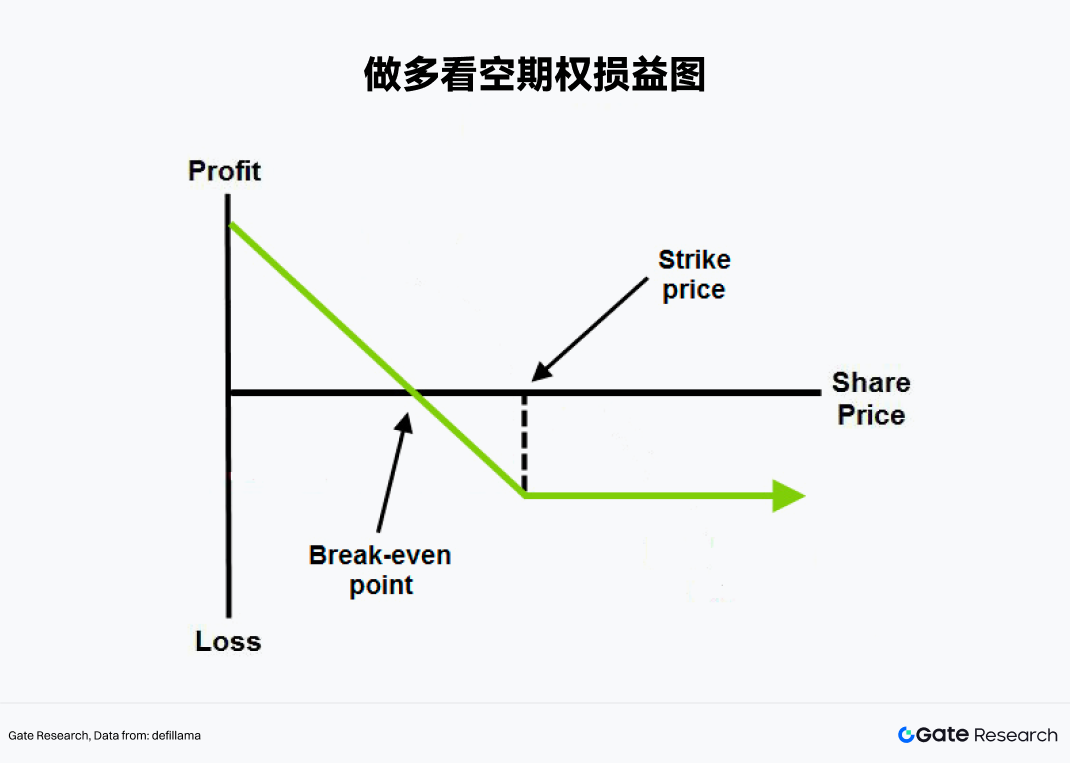
A put option gives the buyer a right to sell the underlying asset at the agreed execution price on or before the expiration date. Buying a put option is what the market commonly refers to as going long on put options (Long Put).
This strategy is most suitable when market judgment is very clear: the investor expects a particular asset's price to decline in the future, preferably with a noticeable drop within a limited time. Unlike spot, options are time-sensitive instruments. When investors buy options, the premium they pay is equivalent to buying a "time-limited insurance policy" for their judgment. If the price of the underlying asset moves favorably within the effective period, this "insurance policy" will increase in value; if the market does not decline as expected, or if the decline is too slow, the time value of the option will continually erode, and it may ultimately become worthless.
In terms of profit structure, going long on put options has several very distinct characteristics.
•Maximum loss is limited. No matter how much the underlying price may rise afterward, the buyer's maximum loss is the premium paid when buying the option.
•Downside profit is significant. As long as the underlying price continues to decline, the value of the put option will rise accordingly, while the maximum profit is also limited.
•Clear breakeven point. The profit turns positive only when the underlying price falls below the "execution price minus premium."
•Strategy is sensitive to time. Simply getting the direction right is not enough; the price also needs to decline significantly before the option expires.
Because of this, going long on put options, although categorized as a bearish strategy, is not a tool that is "suitable for anyone who thinks prices will fall." It is more of a comprehensive judgment of the future price direction, rhythm, and volatility.
1.2 Strategy Advantages
A bear market is not merely about falling prices. It often comes with valuation compression, liquidity contraction, declining risk appetite, and significantly elevated volatility. In this environment, going long on put options is often regarded as a classic bear market strategy for three main reasons.
First, it can amplify the expression of the downtrend. If an investor directly sells the underlying asset, the profit typically corresponds one-to-one with the price drop; whereas after buying put options, in the phase of accelerating declines and rising volatility, the value of the options often displays greater elasticity.
Second, it can control the worst losses. One common occurrence in a bear market is that although the market weakens overall, sudden rebounds frequently appear. Many direct short trades do not fail due to misjudgment of direction, but rather due to unexpected volatility. The advantage of going long on put options is that even if the market suddenly rebounces in the short term, the buyer will not face unlimited losses like leveraged shorts.
From a practical perspective, the best timing for going long on put options may not necessarily be when "the market has already crashed," but often during periods when "the trend has just begun to weaken, but panic has not fully released." Because when the market is highly panicked, implied volatility of options usually rises significantly, making the cost of buying puts at that time often very high, with less favorable odds.
1.3 Strategy Case Study
Gate currently supports short options for various mainstream tokens. Taking BTC as an example, let's assume at a certain point, the current price of BTC is 84,000 USDT. An investor predicts that in the coming month, the market may enter a further decline due to weakening macro expectations, capital flight to safety, and releasing high-position profits. Instead of directly shorting the perpetual contract, he chooses to buy a BTC put option that expires in one month with a strike price of 80,000 USDT, with a premium of 4,000 USDT.
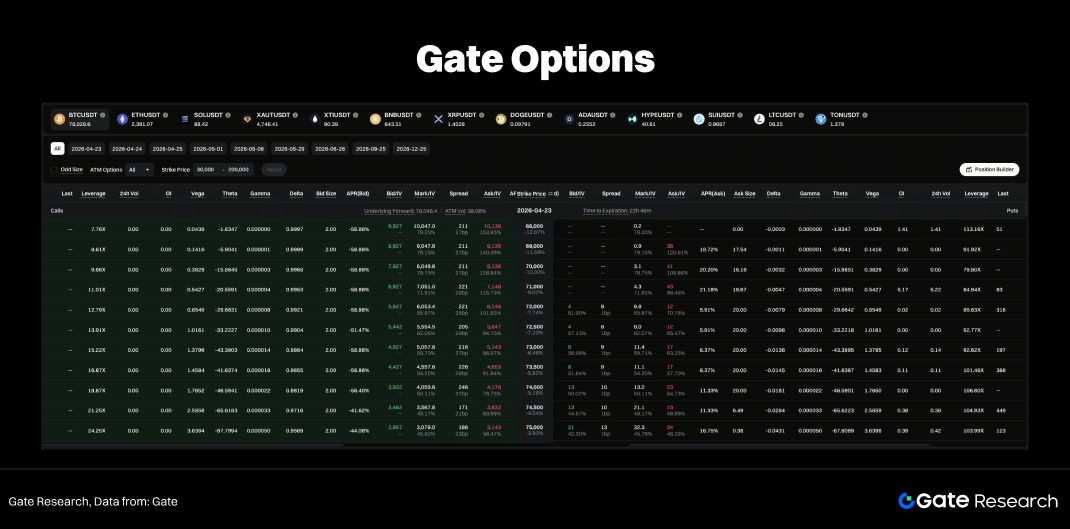
The key figures for this trade are as follows:
• Underlying price: 84,000 USDT
• Execution price: 80,000 USDT
• Premium: 4,000 USDT
• Expiration time: 30 days
• Breakeven point: 76,000 USDT
In other words, the trade will only start to realize net profits if BTC falls below 76,000 USDT at expiration.
If a month later, BTC falls to 70,000 USDT, the intrinsic value of this put option will be:
80,000 - 70,000 = 10,000 USDT
After deducting the initial premium of 4,000 USDT, the net profit is:
10,000 - 4,000 = 6,000 USDT
Conversely, if at expiration BTC's price is still above 80,000 USDT, this put option holds no intrinsic value, and the investor's maximum loss will be the initially paid premium of 4,000 USDT.
Returns, Risks, and Key Variables of Going Long on Put Options
To truly understand this strategy, the key is not to remember that "puts can make money," but to understand why they make money, and under what circumstances they might fail.
2.1 Source of Returns: Price Decline
The most direct source of profit when going long on put options is the decline in the price of the underlying asset. Assume a certain asset currently costs 36.25 USD, the investor purchases a put option with a strike price of 35 USD, paying a premium of 2 USD, with a remaining duration of 90 days. Therefore, the breakeven point for this trade is 33 USD, which is:
Breakeven point = Execution price - Premium = 35 - 2 = 33
If at expiration the price declines to 30 USD, this put option's intrinsic value will be 5 USD, and after deducting the initial 2 USD premium, the net profit will be 3 USD. If at expiration the price is still at 35 USD or above, this option holds no intrinsic value, and the maximum loss is the initially paid premium of 2 USD. This is also the core structure of Long Put: limited losses when prices increase, and continuously expanding profits when prices decline.
2.2 Time Decay: Being Right Still Might Not Make Money
The biggest difference between options and spot involves the "time" dimension.
For the buyer of put options, time is often not a friend. As long as the market does not decline immediately as expected, the time value of the option will gradually erode. Even if the final direction judgment is correct, if the price declines too slowly or too late, the trading outcome may not be ideal.
This means that going long on put options is not only about judging "will it decline" but also about judging "when will it decline."
2.3 Changes in Volatility: Another Layer of Impact in a Bear Market
In addition to price and time, volatility is also a crucial variable in options trading.
Generally, the more fear in the market, the more expensive the options, particularly put options. In a declining market, investors are more willing to pay a premium for protection or speculation. Therefore, going long on put options generally benefits from rising implied volatility. However, this also brings another issue. If investors buy puts when the market has already declined significantly, with panic levels high and option prices obviously expensive, even if their future direction continues to be correct, a drop in volatility may offset some profits. In other words, Long Put is not just about betting on price declines; to some extent, it is also betting that "the decline has not yet been fully priced in."
Conclusion
Going long on put options is one of the most classic directional option strategies in bear markets. Its attractiveness lies in exchanging limited losses for higher profit elasticity during price declines. Compared to directly shorting, it provides better control over tail risks; compared to simply selling the spot, it retains stronger offensive characteristics.
However, it is not a tool that guarantees easy profits just by being bearish. The challenge of Long Put lies in the fact that it requires investors to have a certain judgment on direction, timing, rhythm, and volatility. If the market does not decline quickly or sharply enough, or if the entry point is too crowded, the actual effectiveness of this trade may be greatly diminished.
Cryptocurrencies, as typical high-volatility assets, provide a naturally applicable scenario for Long Put. Once the market enters a phase of declining risk appetite, weak price trends, and increasing event-driven factors, buying put options often becomes a strategy choice that combines both defensive and offensive attributes. But essentially, it is still not a "homework copying tool," but a trading method that requires discipline and a sense of rhythm.
References
•Gate, https://www.gate.com/help/other/options/28363/introductions-of-gate.io-s-options
•Investopedia, https://www.investopedia.com/terms/l/long_put.asp
•InteractiveBroker, https://www.interactivebrokers.com/campus/trading-lessons/bear-market-long-put/
•Optionclue, https://optionclue.com/en/tradinglossary/long-put/
Gate Research Institute is a comprehensive research platform for blockchain and cryptocurrencies, providing readers with in-depth content, including technical analysis, hot insights, market reviews, industry studies, trend predictions, and macroeconomic policy analyses.
Disclaimer
Investing in the cryptocurrency market involves high risks, and users are advised to conduct independent research and fully understand the nature of the assets and products purchased before making any investment decisions. Gate is not responsible for any losses or damages resulting from such investment decisions.
免责声明:本文章仅代表作者个人观点,不代表本平台的立场和观点。本文章仅供信息分享,不构成对任何人的任何投资建议。用户与作者之间的任何争议,与本平台无关。如网页中刊载的文章或图片涉及侵权,请提供相关的权利证明和身份证明发送邮件到support@aicoin.com,本平台相关工作人员将会进行核查。


