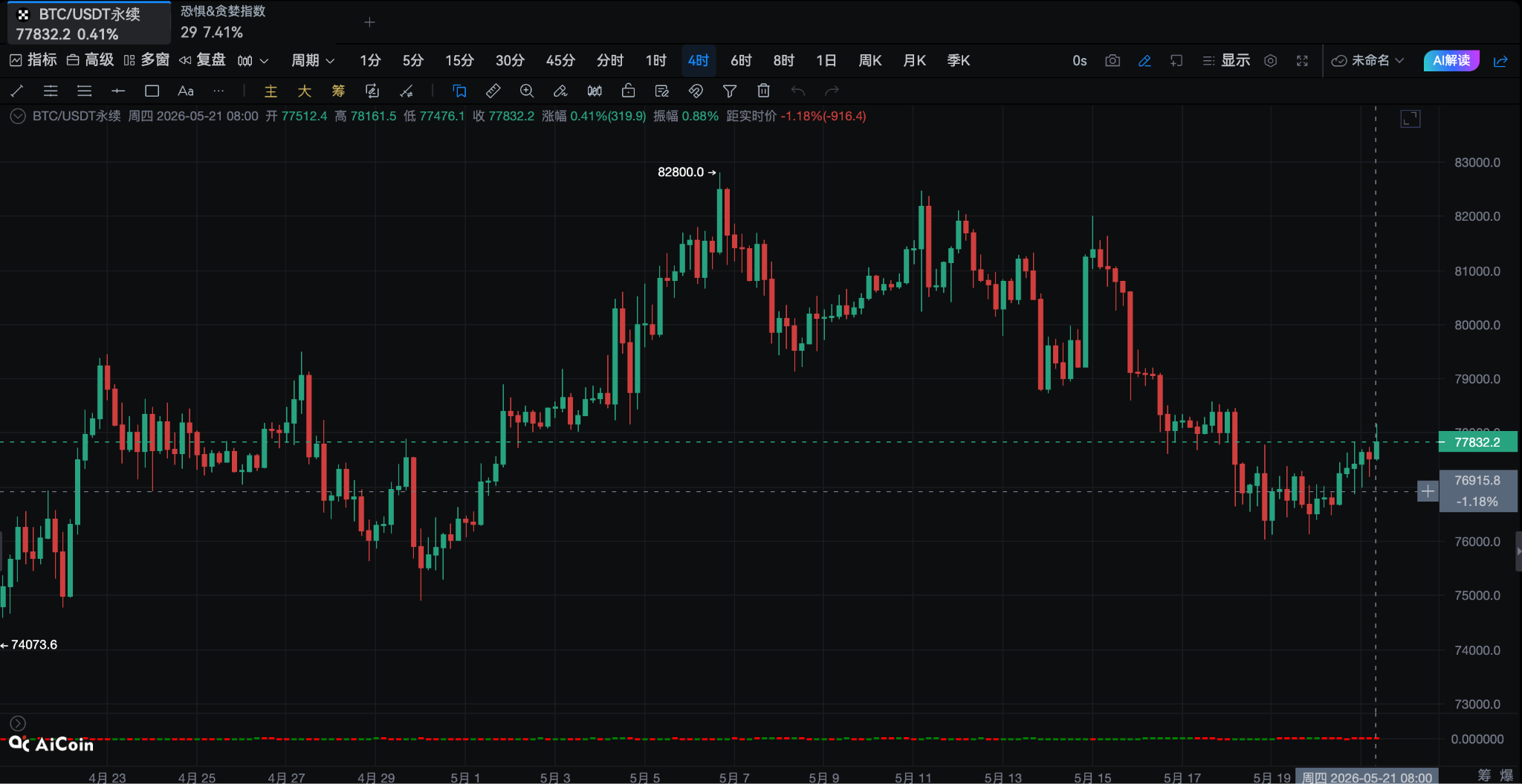
May 21, 2026, is a day when the macro narrative was rewritten simultaneously by two forces on the same trading day: from Washington, the U.S. House Republican leadership postponed the scheduled vote on the war powers resolution regarding the Iraq War, while at the same time, U.S. media exposed a "memorandum of understanding," drafted by multiple mediators, aimed at formally ending the current war and commencing about 30 days of negotiations concerning the Iranian nuclear program and the safety of navigation through the Strait of Hormuz. The intertwining signals of geopolitical escalation and de-escalation pointed directly to the repricing of the Middle Eastern conflict, oil price trajectories, and global risk aversion demand; almost in the same time window, SpaceX submitted IPO/S-1 documents to regulatory authorities, revealing that Anthropic PBC had agreed to pay approximately $40 billion to $45 billion over the next three years for its large-scale AI computing services. Musk subsequently confirmed this collaboration on X and stated that he was in discussions with more companies. The combined effect of the 180-day lock-up period post-IPO and the phased unlock arrangements tied to profitability and stock prices provided a new anchor for the market's understanding of future AI capital expenditure intensity, technology asset valuations, and potential shareholder selling pressure. As the situation in the Middle East raised global risk premiums through Hormuz risks and inflation expectations, and as the SpaceX-Anthropic deal reinforced the growth vision of "AI capital expenditure splurging," assets like BTC and ETH were pulled into two extreme pricing frameworks: one end being "geopolitical hedging" and risk premiums in the context of sanctions and cross-border capital, the other end being growth premiums highly correlated with the U.S. tech and AI sectors. Under the collision of these two macro narratives, what the crypto market is really going to rearrange next is not just the price curve, but which narrative investors are willing to pay a higher premium for.
Iranian Clouds Temporarily Dispersed: Risk Premium Eases
The House Republican leadership pressed the "pause button" on the war powers resolution regarding Iraq on May 21, coupled with the U.S.-Iran "memorandum of understanding" put forth by mediators—attempting to bring the nuclear program and safety of navigation through the Strait of Hormuz back to the negotiating table within about 30 days after a formal ceasefire. In traders' eyes, this set of signals felt more like a hard pivot back from a "military escalation path" to a "diplomatic negotiation path." Even if Iran has not yet given a widely recognized formal response to the "memorandum," and the result remains highly uncertain, the market is no longer pricing in the war itself, but rather: the probability of being authorized to launch a new round of large-scale strikes in the short term is decreasing. This micro-adjustment in probability distribution is enough to pry open the price curve and the premium structure of risk assets.
Historical experience is clear: when tensions in the Middle East rise, oil prices and gold often attach a layer of "geopolitical premium," and the emergence of de-escalation signals often marks the starting point for this premium to begin to ease. The current step from Congress to the "memorandum of understanding" policy shift provides sufficient reason for traders to reduce leverage on extreme scenario hedging positions regarding crude oil and precious metals. Subsequently, the imagined space for moderate easing of inflation and interest rate expectations is reopened. In this scenario, the "high beta risk asset" label on BTC and ETH will be amplified: the correlation with growth assets like U.S. stocks may strengthen, while the prior hedging and risk aversion buying based on expectations of escalating conflict and expanded sanctions would more easily be unwound or redeployed into tech and AI sectors. What truly needs to be closely monitored next is whether this "memorandum" can transition from paper to substantial negotiations; should clouds of war gather again, BTC and ETH could quickly revert back to the "geopolitical hedging" track.
Trump's "100% Answer" and BTC Geopolitical Premium
According to U.S. media citing sources, Trump mentioned the U.S.-Iran "memorandum of understanding" in a call with Netanyahu and publicly warned that if Iran does not provide a "100% correct answer," the situation will escalate rapidly. Coupled with the fact that there is currently no formal peace agreement signed and Iran has not made a widely recognized confirmation of the "memorandum," this effectively tells the market: what we currently have resembles an "event window" that is being wagered upon, rather than a risk that has truly cleared out. The Strait of Hormuz as a key energy passage means that should negotiations break down and conflict escalate again, crude oil and shipping costs would be immediately repriced, with inflation and interest rate expectations rising, and the paths of oil prices, dollar rates, and global risk assets rewritten.
In this structure, what hangs above BTC is not already realized negative news, but an unexpired geopolitical option: in the short term, as Congress postpones the war powers vote and ceasefire intentions are discussed, the panic at the spot layer recedes, allowing BTC and ETH to re-approach the narrative of "high beta growth assets"; but the options market is more concerned with Trump's "100% answer," which typically maintains a high implied volatility during such event windows, filling prices with tail risk premiums. Some funds choose to accumulate spot at lower prices, while others hedge the extreme scenario chain of "failed negotiations—oil prices spike—sanctions intensified" by buying options or holding dollar-pegged currencies. In past similar geopolitical conflicts, BTC has been remembered as a tool for cross-border transfer and sanctions hedging, further reinforcing the weight of this "geopolitical option" in its pricing. Going forward, each hard or softened tone from Trump will directly reflect in BTC's geopolitical premium and volatility structure.
SpaceX's $40 Billion Computing Power and AI Capital Anchor
Almost in sync with the clouds of war in the Middle East, SpaceX introduced another narrative that determines global risk appetite in the IPO/S-1: Anthropic PBC has agreed to pay SpaceX approximately $40 billion to $45 billion over about three years for large-scale AI computing power services. The three-year, large-amount-level computing contract, approaching "super capital expenditure plan," is the first to render the financial consumption of cutting-edge model training into a measurable cash flow curve—AI is no longer merely a valuation story, but is integrated into a mid-term revenue guideline of an aerospace company. Musk later confirmed on X that SpaceX has been providing large-scale AI computing for Anthropic and is in talks for similar collaborations with other companies, intending to provide AI services at "extremely large scales" relying on in-orbit data centers, effectively painting a multi-layered commercial leverage of "space launches + Starlink network + orbital data centers + AI computing power" for the market. For global funds, this contract has become a new anchor for observing AI capital expenditure intensity: as long as these types of three-year computing orders continue to emerge in the primary and secondary markets, the consensus that "the AI cycle has not peaked" will continuously support technology growth premiums, reducing the psychological discount on long-term profit discounting.
For crypto asset pricing, this arms race in AI computing power strengthens another channel of risk appetite. Over the past year, AI-related U.S. stocks and AI concept sectors on the blockchain have repeatedly shown "computing power—model" narrative resonance; any tokens associated with AI infrastructure or model distribution tags tend to gain excess elasticity when U.S. tech sentiment warms up. The $40 billion-level, clearly timed computing order from SpaceX, backed by top model developers, effectively adds a layer of tangible collateral to the "long-term capital expenditure in AI" story, making it more likely for funds to view BTC and ETH as part of "high beta technology assets": in the window of declining geopolitical risk premiums, they will gain risk premium expansion as they follow the rising valuations of U.S. tech stocks, while on-chain AI-themed tokens will amplify this premium, becoming the primary channel from "space + Starlink + AI" narrative to the crypto world. Going forward, the number and scale of multi-year computing contracts like SpaceX-Anthropic will, alongside the Middle Eastern situation, determine whether BTC/ETH leans toward the "war hedging" or "AI growth" narratives.
SpaceX Unlocking Rhythm and Crypto Flow
If the hundreds of billions level computing contracts in the S-1 are written prominently, then another line hidden in the footnotes is the arrangement that truly alters the structure of U.S. high-risk capital flows: the nominal lock-up period for SpaceX post-IPO is 180 days, but it allows for phased early unlocking conditions related to profitability and stock price performance before the lock-up period expires. The lock-up period is no longer a single point in time of "collective sell-off/cash out" but is broken into several probabilistic events linked to performance, making the release of shareholder liquidity smoother and more "conditional." Once profits or stock prices trigger a certain unlocking threshold, some employees and early investors will gain usable dollar positions instantly, forming a localized "wealth effect"; but they will also engage in asset reallocation before and after the unlocking window—choosing between holding onto SpaceX, which continues to rise on high beta or switching to other tech stocks, or reallocating some profits toward high-risk on-chain assets.
In past cycles, large tech IPOs and unlockings often meant a significant "cashization process for tech newcomers": when tech stocks were hot, some profit funds overflowed into assets like BTC and ETH, while during tightening and tech stock pullback phases, crypto assets were frequently used as a "cash-out machine" to fill margin calls or to bring cash back in. By introducing performance-based phased unlocking in the IPO plan for leading private tech companies like SpaceX, this effectively breaks down the rhythm of cross-market rotations into multiple small windows: each time performance exceeds expectations, and stock prices break thresholds triggering early unlocking, it could bring a dollar-valued rebalance fluctuation, creating a bidirectional force on the crypto market, either to siphon then flow back, or to flow back then siphon. While specific threshold values have not been disclosed, the scale of SpaceX and the prospects of its AI computing power business are sufficient to turn these microstructures into key variables for observing U.S. high-risk capital switching between "traditional tech stocks and crypto assets," with BTC and ETH's volatility increasingly shaped by this unlocking rhythm and overall U.S. tech sentiment.
Cooling of War and Surge in Computing Power Underlying BTC
Returning to the market, the Iranian clouds did not immediately dissipate after Congress postponed the war powers vote and the "memorandum" entered negotiations; instead, they were compressed into a state of "risk premium slowly adjusting down, with tail options still in play": as of May 21, U.S.-Iran documents remained at the intention level, and Trump released a firm signal of "rapid development without a 100% correct answer," meaning that as long as negotiations break down, military options could return to the table in a short time. This asymmetric tail risk is difficult to short fully and will only be gradually marked down by the market. Parallel to this, SpaceX disclosed the $40 billion to $45 billion three-year computing order for Anthropic in the S-1, alongside the lock-up and unlocking arrangements related to profitability and stock price performance. On one hand, this provided a mid-term quantifiable anchor for global AI capital expenditure intensity, reinforcing "technology growth premium" and reallocating U.S. high-risk capital; on the other hand, it tightly bound tech stock trends to company fundamentals, forcing funds to repeatedly make relative value choices between U.S. tech and on-chain assets. In the tug-of-war between these two forces, the pricing of BTC and ETH is increasingly likely to oscillate between the narratives of "geopolitical hedging assets" and "high beta tech substitutes," shifting from a single directional bet on one story to multi-scenario hedging compositions surrounding oil prices, interest rates, tech stock sentiment, and on-chain inflows: requiring both protection against a complete U.S.-Iran breakup and space for upward elasticity for the surge in AI computing power and tech risk appetite. Going forward, whether U.S.-Iran negotiations move from intention to substantial agreement, the strength of the interlinkage between crude oil and interest rate expectations, as well as the looseness of money flow in the SpaceX IPO path and overall tech stocks, will become critical observation coordinates for dynamic assessment of risk premium levels in the crypto market and sector rotation structures.
Join our community to discuss and grow stronger together!
Official Telegram community: https://t.me/aicoincn
AiCoin Chinese Twitter: https://x.com/AiCoinzh
OKX Benefit Group: https://aicoin.com/link/chat?cid=l61eM4owQ
Binance Benefit Group: https://aicoin.com/link/chat?cid=ynr7d1P6Z
免责声明:本文章仅代表作者个人观点,不代表本平台的立场和观点。本文章仅供信息分享,不构成对任何人的任何投资建议。用户与作者之间的任何争议,与本平台无关。如网页中刊载的文章或图片涉及侵权,请提供相关的权利证明和身份证明发送邮件到support@aicoin.com,本平台相关工作人员将会进行核查。