The result of the adjustments made by six major fund leaders in Q1 2026 has been released.
As we all know, mid-May every year is one of the most关注的 time windows for the global US stock market. At this time, various institutions must submit their 13F filings to the U.S. Securities and Exchange Commission (SEC), disclosing their positions at the end of the previous quarter. Although the 13F itself has a lag, typically submitted within 45 days after the quarter ends, making it unsuitable for 'real-time copying of homework', it is very suitable for observing how institutional funds reinterpret the main line of the market in the previous quarter.
In the 13F for the first quarter of 2026, the most important change is not which stock was bought by whom or which big shot exited what, but rather the consensus among top Wall Street funds is beginning to fragment.
In the past few years, there has been a very clear common narrative in the US stock market: buy the seven sisters, buy AI, buy platform leaders, buy high-quality technology. Although the direction of funds varied in timing, they were generally moving in the same direction. This time, however, it is different—similarly Google, some are aggressively increasing their positions, while others are almost completely exiting; similarly for Amazon, some sold it completely, while others continued to hold large positions; similarly with Microsoft, some built new core positions, while others completely exited; traditional SaaS has been significantly liquidated by Bridgewater, but AI hardware and computing infrastructure were bought up by another group of funds.
This indicates that their judgments on 'where the money for AI will ultimately flow', 'which company's moat will be revalued by AI', and 'which valuations have already overdrawn the future' are starting to show clear divisions.
Thus, this 13F is not just a simple position list; it resembles a map of counterparty dealings on Wall Street.
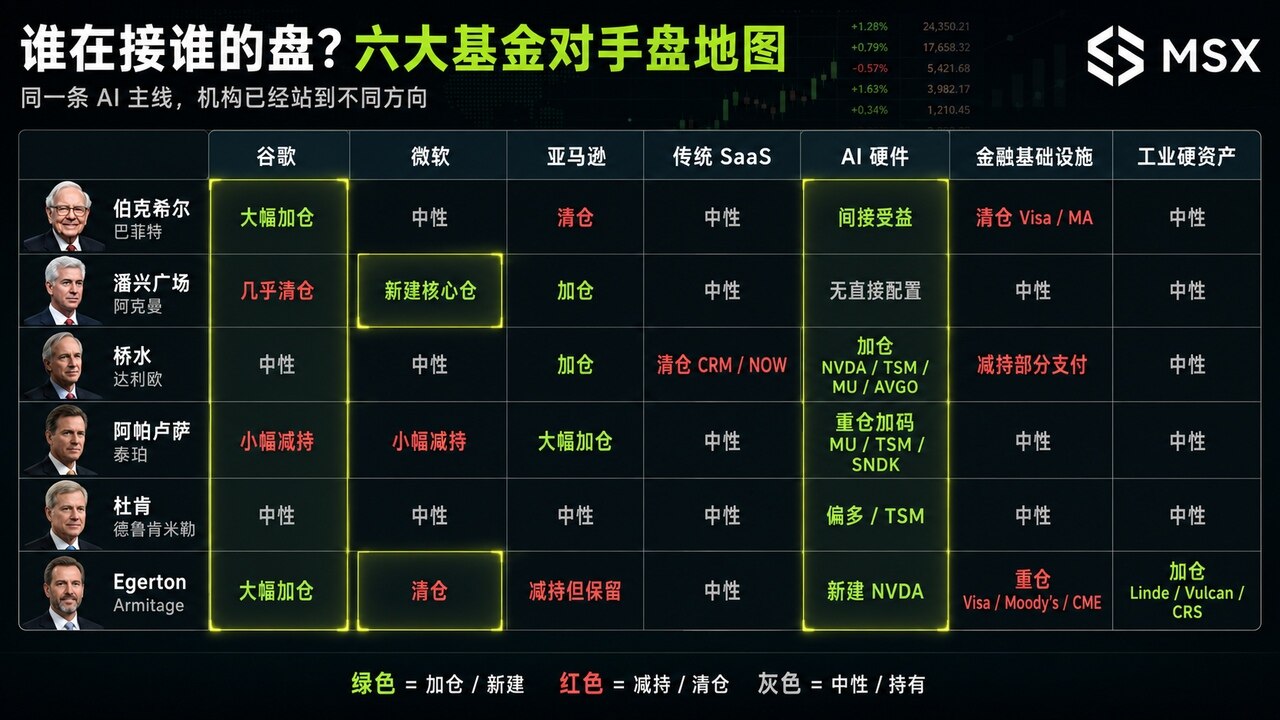
1. The Most Core Change: The Consensus Has Shifted from 'What to Buy' to 'Who is Taking Whom's Position'
One notable trend in this 13F is that institutions have begun to act as counterparties to each other within AI targets.
In the past, trading among U.S. stock institutions resembled a great river, with everyone generally moving in the same direction, just differing in position size and pace. Now, it feels more like a fork in the road, as everyone acknowledges AI as the main narrative, but no one is willing to pay the same valuation for the same story:
- Some buy Google because it is cheap, has strong cash flow, and YouTube and search still hold a moat; others sell Google because AI search might directly undermine its core business model;
- Some buy Microsoft because Azure and the enterprise AI entrance have higher certainty; some sell Microsoft because the market has already given it excessive AI premiums;
- Some buy Amazon because AWS remains the core platform for AI cloud capital expenditures; others sell Amazon because they no longer need to take on the risk of such high valuation platforms;
- Some flee Salesforce and ServiceNow because the intermediary value of traditional SaaS is being compressed by AI; others buy NVIDIA, TSMC, Micron, SanDisk because regardless of which AI application wins, the underlying hardware will need to be purchased first;
Therefore, the core of this 13F is not 'buy AI'.
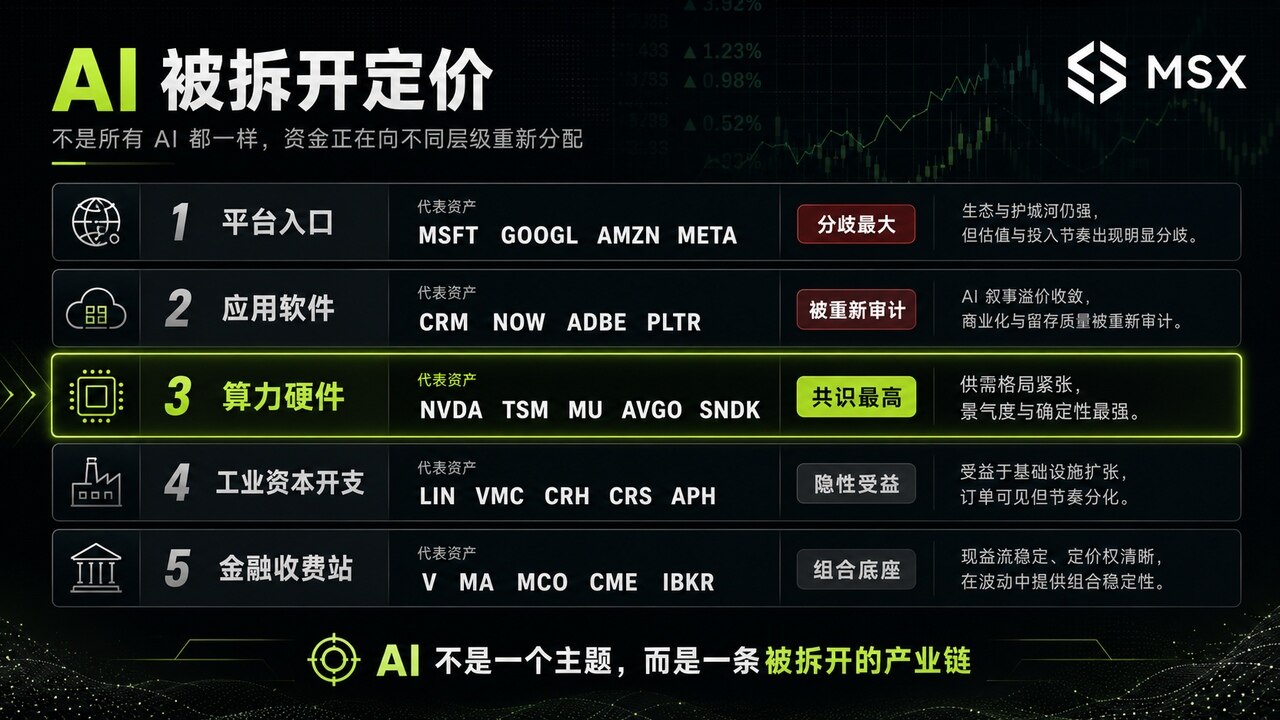
Instead, AI as a unified concept is breaking down, and institutions are starting to dissect it into layers of platforms, applications, hardware, industrial capital expenditures, and financial toll booths for re-pricing.
Let’s break this down in detail one by one.
1. Berkshire: Redefining in the Post-Buffett Era
Objectively speaking, Q1 2026 is the first complete observation window for Berkshire in the post-Buffett era.
The most interesting aspect of this 13F is that it did two seemingly contradictory things: on one hand, it significantly streamlined its portfolio, and on the other hand, it greatly increased its position in Google.
According to public reports, Berkshire significantly increased its Alphabet holdings in the first quarter while building new positions in Delta Airlines, Macy's, etc., and exiting multiple positions including Amazon, Visa, Mastercard, and UnitedHealth:
- Exiting Amazon, Visa, and Mastercard indicates it does not want to continue holding all past seemingly high-quality business models;
- Increasing its position in Google signifies it has not steered away from technology, but instead is seeking assets in technology that align more closely with Berkshire’s traditional aesthetics, namely strong cash flow, reasonable valuation, sufficient controversy, but underlying businesses that have not been completely debunked;
This is why Google has become the biggest point of divergence in this 13F; Berkshire is not buying the 'AI story', but rather a cash flow giant that the market is questioning again, standing on the side of 'Google's moat still has value.'
2. Pershing Square: Ackman Stands Opposite Buffett
If Berkshire is one of the biggest buyers of Google, then Ackman represents the most typical opposing position.
The most shocking action of Pershing Square in Q1 was almost completely exiting Alphabet while building a position in Microsoft, and Ackman emphasized in public explanations that Microsoft's valuation has become more attractive after a price correction, and the long-term growth potential of Azure, Microsoft 365, and enterprise AI remains strong. In other words, he shifted his tech exposure from Google to Microsoft.
This forms a sharp contrast with Berkshire; ultimately, Berkshire sees the resilience of cash flows from Google search, YouTube, cloud, and advertising, whereas Ackman perceives the disruption risk to search entrances posed by generative AI.
One believes Google is undervalued, while the other believes Google's moat is being revalued, or more plainly stated, Ackman has not given up on AI; he just believes Google is not the card with the highest probability of winning in this AI transaction.
3. Bridgewater: Dalio is Selling Software, Buying Hardware
Bridgewater's 13F has always been complex because it does not simply make judgments on individual companies but rather macro allocations.
However, this time Bridgewater’s direction is very clear: sell traditional software, buy AI hardware.
Public 13F tracking shows that Bridgewater exited Salesforce in the first quarter and significantly shifted towards AI hardware and infrastructure like NVIDIA, TSMC, and Amazon; reports from parts of the market also mentioned TSMC becoming one of Bridgewater's significant new builds for the season, while Salesforce became a major exit direction; this line is crucial.
It indicates that Bridgewater is not simply bullish on technology, but rather has made an industrial chain switch within technology. Over the past decade, traditional SaaS has been one of the most comfortable business models: subscription income, customer stickiness, high margins, and great cash flow; but with the emergence of AI, the valuation logic of traditional SaaS is beginning to be re-evaluated.
If large models can automatically generate code, complete processes, and replace certain functions of enterprise software, then the intermediate value of traditional SaaS will be compressed; thus, Bridgewater is not retreating from tech stocks, but rather transitioning from 'software intermediaries' to 'AI hard currency'.
Assets like NVIDIA, TSMC, Micron, Broadcom, Oracle, and Amazon represent computing power, wafer foundry, memory, networking, cloud, and infrastructure, with the common point being that regardless of which AI application ultimately wins, the underlying capital expenditures will likely pass through these phases first.
In summary, Bridgewater is not buying AI concepts but instead buying the necessary expenditures for AI.
4. Appaloosa: Tepper Bets on 'Hardware No One Can Avoid'
David Tepper's Appaloosa also provided a very strong direction in Q1.
Public reports indicate that Appaloosa significantly increased positions in Amazon and Uber, exited airline stocks, and added SanDisk, while continuing to increase exposure to semiconductor and AI hardware chain assets like Micron and TSMC.
Tepper's logic is actually similar to Bridgewater's but more direct: whoever wins AI is not important; first buy all the essentials that all winners must procure:
- Micron represents HBM and memory;
- TSMC represents advanced processes and foundry capacity;
- SanDisk represents the storage chain;
- Amazon represents AWS cloud infrastructure;
These are not purely AI application stories, but rather hardware, cloud, and infrastructure in the AI arms race. Naturally, upon closer inspection, while there is overlap with Bridgewater's thinking, Tepper is more concentrated and aggressive.
In other words, Bridgewater approaches it as a macro allocation 'increase hardware, decrease software,' while Tepper appears to be betting directly that the AI computing power cycle has not ended, asserting that those really able to secure orders and cash flow are the hardware and infrastructure chain.
In summary, Tepper is betting on the people selling shovels, particularly those closest to the power supply bottleneck.
5. Duquesne Family Office: Druckenmiller's Signal is 'Not Chasing the Hottest Spots'
Druckenmiller's Duquesne Family Office differs significantly from the previous ones.
It is not the most typical AI hardware buyer this time, but its significance lies in representing a different institutional mindset, one of not staying too long in the most crowded places.
In fact, Druckenmiller has already reduced or exited positions in popular AI concepts like NVIDIA and Palantir while continuing to monitor higher-upstream assets like TSMC; public reports also indicate that funds like Duquesne, which operate on a macro trading basis, are characterized by rapid adjustments rather than long-term adherence to a single narrative.
This aligns closely with the main line of this 13F; when the market has inflated AI applications into consensus, truly sensitive macro funds have begun to move toward higher-upstream, lower-tier, and cheaper segments.
In simple terms, he doesn’t occupy the most populated areas but moves ahead to places where the market hasn’t fully priced yet.
6. Egerton Capital: Exited Microsoft, Increased Google, NVIDIA, and Industrial Hard Assets
Egerton Capital not only bought AI but also financial infrastructure and industrial hard assets; more importantly, it exited Microsoft, taking the opposite stance to Ackman.
Public 13F tracking shows that Egerton Capital's first quarter 13F portfolio is about $9 billion, with the top five holdings including Visa, Alphabet, Moody's, Linde, and Carpenter Technology; at the same time, they newly built or increased positions in NVIDIA, Linde, Devon Energy, Canadian Natural Resources, etc.
This holdings arrangement is interesting; it does not simply reflect buying the seven sisters but divides the portfolio into several lines:
- The first line is financial infrastructure: Visa, Moody’s, CME, Interactive Brokers, Mastercard;
- The second line is AI platforms and computing power: Alphabet, NVIDIA;
- The third line is industrial hard assets and capital expenditures: Linde, Vulcan Materials, Carpenter Technology, Amphenol;
- The fourth line is energy and resources: Devon Energy, Canadian Natural Resources;
This shows that Egerton is not buying an AI story but is purchasing in the intersection of the AI cycle, industrial capital expenditure, and financial toll booths.
Crucially, it exited Microsoft, creating a very clear opposite position to Ackman.
Ackman believes Microsoft's victory probability is higher at the AI enterprise entrance and Azure, thus building a position in Microsoft; Egerton opts to exit Microsoft, allocating more tech exposure to Google and NVIDIA.
Despite both focusing on AI and quality growth, the institutions’ conclusions are completely opposite.
2. Horizontal Comparison: Who is Counter-Trading with Whom?
1. Google: The Biggest Divergence Sample in This 13F
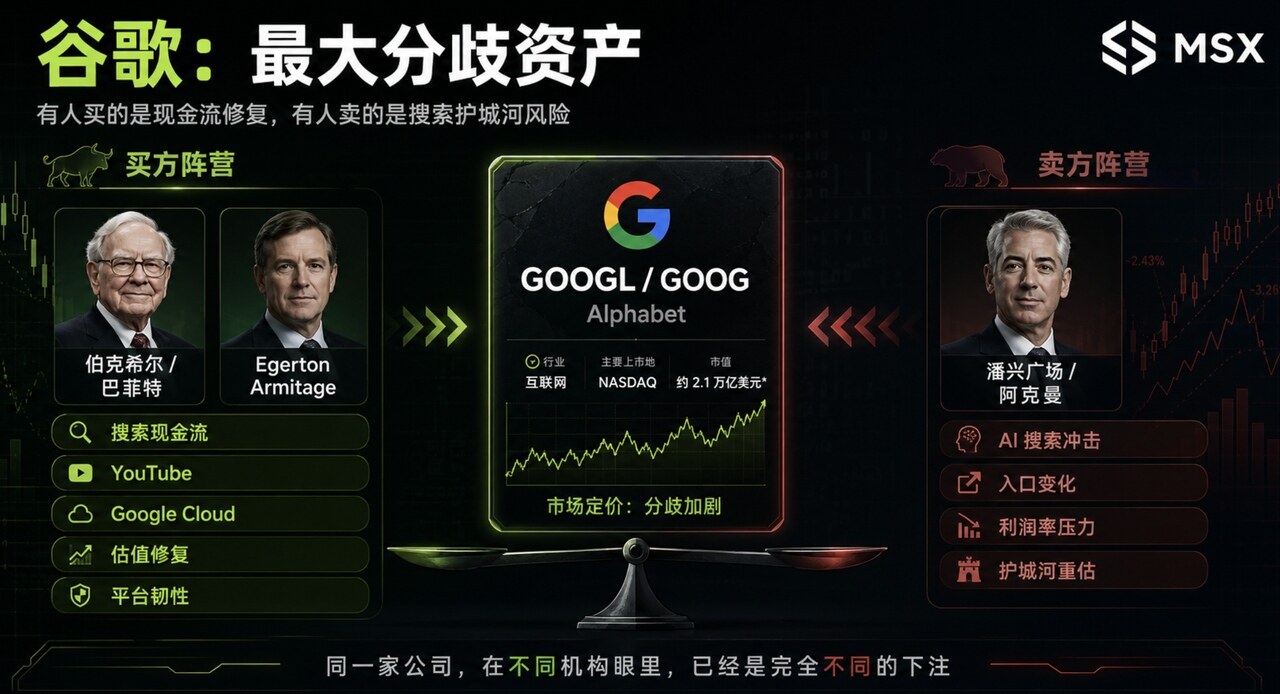
It can be said that Google is the most noteworthy asset in this 13F: Berkshire significantly increased its position, Egerton also increased its position in Alphabet, but Ackman almost exited.
This indicates that Google has changed from being the past consensus tech leader to a divergent asset. Those bullish believe that Google search, YouTube, cloud, and advertising cash flow are still strong, and its valuation is relatively not that expensive; the market has over-amplified the impact of AI. Conversely, those bearish believe that generative AI could alter search entrances, the advertising business model is facing revaluation, Google Cloud and Gemini need to prove their commercialization efficiency, and capital expenditures may compress profit margins.
Thus, Google is not simply a case of "institutions are all buying" or "institutions are all selling"; it’s more like a moat pressure test.
Those buying Google are acquiring cash flow and undervalued recovery; those selling Google are doing so out of concern for the disruption risk AI searches pose to old entrances.
2. Microsoft: Some See it as the Enterprise AI Entrance while Others Think It’s Already Overpriced
Microsoft is also a highly divergent subject this time.
Ackman’s new position in Microsoft stems from his observation of the long-term certainty of Azure, Microsoft 365, and enterprise AI; on the other hand, Egerton’s exit from Microsoft shows another class of institutions unwilling to pay excessive AI platform premiums for Microsoft.
This divergence is crucial. Microsoft has not been abandoned by the market, but it is no longer a consensus asset without controversy.
The core question is whether a good company has been overdrawn at a good price? This is also a common problem for high-priced tech stocks; the business can continue to be good, but the stock price has already priced in several years of future performance.
3. Amazon: Berkshire Sells, Ackman and Tepper Buy
Amazon is also not a consensus.
Berkshire exited Amazon, but Ackman, Tepper still value Amazon, and Bridgewater placed it in an important position, while Egerton retained their position despite reducing it.
The underlying divergence is whether Amazon is a high-valuation platform risk or the core infrastructure in the AI cloud capital expenditure cycle.
Those optimistic see AWS, its e-commerce fundamentals, advertising business, and AI cloud demand; those skeptical observe composition streamlining, valuation discipline, and rebalancing of platform assets.
Thus, Amazon does not represent a 'moat controversy' like Google; it resembles a 'portfolio positioning controversy, with institutions questioning whether a large exposure to Amazon is still necessary at the current price and portfolio structure.
4. Traditional SaaS: From Safe Asset to Audited Asset
Bridgewater's exit from Salesforce and ServiceNow represents one of the most structurally significant moves in this 13F.
It is not simply about selling two stocks; it represents the market's beginning to reassess the traditional SaaS business model, as SaaS used to be a high-quality asset relying on subscriptions, stickiness, and data processes to earn profits. However, with the widespread adoption of AI models, the intermediate value of enterprise software is being challenged.
If many processes can be automatically completed by AI, and numerous codes can be generated by AI, with various software functions directly invoked by large models, then the high valuations of traditional SaaS require reinterpretation.
This is also why, in this 13F, traditional software and AI hardware have formed a very clear opposing position—selling software intermediaries while buying computing power, memory, foundry, cloud, and hardware infrastructure.
5. Financial Infrastructure: Berkshire Sells, Egerton Buys
Visa and Mastercard also showcase an interesting divergence.
Berkshire exited Visa and Mastercard, but Egerton's primary holding is Visa, while also holding assets like Moody's, CME, Interactive Brokers, which shows that financial toll booths have not lost their value.
The disparity is simply in how different institutions view their positioning within the portfolio. Berkshire may be clearing out older holdings, while Egerton perceives Visa and Moody's as long-term cash flow bases.
Thus, this is not just a simple case of 'payment stocks are failing', but rather financial infrastructure is no longer an unthinking consensus, yet remains high-quality base assets in the eyes of certain institutions.
3. How Should We Understand This 13F?
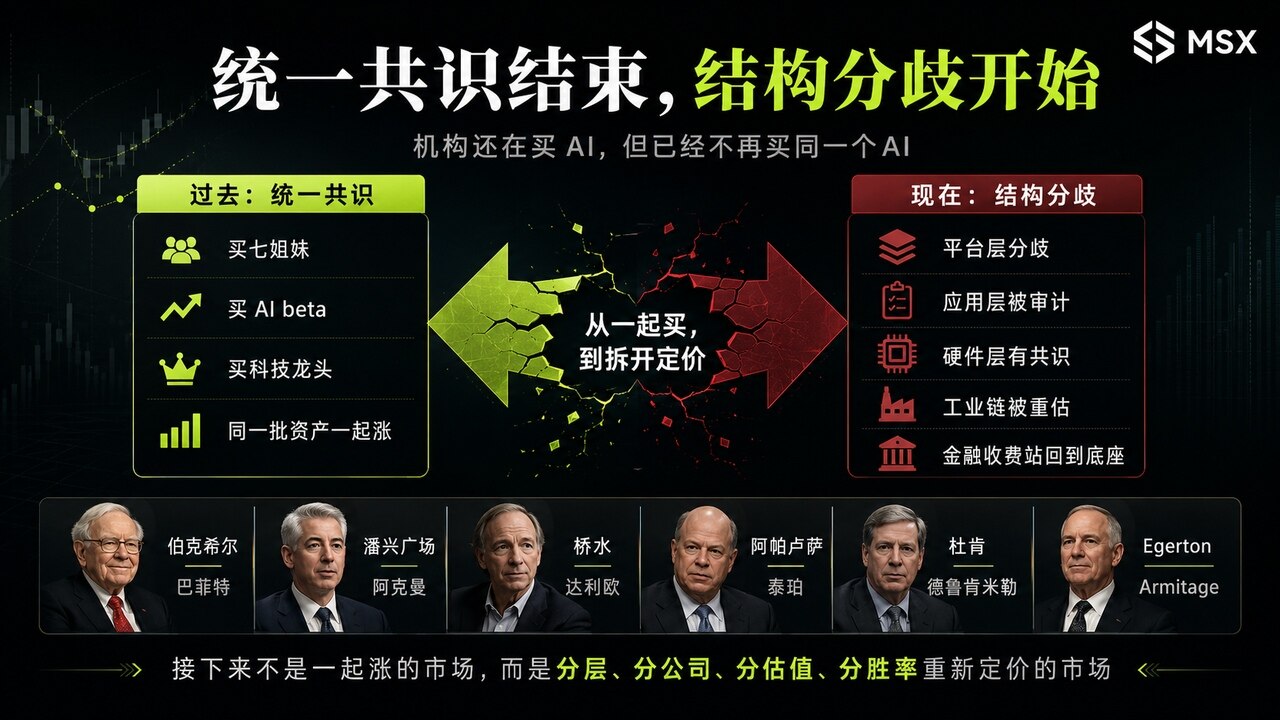
Many might say: this 13F still seems to be buying AI, how can it be said the consensus is gone?
The key is that the consensus direction around AI remains, but the beta consensus of AI has vanished.
It is well known that buying AI, buying the seven sisters, buying tech leaders, buying semiconductor ETFs have had a high probability of aligning with the main narrative, but now it’s different.
AI has been dissected; for example, layers including platform, application, hardware, cloud, industrial capital expenditures, and financial toll booths are starting to be valued independently, which suggests that the future will not just be 'any AI-related stock will rise'; the market will scrutinize details increasingly.
In brief, the true signal from this 13F is the AI transaction has shifted from generalization to stratification.
At the same time, the divergence concerning Google serves as a typical new signal—that no one has an eternal moat.
Search was once one of Google’s strongest moats, but with the emergence of generative AI, it must also re-accept market scrutiny. This does not mean that Google will definitely fail; rather, Berkshire and Egerton’s increased positions in Google indicate that some institutions believe the market is too pessimistic about Google; but Ackman’s exit from Google suggests that another class of institutions believes the changes in the search business model cannot be ignored.
This is what constitutes a truly mature market—not everyone believes in the same moat, but rather everybody is using new information to revalidate old beliefs.
Furthermore, Microsoft, Google, Amazon, NVIDIA, TSMC, Micron can all be good companies, but good companies do not equate to good prices.
Valuation discipline is very evident in this round of institutional movements: Berkshire realized part of its assets at high levels; Ackman bought into Microsoft after a correction; Egerton exited Microsoft but increased positions in Google and NVIDIA; Tepper bet on hardware but would also trim some high-tech exposures.
This indicates that big funds are not simply superstitious about company quality; they genuinely care about whether this quality, relative to the current price, offers sufficient odds.
Lastly, a commonality seen in many institutions this time is portfolio streamlining, with Berkshire and Appaloosa reducing holdings; Pershing Square was originally highly centralized while Egerton's nearly billion-dollar portfolio includes only over twenty U.S. stock holdings.
This indicates that in a high-level market, true large funds may not necessarily be more diversified, but rather more concentrated. The deeper one gets into a period of divergence, the more one cannot rely on 'buying a little of everything' to resolve issues.
You must know which layer you are buying, what risks you are taking on, who your counterparties are, and why the market might reprice it.
4. What Insights Does This Give Us?
I believe the greatest value of this 13F is who is buying, who is selling, and who is taking whom's position.
If an asset is being bought by all institutions collectively, that indicates consensus; if an asset is being significantly bought by one portion of top-quality funds while simultaneously being sold off by another portion, that indicates divergence.
Divergence assets are more worthy of study than consensus assets because real excess returns often appear when the market has not yet reached a unified answer.
Google serves as a typical example.
Berkshire and Egerton are on the buy-side, whereas Ackman is on the sell-side.
This does not prompt you to simply choose a side, but rather reminds you: you must answer one question—do you believe Google’s search moat has been permanently weakened by AI, or do you think it has been temporarily undervalued by the market?
If unable to answer, don't copy the homework.
Another critical point is that in the future, when assessing AI, you can no longer just ask, 'is it an AI concept'; you must at least break it down into three layers:
Platform layer: including Microsoft, Google, Amazon, Meta. Evaluate the entrance, cloud, advertising, cash flow, and ecological positioning;
Application layer: including Salesforce, ServiceNow, Adobe, Palantir, etc. Assess if AI is enhancing or replacing it;
Hardware and infrastructure layer: including NVIDIA, TSMC, Micron, Broadcom, SanDisk, Oracle, as well as electricity, industrial gases, materials, data center chains, overall assessing capital expenditures, capacity bottlenecks, and order fulfillment.
Overall, this time the most consistent asset among institutions is not all AI but rather hardware and infrastructure; the greatest divergence exists at the platform level; and the highest pressure points lie in traditional application software.
Additionally, a friendly reminder: do not use 'holding long-term' as an excuse not to sell. Ackman’s exit from Google, Berkshire's exit from Visa, Mastercard, Amazon, and Bridgewater's exit from Salesforce and ServiceNow all signify that real institutional investors will not hold onto something just because they’ve held it for a long time.
The standard for selling should not be 'how long I have held it' but rather whether my original reasons for buying still hold valid?
If the moat has changed, cash flow expectations have shifted, valuation odds have altered, or industry positioning has changed, then simply holding on for a long time should not be a reason to continue holding.
Holding duration is a result.
Holding conditions are the premise.
Of course, another point is that it is time to streamline holdings; many retail investors like to build a supermarket-style portfolio—holding twenty or thirty stocks without substantial capital, claiming to spread risk.
However, in this 13F, true large funds are precisely streamlining their portfolios at high levels for a straightforward reason: when the market enters a period of divergence, the differences between assets widen, and the more diversified one is, the more likely they are to dilute genuinely promising positions while buying into risks that they haven’t comprehended.
If you cannot summarize a stock's core competitiveness, major risks, and current odds in three sentences, it doesn’t belong in your core holdings.
Lastly, this 13F also conveys an old truth: in a high-level market, cash is not trash.
Berkshire cashing out some assets at high levels, Tepper trimming high-tech exposure, and Druckenmiller not clinging to popular AI all point to the same act—avoiding the risk of being passively hit in the most crowded trades.
When a popular asset surges excessively in the short term and its valuation clearly entails a prepayment of future performance, the best discipline is not to fantasize about selling at the peak, but rather to gradually convert profits into cash.
The value of cash is not reflected when prices rise; it appears when the market suddenly takes a nonlinear fall.
In Conclusion
To summarize this 13F in one sentence: Institutions are still buying AI, but they are no longer buying the same AI.
Thus, what this 13F truly tells us is not which big shot to copy, but rather when top-tier institutions begin trading against each other, ordinary investors must look beyond conclusions and clearly understand the assumptions behind each transaction.
The consensus hasn't completely vanished, but the unified consensus has ended. Going forward, the U.S. stock market will no longer be a market that rises in unison but will be one that needs to be stratified, evaluating companies, valuations, and probabilities anew.
Let us welcome the new direction together.
免责声明:本文章仅代表作者个人观点,不代表本平台的立场和观点。本文章仅供信息分享,不构成对任何人的任何投资建议。用户与作者之间的任何争议,与本平台无关。如网页中刊载的文章或图片涉及侵权,请提供相关的权利证明和身份证明发送邮件到support@aicoin.com,本平台相关工作人员将会进行核查。


