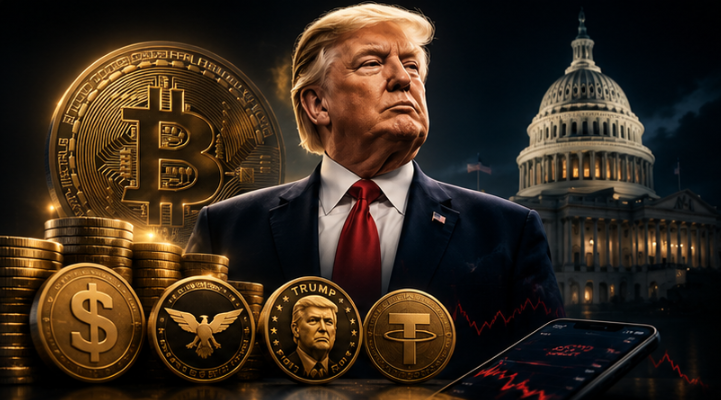
In June 2026, Reuters published two in-depth investigative reports on the cryptocurrency business landscape of the Trump family, drawing widespread attention from the global financial markets and media. The investigation revealed that since Trump's return to the White House, his family has generated approximately $2.3 billion in profits through four core cryptocurrency ventures—World Liberty Financial (WLFI), the $TRUMP meme coin, American Bitcoin, and ALT5 Sigma (later renamed AI Financial)—while at the same time, many investors involved in these projects faced total losses close to $2.3 billion. Although "the family profits $2.3 billion while investors lose $2.3 billion" does not necessarily imply a strict one-to-one correspondence between the two, this figure clearly reflects a reality: during the cryptocurrency boom of the past two years, the Trump family has gained substantial profits through brand licensing, equity arrangements, token distribution, and capital operation, while many ordinary investors have shouldered most of the risks as the market enthusiasm subsided.
Even more noteworthy is that these four businesses, although spread across different sectors and covering decentralized finance, stablecoins, meme coins, Bitcoin mining, and digital payments, all share a highly consistent underlying logic. They have not achieved success through revolutionary technological innovation, nor have they established market value through steadily growing business income, but rather to a large extent, leveraged the significant influence and topical effect of Trump, a globally recognized political figure, to convert political brands into financial assets, and then package these financial assets as investment opportunities to sell to the market.
From "Bitcoin is a scam" to building a cryptocurrency empire
If one reviews Trump's past public stance on digital currencies, this change is quite dramatic. As early as between 2019 and 2021, Trump expressed skepticism about Bitcoin and other digital assets multiple times. He not only publicly stated that he was not a supporter of Bitcoin but also believed that digital currencies could threaten the dollar's status as the global reserve currency, even going so far as to call Bitcoin "something that looks like a scam."
However, as the U.S. cryptocurrency industry gradually grew into a significant political donation force, and as the digital asset market attracted increasing attention from younger voters and investors, Trump’s stance began to shift noticeably. During the 2024 presidential campaign, he started frequently sending friendly signals to the cryptocurrency industry, promising to push for the United States to become a global cryptocurrency hub, oppose excessive regulation, and support innovation in digital assets. As his campaign gained traction and expectations for his policies in the cryptocurrency sector continued to heat up, Trump was gradually shaped by the market into the so-called "crypto president."
Amidst this backdrop of interlocking political and market sentiments, a cryptocurrency business network centered around the Trump family quickly took shape. Unlike traditional entrepreneurs who need to invest in technological research and development, build infrastructure, or operate businesses for the long term, the most important asset of the Trump family is actually just one— the name Trump itself. The political influence, media attention, and societal discussion that this name represents became the core foundation of all subsequent business operations.
World Liberty Financial: The most important cash cow of Trump's cryptocurrency empire
Among all the Trump family's cryptocurrency projects, World Liberty Financial is undoubtedly the core and the most profitable business. From public promotion, this project is positioned as a decentralized financial platform, aiming to create a comprehensive ecosystem that integrates lending, stablecoin issuance, on-chain asset management, and digital financial services. However, what truly supports its market value is not technological innovation, but rather the political brand endorsement provided by the Trump family.
World Liberty Financial initially raised funds by issuing WLFI governance tokens. Unlike normal cryptocurrencies, this token does not possess free trading attributes, and investors remain in a locked state after purchasing it, with its main function being to participate in project governance voting. From a business logic standpoint, this means that investors bear the risk of asset price volatility without obtaining the normal liquidity expected in the market.
More importantly, according to publicly disclosed information, Trump-affiliated entities hold important economic rights in the project and receive a high percentage of the revenue from token sales. In other words, when investors purchase WLFI tokens, a large amount of funds goes directly into the project system, and a considerable portion of the profits ultimately flows to the Trump family. Reuters estimates that this single venture has generated around $1.6 billion in revenue for the Trump family, which accounts for most of the total profits across the entire cryptocurrency landscape.
In addition to governance tokens, World Liberty Financial also launched the stablecoin USD1. Similar to mainstream stablecoins like USDT and USDC, the business model of USD1 essentially involves using the U.S. dollars deposited by users to purchase U.S. Treasury bonds and other low-risk financial assets, generating revenue through the interest produced by these assets. As the stablecoin scale continues to expand, the fund pool controlled by the project will also grow in tandem, with the interest income generated serving as a source of steady cash flow. For the project operator, this model means that even if market trading enthusiasm declines, as long as the scale of the stablecoin can be maintained, the revenue source remains relatively stable.
However, for investors, the situation is entirely different. As market sentiment gradually cools, the price of WLFI tokens continues to drop, and coupled with restricted liquidity and the existence of the lock-up mechanism, many investors are unable to exit in time. According to Reuters statistics, losses related to investors associated with World Liberty Financial have reached hundreds of millions of dollars, while the Trump family has long locked in substantial profits through token sales and project revenue distribution.
$TRUMP Meme Coin: The most direct financialization experiment of presidential IP
If World Liberty Financial at least has some financial business logic, then the $TRUMP meme coin represents the most direct and thorough commercial realization of the Trump brand.
Meme coins do not generate cash flow and lack traditional asset backing; their value mainly derives from market sentiment and community consensus. Whether it's Dogecoin or Shiba Inu Coin, their price increases more depend on topical spread and investor sentiment rather than actual business performance.
Trump clearly has the ability to create market sentiment. After the launch of the $TRUMP meme coin, a large number of investors quickly flooded into the market. Many bought the token not because they understood blockchain technology or because they were optimistic about its future application scenarios, but because they believed in Trump’s brand value, even viewing the presidential title as a form of implicit credit endorsement.
During the market frenzy, the token price rose rapidly, creating a typical speculative environment for meme coins. According to a Reuters investigation, Trump-affiliated entities hold a large number of reserved tokens and have gained over $600 million from the rise in token value and related fee income.
However, the meme coin market has always followed a similar pattern: early market entrants tend to reap the most profits, while latecomers bear the most significant risks. When market enthusiasm begins to wane, the price of $TRUMP retraced about 97% from its peak, leaving many retail investors who bought at high prices facing severe losses. Many later admitted that they were not investing in a rigorously researched project, but rather placing faith in Trump’s brand and presidential identity.
American Bitcoin: Injecting the Trump concept into a mining company
Compared to the previous two projects, American Bitcoin appears closer to the traditional cryptocurrency industry. This company mainly engages in Bitcoin mining, and its business model includes building mining farms, deploying mining machines, obtaining Bitcoin rewards, and holding or selling Bitcoin for profit.
From an industry perspective, this was originally a relatively ordinary mining company. However, when the Trump family got involved, the market quickly assigned it a new identity—"Trump concept stock."
For mining companies, the biggest challenge is often not the mining technology itself, but rather financing ability and market valuation. The addition of the Trump brand significantly increased American Bitcoin's visibility in the capital markets, as investors were willing to provide a valuation far above the industry average.
Subsequently, the company achieved public trading through a merger with a listed company. Fueled by the capital markets, its valuation once surged, and the value of the equity held by the Trump family also rapidly increased. For the Trump family, the most significant advantage of this model lies in acquiring significant book wealth growth without directly selling assets.
However, as the market began to refocus on business fundamentals, problems gradually emerged. The profitability of mining companies ultimately depends on Bitcoin prices, electricity costs, equipment efficiency, and operational management levels, not on a political figure's name. When market sentiment ebbed, stock prices began to return to reality, and many investors who had bought at high prices faced corresponding losses.
ALT5 Sigma and AI Financial: A capital frenzy brought by concept overlapping
Compared to the previous projects, the story of ALT5 Sigma resembles a conceptual game in the capital markets.
This company initially engaged in digital payment and cryptocurrency asset settlement services, with its main clients being enterprises and merchants, providing cryptocurrency payment processing, digital asset transfer, and settlement services. Based on the business itself, it aligns more closely with a fintech company.
However, after establishing a connection with the Trump cryptocurrency ecosystem, the company began to receive unprecedented market attention. It later rebranded as AI Financial, simultaneously combining artificial intelligence, cryptocurrency, and the Trump concept.
In the capital markets, few investment themes can boast the three hot labels of AI, Crypto, and Trump at the same time. Hence, the company's stock price surged, and the market assigned it a valuation far exceeding that of traditional payment companies.
But the capital market ultimately needs to return to reality. As investors gradually realized that the company's actual revenue growth could not match such high valuations, market enthusiasm began to cool, and stock prices showed significant declines. For early shareholders, this appreciation process had created substantial wealth; while for later investors, it meant bearing losses when the high valuations normalized.
The common logic behind the four projects: How political influence transforms into financial assets
On the surface, these four businesses belong to completely different industry sectors, but a closer analysis reveals they follow the same set of business logic.
Firstly, the Trump family leverages its globally recognized political brand to establish market trust and attention; secondly, they amplify market sentiment through media dissemination and social platforms; afterward, the projects attract investors through token issuance, financing going public, or pushing up valuations; and finally, the family realizes profits through equity, tokens, revenue sharing, or brand licensing fees.
In this process, the Trump family gains front-end profits, while market investors shoulder back-end risks.
In a sense, these four projects are not traditional technology startup stories but resemble an experiment on how political influence can be converted into financial assets. When the presidential identity combines with the capital market, the resulting amplification effect far exceeds what ordinary companies can achieve.
Who are the real payers?
From a business perspective, the Trump family undoubtedly executed an extremely successful brand monetization. They utilized their influence to establish a cryptocurrency business empire covering stablecoins, meme coins, mining, and digital payments with almost no need to commit significant personal capital, yielding billions in profits.
However, for investors, this event once again proves an old and harsh rule of the financial market: when investment decisions are based on emotion, belief, and celebrity effects, risks have likely already begun to accumulate.
Many investors buying these assets did not carefully analyze the projects' cash flow, profitability, and business models; instead, they were buying an imagination of future appreciation. They believed that the presidential identity could create value, that political influence could continually drive price increases, and that the brand itself would be sufficient to replace fundamentals.
However, history has repeatedly shown that while brands can generate attention and traffic can create short-term prices, the long-term value is ultimately determined by how much real profit assets can generate.
The $2.3 billion wealth created by the Trump family's cryptocurrency empire may merely be a numerical success story; yet for the entire market, it resembles a real lesson on how political influence, capital markets, and investment psychology interact with one another.
免责声明:本文章仅代表作者个人观点,不代表本平台的立场和观点。本文章仅供信息分享,不构成对任何人的任何投资建议。用户与作者之间的任何争议,与本平台无关。如网页中刊载的文章或图片涉及侵权,请提供相关的权利证明和身份证明发送邮件到support@aicoin.com,本平台相关工作人员将会进行核查。


