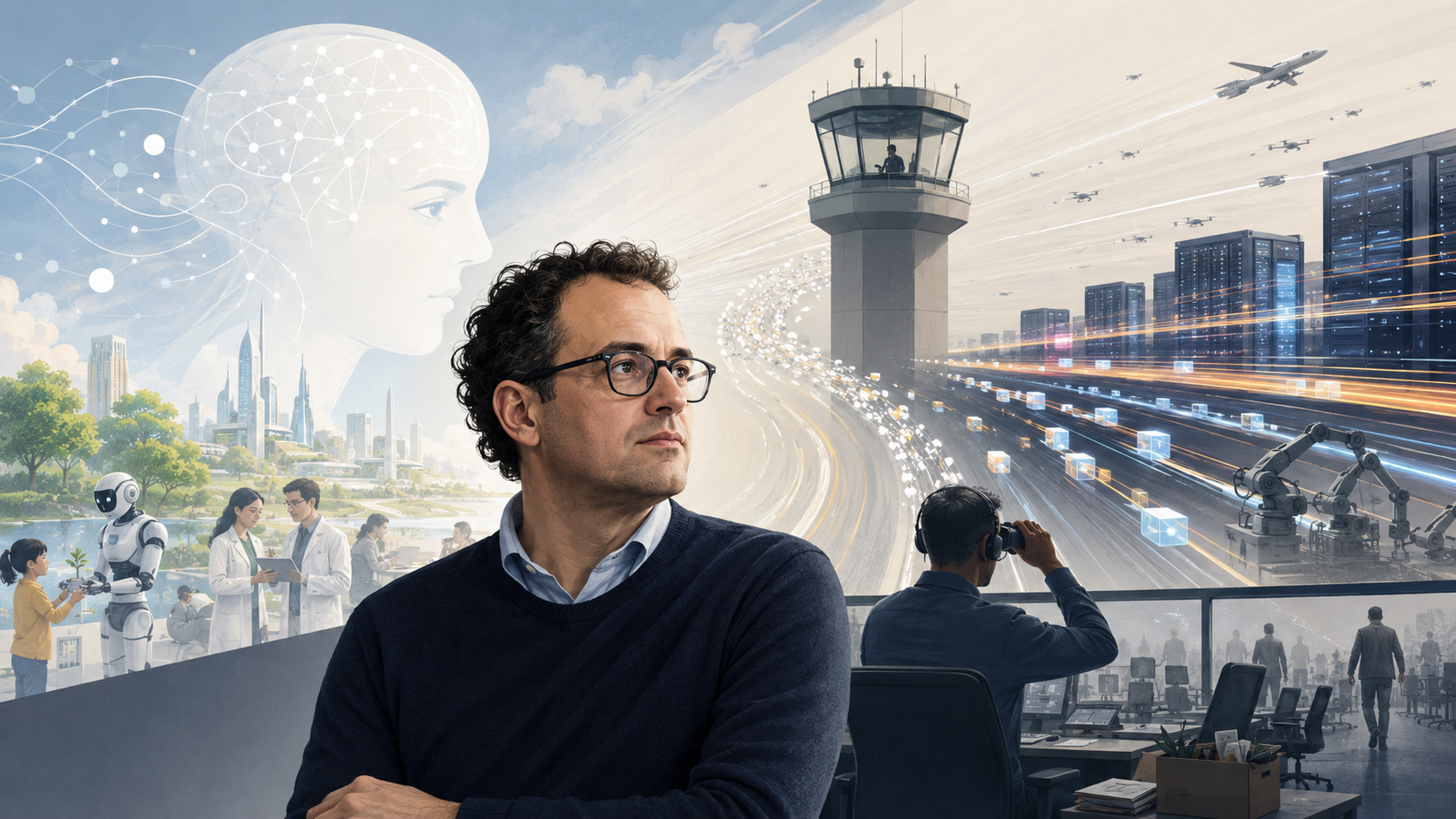
In June 2026, Anthropic CEO Dario Amodei published a public article titled “Policy on the AI Exponential.” In this lengthy piece, he made a specific suggestion: the U.S. government should establish a regulatory body similar to the Federal Aviation Administration (FAA) to conduct mandatory third-party testing on all cutting-edge AI models. The tests would cover four dimensions: cybersecurity, biological weapons, uncontrolled risks, and automated research and development. The government would have the authority to prevent the release of models that do not pass the tests.
In the same article, Amodei also wrote a statement that is quite rare among the CEO community in Silicon Valley: AI may lead to “significant and persistent unemployment,” which may be an “inherent property of technology broadly replicating human cognition,” and traditional economic adjustment mechanisms may be overwhelmed by the speed of technology.
For a CEO who has long held “Responsible Scaling” (Responsible Scaling Policy, abbreviated as RSP) as his external banner, these statements are not made lightly. For the past three years, his public stance has been corporate transparency and waiting for risks to materialize before legislating. Now he is not only calling for government intervention but is also announcing that Anthropic will invest approximately $350 million to promote the implementation of this regulatory framework.
The transition from “corporate self-regulation” to “actively spending and seeking legislation” itself signals a change. What corrections have Amodei’s views undergone in the past few years? What factors have forced him to shift from “internal constraints” to “external demands”?

An Optimistic Letter, A Warning, A Call for Help
Amodei's diagnosis in “Policy on the AI Exponential” is: AI technology is developing exponentially, significantly exceeding the response speed of existing policy-making processes. He mentioned that the Claude Mythos Preview model released by Anthropic in April of this year exhibited national-level vulnerability discovery capabilities in cybersecurity. According to the system card released by Anthropic, the model's performance in tasks such as zero-day vulnerability discovery has already reached the threshold for reporting to national security agencies.
The prescription is to establish a mandatory regulatory mechanism similar to the FAA. Preceding models must undergo third-party testing across four dimensions, and the government has the right to block the release of models that do not pass the tests. The radical aspect of this suggestion is that it demands not industry self-regulation or voluntary commitments, but legally binding pre-approval.
Amodei clearly acknowledges that AI may lead to large-scale persistent unemployment. He wrote that this might be an “inherent property of technology broadly replicating human cognition,” and traditional economic adjustment mechanisms may be overwhelmed by the speed of technology. This judgment is consistent with his earlier stance in “The Adolescence of Technology,” but the expression is more definitive.
Along with the article, Anthropic announced three new initiatives: a $200 million Economic Futures Research Fund for empirical research and policy experimentation; a $150 million national scholarship program aimed at early-career professionals; and funding support for legislative proposals and unemployment policy frameworks related to testing cutting-edge models. The official name for the third initiative has not yet been announced, but various media reports indicate that its core is to directly fund legislative advocacy work.
The total amount of these three initiatives is approximately $350 million. For reference, Anthropic completed a $30 billion Series G financing round in February 2026, reaching a company valuation of $380 billion. $350 million accounts for about 1.2% of that financing round.
The $200 million Economic Futures Research Fund did not appear out of nowhere. Anthropic launched the Economic Futures Program in June 2025, with an initial promised amount of $10 million. From $10 million to $200 million, the scale increased 20-fold within a year. This leap indicates that Amodei’s judgment regarding the economic impact of AI is tightening; he no longer considers it a long-term issue.
From Optimistic Vision to Policy Appeal
Amodei’s policy shift did not happen suddenly. When examining the three major articles he published over the past two years together, a trajectory of correction becomes apparent.
In October 2024, Amodei published “Machines of Loving Grace.” The tone of this article was optimistic. He described a future where AI greatly benefits humanity: in biology and health, AI can compress scientific discoveries that would typically take decades into just a few years; in economic development, AI can bring unprecedented productivity enhancement; on a broader social level, AI has the potential to help humanity solve grand issues like climate change and poverty.
The core message of this article was: the risks of AI are real, but as long as humanity can safely navigate the critical window of technological development, the rewards will be immense. At that time, Amodei positioned this critical window around 2026.
By January 2026, Amodei published “The Adolescence of Technology.” The tone of this long article changed significantly. He compared the current stage of technological development to the “adolescence” of human civilization: dangerous, unpredictable, but unavoidable. He began to shift from technical safety to broader socio-economic risks, calling for a wealth tax to address the economic impacts that AI may bring.
In the article, Amodei no longer described the economic risks of AI as “transitional pains needing management,” but began using terms like “structural shock.” He wrote that the impact of AI on the labor market may not be gradual but could be leap-like; once certain cognitive abilities are replicated by models, corresponding occupational groups may face massive replacement in a short time.
Then came the June 2026 “Policy on the AI Exponential.” Amodei’s position transitioned from “warning” to directly proposing policy prescriptions, and he is willing to invest time and effort to promote this.
The optimistic vision of “Machines of Loving Grace” was squeezed by the real risks highlighted in “The Adolescence of Technology”; the latter’s warning about the labor market was upgraded in “Policy on the AI Exponential” to a direct appeal for policy tools. This is not a flip-flop in stance, but rather a judgment adjustment forced step by step by the overflow of technological capability into economic and national security.
What Was Removed from RSP 1.0 to 3.0
To understand why Amodei shifted from “internal constraints” to “external demands,” it is also necessary to look at what has happened within Anthropic’s self-regulation framework.
In September 2023, Anthropic released the RSP 1.0 version. This is an internal governance framework for security, with the core commitment being: if a model reaches certain predefined dangerous capability thresholds without adequate safety measures, Anthropic will suspend training or deployment. RSP 1.0 represented a typical “internal constraints” approach: the company sets its own red lines, monitors itself, and commits to compliance. At that time, this framework was seen as a benchmark for self-regulation among leading AI companies by the safety community.
On February 24, 2026, Anthropic released the RSP 3.0 version. This version removed some of the strict commitments from earlier iterations, including modifications to the hard suspension training conditions. The safety community responded quickly. Zvi Mowshowitz, a long-time observer of AI safety, published an analysis on Substack, criticizing this modification as a concession to commercial competitive pressure. Similar criticisms also emerged in effective altruism forums, suggesting that Anthropic's retreat from security commitments indicates that relying solely on corporate self-regulation is not sustainable in reality.
The evolution from RSP 1.0 to 3.0 exposed a structural problem. When commercial competition and technological acceleration pressurize simultaneously, it is difficult to maintain hard safety clauses unilaterally committed by a company. If one company slows down due to safety concerns while its competitors do not face the same constraints, then safety self-regulation becomes a competitive disadvantage.
This dilemma directly laid the logical groundwork for Amodei's policy appeal in June. In “Policy on the AI Exponential,” he essentially acknowledged this point: since internal self-regulation is insufficient, external enforcement is needed to set industry bottom lines.
But there is a trust paradox here. While Amodei called for external regulation, Anthropic’s own self-regulation framework had just undergone a modification criticized by the safety community as a “retreat.” Some members of the safety community thus questioned: does a company that compromises on internal self-regulation have the credibility to call for government to establish mandatory regulations? In discussions on Hacker News, some commenters described this as a suspicion of “being both athlete and referee.”
What Is $350 Million Buying?
The three new initiatives announced by Anthropic may appear on the surface to be charitable and public welfare investments. But when viewed alongside Amodei’s policy appeal, the actual function of these funds becomes clearer.
The $200 million Economic Futures Research Fund is intended for empirical research and policy experimentation. The $150 million scholarship program is for early-career professionals. The third initiative directly funds legislative proposals and policy framework advocacy work.
These funds are precisely targeted at the policy directions outlined by Amodei in his lengthy piece. The Economic Futures Research Fund can be used to support research that backs his judgment of “AI causing structural unemployment,” providing academic backing for policy legislation. The scholarship program can cultivate a batch of professionals who resonate with his governance ideas. The legislative advocacy fund is the most direct: providing money to help draft and lobby for bills aligned with Anthropic’s safety concepts.
In discussions on Hacker News, some developers raised concerns about “regulatory capture.” This concept refers to the scenario where companies push for regulation to raise industry entry barriers, thus consolidating their market position. Mandatory third-party testing and high compliance costs may be controllable expenses for leading companies like Anthropic that already have well-established safety teams and red team testing capabilities. However, for startups with limited funding and talent, this may pose an insurmountable barrier.
An analysis article on Medium directly raised this issue: is Amodei’s proposal a safety plan, or a blueprint for regulatory capture? The article pointed out that Anthropic abandoned hard suspension commitments in RSP 3.0 but is now demanding that the government impose legal constraints on the entire industry.
From Amodei’s logical perspective, he may not see this as a contradiction. In his framework, the compromise of internal self-regulation is precisely due to the absence of external enforcement that leads to a prisoner’s dilemma. If the government sets a uniform industry bottom line, companies do not need to choose between “safety” and “competition.” From this perspective, the $350 million is an attempt to break this dilemma.
However, this logic has a premise: the design of the regulatory framework must be fair and cannot favor any single company. Whether Anthropic, as the promoter and funder of the framework, can maintain this distance is a question that has not yet been answered.
Does the Safety Community Buy It?
The response to Amodei’s policy appeal from developers and the safety community can be described as “divided.”
Some people believe that this is the first time that a leading AI company has acknowledged the limitations of industry self-regulation with such specific policy suggestions and real monetary investments. In the context of AI capabilities spilling over rapidly into sensitive areas like cybersecurity and biosecurity, government intervention to set bottom lines is necessary and urgent.
Another part of the questioning focuses on two points. The first is the trust issue. Anthropic's concessions in RSP 3.0 led some members of the safety community to believe that the company has already overdrawn its credibility. Zvi Mowshowitz’s analytical article on Substack critiqued each retreat in Anthropic’s commitments. In this context, Amodei’s call for government regulation was interpreted by some as “if you can’t do it, then let the government force everyone to do it.”
The second concern is the risk of regulatory capture. The compliance costs of mandatory third-party testing may become a moat for leading enterprises. Anthropic’s investments in safety infrastructure are leading in the industry; if regulatory standards are based on Anthropic's current practices, other companies will incur enormous costs to catch up.
However, one factor in Amodei’s appeal has made the option of “doing nothing” increasingly unacceptable. After the release of the Claude Mythos Preview in April 2026, its demonstrated cybersecurity capabilities exceeded the expectations of many observers. According to the official system card from Anthropic, the model's performance in zero-day vulnerability discovery tasks has triggered internal agreements for reporting to national security agencies. The UK AI Safety Institute subsequently released an independent assessment report on Mythos Preview, confirming the magnitude of its capabilities in cybersecurity.
When a model’s capabilities have already reached the level of national security, and the internal RSP framework of the company has been forced to compromise under commercial competitive pressure, the remaining options are indeed limited. Either the government intervenes to set mandatory bottom lines, or one must accept a race devoid of any hard constraints. This tension is not solely a problem for Anthropic.
What Has Changed in Three Years of Positions?
From “Responsible Scaling” to “Policy Exponential Gap,” the core change in Amodei’s governance thought is: he no longer believes that corporate self-regulation is sufficient to cope with the speed of AI development.
This judgment has been gradually pushed forward by a series of events. The optimistic vision of 2024 has been revised in the face of the technological realities of 2025 and 2026. The compromises from RSP 1.0 to 3.0 have demonstrated the vulnerability of internal self-regulation frameworks under commercial competitive pressure. The capability overflow of Claude Mythos Preview has rendered the incremental approach of “waiting for risks to materialize before legislating” unfeasible.
Amodei’s response is to turn to external enforcement. He not only calls for the government to establish a regulatory mechanism similar to the FAA but also dedicates $350 million to promote the implementation of the framework. The essence of this posture shift is that when the speed of technological development surpasses the capacity of corporate self-regulation, the only constraint that can still keep up is government.
However, this solution also brings new issues. The risks of regulatory capture, the trust deficit brought about by retreating self-regulation commitments, and the controversy around the judgment that “AI will inevitably lead to large-scale persistent unemployment” in academic circles are all real resistance that Amodei’s policy appeal will need to confront.
For those observing the cutting-edge AI industry, Amodei’s lengthy piece provides a clear signal: when the CEO of an AI company that bears safety as its banner publicly acknowledges that its self-regulation framework is insufficient and actively calls for help from the government, this itself is a node worth tracking.
免责声明:本文章仅代表作者个人观点,不代表本平台的立场和观点。本文章仅供信息分享,不构成对任何人的任何投资建议。用户与作者之间的任何争议,与本平台无关。如网页中刊载的文章或图片涉及侵权,请提供相关的权利证明和身份证明发送邮件到support@aicoin.com,本平台相关工作人员将会进行核查。


