Author: Max.s
A person who lost 90 billion dollars decided to create a project that cannot spend money.
You read that correctly.
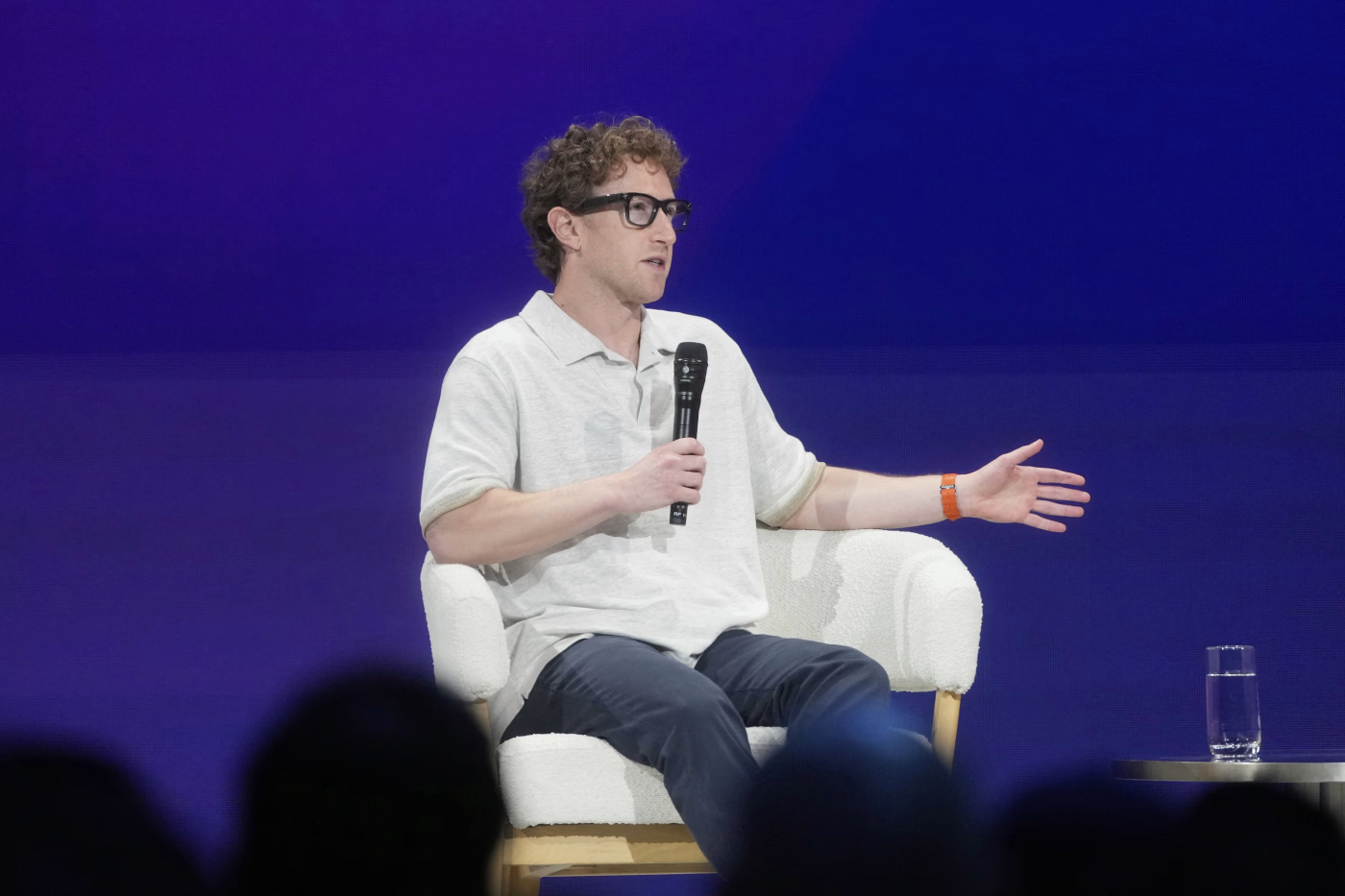
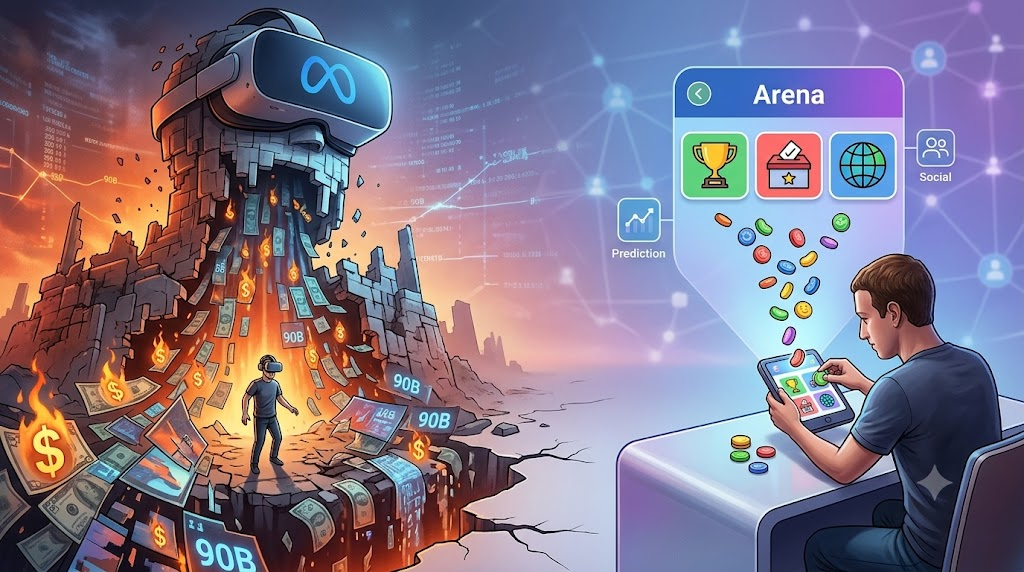
Just yesterday, The New York Times revealed that Zuckerberg personally led a team to develop a prediction market application called Arena — users can bet on the results of elections, sports, and international events, but the chips are points. Not dollars, not USDC, but joy beans.
Yes! Just like those you wouldn't mind losing after a night of Mahjong.
What lesson can be bought with 90 billion dollars?
Let's review the "burning money chronicle" of Meta.
In 2021, Zuckerberg renamed Facebook to Meta, claiming to build the metaverse. His Reality Labs division began to spend money extravagantly — VR headsets, the virtual social platform Horizon Worlds, immersive office spaces…
And what was the result?
Horizon Worlds' monthly active users once fell below 200,000, failing to reach the original target of 500,000. In 2024, the loss was 17.7 billion dollars, in 2025, the loss was 19.2 billion dollars, with the total loss nearing 90 billion dollars. 90 billion. This amount is enough to buy several Polymarkets.
And Meta itself admits that the loss scale in 2026 will "be on par with 2025."
In other words, the bottomless pit of the metaverse hasn’t been filled yet, and Zuckerberg is already impatiently digging a new hole next to it.
From "changing the world" to "copying others' homework"
Interestingly, this is not the first time Meta has ventured into prediction markets.
In the early days of the pandemic in 2020, Meta launched a crowdsourced prediction app called Forecast, allowing users to speculate on current events. And what happened? It was quietly taken down in 2022.
At that time, Polymarket hadn’t become popular, Kalshi hadn’t won its lawsuit against the CFTC, and the entire prediction market's annual transaction volume was less than 50 billion dollars.
And now? By 2026, the industry transaction volume has surpassed 130 billion dollars, Kalshi's valuation is soaring to 40 billion dollars, and Polymarket’s valuation is 9 to 15 billion dollars.
Others have expanded the cake, and Zuckerberg has come smelling the aroma.
Does this pattern sound familiar? Snapchat introduced Stories → Instagram launched Stories. TikTok became popular with short videos → Meta rolled out Reels. Twitter is still gasping for breath → Meta launched Threads.
Every time it’s: you became popular, I copied, and I used 3.5 billion users to crush you.
Most of the time, this strategy is indeed effective. But prediction markets are neither short videos nor ephemeral stories.
The soul of the prediction market is "real money"
Let me explain why this is absurd.
The reason prediction markets can make accurate predictions is that participants bet their own money. When they feel pain, they will think seriously; when they suffer losses, they will speak the truth. The price can reflect probabilities because every dollar is a real pound of flesh voting.
Now Meta says: we are going to create a prediction market, but we won’t let users spend real money.
This is akin to opening a Michelin restaurant, but all the dishes are made of air. The decor is luxurious, the menu is exquisite, and diners come in droves — it’s just that everyone is chewing on wind.
A prediction without the constraint of real money isn’t called a prediction; it’s called voting.
And the internet is not short of votes. The comment section on Weibo votes every day, and moments in social media predict every day — have you ever seen someone accurately calculate a probability based on "likes"?
Zuckerberg certainly knows this. The real purpose of the points system is not to make predictions; it’s to bypass regulation.
The CFTC just launched the first insider trading lawsuit in the history of prediction markets in April 2026 — a U.S. military officer profited from confidential information on Polymarket. The direction of regulation is already very clear.
So Arena uses points; in the eyes of the law, this is a "game," in terms of product, this is "social," and in the view of prediction markets — this is a soulless shell.
The most expensive "trial"
Let’s put the two most glaring figures together:
Total accumulated loss of Reality Labs: 90 billion dollars
Initial design of Arena: a points game that cannot spend real money
A company that burned 90 billion dollars on hardware and content turned around and made a "zero financial risk" social toy.
This isn’t "learning a lesson"; it’s a cat that has been scalded by hot water — from now on, it dares not even touch warm water.
The lesson from the metaverse is clearly understood: the cost of creating a new track out of thin air is extremely high. But Zuckerberg’s understanding seems to be: then I won’t create a new track; I’ll just copy one that others have already worked through.
The problem is that what others have worked through relies on real money. Polymarket made a name for itself in the 2024 election by using real cash in voting. Kalshi can get money from Morgan Stanley based on CFTC licenses and years of federal lawsuits.
These things cannot be replicated, no matter how much traffic you have.
3.56 billion daily active users are indeed terrifying. But if these 3.5 billion people come to Arena, vote a bunch of "joy bean predictions" with points, then what?
The probabilities yielded are inaccurate → Users find it boring → Activity decreases → Zuckerberg says "this is an experimental project" → quietly taken down.
The script is exactly the same as Forecast.
Maybe little Zuckerberg doesn’t care about the accuracy of predictions
Finally, let’s consider a "contrarian perspective" — what if we are wrong?
Maybe Zuckerberg never intended to create a true prediction market. Perhaps the goal of Arena is simply to become a social platform for trending events: users come here not to make money but to see what others think, argue with friends, and showcase their "prediction accuracy."
Essentially, it’s no different from fighting on Weibo; it’s just got a scoring system added.
Under this logic, points are not a defect, but a design. Real money might scare off regular users. What Meta wants is not financial depth, but user engagement.
If this path works, Kalshi and Polymarket might even benefit — Meta pushes the concept of "prediction" to billions of people who have never interacted with financial derivatives, and a small portion might feel "points aren’t exciting enough; I want to play with real money," and then flow to licensed platforms.
Meta makes the cake bigger, and professional platforms eat the cake.
This is probably the outcome that no one wishes to see but is most likely to happen.
So the question arises: do you think Zuckerberg has finally learned his lesson, or is he just taking a cheaper route to repeat the same mistakes?
免责声明:本文章仅代表作者个人观点,不代表本平台的立场和观点。本文章仅供信息分享,不构成对任何人的任何投资建议。用户与作者之间的任何争议,与本平台无关。如网页中刊载的文章或图片涉及侵权,请提供相关的权利证明和身份证明发送邮件到support@aicoin.com,本平台相关工作人员将会进行核查。


