Author: Claude, Shenchao TechFlow
Senchao Guide: The privacy AI platform Venice has completed its first round of external financing of $65 million, with a valuation of $1 billion, entering the unicorn club, led by Dragonfly with participation from Coinbase Ventures. For VVV holders, the real highlight is not the money itself, but rather the equity + token mixed structure in this round: Founder Erik Voorhees emphasized that the team has not sold a single coin and plans to continue buy back and destroy coins to reduce the supply; however, investors hold warrants that allow them to purchase 5 million VVV within 8 years, with the option to start exercising after one year, bringing about 6,000 new coins to the market daily. After the news was announced, VVV surged, with the market interpreting it as a positive development.
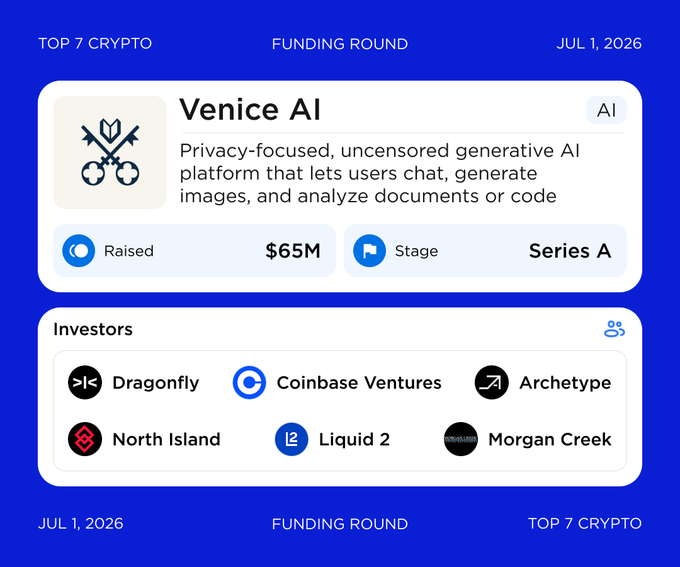
Erik Voorhees's Venice has secured its first external funding since its inception.
According to The Block, Venice, the privacy AI platform created by ShapeShift founder Voorhees, has completed a Series A financing of $65 million, with a valuation of $1 billion. Cryptocurrency venture capital Dragonfly led the round, with other investors including Coinbase Ventures, North Island Ventures, F-Prime, Archetype, Liquid2 Ventures, Morgan Creek, and others participating. This is the first time Venice has introduced external capital since its launch two years ago; previously, it had neither conducted a VC private placement nor monetized its VVV tokens from the treasury.
Equity + Token Dual Structure, Investors Receive Nearly 9% Equity Plus Two Batches of VVV
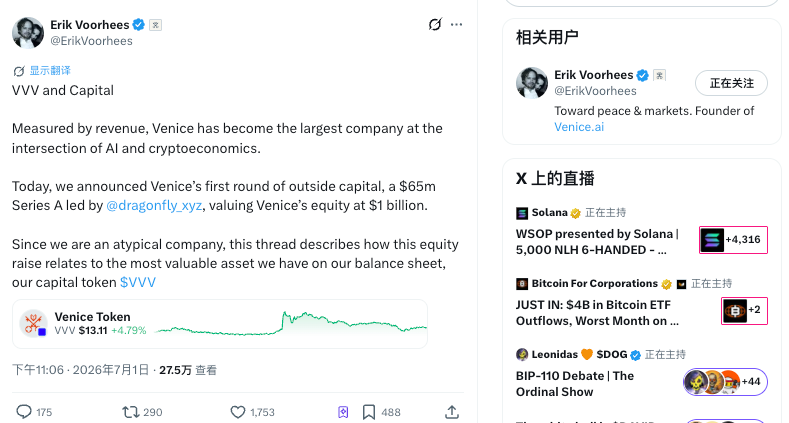
Voorhees disclosed the complete terms of this round in a tweet thread. The $65 million has purchased three things: 8.98% of Venice's equity, the rights to 1.5 million VVV tokens, and warrants to buy another 5 million VVV at an agreed price over the next 8 years.
Warrants are the rights to purchase tokens at an agreed price at a future date. According to Voorhees's calculations, if investors exercise all of these 5 million warrants, they will need to pay Venice approximately $66.5 million, raising the total funds raised in this round to about $131.5 million. The rights to tokens and warrants both have a one-year lock-up period and then unlock linearly over the following three years.
What investors gain now is equity, along with an option to "purchase tokens at an agreed price later," rather than immediately tradable tokens. This structure that bundles equity, token rights, and token warrants together is uncommon in crypto financing; most projects either offer pure equity or directly sell tokens to VCs.
Founder's "Develop Products and Tokens First, Then Attract VCs," Contradicts Industry Norms
Voorhees emphasized that Venice chose to sell equity rather than its treasury tokens to raise funds. He stated that Venice is currently still the largest holder of VVV, holding over 30 million out of a total supply of over 80 million, and the company and team have never sold a single VVV, despite the token rising over 700% this year.
Venice's financing pace is the exact opposite of industry norms. Most projects pre-sell tokens to VCs without disclosing terms, promising to develop products and attract users later; Venice launched products and tokens first, generated users and revenue, and then attracted external investors.
This approach is supported by business data. According to the company, Venice reached 3 million users in April and achieved profitability in the first quarter, with multiple media outlets citing Voorhees as saying its annualized revenue (run-rate) has surpassed $70 million. It's rare for an AI startup at Series A to be profitable before raising funds.
Warrants Present Future Selling Pressure for VVV, but the Founder Considers It "Mild"
For token holders, those 5 million warrants are an unavoidable issue. They represent potential future issuance, and once exercised, they will become new circulating supply, thus creating selling pressure.
According to Voorhees's calculations, if investors fully exercise their warrants, starting about a year from now, around 6,000 VVV will enter the market daily, which is approximately 0.2% of the current daily trading volume. This scale is relatively small compared to the market depth. Unexercised warrants will correspond to tokens that remain on Venice's balance sheet and do not enter circulation.
On the token strategy front, Venice insists on maintaining its current approach, continuing to use a portion of its revenue to buy back and destroy VVV while gradually reducing the token issuance. With destruction reducing the supply and warrants increasing potential supply, these two forces are in opposing directions. The net supply of VVV will depend on whether the intensity of buybacks and destruction can outweigh the unlocked warrants and regular issuance. This is the key variable for holders to monitor going forward and more worth tracking than the funding round itself.
It should be noted that the "6,000 per day, accounting for 0.2% of daily trading volume" figures come from Voorhees's own calculations and represent the account of the financing party, with no independent data from Shenchao for cross-verification. Readers should take this as reference rather than conclusion.
Funds Will Be Used to Build Computing Power, Targeting GPU and the First Data Center
According to the founder, the proceeds from this financing will be used to build computing power infrastructure, including Venice's first data center, to reduce reliance on rented GPUs.
His reasoning is that self-built computing power can lock in production capacity amid the "upcoming resource crunch" and improve profit margins, thus making "larger-scale VVV destruction possible."
In other words, self-built computing power lowers costs and increases profits, allowing profits to be used for buybacks and destruction of VVV. In addition to computing power, Venice also plans to use the funds to enter new markets, acquire "synergistic" businesses, hire staff, and expand its customer base.
On the product side, Venice positions itself as a privacy and censorship-resistant alternative to ChatGPT, claiming not to store user prompts on its own systems, with requests being encrypted and forwarded through external proxies, and paid subscriptions also offering end-to-end encryption. The platform claims to have integrated over 200 AI models, including self-hosted open-source models and closed-source models from OpenAI and Anthropic accessed anonymously via API. Besides VVV, Venice also has a DIEM token: users stake VVV to receive sVVV, then lock a portion of sVVV to mint DIEM, with each DIEM corresponding to a $1 value of API quota on the platform, which never expires.
免责声明:本文章仅代表作者个人观点,不代表本平台的立场和观点。本文章仅供信息分享,不构成对任何人的任何投资建议。用户与作者之间的任何争议,与本平台无关。如网页中刊载的文章或图片涉及侵权,请提供相关的权利证明和身份证明发送邮件到support@aicoin.com,本平台相关工作人员将会进行核查。


