Started at USTC.
Author/Wang Lu
Report/Investment Circle PEdaily
This usually low-key Hefei 985 unexpectedly became popular.
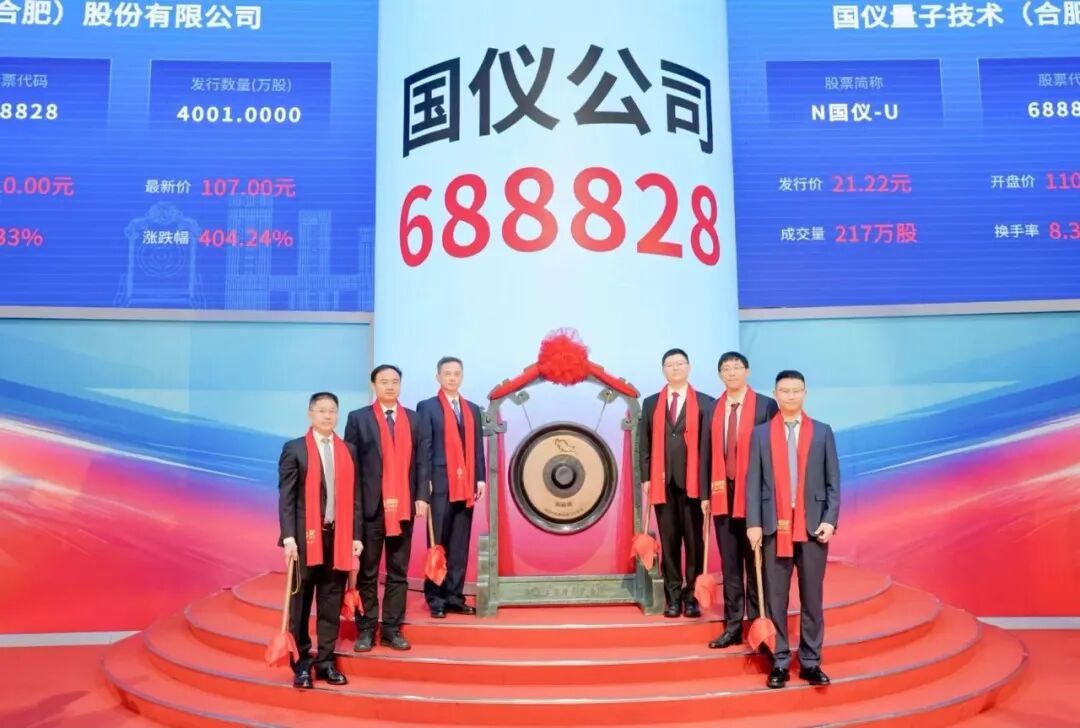
This week, National Instrument Company officially landed on the Sci-Tech Innovation Board, creating "the first stock of quantum precision measurement," with a market value exceeding 40 billion yuan on its first day, bringing super returns to its investors. The most remarkable return comes from the University of Science and Technology of China.
Years ago, He Yu's entrepreneurial idea sprouted from the laboratory at USTC. Subsequently, the technology moved out of the campus, the team dove into the industry, and the alma mater accompanied them as a shareholder all the way. Until the bell rang, this technological achievement transformation spanning more than a decade turned into a tangible return—over 1000 times profit.
Across the country, similar scenes are emerging intensively. Like National Instrument Company and USTC, Zhipu and Tsinghua, Changjin Photonics and Huazhong University of Science and Technology, these tech companies have the shadow of universities behind them, profoundly influencing the industries of their respective cities.
This is a unique harvest of universities in the era of technology.
USTC Alumni Join Hands to Ring the Bell
Thousand-fold Returns Born

The story began in Hefei in 2016.
At that time, He Yu teamed up with Zhang Wei and Rong Xing, several fellow USTC members, crammed in a 14-square-meter office lent by their mentor Du Jiangfeng to start their entrepreneurial journey.
Ten years later, they stood on the IPO bell-ringing stage. After the IPO, USTC Asset Management Co., Ltd. held 53,097,600 shares, accounting for 13.27% of the total share capital. Based on the closing price on the IPO day, this portion of equity has a market value exceeding 5.8 billion yuan.
All of this originated from the technological equity investment of the year. When the National Instrument Company was established in 2016, USTC invested 5.1425 million yuan in non-monetary assets to acquire a 25% equity stake. The following year, four patents completed the change of rights holders, and the complete data of one proprietary technology was officially transferred to the company.
Afterwards, National Instrument Company underwent multiple rounds of financing, and USTC's shareholding ratio was somewhat diluted but remained the largest external shareholder.
If we simply calculate the investment return based on the technological valuation of that year, the book return of this investment has exceeded 1100 times. Of course, this is still an unrealized wealth, as the held shares are still under a lock-up period. However, the story of a university and its students jointly conducting the transformation of technological achievements and accompanying the company to the IPO is already compelling enough.
In fact, USTC's support for He Yu did not start when it became a shareholder.
In 2009, He Yu was admitted to the youth class at USTC and continued to study there until obtaining his doctorate. He describes himself as a "tinkering USTC person": organizing physics discussion groups, founding a newspaper, forming the "Ge Wu Zhi Zhi Society" with classmates, and even creating an interactive Q&A device for campus entrepreneurial projects.
That was He Yu's first entrepreneurial attempt. The team received startup funding from USTC's entrepreneurship program, and the product garnered good feedback on campus, but it never managed to reach a larger market. This unfinished attempt gave him a chance for commercial trial and error.
The rest of the story is well known. Because of mentor Du Jiangfeng's mention of the temporary price increase of imported scientific instruments and the half-year wait for maintenance, He Yu shifted to high-end scientific instruments, leading to the establishment of National Instrument Company in 2016.
More than a decade later, the once inexperienced young man brought a listed company to the stage. USTC witnessed his growth all along and accompanied him through the lengthy entrepreneurial journey. Cultivating talents, grounding technologies—"red and specialized progress together, theory and practice blended," here has a vivid annotation.
A University, A City

The story of the connection between USTC and Hefei is still widely talked about.
In 1958, the country urgently needed cutting-edge scientific and technological talents, and the University of Science and Technology of China was established in Beijing. A group of scientists, including Qian Xuesen, Guo Yonghuai, Zhao Jiuzhang, and Hua Luogeng, took the stage to teach, bringing frontier research into the classroom. Twelve years later, the school relocated to Hefei, with 8,650 tons of materials and 35,000 boxes of instruments and books moving south with the faculty and students.
At that time, Hefei did not have the industrial profile it has today, nor could it foresee that chips, quantum technology, and artificial intelligence would become the most prominent industrial signatures of this city several decades later. Facing the arrival of USTC, it did its best to sincerely retain this university.
A quality university and talent education have been USTC's talent training positioning for many years. The scale of undergraduate enrollment is kept at around 2,000 students annually, and the majors are closely aligned with cutting-edge, frontier, and interdisciplinary fields.
There is a saying among former students jokingly: "Don't risk your life to go to USTC." A solid theoretical foundation, proficient experimental skills, and one foreign language are the three basic skills that must be mastered. For basic courses, the most challenging textbooks are chosen, and professional courses closely follow the latest research progress; students enter laboratories early on to receive scientific training.
Years later, this training left a mark on a group of USTC entrepreneurs.
Li Qingfeng once studied in the youth class at USTC, and during his PhD, he co-founded iFlytek with 18 faculty and students; Tao Yuequn brought corneal shaping lens technology back to the country and later founded Opcon Vision; Chen Yunji and Chen Tianshi, brothers who entered the youth class at ages 14 and 16, then devoted themselves to cross-disciplinary research in AI and chips, later founding Cambricon; and the recently completed nearly 3 billion yuan Pre-IPO round financing firm Origin Quantum, whose founder is also USTC professor Guo Guoping...
They ventured into artificial intelligence, medical devices, semiconductor chips, and quantum computing, each carrying a similar technological foundation: willing to sit on a cold bench, willing to wait for many years for a technology. Thus, USTC has become Hefei's most distinctive sci-tech innovation coordinate.
According to publicly available data from the USTC Alumni Association, by 2025, there will be 31 "USTC Series" A-share listed companies founded by alumni or incubated from the school’s technological achievements, among which 21 were listed after 2019.
If we focus back on USTC's own achievement transformation system, as of the listing of National Instrument Company, the school has formed 24 existing holding enterprises and 92 authorized enterprises, with 7 of these companies listed on A-shares.
Among these, there is an even more instructive scene.
In the early years, USTC mainly participated in equity investments with patents and proprietary technologies, with the asset company holding the enterprise's equity long-term. As the number of achievement transformation projects increased, USTC began exploring new paths. In 2020, the school launched the reform of technology achievement authorization; the following year, it proposed the "authorization + transfer + agreed returns" model, granting more disposal rights to research teams, while the school retained future profits through agreements. According to disclosures, the number of achievement transformations in the three-year reform pilot has exceeded three times the total of the previous five years.
Behind this, the greatest support, of course, comes from Hefei.
In 2012, Anhui Province, the Chinese Academy of Sciences, Hefei City, and USTC jointly established the Advanced Technology Research Institute. Ten years later, USTC Silicon Valley emerged, with technology managers, industrial funds, and application scenarios successively making up for the gaps. Public data shows that about 90% of USTC's authorization reform projects are located in USTC Silicon Valley.
It can be said that USTC provides original innovation for Hefei, while Hefei allows these technologies to have the opportunity to leave the campus and enter a broader industrial world. Over the past fifty years, a university and a city have long been inseparable. USTC's ideals have taken root here, and Hefei's ambitions have also grown from this.
University's Great Harvest

This scene is not an exception.
In the first eight months of this year, the grandeur of IPO bell-ringing is vividly remembered. Artificial intelligence, optoelectronics, quantum technology—several of the most conspicuous technology tracks have appeared the presence of university laboratories behind them.
The most striking return comes from Tsinghua.
In 1996, the Department of Computer Science at Tsinghua University established a Knowledge Engineering Laboratory. More than twenty years later, Tang Jie and others promoted the transformation of research achievements to industry, leading to the birth of Zhipu.
In January of this year, Zhipu went public on the Hong Kong Stock Exchange, becoming the world's first listed company with a core business based on a general artificial intelligence foundation model. Subsequently, its market value once exceeded 1 trillion HKD. As of the close on August 13, Zhipu's total market value was approximately 613.2 billion HKD. The prospectus disclosed that Tsinghua University’s wholly-owned subsidiary, Huako Technology, holds 15,534,400 shares of Zhipu. Based on the closing price on that day, this portion of shares is valued at approximately 20.4 billion HKD.
Wuhan presents another path.
As early as 2012, Huazhong University of Science and Technology Professor Li Jinyan founded Changjin Photonics in Optics Valley, pushing specialty fiber technology towards industrialization. The prospectus shows that among the 8 core technical personnel of the company, 7 graduated from Huazhong University of Science and Technology, and among the 37 invention patents, 12 were assigned from Huazhong University of Science and Technology.
Until May of this year, Changjin Photonics was listed on the Sci-Tech Innovation Board, rising 1510.52% on its first day of trading, with a total market value reaching 61.8 billion yuan. In the last round of equity changes before the listing, Huazhong University of Science and Technology's equity investment company acquired 750,000 shares at 24.34 yuan per share, yielding similarly rich returns.
The listing of Changjin Photonics coincided with the concentrated explosion of the optoelectronic industry in Wuhan. Over the past forty years, from a fiber to a complete industrial chain, Optics Valley has gradually gathered a number of enterprises such as Changfei Fiber, Huagong Technology, Guangxun Technology, and Fiberhome Communication. Huazhong University provides talent and technology, while Wuhan transforms these achievements into an industrial chain.
Then there’s Chengdu. Previously, Chengdu Huayi, Chengdian Photonics, and Jiachitech, incubated by the University of Electronic Science and Technology, were successively listed. Among them, Jiachitech was founded by three teachers from the University of Electronic Science and Technology. In July this year, co-founder Liang Difei signed an agreement to donate 10 million shares to his alma mater’s foundation, which, based on the closing price on the last trading day before the signing, is valued at approximately 447 million yuan.
Such scenes are the best response to the significance of the transformation of university technological achievements. Transitioning from the laboratory to the exchange often takes a decade or even longer. During this period, there are numerous experiments, engineering implementations, and market validations, as well as countless researchers who have sat on the "cold bench."
All the bounties seen today began with an unremarkable start long ago. Ultimately, it is the reward of time for long-term perseverance.
免责声明:本文章仅代表作者个人观点,不代表本平台的立场和观点。本文章仅供信息分享,不构成对任何人的任何投资建议。用户与作者之间的任何争议,与本平台无关。如网页中刊载的文章或图片涉及侵权,请提供相关的权利证明和身份证明发送邮件到support@aicoin.com,本平台相关工作人员将会进行核查。


