Author: Santiago Roel Santos
Compiled by: Tim, PANews
The Paradox of Price and Adoption
Cryptocurrency adoption will continue, but market prices may not recover for a long time.
This contradiction between the acceleration of real adoption and the lagging market prices is not a flaw, but rather a necessary characteristic of the current stage of evolution in the crypto market.
If you view the crypto market from a ten-year perspective, its prospects will be very attractive. However, maintaining this long-term perspective is psychologically challenging. You should be prepared to watch the adoption rate expand continuously while prices stagnate or slowly decline; you should also be ready to witness others profiting in other fields (AI, stocks, or the next market craze) while the crypto space seems forgotten.
This feeling can be very unfair, and the process can be excruciating. But the lag in prices is inevitable. Fundamentally, many of these crypto assets should not have enjoyed their previous valuations.
The market does not care about actual adoption until prices crash, at which point it starts to care again.
The Bubble Created by Application Popularization
The early stages of application popularization may actually give rise to bubble issues. This is a painful process of value discovery, where the real demand for use cannot support inflated valuations, leading the market to recalibrate, which is precisely the necessary path for long-term healthy development.
When crypto infrastructure achieves scalable application, it becomes clear that the funds invested from the outside far exceed the actual demand. The popularization of applications will bring about a pressure test of business models rather than a validation of value. Some projects will fade into silence, while others may survive, but their valuations will be far below the visions depicted at their peak.
Cryptocurrencies are gradually fading from the spotlight, becoming mere bystanders. From exciting to mundane, this is the necessary path from noise to maturity.
This is a good thing.
This narrative is not new. During the burst of the internet bubble, the Nasdaq index plummeted by about 78%, while the number of internet users tripled, and broadband infrastructure was fully deployed. The market took years to recover, and now the internet has quietly reshaped the world, while investors are still licking their wounds, software has "devoured" the entire world.
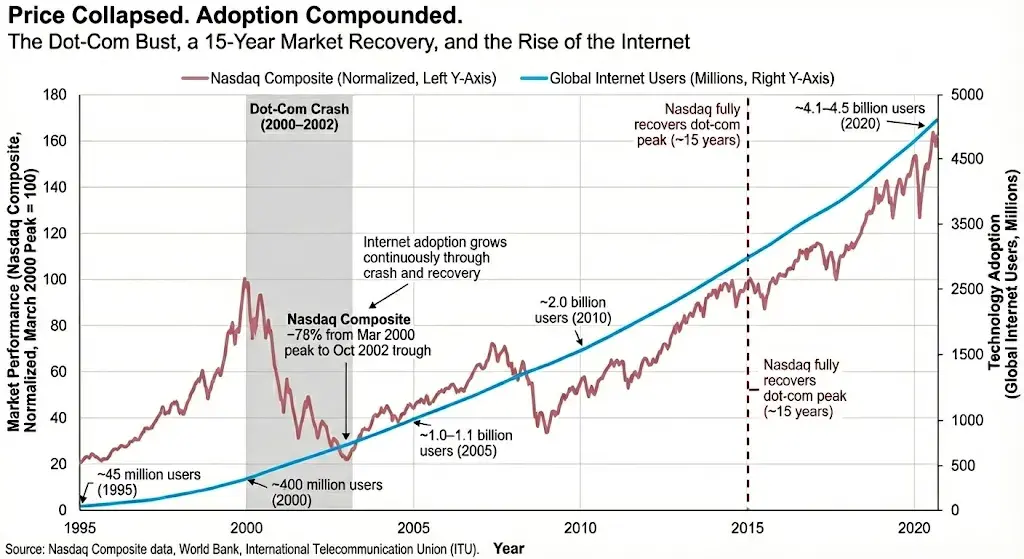
Infrastructure technology does not reward those who seek quick gains.
When Infrastructure Wins, Who Will Be the Real Winners?
The shift in market stages will make many participants uncomfortable. Those builders who have devoted years to maintaining open-source codebases will witness other companies replicate their results and capture most of the economic benefits; early investors in infrastructure from native crypto venture capital firms will see traditional VCs gain more value; retail investors who buy tokens instead of equity may feel marginalized, as companies benefit from the ecosystem without returning corresponding value to token holders.
Some are structural issues, while others are self-inflicted dilemmas.
The market is self-adjusting. Open networks will develop rapidly, systemic incentives will change, and value capture mechanisms will improve, but not all models will survive to benefit from that day.
Crypto adoption is quietly advancing, but the market has not yet truly recognized it. It may take years for the market to re-establish value connections and realize that crypto technology is the core operating system, not just a speculative asset.
Price Cycles and Application Cycles Are Two Different Things
Price cycles are driven by market psychology and liquidity.
Application cycles are driven by practical value and infrastructure.
The two are related but not synchronized. Historically, prices often lead applications, which is common in early technological revolutions. Now, applications are beginning to dominate, while prices are lagging.
Currently, the marginal buyers of crypto assets are elsewhere, chasing the AI wave. This phenomenon may continue or reverse, independent of our will.
What we can see is that a world without stablecoins, without transparent funding channels, and without global 24/7 real-time settlement is becoming increasingly hard to imagine.
The deepest lesson from cycles is that we must accept that the time disconnect between application and price may far exceed expectations, and if you want sustained compounding, you need to remain rational when you lose patience.
This is not a declaration advocating HODL.
Many crypto projects will never recover. Some had flaws from the outset, some lack protective moats, and others have been completely abandoned. New winners will emerge, there will be fallen stars, and there will be a few true comeback stories.
Corrections Are Healthy
We are entering a different regulatory and economic environment. This creates opportunities to address long-standing issues: weak product revenues, insufficient asset disclosures, mismatched equity and token structures, and opaque team incentives.
If the crypto industry truly wants to become what it aspires to be, it must first present itself as it should.
I believe anything is possible. My most confident view is that most companies will adopt crypto technology to remain competitive within the next 15 years. By then, the total market capitalization of cryptocurrencies will exceed one trillion dollars. Stablecoins, tokenization, user scale, and on-chain activity will grow exponentially. Meanwhile, valuation standards will be redefined, existing giants may decline, and unreasonable business models will ultimately be eliminated.
This is healthy and necessary.
Cryptocurrencies will eventually become intangible. The more a company makes cryptocurrencies the core of its product, the more fragile its business model tends to be. The truly lasting winners will embed it deeply into their business processes, payment systems, and balance sheets. Users should not perceive the existence of crypto technology but should feel the benefits of accelerated settlement, reduced costs, and fewer intermediaries.
Cryptocurrencies should be pure and "boring."
As capital tightens, the era of rampant airdrops, subsidy-driven demand, unreasonable incentives, and excessive financialization is coming to an end, which is just another inevitable cycle of history.
My basic judgment is simple: crypto applications will accelerate in popularization, prices will readjust, and valuations will return to rationality. Crypto is a long-term trend, but that does not mean the tokens you hold will necessarily rise.
Who Captures the Value of Crypto Technology?
The underlying technology primarily benefits consumers by lowering prices and improving experiences. Secondary beneficiaries are those enterprises that upgrade their systems to leverage cheaper, faster, and more programmable infrastructure.
This theoretical framework raises some uncomfortable but necessary questions:
- Visa or Circle?
- Stripe or Ethereum?
- Robinhood or Coinbase?
- A basket of Layer 1 protocols or user aggregators?
- A basket of Layer 1 protocols or DeFi?
- A basket of Layer 1 protocols or DePIN?
- DeFi or traditional financial stocks?
- DePIN or infrastructure stocks?
This is not an absolute either-or; diversified investment strategies are also viable. The question lies in relative value and relative performance: who will capture the residual value created by blockchain?
I lean towards traditional and hybrid enterprises that access open settlement channels to lower costs and improve profit margins. History shows that they often benefit more than the infrastructure itself.
But it must be emphasized that every theoretical framework has exceptions.
What I Believe and What I Do Not Believe
I do believe that networks with real demand will eventually monetize, as the internet has proven. Facebook went through many years before commercialization.
I am confident that some Layer 1 values will be validated as they develop, ultimately matching their valuations. But I also believe that most will struggle to acquire users and find sufficient value support.
I believe the gap between winners and losers will widen further, and distribution, market entry strategies, user relationships, and unit economics will be far more important than first-mover advantages.
A common misconception in the crypto space is the overestimation of the early advantages of technological leadership while underestimating the other factors needed for subsequent development.
Returning to Reality
I am not particularly optimistic about price trends in the coming years. Adoption rates will continue to rise, but prices may decline further, potentially exacerbated by broader stock mean reversion and a cooling AI hype cycle.
However, patience is a significant advantage.
- I am optimistic about the crypto-as-a-service model.
- I am optimistic about crypto-empowered enterprises.
- I am bearish on excessive financialization.
- I am bearish on failed unit economics.
- I am bearish on overbuilding for infrastructure.
Protecting principal becomes crucial. The value of cash is underestimated: not for its yield, but for the psychological immunity it provides. It allows you to act decisively when others cannot.
The market has entered a fast-paced and increasingly impatient era. Today, having a longer time horizon than most participants is itself a substantial advantage. Professional managers must frequently adjust their portfolios to prove their value. Faced with increasing life pressures, retail investors are increasingly chasing short-term trends. Meanwhile, institutional investors will once again declare that cryptocurrencies are dead.
Slowly, more traditional companies will adopt crypto technology, and more balance sheets will connect to blockchains.
One day, when we look back on this period, everything will seem so clear. Signals are everywhere; only steadfast belief often appears easy after prices rise.
Before that: wait for the pain to come.
Wait for sellers to cut losses, wait for faith to collapse, but we have not yet reached that stage.
There is no need to rush into action; the market will continue to fluctuate, life goes on, and spend more time with those you care about. Do not let your investment portfolio become your entire life.
The crypto world will quietly operate, whether the market is in the dark or brightly lit.
Good luck to everyone.
免责声明:本文章仅代表作者个人观点,不代表本平台的立场和观点。本文章仅供信息分享,不构成对任何人的任何投资建议。用户与作者之间的任何争议,与本平台无关。如网页中刊载的文章或图片涉及侵权,请提供相关的权利证明和身份证明发送邮件到support@aicoin.com,本平台相关工作人员将会进行核查。


