Written by: Sylvain Saurel
Translated by: Chopper, Foresight News
This is simply unbelievable. In a world currently suffering from ongoing inflation, expanding sovereign debt, and profound changes in the international financial landscape, former British Prime Minister Boris Johnson recently made some shocking financial statements in the Daily Mail. What is his core argument? Pokémon cards are essentially a more reliable investment than Bitcoin.
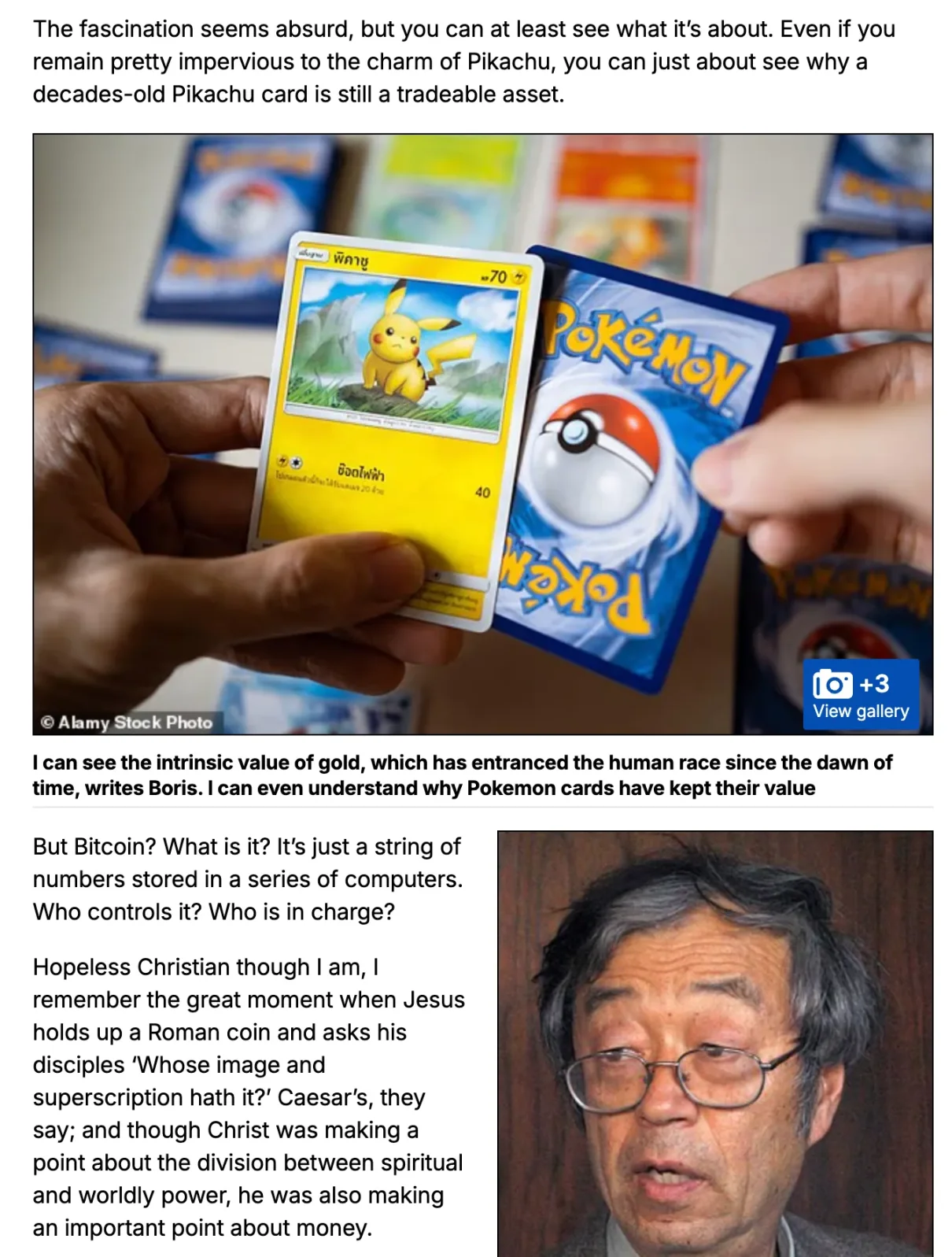
This article did not come from a satirical publication like The Onion, but is a genuine column penned by someone who was recently at the helm of G7 economies, and this person has a fundamental misunderstanding of the nature of currency, fraud, and technology.
In order to prove that the highest market capitalization cryptocurrency is a "Ponzi scheme," Johnson cited a heartbreaking but entirely localized case. He narrates the experience of an elderly man from his village: the man handed £500 to a stranger in a local pub, who promised to magically double the money. As a result, over the next three and a half years, the scammer siphoned off £20,000 from the old man under various fees and charges. Just because this scammer brought up the term "cryptocurrency" during the con, Johnson boldly concluded: Bitcoin itself is a scam.
This level of economic analysis is not only intellectually lazy but also constitutes a serious misguidance to a public desperately seeking a safe haven for their wealth. We must rigorously refute these statements, not only to vindicate a form of digital asset but also to expose the obvious cognitive blind spots of the political class.
Blame the robber, or blame the ATM?
Let's start with the most obvious logical fallacy in Johnson's statements: equating decentralized software protocols with the malicious actions of human criminals.
Bitcoin did not steal a penny from the elderly man in the pub; it was the scammer who committed the theft. What Johnson describes in anger is one of the oldest tricks in the criminal handbook — advance payment fraud. This is entirely consistent with notorious "Nigerian prince" email scams, romance scams, and the psychological manipulation techniques used in traditional telephone scam rooms. Scammers promise unrealistic returns and continuously demand advance payments to "unlock" the illusory funds, only to disappear in the end.
The criminal that Johnson refers to in the village could equally easily have lied about investing that £500 in the forex market, rare gold coins, the Brooklyn Bridge, or even a pristine first-edition holographic Charizard card. The medium used for the fraud has no bearing on the mechanism of the scam itself. The core of fraud is deception, not the asset that is used as bait.
To deem Bitcoin a Ponzi scheme solely because a criminal used its name to defraud an elderly man is as absurd as declaring dollars or pounds a scam because someone was robbed at a Barclays ATM.
A Ponzi scheme is a very clearly defined form of financial fraud. It requires a central operator who pays false returns to early investors using the funds from new investors, relying on a continuously growing victim pool to maintain the illusion until it inevitably collapses.
Bitcoin has no central operator. It has no CEO, no marketing department, no sales pitches, and no corporate headquarters. It does not distribute dividends nor promise any returns. It is simply a decentralized software protocol — a neutral, open-source ledger maintained collectively by thousands of independent nodes across the globe. Blaming a neutral mathematical ledger for the existence of thieves is a serious conceptual error.
The hardest currency in human history
In his column, Johnson deliberately avoids one objective, verifiable fact: what Bitcoin actually is and its true performance on the global stage. He disparages Bitcoin as a fleeting illusion while ignoring the substantial empirical data that portray a completely different role for Bitcoin in the modern economy.
Massive scale and liquidity
Bitcoin is by no means a small scam at the corner of a bar. It is a mature asset class with a market capitalization of $1.42 trillion. To put it in perspective, its market cap rivals or even exceeds some of the largest and most stable publicly traded companies in the world. In addition, Bitcoin's daily trading volume is approximately $62 billion. This deep, continuous, around-the-clock liquidity is a characteristic of major currencies or commodities, not a regional Ponzi scheme that is about to collapse at any moment.
Unparalleled transparency
The ironic aspect of this pub scam is that if the elderly man truly bought Bitcoin and held it himself, he would have been interacting with the most transparent financial network in human history. Bitcoin operates on a public blockchain. From the genesis block mined in 2009, every transaction is permanently recorded and verifiable across the entire network, enabling anyone with internet access to audit it comprehensively. Traditional banks operate in closed information silos where people must blindly trust opaque institutions, which often intentionally obscure risks. Bitcoin, on the other hand, operates entirely in the open, relying on cryptographic truth rather than corporate promises.
Unmatched performance
If we are to discuss investment value, this is also why Johnson attempts to compare it with Pikachu; the actual data is overwhelmingly unfavorable to his viewpoint. Since its inception, in any given four-year period, Bitcoin has outperformed all fiat currencies, all stock indices, and all precious metals.
The four-year metric is not arbitrarily chosen; it aligns perfectly with Bitcoin's built-in "halving" cycle. Every four years, the allocation of newly created assets to miners is automatically halved, enforced by code to ensure absolute scarcity. Although Bitcoin is notorious for its volatility in the short term, its long-term trend has continuously been upward, driven by an ever-increasing global adoption rate and a strictly limited total supply capped at 21 million coins.
11% inflation analysis: How quantitative easing destroyed the pound
The most revealing and hypocritical part of Johnson's column is his so-called philosophical defense of fiat currency. To explain why pounds or dollars are valuable while Bitcoin is allegedly not, he invokes the Bible. Specifically, he quotes the story of Jesus, who pointed to a Roman coin and said, "Render unto Caesar the things that are Caesar's."
Johnson believes that currency must be imprinted with "Caesar's likeness" to possess inherent value. In his worldview, value does not arise from scarcity, utility, or consensus, but from authority, decree, and the implicit threat of state coercion.
But the question is, what happens when Caesar severely inflates the currency and mishandles management?
The government that Boris Johnson led is precisely the architect of monetary policies that ultimately triggered double-digit inflation. To understand how absurd it is for a former Prime Minister to equate Bitcoin with a Ponzi scheme, we must grasp how the Bank of England operates, particularly the mechanism of quantitative easing (QE).
During Johnson's tenure, especially during the COVID-19 pandemic, the British government required massive funding to finance extensive furlough programs and public health projects. Since tax revenues could not cover this historic deficit, the government turned to the Bank of England.
Through quantitative easing, the Bank of England essentially created hundreds of billions of new pounds out of thin air. They used these newly created digital reserves to purchase government bonds from private financial institutions. From 2009 to 2021, the Bank of England's bond-buying program soared to an astonishing £895 billion, and this process accelerated significantly during Johnson's time in Downing Street.
This policy flooded the financial system with newly minted fiat currency. The UK's M4 money supply (a measure of the total currency in circulation in the UK economy) shot up dramatically.
The laws of economics are simple and brutal: if the money supply increases significantly while the actual supply of goods and services stagnates (or even shrinks dramatically, as during pandemic lockdowns and subsequent supply chain shocks), prices for goods must rise. More pounds chasing fewer goods.
For anyone familiar with the history of money, the outcome is entirely predictable. By the end of 2022, the UK's consumer price inflation rate reached a staggering peak of 11.1%.
Consider what this number means for ordinary people. It means that the money in their bank accounts — money bearing "Caesar's likeness" — lost more than one-tenth of its purchasing power within a year. It means soaring energy bills, skyrocketing food prices, and a cost of living crisis that severely impacts the working class and the middle class. This is not a localized scam at the pub; it is a systematic, nationwide dilution of wealth orchestrated by the highest echelons of government and central banks.
Moreover, the massive debt also triggered a historic crisis in the gilt bond market. The sovereign bond market became extremely volatile, forcing the Bank of England to step in urgently to buy bonds to barely stave off bankruptcy for the national pension funds.
Stretching the timeline further, the picture for fiat currency becomes even bleaker. Since the founding of the Bank of England in 1694, the purchasing power of the pound has depreciated by over 99%. Central banks explicitly set a target of allowing public wealth to depreciate by 2% per year, and as we saw during Johnson's era, they often lost control, allowing inflation to soar far above their targets.
A politician who actively participated in this system and personally caused the continuous depreciation of public savings turns around to accuse a strictly scarce, decentralized asset of being a "scam." This is the height of irony. The fiat currency system is one that continually dilutes public purchasing power to fill the state's endless debts. If we are to look for a system that quietly siphons off the wealth of the ignorant, we need only look at the printing machines on Threadneedle Street (the location of the Bank of England).
It's not Pikachu's fault; it's the politicians who don't understand currency
With that said, we can finally return to Pikachu.
Johnson claims that a piece of paper imprinted with a cartoon mouse is a superior store of value compared to Bitcoin; this is a typical demonstration of financial illiteracy. Yes, the rare collectibles market is undoubtedly very active. A first-edition Charizard card can fetch a handsome price at auctions due to its nostalgia, condition, and physical rarity. But a trading card is, in essence, not currency.
You cannot break down a Pokémon card into 100 million interchangeable small units to buy a cup of coffee or a loaf of bread.
You cannot send a Pokémon card to a relative far away in El Salvador in three seconds, instantly settle it on an immutable ledger, and have no intermediaries taking a cut.
You cannot verify the authenticity of a Pokémon card using cryptography without relying on centralized, subjective grading agencies (like PSA). These agencies charge exorbitant fees and can introduce human errors.
Bitcoin represents a profound technological and economic transformation: for the first time in history, humanity has achieved absolute, verifiable digital scarcity. It allows us to store wealth in a decentralized network without being inflated, manipulated, or censored by any CEO, board, or Prime Minister.
When politicians like Boris Johnson ridicule this innovation using tragic local cases and absurd faulty analogies, they severely undermine the public interest. True financial literacy is the only defense for the masses against pub scammers and the invisible plunder of central bank inflation.
The elderly man from Johnson's village was undoubtedly harmed, but what harmed him was an ordinary thief, not a set of algorithms. Meanwhile, tens of millions of hardworking Britons are daily being pillaged by the fiat currency system, their purchasing power eroded continuously, while their former leader compares a multi-trillion dollar global currency network to a children's toy.
We deserve a higher standard of economic discussion. The era of blindly believing that Caesar's likeness can safeguard our wealth is rapidly coming to an end. The era of decentralized, verifiable hard currency has just begun.
免责声明:本文章仅代表作者个人观点,不代表本平台的立场和观点。本文章仅供信息分享,不构成对任何人的任何投资建议。用户与作者之间的任何争议,与本平台无关。如网页中刊载的文章或图片涉及侵权,请提供相关的权利证明和身份证明发送邮件到support@aicoin.com,本平台相关工作人员将会进行核查。


