Author: BitpushNews
The "Wild West" era of crypto assets has officially come to an end?
On March 17, 2026, the United States Securities and Exchange Commission (SEC) and the Commodity Futures Trading Commission (CFTC) jointly released an interpretive document numbered 33-11412, a 68-page regulatory framework officially declaring: the United States crypto regulation bids farewell to a decade-long era of "law enforcement instead of regulation" and enters a new era of clarity and harmonization driven by "Project Crypto".
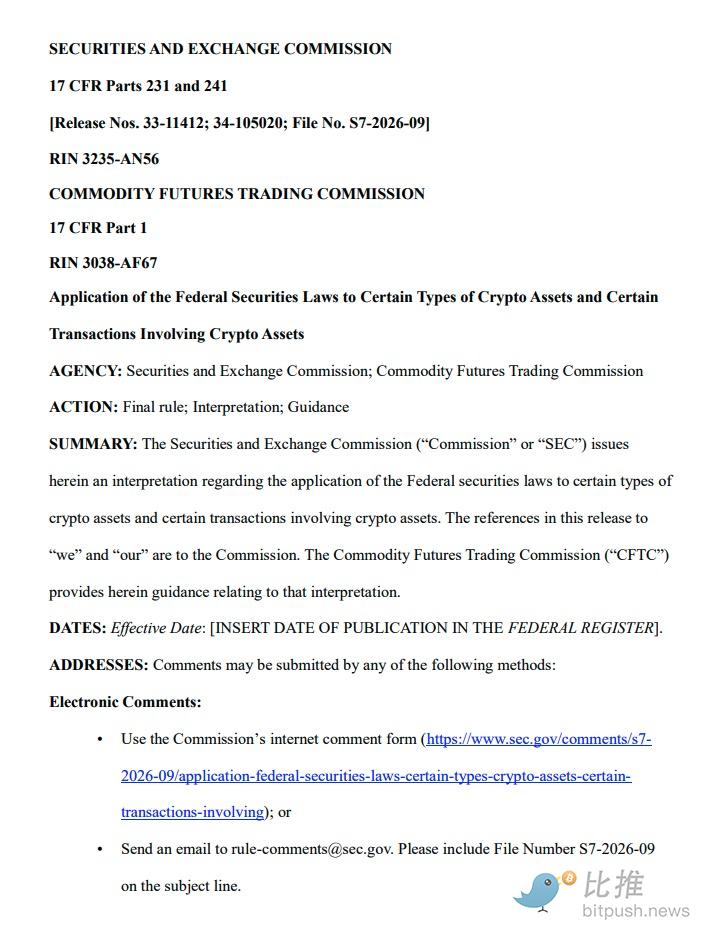
This document is not only a rare collaborative achievement between the SEC and CFTC, but also the most milestone-guiding document in the history of U.S. crypto regulation. Below is a summary interpretation of the full text:
1. Background: Moving from Conflict to Collaboration with "Project Crypto"
In 2017, the SEC first applied the Howey test to crypto assets through the "DAO Report." Over the next decade, regulation primarily relied on enforcement actions to define asset characteristics, leaving the market in a state of uncertainty and controversy.
In early 2025, the SEC established the "Crypto Task Force," which subsequently launched the "Project Crypto" initiative co-led by SEC Chairman Paul S. Atkins and CFTC Chairman Michael S. Selig, aimed at coordinating the authority of the two regulatory agencies and establishing a unified asset classification system to provide a clear path for crypto innovation to remain in the United States. In January 2026, the project was officially upgraded to a joint action between the SEC and CFTC.
2. Asset Classification: The "Five Categories" Logic for Crypto Assets
The document categorizes crypto assets into five major categories based on asset characteristics, purposes, and functions, providing the market with clear classification standards for the first time:
Digital Commodities
Definition: Refers to assets whose value derives from the "functional" operation of a crypto system and supply-demand dynamics, rather than relying on others' managerial efforts.
Core List: The document explicitly names mainstream tokens such as BTC, ETH, SOL, XRP, ADA, DOT, AVAX, LINK as digital commodities. These assets are not controlled by any single centralized entity and do not possess intrinsic economic rights that generate passive income.
Digital Securities
Definition: Refers to "tokenized securities," which are traditional securities represented in the form of crypto assets, or digital assets possessing the economic substance of securities (such as representing ownership or dividend rights in a company).
Regulation: Regardless of whether on-chain or off-chain, as long as it meets the economic substance, it falls under the SEC's regulatory scope.
Regulated Payment Stablecoins
Definition: Stablecoins issued by authorized agencies that meet the definition of the 2025 "GENIUS Act."
Qualitative: Such stablecoins are explicitly excluded from the definition of "securities," primarily serving as payment tools under specific legal constraints.
Digital Tools
Usage: Tokens that have utility only within specific crypto systems (such as access rights or service payments) and are generally not considered securities.
Digital Collectibles
Definition: Assets intended to be collected and/or used, representing items such as art, music, videos, in-game items, or internet memes.
Examples: CryptoPunks, Chromie Squiggles, WIF, VCOIN, etc.
Qualitative: They are not securities themselves, and their value derives from supply-demand relationships rather than others' managerial efforts. However, if fragmented and sold off, they may constitute securities.
3. Innovation: "Separation" and "Dynamic Conversion" of Securities Attributes
This is the most groundbreaking legal innovation in the document - the SEC acknowledges for the first time that the "securities attributes" of crypto assets are not permanent.
"Separation" Mechanism
Principle: A project may initially be regarded as a security (investment contract) because it satisfies the Howey test during the fundraising phase. However, once the project completes its roadmap, achieves autonomous operation of its open-source code, and decentralizes network power, the asset can be "separated" from the investment contract.
Judgment Criteria: When investors no longer rely reasonably on the issuer's "core managerial efforts" to obtain profits, but rather depend on the operation of the system itself and market supply and demand, the asset transitions from "security" to "digital commodity."
Separation Timing: It can occur immediately when the asset is delivered to buyers or at a future date.
Three Scenarios of Separation
Issuer Fulfillment: Even if the issuer continues to provide non-core maintenance after fulfilling its core managerial efforts, the asset is no longer bound by the investment contract.
Issuer Abandonment: If the issuer publicly announces the abandonment of development and ceases to fulfill commitments, the asset is no longer subject to securities law jurisdiction (however, the issuer may still bear legal liability for fraud).
Secondary Market Trading: If subsequent buyers do not reasonably expect to rely on the issuer's efforts for profit, the transaction does not constitute a securities transaction.
Transparency Recommendations
The SEC encourages project parties to publicly disclose the progress of their roadmaps and the achievement of milestones for market identification of "separation points."
4. On-Chain Activities Qualitative Assessment: Sweeping Away Decentralization Obstacles
The document provides extremely detailed and favorable explanations regarding long-disputed activities such as staking, mining, packaging, and airdrops:
Protocol Mining
Qualitative Assessment: PoW mining is an "administrative or transactional" activity that ensures network security and verifies transactions.
Conclusion: Both solo mining and joining mining pools do not involve the issuance of securities.
Mining Pool Operation: The activities of the mining pool operator are considered administrative transactions and do not constitute core managerial efforts.
Protocol Staking
Qualitative Assessment: Staking is an administrative activity that maintains network operation.
Scope: Includes solo staking, delegated staking, custodial staking, and liquid staking.
Custodial Staking: When custodians stake on behalf of users, as long as it does not involve secondary lending, leverage, or discretionary trading, it does not constitute a securities activity.
Supporting Services: Services such as slash insurance, early unstaking, flexible yield distribution, and asset aggregation are all considered administrative transactions.
Staking Receipt Tokens
Qualitative Assessment: If the underlying assets are non-securities commodities and are not bound by investment contracts, the tokens themselves are not securities.
Principle: The tokens merely exist as "receipts" without generating revenue, as the income comes from the underlying staking activities.
Wrapping Tokens
Definition: Users deposit crypto assets with custodians or across chains to receive redeemable wrapping tokens pegged 1:1.
Qualitative Assessment: If the underlying assets are non-securities commodities and not governed by investment contracts, wrapping tokens are considered an "administrative function," aimed at enhancing interoperability and do not constitute securities transactions.
Key Restrictions: The custodian must lock the assets and may not lend, mortgage, or re-stake.
Airdrops
Qualitative Breakthrough: If the recipients do not provide money, goods, services, or other consideration, it does not meet the "money investment" element of the Howey test.
Applicable Scenarios:
Airdropping to wallets holding specific tokens without prior announcement.
Rewarding early users of test nets.
Airdropping to eligible users based on application usage.
Red Line: If recipients must provide services (such as social media promotion) in exchange for an airdrop, it may constitute a securities issuance.
5. Consolidation of U.S. Leadership Position
The document concludes with a detailed analysis of its economic implications:
Eliminating the "Chilling Effect": By providing legal clarity, it reduces business stagnation caused by compliance opacity and encourages crypto innovation to return to the United States.
Reducing Compliance Costs: Clear classification and separation paths significantly lower the legal consulting and regulatory response costs for companies.
Enhancing Market Transparency: The new framework requires more detailed disclosures during the "investment contract" phase, better protecting investors.
Promoting Competition and Innovation: Clear rules will attract more issuers and entrepreneurs to enter the market.
Improving Pricing Efficiency: Reducing price distortions caused by uncertainty.
6. Historic Breakthrough in Regulatory Cooperation
Structurally, the document establishes a clear analytical path: first classify assets, then assess transaction structures, and finally analyze whether investment relationships continue to exist.
More importantly, this is a rare coordinated result between the SEC and CFTC on crypto regulatory issues. Previously, the two agencies had long-standing disagreements over the definition of "securities vs. commodities," and this joint framework essentially provides a preliminary classification of major asset categories, marking the shift of U.S. crypto regulation from a stage of "institutional authority competition" to a "division system based on unified rules."
This 68-page document not only ends a decade of regulatory chaos but also establishes the United States' leadership position in the global crypto regulatory landscape. For practitioners, it is a must-read "industry constitution"; for investors, it is a clear "rights protection guide"; for entrepreneurs, it is a definite "compliance roadmap."
The "Wild West" era of crypto assets has officially come to an end.
免责声明:本文章仅代表作者个人观点,不代表本平台的立场和观点。本文章仅供信息分享,不构成对任何人的任何投资建议。用户与作者之间的任何争议,与本平台无关。如网页中刊载的文章或图片涉及侵权,请提供相关的权利证明和身份证明发送邮件到support@aicoin.com,本平台相关工作人员将会进行核查。


