Written by: Spinach Spinach
Preface
Readers who follow me may remember that I wrote an interpretation of the SEC's tokenized securities statement less than two months ago.
After that article was published, many people asked me: Is this the "ultimate answer" to cryptocurrency regulation?
No.
That statement was just a Staff Statement, with limited legal effect, and only covered the category of "tokenized securities"—it did not address the more fundamental question, "What constitutes a security and what does not."
Now, the ultimate answer has arrived—at least the "first step of the ultimate answer."
On March 17, 2026, the SEC and CFTC jointly released a 68-page formal interpretive guidance (Release No. 33-11412; 34-105020), titled "Application of Federal Securities Laws to Certain Types of Crypto Assets and Certain Transactions Involving Crypto Assets."
Nearly nine years have passed since the SEC released that famous DAO Report in 2017. During these nine years, the primary way for the industry to obtain regulatory signals has been by reading enforcement announcements—who gets sued is case law.
This document marks the SEC's first proactive effort to provide a systematic answer instead of letting the courts do it for them.
It accomplished three things:
It divided all crypto assets into five categories, clarifying the boundaries between securities and non-securities;
It dealt with gray areas through an "entangling/untangling" mechanism for investment contracts, changing the underlying logic for project teams and exchanges to list;
It provided legal characterizations for mining, staking, wrapping, and airdrops one by one.
If the statement from January was the recipe for "digital securities," then this document is the menu for the entire banquet—and using the words of the new document, all previous Staff Statements are "superseded" by this interpretation.
Next, let’s break it down one by one.
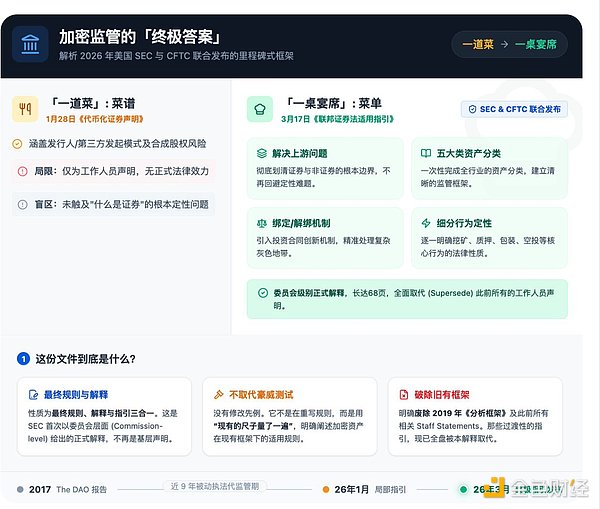
1. What exactly is this document?
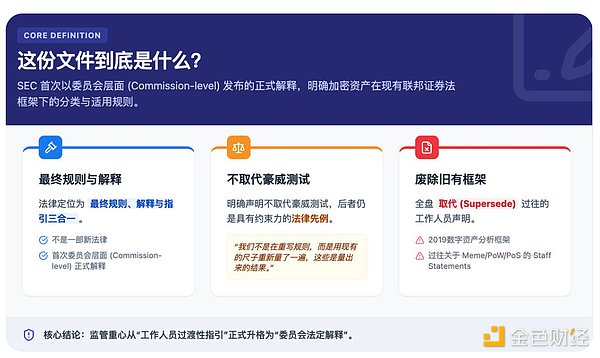
First, we need to clarify its nature. The legal positioning of this document is "Final rule; Interpretation; Guidance"—that is, a combination of final rules, interpretations, and guidance.
It is not a new law, nor does it modify the Howey test, but rather it is the SEC's first official interpretation at the Commission level, clearly elaborating the classification and application rules for crypto assets within the existing federal securities law framework.
Notably, the document explicitly states: "The interpretation in this release does not supersede or replace the Howey test, which is binding legal precedent." (This interpretation does not replace the Howey test, which remains binding legal precedent.)
In other words, the SEC is not rewriting the rules but telling you: we measured with the existing ruler, and these are the results.
At the same time, this document directly replaces the SEC staff's 2019 "Framework for 'Investment Contract' Analysis of Digital Assets," as well as all previous staff statements on related topics.
As the document states: "the views expressed by the Commission in this release supersede any prior statements by the Commission or its staff on these topics."
This means that previous Staff Statements regarding Meme Coins, PoW mining, PoS staking, stablecoins, etc., while providing valuable transitional guidance, have now been replaced by this formal Commission-level interpretation.
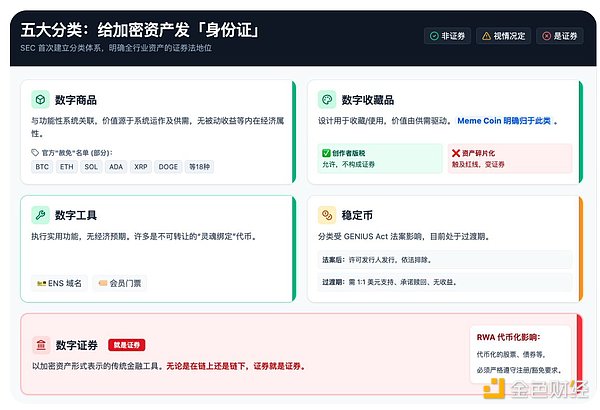
2. The Five Categories: Issuing "IDs" for Crypto Assets
The most critical and practically valuable part of this document is the classification of crypto assets into five categories. This is the first time the SEC has established a classification system (taxonomy) for crypto assets in the form of a formal interpretation, and each category clarifies its status under securities law.
Category One: Digital Commodities—Not Securities
The definition of digital commodities is: those inherently associated with a "functional" crypto system, whose value derives from the programmatic operation and supply-demand dynamics of that system, rather than the profit expectations resulting from efforts of others in managing it. Digital commodities do not possess inherent economic attributes such as passive income, future income rights, or rights to share in profits.
The key term here is "functional"—the SEC has specifically defined what a functional crypto system is: the native crypto asset of that system can be used within the system according to the programmatic functions of the system.
The document names a number of digital commodities, including: BTC, ETH, SOL, ADA, AVAX, DOT, XRP, LINK, DOGE, SHIB, LTC, APT, HBAR, XLM, XTZ, BCH.
More importantly, the document also mentions that ALGO and LBC (LBRY Credits) are also considered digital commodities—even though they do not have corresponding CFTC-regulated futures contracts.
The significance of this list is extremely profound.
It is important to know that the SEC previously argued in the Ripple case that XRP's sales constituted investment contracts (i.e., securities transactions), and hinted in multiple enforcement actions that SOL and ADA might also be securities.
Now, these assets have been officially "pardoned"—at least from the SEC's perspective, they are not considered securities.
However, a critical caveat must be noted: "Based on our understanding of their characteristics, terms, and functions as of the date of this release." (Based on our understanding of their characteristics, terms, and functions as of the release of this document.) This means that this classification is not permanently set in stone, and the SEC retains room for future adjustments.
Category Two: Digital Collectibles—Not Securities
Digital collectibles are defined as crypto assets designed for collection and/or use, representing or conveying rights to artworks, music, videos, trading cards, game props, internet memes, and more. Likewise, they do not possess inherent economic attributes such as passive income or profit sharing.
What is most noteworthy here is: Meme Coins are explicitly classified as digital collectibles. The document defines Meme Coins as "crypto assets inspired by internet memes, characters, current events, or trends, created to attract enthusiastic online communities to purchase and engage in trading." Their value "is driven by supply and demand, rather than any fundamental management efforts of others."
Examples of digital collectibles listed in the document include: CryptoPunks, Chromie Squiggles, Fan Tokens, WIF (dogwifhat), VCOIN.
There is an interesting boundary case regarding creator royalties. The document explicitly states that the creator royalty mechanism of NFTs—that is, automatically paying a percentage to creators on each resale—does not turn digital collectibles into securities. The reason is that holders do not receive any share from the creators' royalties and do not have rights or interests in any business entity of the creators.
However, the document also draws a red line: If digital collectibles are fractionalized, allowing individuals to gain partial ownership of a single digital collectible, it may constitute the offer and sale of securities, as it may involve holders' profit expectations based on the fundamental management efforts of others.
Category Three: Digital Tools—Not Securities
Digital tools are crypto assets utilized for practical functions, such as memberships, tickets, vouchers, identity badges, and more. Their value derives from actual functions, with examples including ENS domain names and Consensus tickets from CoinDesk. Many digital tools are non-transferable "soul-bound" Tokens.
This classification is quite intuitive, so I won’t elaborate further.
Category Four: Stablecoins—Conditional
The classification of stablecoins is complex, as it relates to the GENIUS Act passed in July 2025. In short:
According to the GENIUS Act, "payment stablecoins" issued by a "permitted payment stablecoin issuer" will be excluded from the definition of securities once the GENIUS Act comes into effect.
During the transition period before the GENIUS Act is in effect, the SEC adopts the analysis of "Covered Stablecoins" from the previously published Stability Statement by Corporation Finance staff—which means that stablecoins meeting specific criteria (generally referring to those backed 1:1 by USD assets, promises of redemption, and not paying income) do not constitute securities.
However, stablecoins that do not meet these conditions may still constitute securities and need to be judged based on specific facts and circumstances.
Category Five: Digital Securities—They Are Securities
Digital securities are financial instruments represented in the form of crypto assets that inherently fall under the definition of securities listed within financial instruments. Whether the securities are issued on-chain or off-chain, they are still securities—"A security is a security regardless of whether it is issued, or otherwise represented, off-chain or on-chain."
This is crucial for the RWA (real-world assets) tokenization industry: If you are tokenizing stocks, bonds, or other financial instruments that are already securities, the tokenized version remains a security and must comply with the corresponding registration and exemption requirements.
3. The "Entangling" and "Untangling" of Investment Contracts—Affects Core Rules for Every Project Team and Exchange
No matter how clear the classification is, there’s a real issue we can’t avoid: The vast majority of tokens in the crypto world have undergone ICOs, private sales, or public sales, which included a plethora of promises regarding future developments. According to the logic of the Howey test, these transactions might constitute the issuance of securities.
So the question arises—do these tokens forever wear the "securities" label? Is every transaction on the secondary market teetering on the brink of legality?
The SEC's answer is: not necessarily.
But before diving deeper, it is necessary to clarify why this issue is crucial—"Your token sale constitutes an investment contract" is not an academic qualification, but one that will trigger a series of very specific legal consequences.
In the United States, issuing securities must be registered with the SEC or meet specific exemption conditions (such as Reg D for accredited investors, Reg S for non-U.S. investors). For early crypto projects, going through full registration is nearly impossible.
If you are selling tokens directly on your website without registration or an exemption—then you are illegally issuing securities. Consequences include SEC enforcement actions, returning all raised funds plus interest, investors demanding "token refunds," and founders facing civil fines or even criminal charges.
Moreover, this issue isn’t just about the project teams. While tokens are "entangled" in investment contracts, every transfer on any trading platform theoretically constitutes securities trading—platforms must register as securities exchanges, and market makers need to register as broker-dealers.
This is precisely the core logic behind the SEC’s lawsuits against Coinbase and Binance over the past few years: it’s not that a given token you traded is a security, but that the investment contract surrounding it hasn’t disappeared, rendering you involved in unregistered securities trading.
Understanding this stake helps to grasp why the "untangling" mechanism is so critical—it's the only path for tokens to "graduate" from the jurisdiction of securities law.
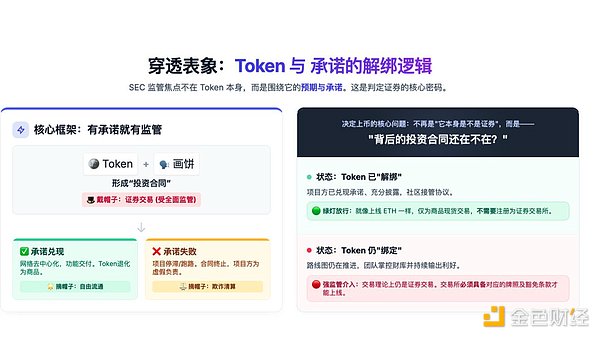
Core Principle: Token ≠ Security, but Selling Tokens' "Promises" Can Constitute Securities
Using the original scenario from the Howey case to understand: a piece of land is not a security itself, but if a developer sells the land with promises of "I will help you grow oranges, help you sell them, and share profits with you," that transaction becomes an investment contract—an investment contract is a security.
The key point is: the land hasn’t changed, but the promises and arrangements surrounding the land have. Similarly, a token itself might not be a security, but the development promises attached to its sale can make that transaction a securities transaction. When the promises are fulfilled or vanish, the token is "untangled," returning to a non-security status.
How do you determine if it is "entangled"?
Four Dimensions:
The document's logic is clear—when a project team sells a token with promises, and a buyer pays for those promises, it may constitute an investment contract. However, not all promises count; the SEC provides four evaluative dimensions:
- Who said it (only commitments from the project team and its affiliates count; community influencers’ endorsements do not count)
- When was it said (must be before or during the sale; post-sale tweets won't retroactively turn it into a securities transaction),
- How was it said (commitments made through formal channels, such as white papers, websites, or official social media, are more likely to be recognized),
- How specific was it (commitments with milestones, timelines, team, and funding plans establish reasonable expectations; vague slogans like "We are building the future of Web3" likely do not count).
How to "untangle"? Two paths:
Path One: The promises were fulfilled.
The project team has completed all key milestones promised in the white paper and disclosed them publicly, resulting in the natural dissolution of the investment contract. A clever design is that whether they are "completed" depends on how the project team defines these efforts themselves, not the general understanding of "sufficient decentralization" in Crypto Twitter—if you promised to do XYZ, doing XYZ suffices.
Path Two: The promises failed.
The project team publicly announces they are abandoning development, or a sufficient amount of time has passed where the market has recognized that the project team has done nothing and has no intention to do so, in which case the investment contract similarly disappears. But the SEC adds an essential caveat: investment contracts can disappear, but legal responsibilities do not. The project team may still bear liability for fraudulent misrepresentation during fundraising. You can "untangle," but you cannot "default."
Using a scenario from the crypto sphere to string together the whole logic:
Assume a project team issues an ABC Token in 2024, with the white paper promising to raise $50 million to develop an L1 public chain, stating in the roadmap to testnet in Q4 2024, mainnet in Q2 2025, and achieving EVM compatibility by Q4 2025, at which point ABC would serve as the native Gas Token.
Investors buy ABC, drawn by the roadmap—at this stage, ABC itself is not a security, but the combination of "funds + promises + profit expectations" constitutes an investment contract, requiring the token sale to be registered or exempt, with secondary market trading also constituting securities trading.
Fast forward to Q4 2025, the mainnet is launched, EVM compatibility is completed, every milestone in the roadmap has been checked off, and the project team publicly announces "the roadmap is fully completed"—the promises have been fulfilled, the investment contract dissolves, and ABC is "untangled."
Thereafter, buying and selling ABC on Coinbase or Uniswap is like trading ETH, no longer constituting securities trading.
In a parallel universe, if the project team takes the $50 million, the CTO runs away, the code is abandoned, and the founder tweets to announce "development has stopped"—the promises have failed, and the investment contract similarly dissolves. But the SEC could still pursue liability for fraudulent misrepresentation based on the fundraising process.
In other words, as long as the project team’s promises have not been fulfilled, the SEC can come after you for an explanation.
There’s also a third situation: if the white paper only states "We are building the future of Web3," with no specific plans—then the investment contract may not have been valid from the start because the promises are too vague, failing to establish reasonable profit expectations.
The impact on the secondary market is profound:
During the "entangled" period, secondary market trading of the token constitutes securities trading, requiring registration or exemption;
Once "untangled," these transactions are no longer governed by federal securities law. This offers an unprecedentedly clear framework for exchanges to list tokens.

Finally, a plain language summary:
A token itself is a "thing," not a security; but the promises the project team made when selling the token can turn that transaction into a securities transaction. If the promises are fulfilled, the securities trading label is removed, and the token can circulate freely in the secondary market; if the promises fail, the label is also removed, but the project team may still have to account for any lies made when making those promises.
From start to finish, the SEC is focused not on the token itself but on the promises surrounding the token—where there are promises, there is regulation; when the promises disappear, regulation withdraws. This is the most essential framework of the entire document.
For exchanges, the logic changes: when deciding whether to list a token, the core question is no longer "Is this token a security?" but "Does the investment contract behind this token still exist?"
If the project team has fulfilled all the promises in the white paper and disclosed them publicly—then the token is "untangled," and listing it for the exchange is like listing ETH, without needing to register as a securities exchange. But if the project team’s roadmap is still progressing and promises have not been fulfilled—then the token remains "entangled" in the investment contract, and every transaction is theoretically a securities transaction, requiring the corresponding licensing for the exchange.
In other words, this document gives exchanges a new yardstick: no longer guessing "Will the SEC come after me?" but checking whether the project team’s promises have been fulfilled.
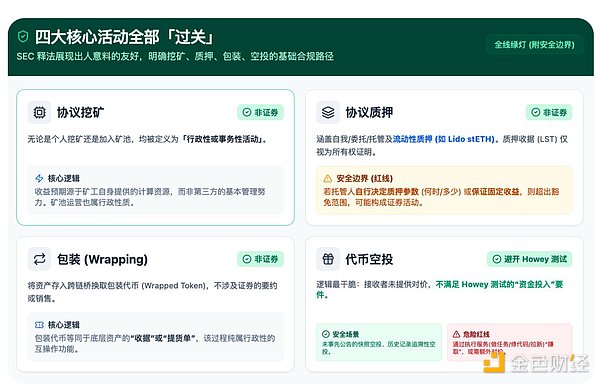
4. Mining, Staking, Wrapping, Airdropping—All Four Activities "Pass"
The latter half of the document analyzes four common crypto asset activities, and the conclusions are surprisingly friendly.
Protocol Mining: Not Securities Trading.
Whether individual mining or joining a mining pool, mining itself is defined as "administrative or ministerial activity." Miners' expected earnings come from the computing resources they provide, rather than from the fundamental management efforts of a third party. The activities of mining pool operators are also defined as administrative in nature.
Protocol Staking: Not Securities Trading.
This includes four forms: self-staking, self-custody staking (delegated to a third-party node operator), custodial staking (assets given to custodians for staking), and liquid staking (such as Lido’s stETH model). The SEC's core logic is that staking itself is an administrative activity that maintains network security, and the activities of service providers (including node operators, custodians, and liquid staking providers) are also administrative, not constituting fundamental management efforts.
More importantly, the document clarifies that Staking Receipt Tokens (such as stETH, cbETH, etc.) are also not securities.
Provided that their underlying assets are non-security crypto assets and not bound by investment contracts. The SEC defines these as "receipts," proof of ownership of the custodial digital commodities.
However, the document sets certain "safety boundaries": If custodians independently decide whether, when, and how much to stake (rather than acting per depositor instructions), or guarantee/fix reward amounts, they fall outside the scope of this interpretation. Likewise, if liquid staking providers independently decide staking parameters or guarantee returns, they also fall outside the scope. These boundary cases may still constitute securities activities.
The document also lists several "ancillary services"—including penalty guarantees, early unlocking, alternative reward payment plans, and digital commodity aggregation—and clarifies that all of these are administrative activities, not altering the non-security nature of staking.
Wrapping: Not Securities Trading.
Depositing one type of crypto asset into a custodian or cross-chain bridge in exchange for an equivalent amount of "Redeemable Wrapped Tokens" does not involve the offer or sale of securities. Wrapped tokens are seen as receipts for underlying assets, with their value entirely deriving from underlying assets; the wrapping process is an administrative interoperability function.
Airdrops: Do Not Meet the First Requirement of the Howey Test.
This part is the most straightforward logic of the entire document. The SEC directly addresses the first requirement of the Howey test—"investment of money"—stating that if the recipient provides no consideration (money, goods, services, or other consideration) to the issuer in exchange for the airdropped tokens, it does not satisfy the first requirement of an investment contract, and thus does not constitute securities trading.
However, there’s a crucial limitation: If recipients "earn" the airdrop by performing certain services (e.g., completing specific tasks, fixing code, promoting the project), then that airdrop would not fall within this interpretation.
Likewise, if the airdrop requires recipients to provide additional consideration after the announcement to obtain the tokens, it also falls outside of this interpretation.
The document provides several "safe" airdrop scenarios: unannounced snapshot airdrops (to wallets holding specific tokens), retrospective airdrops to early users of the testnet (provided that the airdrop was not announced beforehand during the test phase), and unannounced airdrops based on historical usage records.
5. The Role of CFTC: From Bystander to Joint Regulation
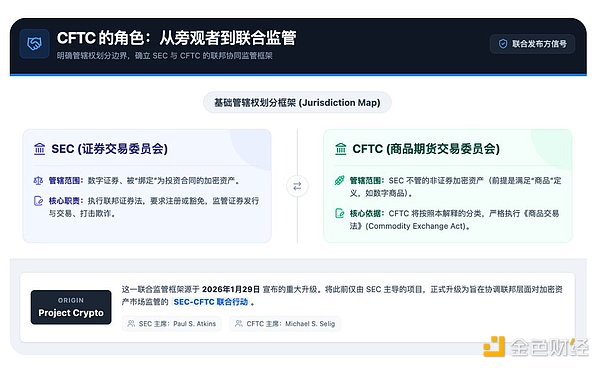
The CFTC is a joint publisher of this document, which itself is an important signal. The document explicitly states that the guidance provided by the CFTC indicates: CFTC and its staff will enforce the Commodity Exchange Act according to this interpretation, and "certain non-security crypto assets could meet the definition of 'commodity' under the Commodity Exchange Act."
In other words, for those (non-securities crypto assets) that the SEC does not oversee, the CFTC will regulate them—at least within the scope of meeting the "commodity" definition. This provides a foundational framework for delineating the jurisdiction of the SEC and CFTC.
The document also mentions that this joint regulatory framework stems from SEC Chair Paul S. Atkins and CFTC Chair Michael S. Selig announcing "Project Crypto" on January 29, 2026—upgrading a project previously led by the SEC to a joint SEC-CFTC action aimed at coordinating federal regulation of the crypto asset market.
6. The Practical Impact on the Industry
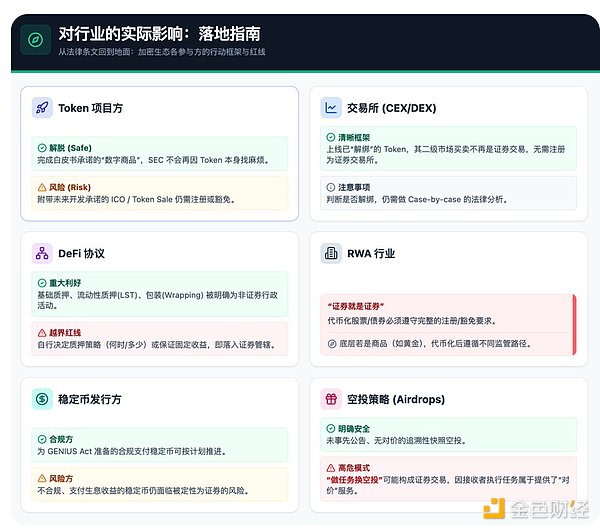
After so much legal analysis, let’s return to ground level and discuss the actual impact of this document on various participants in the crypto industry.
For Token Project Teams:
If your token falls within the "digital commodity" category (the native token of a functional system), and you have completed the development goals promised in your white paper, you can significantly relax—at least the SEC will no longer pursue you claiming the token itself is a security.
However, if you are conducting an ICO or token sale with accompanying promises about future developments, your sale may still constitute an offer for an investment contract, requiring registration or exemption.
For Exchanges:
This document provides exchanges with a clearer legal analysis framework for listing tokens. If a token has "untangled" from the investment contract (the issuer has fulfilled the promises or clearly abandoned them), then secondary market trading of that token is no longer securities trading, and exchanges do not need to register as securities exchanges.
However, determining whether a token has "untangled" still requires a case-by-case legal analysis.
For DeFi Protocols:
Staking, liquid staking, wrapping, and other core DeFi activities have been clearly defined as non-securities trading, which is significant for DeFi’s legitimacy. However, the document also sets boundaries—if your staking service exceeds the "administrative" scope (e.g., independently deciding staking strategies or guaranteeing returns), you may still fall within the jurisdiction of securities law.
For the RWA Industry:
Tokenized securities are securities—this point has been reiterated. If you are engaged in RWA tokenization and the underlying assets are securities (stocks, bonds, etc.), you must comply with the full securities registration and exemption requirements. However, if the underlying assets are commodities (such as gold, bulk commodities), the regulatory path for tokenization will differ.
For Stablecoin Issuers:
Compliance-focused stablecoin issuers preparing for the GENIUS Act can continue with their planned progress. Non-compliant, yield-paying stablecoins still face the risk of being classified as securities.
For Airdrop Strategies:
Unannounced, no-consideration retrospective airdrops are clearly marked as safe. However, task-based airdrop models may constitute securities transactions because recipients provided services as consideration.
7. Unresolved Matters
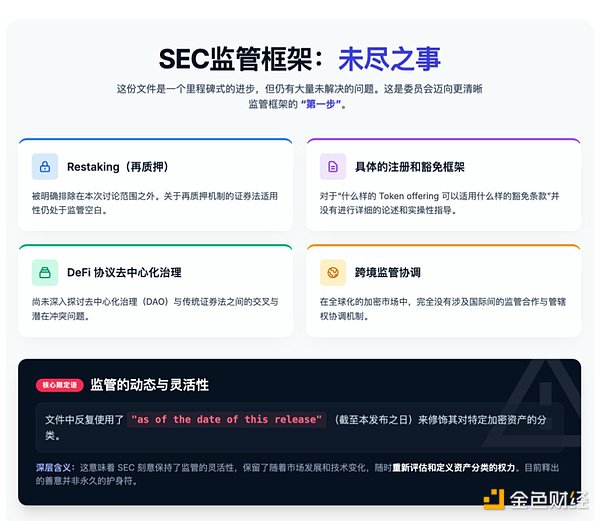
While this document marks a milestone advancement, many issues remain unresolved.
The document explicitly states this is "Commission's first step toward developing a clearer regulatory framework," and the SEC is seeking public feedback on this interpretation, which may lead to refining, revising, or expanding upon the interpretation.
Important issues not covered in the document include: restaking is explicitly excluded from discussion; specific registration and exemption frameworks (which types of token offerings can use which exemptions) are not detailed; the intersection of decentralized governance of DeFi protocols and securities law is not explored in depth; and cross-border regulatory coordination is also not covered.
Furthermore, the document frequently uses the phrase "as of the date of this release" to modify classifications of specific crypto assets. This implies that the SEC retains the power to reevaluate classifications as market conditions change.
Conclusion
From the 2017 DAO Report to this joint interpretive guidance in 2026, U.S. crypto regulation has travelled a long and winding road. This document is not perfect—it does not solve all issues, its classification system remains vague under boundary conditions, and its "untangling" standards still require extensive legal judgment in practice.
But it has accomplished the most crucial task: it has committed the rules to paper.
For an industry that has long lived under the shadow of "regulation by enforcement," simply "clearing up the message" is, in itself, invaluable.
From now on, crypto project teams can at least compare their legal risks against a formal framework, rather than reverse engineer regulatory logic from the SEC’s enforcement announcements.
Of course, the real challenge is just beginning. This interpretation is merely the first step. The subsequent registration framework, exemption mechanisms, intermediary regulatory rules, and the division of jurisdiction between the SEC and CFTC are key pieces determining whether the crypto industry can truly achieve compliant operation in the United States.
Source of the document: SEC Release No. 33-11412; 34-105020, "Application of the Federal Securities Laws to Certain Types of Crypto Assets and Certain Transactions Involving Crypto Assets," dated March 17, 2026.
免责声明:本文章仅代表作者个人观点,不代表本平台的立场和观点。本文章仅供信息分享,不构成对任何人的任何投资建议。用户与作者之间的任何争议,与本平台无关。如网页中刊载的文章或图片涉及侵权,请提供相关的权利证明和身份证明发送邮件到support@aicoin.com,本平台相关工作人员将会进行核查。