This week, in East Eight Time, the military actions of the U.S. and Israel around the Strait of Hormuz have significantly escalated. The U.S. Central Command has stated that it has bombed "Iranian coastal facilities threatening shipping in the Strait of Hormuz," while Israel's Defense Minister Katz publicly declared that it will "significantly increase strikes until the threat to U.S. and Israeli interests is eliminated." In response, Iran has retaliated with its 71st wave of missile and drone strikes, leading to a standoff between the three parties near this global energy artery, forcing the market to reassess the security of Hormuz. Meanwhile, the Bitcoin network mining difficulty was reduced by 7.76% to 133.79T, marking the largest drop since the end of 2025. Combined with the analysis suggesting oil prices could reach 180 dollars or correspond with Bitcoin dropping to 51,000 dollars, the correlation between energy and cryptocurrency is being magnified. The central question this article attempts to answer is: when the Strait of Hormuz, responsible for about 20% of global oil transportation, is under tension, how does this impact flow through oil prices and dollar liquidity, subsequently transmitting through to the pricing of cryptocurrencies and Bitcoin decisions?
Hormuz Becomes a Powder Keg: Three Parties Amplifying Shipping Threat Narratives
In chronological order, this current round of tensions in the Middle East began with U.S. airstrikes on Iranian coastal military facilities. The U.S. Central Command's public stance is that these targets "threaten the security of shipping in the Strait of Hormuz," embedding the action directly into the narrative of global energy security. Shortly after, Israeli Defense Minister Katz declared that Israel would "significantly increase its strikes" targeting ongoing actions until "the threat to U.S. and Israeli interests is eliminated," linking Israel's security to U.S. maritime interests in the region. Iran responded with its 71st wave of missile and drone attacks, emphasizing retaliation and deterrence, creating a cyclical military escalation of exchanges.
In terms of public statements, the U.S. military directly mentioning Hormuz shipping has rebranded this strait from a local conflict scene to a vital point in the global supply chain; Israel, through strong language from its Defense Minister, attempts to amplify expectations of "sustained strikes," demonstrating costs to opponents while signaling resolve to allies. The rhetoric from all three parties constructs a narrative framework that "Hormuz shipping is genuinely threatened," compelling the market to map geopolitical events directly onto tanker passage and insurance risks.
Meanwhile, the media reports, citing a single source, that the U.S. military is sending three warships and approximately 2,500 Marines into the relevant waters. This information lacks cross-verification from multiple sources, and the specific timeline for deployment has not been disclosed. Regardless of the details, the information itself reinforces the signal that "the U.S. is prepared to maintain a high intensity military presence near Hormuz for the long term." It is important to emphasize that regarding the troop increase, what can currently be confirmed is direction and scale; more tactical details remain unknown, and any further elaboration could slip into speculation.
The reason every military news from Hormuz is amplified lies in its unique position in the energy landscape - this strait is responsible for approximately 20% of global oil transportation. Whether actually striking tankers or merely increasing passage costs and insurance premiums, any escalation in tension is sufficient to rapidly ignite risk premiums on the pricing front. For the global economy and financial markets dependent on energy inputs, Hormuz resembles a "geopolitical single point of failure": an escalation in conflict need not escalate into a full-scale war to be reflected asymmetrically on oil price curves.
Oil Prices Aiming for 180 Dollars: Dual Constraints of Inflation and Liquidity
In this context, the most direct financial consequence of the tension in Hormuz is the elevation of geopolitical risk premiums pushing up oil prices. Even if supply has not been massively interrupted, as long as the market perceives potential disruptions to passage in Hormuz, the futures curve will preemptively price in potential risks. When safe-haven buying coincides with speculative funds rushing into long positions in oil, oil price expectations will rise quickly, transforming what is merely news of localized conflict into broad-based energy inflation. For central banks and asset managers, this is no longer purely military news, but a variable that directly affects inflation trajectories and asset allocation weights.
In this rising emotion channel, some analysts propose an extreme scenario: "Oil prices at 180 dollars could drive Bitcoin down to 51,000 dollars." Such statements are more of a scenario projection than a rigorous causal quantitative model, aiming to provide a curve for investors to envision stress testing - how risk assets might be revalued as oil prices soar to extreme levels. It is essential to emphasize repeatedly that there is no mechanical correspondence between 180 dollar oil prices and 51,000 dollar Bitcoin prices; this is merely a representative viewpoint the market is using to assess the combination of "energy shocks + tightening liquidity," not a precise prediction of time and price paths.
Looking back at the macro framework, the Federal Reserve currently maintains the federal funds rate within the 3.50%-3.75% range (according to HSBC data), which is already in a delicate balance between "containing inflation and stabilizing growth." If tensions in Hormuz continue to push oil prices higher, core inflation indicators may come under pressure again, forcing the Federal Reserve to weigh between difficult choices: on the one hand, maintaining or even strengthening a hawkish stance to defend inflation targets; on the other hand, high interest rates are already exerting downward pressure on the real economy and asset markets. Under the shadow of "stagflation," any shock tilted toward inflation will amplify policy difficulties.
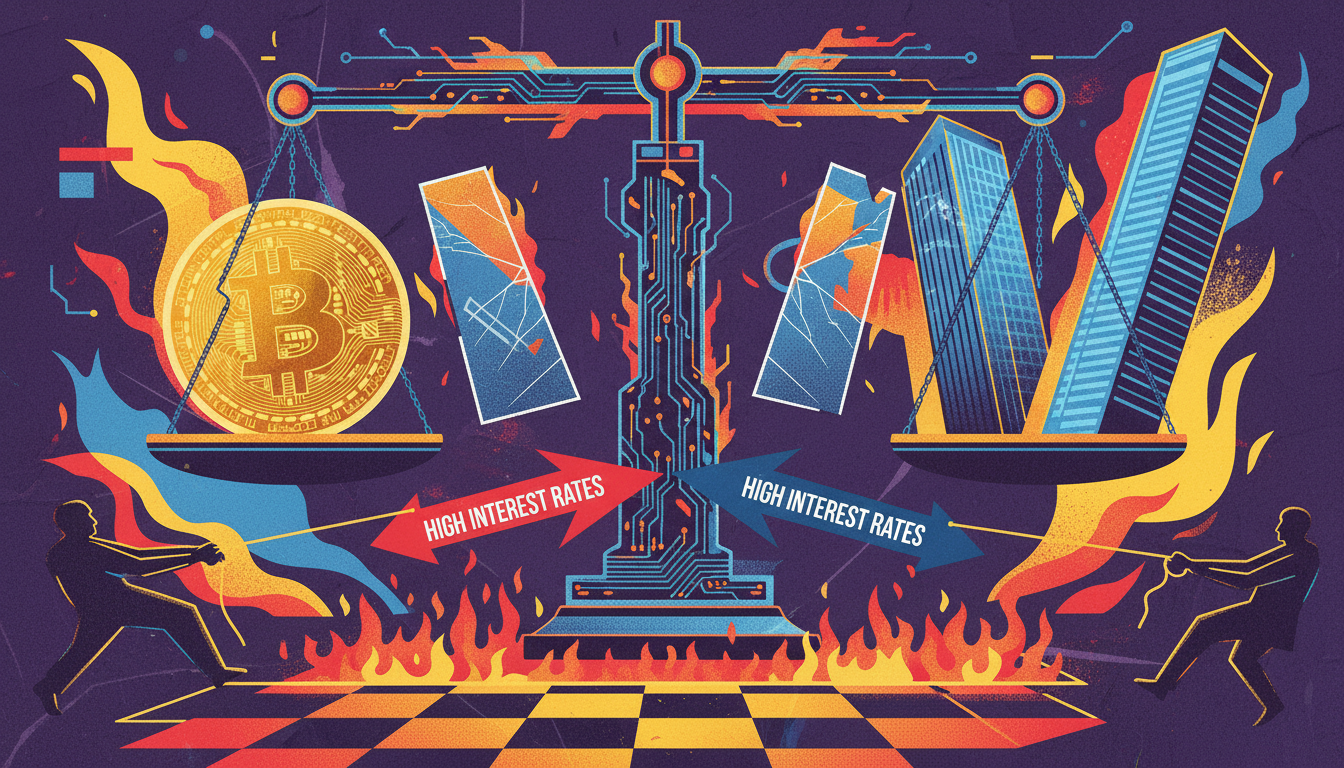
For the cryptocurrency market, the surge in oil prices combined with high interest rates effectively compresses both risk appetite and dollar liquidity. On one hand, high energy costs increase the rigidity of expenses for businesses and households, squeezing the marginal funds that can be directed toward high-volatility assets; on the other hand, if renewed inflation forces the Federal Reserve to maintain a firm position, high U.S. dollar rates will continue to siphon off global liquidity, causing high-beta assets represented by Bitcoin to compete for pricing power in a more scarce liquidity pool. The result is often increased volatility: including both the resilience of a sharp rebound post-negative flush and the fragility under panic situations.
Investment Safe Haven Misalignment: The Rupture and Rotation of the Safe Haven Narrative
Historically, during geopolitical crises, Bitcoin's role in market narratives has been unstable: at times, it has been packaged as "digital gold" and has synched with gold in certain localized conflict and currency devaluation scenarios; however, in broader stages of global risk aversion, especially during periods of tightening U.S. dollar liquidity, Bitcoin is often sold off alongside tech stocks, exhibiting typical characteristics of high-risk assets. This variance in historical performance underscores that the "safe haven" label cannot be rigidly fixed, as it relies upon macro environments and capital structures, not merely the conflict itself.
When both oil prices and interest rates are on the rise, institutional capital tends to prioritize reducing high-risk positions in their allocations rather than adding allocations to cryptocurrencies like Bitcoin. For large asset managers and hedge funds, the primary task is often to control portfolio volatility and drawdown: reducing exposure to high-beta stocks, cutting crypto exposure, increasing cash and short-duration bonds, or selectively increasing holdings of energy and precious metals on the commodity side; this process has played out numerous times in past risk events. For most institutions, viewing Bitcoin as "a safe-haven asset to immediately increase allocation during wartime" still exceeds mainstream risk control frameworks.
Behind this misalignment lies an inherent contradiction between the "safe haven asset" label and Bitcoin’s high volatility and high-beta properties. On the one hand, Bitcoin's decentralized and censorship-resistant features lend it an inherent logic to hedge against single sovereign currencies and capital controls, making it easily categorized as "alternative safe haven" in narrative contexts; on the other hand, its price is extremely sensitive to leverage, derivatives positions, and emotional fluctuations, often being the first to face pressure during liquidity-tightening periods. As a result, Bitcoin may switch roles between "digital gold" and "tech stock 2.0" across different macro stages, making it impossible to provide stable expectations based solely on geopolitical conflicts.
Therefore, in the context of the current escalation in the Middle East and tensions in Hormuz, Bitcoin's performance is likely to be more dominated by dollar liquidity and overall risk appetite than by the outcome of any single conflict. If the rise in oil prices is perceived by the market as short-term controllable and does not substantially alter the central bank’s path, some capital may re-narrate the story of "hard assets and scarcity" through the "geopolitical risk" context, providing temporary support for Bitcoin; however, if energy shocks and high interest rates collectively push global capital into defensive mode, Bitcoin is more likely to be included in the "risk reduction" list.
Hashrate Migrating Amidst Flames: Signals and Boundaries of Tremendous Difficulty Drop
Apart from price narratives, the Bitcoin network itself has also provided a rare signal: the most recent adjustment of the mining difficulty has decreased by 7.76% to 133.79T, marking the largest drop since the end of 2025. Such a significant single adjustment is rare in the context of a long-term increasing difficulty trend, indicating a notable decline in the overall hashrate within the past difficulty cycle. For miners, this represents a temporary easing of competitive pressure; for observers, it serves as a warning light indicating unusual fluctuations in hashrate distribution and economic incentives.
Bitcoin's difficulty adjustment mechanism automatically corrects based on the block generation speed over the previous two weeks to ensure an average of one block every ten minutes. When many mining machines shut down or capacity goes offline, the network's block generation slows, and the difficulty will passively adjust downward in the next window. This mechanical rule is neutral in nature; however, when the adjustment magnitude is unusually amplified, it often indicates a drastic shift in hashrate related to geography or cost structures. Historically, certain geopolitical conflicts, significant fluctuations in energy prices, or regulatory crackdowns have often correlated with timeframes of hashrate fluctuations, reminding us that hashrate does not float outside geopolitics but is deeply embedded in the energy and policy environments of various countries.
If we refocus on oil prices, rising energy costs theoretically would directly squeeze profit margins for mining operations that depend on thermal electricity and large-scale power grids. For small to medium miners already on the edge of break-even, once electricity or fuel prices are pushed up by external shocks, ceasing operations or relocating can quickly shift from a financial choice to a survival option: some mining operations may be forced to shut down, reducing hashrate; others may choose to relocate to areas with lower electricity prices and more lenient policies, reshaping the hashrate map. In the scenario of rising oil price expectations due to tensions in Hormuz, this pressure would accelerate its release and create an "outward expulsion effect" between regions.
However, what can be responsibly stated at present is only that there is a historical correlation between hashrate and geopolitics, and that the current significant decrease in difficulty coincides with external environmental changes. The briefing did not provide any verified information regarding specific countries or facilities being targeted, so we cannot or should not attempt to directly correlate this difficulty change with any single military target. For investors and industry participants, a more reasonable approach is to view hashrate as a kind of "on-chain macro indicator": it can indicate pressures and migration directions but cannot replace intelligence systems to identify battlefield details.
The Dual Game Between Wall Street and Miners: Magnifying Glass Under Liquidity Contraction
From the perspective of institutional capital, whenever uncertainty in the Middle East escalates, asset repricing often follows a relatively fixed sequence: firstly, crude oil and related energy stocks are revalued under the influence of geopolitical premiums; secondly, the rates and bond markets adjust to potential inflation pathways; and finally, the equity market and cryptocurrency assets, considered high-risk sectors, react subsequently. In this chain, cryptocurrency assets occupy a position further back, having to bear both the transmission of upstream oil price and interest rate variables, as well as accepting selling pressure overflowing from traditional assets after risk appetite contracts. This round of tension in Hormuz has not broken this logic but rather reinforced the market memory that "energy leads, liquidity follows."
From the miners’ perspective, there is another triangular game: electricity prices, hashrate, and coin prices constitute the boundaries of profit space. The surge in oil prices not only raises transportation and equipment costs but, more importantly, pushes up electricity prices through the power generation mix, elevating the marginal costs of hashrate production. When the difficulty has not fully adjusted downward and coin prices are under pressure, miners' profit margins will be squeezed from both directions, forcing them to make difficult choices between reducing production, accumulating, or selling. In extreme scenarios, some miners may choose to increase their selling of coins to maintain cash flow, creating ongoing natural selling pressure in the spot market.
When miner selling pressure coincides with institutional de-risking within the same time window, the amplifying effect on price volatility in the crypto market will significantly intensify. Institutions reduce risk exposure due to risk control and redemption pressures, while miners accelerate monetization due to cost and cash flow constraints; the two actions align in direction, making it easy to form "impulse-like downward" patterns on price charts. During these phases, both on-chain indicators and traditional market liquidity indicators often send aligned signals: increased transaction volume, reduced buy depth, rising slippage and volatility.
Above all this hangs the "Damocles' sword" of futures leverage and the clearing chain. Geopolitical breaking news often comes during non-U.S. hours or when liquidity is thin, at which point high-leverage contract positions are susceptible to continuous liquidation and cascading liquidations, creating a “news-driven - technical trigger” negative feedback loop. For mainstream coins like Bitcoin, the scale of futures and perpetual contract positions is already huge; once prices hit critical margin thresholds, triggering forced liquidations and cascading clearances, the selling pressure from both physical miners and financial institutions will be further exaggerated in the mechanical sell-off of the derivatives market.
The Flames Abate, Yet the Crypto Market Walks a Tightrope Under the Shadows of Oil Prices and Hashrate
In summary, this round of military escalation in the Middle East, exemplified by the Strait of Hormuz, firmly ties localized conflicts to the global macro narrative. The structural fact that Hormuz handles about 20% of global oil transportation implies that each military friction could be asymmetrically amplified in oil prices; further, oil price shocks transmit through inflation expectations, the Federal Reserve's difficult choices within the 3.50%-3.75% interest rate range, cascading down to dollar liquidity and global risk appetite, ultimately landing on the pricing of crypto assets including Bitcoin.
Within this chain, Bitcoin is neither a natural safe haven nor a destined source of disaster but is embedded as a part of the macro liquidity framework. Its performance is largely influenced by the looseness or tightness of dollar liquidity and the overall level of market leverage, rather than the outcome of any specific conflict. The extreme scenario projections of a difficulty drop of 7.76% to 133.79T, oil prices reaching 180 dollars, and Bitcoin dropping to 51,000 dollars, remind us that on-chain and price signals are responding to external pressures, yet the specific paths remain swayed by macro policies and capital behaviors.
For investors, tracking this unfolding game requires at least three clues to run in sync: first, focusing on oil price trends and the military dynamics around Hormuz to gauge the breadth and sustainability of energy shocks; second, closely monitoring the Federal Reserve’s attitude and market expectations regarding interest rate paths to understand whether liquidity is tightening or marginally easing; third, combining the dynamics of Bitcoin's hashrate and difficulty migration to observe how miners and the network adjust under cost pressures. Remaining vigilant across these dimensions rather than being led by a single narrative can help maintain decision quality amid significant volatility.
Finally, it is crucial to emphasize that all military processes and price scenarios discussed in this article are projections based on public information and market views, rather than certain depictions of the future. The tensions in Hormuz, oil price fluctuations, and Bitcoin price levels reflect a framework of correlation rather than a one-to-one correspondence of inevitable causality. Misinterpreting correlation as causation not only amplifies emotional fluctuations but may also mislead positioning decisions at critical moments - this, perhaps, is the greatest risk needing vigilance for the crypto market standing at the frontlines.
Join our community to discuss and grow stronger together!
Official Telegram community: https://t.me/aicoincn
AiCoin Chinese Twitter: https://x.com/AiCoinzh
OKX benefit group: https://aicoin.com/link/chat?cid=l61eM4owQ
Binance benefit group: https://aicoin.com/link/chat?cid=ynr7d1P6Z
免责声明:本文章仅代表作者个人观点,不代表本平台的立场和观点。本文章仅供信息分享,不构成对任何人的任何投资建议。用户与作者之间的任何争议,与本平台无关。如网页中刊载的文章或图片涉及侵权,请提供相关的权利证明和身份证明发送邮件到support@aicoin.com,本平台相关工作人员将会进行核查。