This week in East Eight Zone time, the interest rate trading market is experiencing a dramatic narrative reversal: traders have pushed the pricing for another rate hike by the Federal Reserve this year above 50%. The original debate around "how much to cut rates" and "whether to stay put" has quickly been replaced by "will there be another rate hike". Simultaneously, the VIX index, which measures fear in U.S. stocks, rose by about 1.17 points to 26.5 points in a single day, indicating heightened risk aversion and increasing volatility, collectively pointing to a "repricing" of global risk assets. The sudden shift in sentiment from betting on easing to re-adjusting the rate hike narrative is intertwined with multiple narratives of geopolitical conflict, inflation expectations, and policy maneuvering.
The sudden counterattack on bets for rate cuts
Over the past few months, the mainstream market narrative has still revolved around "moderate inflation decline and a shift in monetary policy towards easing", with expectations predominantly focusing on maintaining the current interest rate or even starting a rate-cutting cycle within the year. In terms of asset allocation, the focus has been on U.S. growth stocks and some highly leveraged assets, betting on the continuation of "the peak of high-interest rate era", with longer-duration and interest-sensitive assets continually being accumulated.
All of this was quickly overturned once traders revised the probability of a rate hike within the year to over 50%. For interest-sensitive assets, this means that the pricing foundation, which was previously built on the assumption of "the worst-case scenario being to stay put", has been breached, with the impact of elevated discount rates far exceeding most investors' psychological expectations, and a batch of positions "lying flat to benefit from the easing" are now passively exposed to the risk of rising rates.
On a micro level, rapid position turnover and hedging actions have occurred in the options and interest rate swap markets: on one hand, strategies betting on controlled volatility and peak interest rates were concentrated for liquidation, pushing up volatility itself in a short period; on the other hand, more funds began buying put options, defensive structured products, and rate-hiking hedging tools to correct portfolio vulnerabilities under the "another rate hike" scenario. The sharp change in interest rate expectations has been amplified at the derivatives level into a chain reaction of position restructuring.
The rising tensions in the Middle East push inflation back to the table
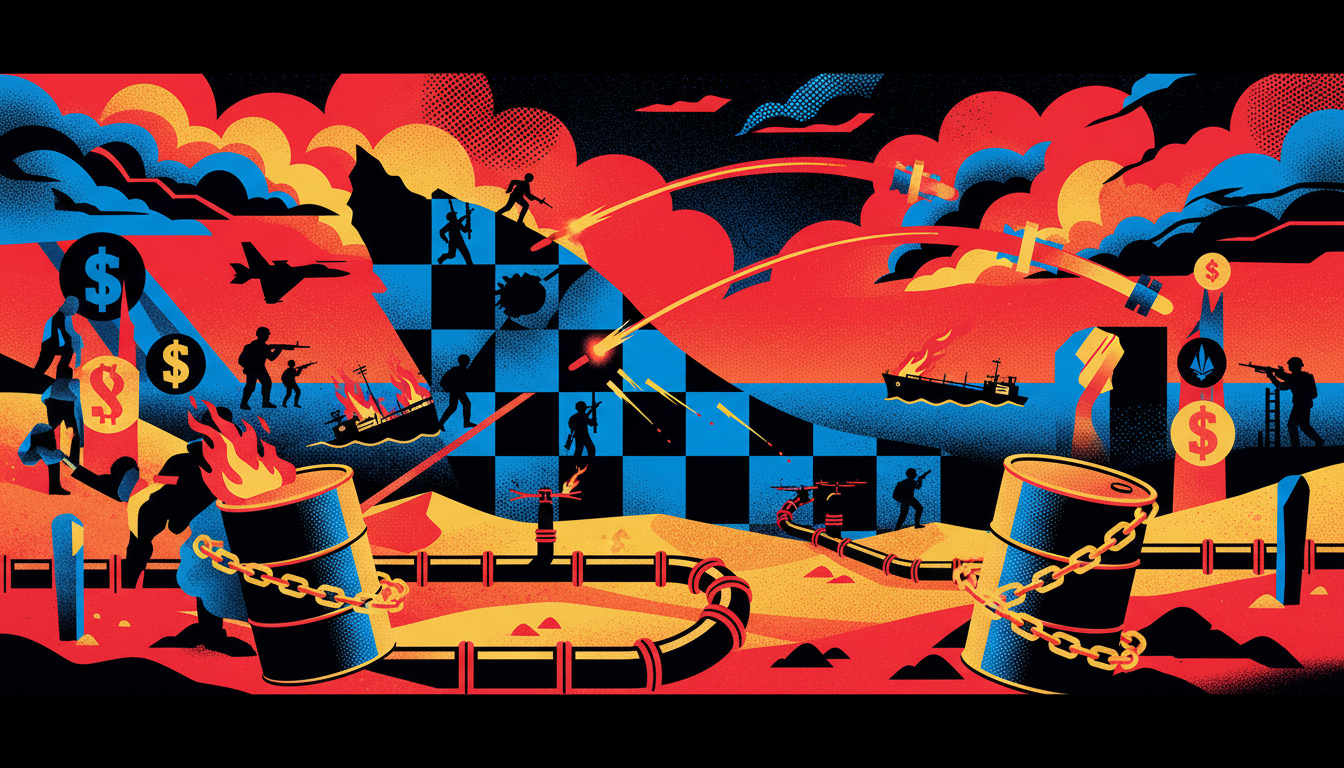
This round of rate hike expectation repricing did not happen in a vacuum. The Iranian missile strikes on Israel have once again escalated tensions in the Middle East, leading the market to focus on the strategically significant Strait of Hormuz for global energy and shipping. Any whispers surrounding blockade risks quickly raised geopolitical premiums, forcing a reassessment of the safety expectations for tanker and crude oil supply routes.
In terms of pricing, this means that expectations for rising crude oil and transportation costs have re-entered the center of the inflation discussion. Even though spot oil prices have not yet shown uncontrollable surges, traders have begun to assign a higher weight to the risk of a resurgence in "imported inflation": once energy and shipping costs remain high for a period, the hard-won results of prior inflation declines may very well be partially offset by this exogenous shock, further compressing the space for a "light shift" in monetary policy.
For this reason, members of the International Energy Agency agreed on March 11 to release strategic oil reserves in an attempt to buffer potential shocks by increasing supply, thereby alleviating market fears about uncontrollable oil prices and inflation expectations. This action, in itself, is an indirect confirmation of the "energy pressures potentially heightening inflation risks": policymakers hope to use reserve oil to buy time, allowing central banks more room in their interest rate decisions, but it also indirectly reinforces the market's perception that "the oil price issue is sufficient to disrupt monetary policy paths".
Fear index rises: money is paying for volatility again
As the narrative layers accumulate, the turning point in sentiment has already clearly emerged in the data. The VIX index rose about 1.17 points to 26.5 points in a single day, which not only indicates a significant rise in implied volatility for U.S. stocks but also marks a noticeable increase in market demand for short-term hedging. Investors are beginning to be willing to pay higher premiums for "downside protection", an act that itself is a vote for increased uncertainty about the future.
When the rise in volatility overlaps with the revision of interest rate expectations, the discount pressures on risk assets are magnified exponentially in a short time: on one hand, a higher risk-free rate directly raises the discount rate for future cash flows, weakening the justification for high valuation assets; on the other hand, the rise in volatility itself increases the required risk premium, causing valuations that were previously barely "acceptable" to start appearing shaky. Price corrections are no longer just technical adjustments, but rather a systemic action centered around resetting pricing anchors.
In such an environment, traditional safe-haven assets and cash positions are regaining favor. Some institutions have begun actively reducing exposure to high beta and highly leveraged targets, instead increasing their holdings in short-duration bonds, gold, and cash, indicative of a clear cooling in risk appetite. For many investors, the top priority is no longer "chasing extra yields," but rather "surviving this round of uncertainty," which also explains why the trading activity of hedging and safe-haven tools has simultaneously increased.
The game of oil and interest rates: dual pressure from G7 and the Federal Reserve
Concerns surrounding inflation and energy are not just amplifications of market sentiment. On the policy front, G7 nations plan to discuss using reserve oil to buffer supply shocks and price pressures potentially brought about by geopolitical conflicts, which echoes the International Energy Agency's coordinated release of strategic oil reserves. Whether from the perspective of protecting consumers, stabilizing electoral sentiment, or maintaining global supply chain stability, major economies are attempting to use "energy policy tools" to place a valve on inflation expectations.
However, if oil prices remain stubbornly high, the political and economic pressures faced by central banks, particularly the Federal Reserve, will simultaneously increase. Politically, high prices directly erode residents' real incomes, and voter sentiment may direct criticism towards the central bank and government for being "not tough enough on inflation"; economically, rising pressures on corporate costs squeeze profit margins, increasing the risk of a new upward spiral in wages and prices. In such a scenario, even if the Federal Reserve is worried about rate hikes dragging down growth, it may be forced to take a more hawkish stance on "anti-inflation rhetoric" to maintain its inflation targets and credibility.
Therefore, the future policy mix is likely to present a "front-end hawkish + energy intervention" dual-track response model: on one hand, maintaining a stronger tightening stance at the front end of interest rates, even if not explicitly committing to multiple rate hikes, could signal the anti-inflation resolve to the market through "raising rate hike probabilities and extending the duration of high rates"; on the other hand, measures such as coordinating the release of reserve oil and guiding energy-producing countries to increase production could hedge against external supply shocks while striving to stabilize price expectations without "crushing the economy".
Information warfare is also crucial: networks and platforms as new systemic variables
The timing of this round of expectation repricing coincides with a series of seemingly "technical level" events erupting. The Apifox supply chain attack exposed vulnerabilities in the cybersecurity of critical infrastructure—should core systems used for trading, clearing, risk control, or data distribution face similar attacks, the financial market's imagination of "systemic risk" would be rapidly amplified, and risk appetites would further contract due to technical uncertainties.
Meanwhile, the X platform service interruption weakened the real-time access and dissemination of information for traders. In an era where high-frequency trading and emotional trading are on the rise, market prices are highly dependent on information flows: when the core opinion and information distribution platform experiences intermittent failures, the price discovery process gets disturbed, forcing some participants to make more conservative position adjustments due to delayed information, or amplifying panic responses amidst rumors and fragmented messages.
In an environment of high uncertainty combined with information noise, markets are more likely to swing between extreme expectations. With the slightest disturbance, narratives surrounding "systemic risk" and "black swans" receive excessive attention, while macro variables that should be priced through data and rational discussions get packaged into stronger emotional stories. Rate hike probabilities, inflation paths, and geopolitical conflicts begin to be further amplified or distorted by the efficiency of information dissemination and cybersecurity as "soft variables".
Chain reactions from rate hike probabilities to asset prices
Putting these pieces together reveals a relatively clear chain: the escalation of geopolitical conflicts in the Middle East and uncertainty in energy supply has drawn once-diminishing inflation concerns back into the spotlight; on this basis, the market is forced to revisit the script of "another rate hike," with the probability of the Federal Reserve's rate hike within the year priced over 50%, and hawkish expectations rising.
For global risk assets, this means a need to reprice under the dual pressure of "higher rates lasting longer + rising volatility". The risk-free rate and risk premium parameters in valuation models are both adjusted upward, with high leverage, high valuation, and high growth assets bearing the brunt, while traditional safe havens and cash gain strength due to "providing certainty." The short-term price fluctuations are essentially searching for a new equilibrium for this new macro hypothesis.
Looking ahead, what truly determines whether this round of hawkish expectations can materialize is not the sentiment itself, but rather the subsequent inflation data and policy statements: if the price data over the next few months confirms limited energy and imported inflation pressures, rate hike probabilities may be pushed back again; conversely, if inflation indicators remain stubborn and the decision-makers' rhetoric continues to lean hawkish, then "another rate hike" will move from being a market script to a reality option. For all asset holders, the current need is not to gamble on the outcome itself, but to acknowledge that "the path has already shifted" and to allow for sufficient buffer space in position and risk management for this shift.
Join our community to discuss and grow stronger together!
Official Telegram community: https://t.me/aicoincn
AiCoin Chinese Twitter: https://x.com/AiCoinzh
OKX welfare group: https://aicoin.com/link/chat?cid=l61eM4owQ
Binance welfare group: https://aicoin.com/link/chat?cid=ynr7d1P6Z
免责声明:本文章仅代表作者个人观点,不代表本平台的立场和观点。本文章仅供信息分享,不构成对任何人的任何投资建议。用户与作者之间的任何争议,与本平台无关。如网页中刊载的文章或图片涉及侵权,请提供相关的权利证明和身份证明发送邮件到support@aicoin.com,本平台相关工作人员将会进行核查。