Author: Liu Jiaolian
1. A Simple Idea
Assume the current price of Bitcoin is $75,000.
You looked at the market and feel that it is unlikely to drop below $70,000 in the short term. So you sell a one-week expiration put option with a strike price of $70,000, earning a premium.
Selling options requires a margin. You calculated:
- If at expiration BTC drops to $70,000, the buyer will exercise, and you need to buy BTC at $70,000, requiring $70,000.
- If it drops to $60,000, you lose $10,000, but the settlement still only requires $70,000 (you buy BTC, the other party takes $70,000).
- If it drops to $50,000, you lose $20,000, but the settlement still only requires $70,000.
As long as you have $70,000 in your account, you can complete the settlement, no matter how low the price drops.
This is common sense, right?
This seemingly common-sense judgment only applies to traditional finance. In the crypto world, it does not hold.
2. Margin Logic in Traditional Finance
Let's clarify how the margin rules in traditional finance (taking the stock ETF options of the Shanghai Stock Exchange as an example) work.
When you sell a put (a bearish option), the exchange requires you to deposit margin. The core logic of this margin is simply: to ensure you have the ability to complete the settlement.
If you place the total funds corresponding to the strike price in your account, the exchange considers you to have no default risk. Regardless of price fluctuations, as long as you do not actively close your position, the exchange will not interfere with you.
This is fair—the fact that you committed to buying at $70,000 at expiration and you actually have $70,000 means you have no possibility of default; why should they forcibly close your position?
The answer from traditional finance is: there is no reason; your position is secure.
Of course, the margin calculation in traditional finance is not simply and bluntly collecting the full strike price. The Shanghai Stock Exchange rules contain a set of precise formulas, let's take a look.
Put option obligation maintenance margin = Min{ contract settlement price + Max(12% × underlying closing price - put option in-the-money, 7% × strike price), strike price } × contract unit
Where: put option in-the-money = Max(underlying closing price - strike price, 0)
The key to this formula is the structure Min(..., strike price). No matter how large the result in the parentheses is, it ultimately has to be compared with the strike price and take the smaller one. The strike price is the ceiling.
What does this mean? Your maximum loss is locked in. You know the worst situation is that at expiration, you bring out the money corresponding to the strike price and obtain BTC. That's all.
3. The Black Box of Crypto Options
The methods in the crypto world are completely different.
Again, you, in the crypto exchange sell a put option on BTC, with $70,000 as margin in your account. You think you are completely safe.
Then the price of BTC plummets, dropping from $75,000 to $50,000.
According to the logic of traditional finance, your account has lost $20,000 (option floating loss), leaving you with $50,000. But settlement only requires $70,000; you still have $50,000, and plus at expiration you can recover the premium, theoretically, there are no issues.
But in the crypto world, things have started to spiral out of control.
The margin system of crypto exchanges operates on an entirely different logic. Taking a certain platform's unified account as an example, the risk indicator is called uniMMR:
uniMMR = Adjusted Equity of Unified Account / Unified Maintenance Margin Amount
Where:
- Adjusted Equity = Total Equity - Open Position Loss (will deduct floating loss)
- Maintenance Margin = ∑(Loan × MMR) + ∑(Futures Maintenance Margin)
The maintenance margin for option sellers is determined by a dynamic risk model and will be adjusted in real time as the underlying price changes.
When BTC sharply drops, your option position has increased floating losses, and adjusted equity shrinks. Meanwhile, the maintenance margin automatically increases due to the decline in the underlying price. With pressure from both sides, uniMMR declines sharply.
The forced liquidation threshold set by the platform is:
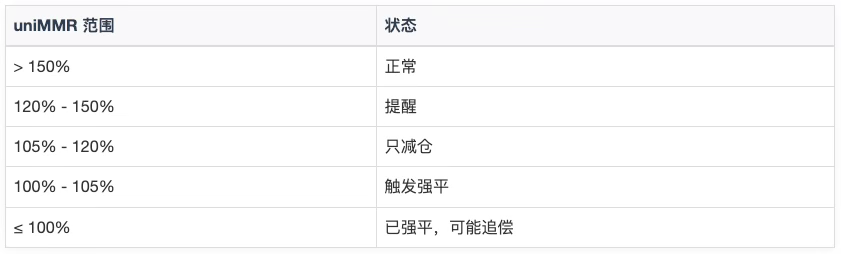
Once your uniMMR drops below 105%, the system will trigger a forced liquidation.
You have enough funds to settle in your account, but you are liquidated.
This is the black box of crypto options. There is no ceiling like Min(..., strike price), and there is no hard limit of the strike price in the formula. The maintenance margin can continue to rise as the underlying price declines, until it liquidates you.
4. Why Is This Happening?
You might ask: why does the exchange design such seemingly unreasonable rules?
The answer lies in another question: What is the biggest risk in the crypto world?
It is not price volatility, but liquidation.
In traditional finance, leverage is strictly limited. When you sell options, the leverage will not be too high. But in the crypto world, some people use 100 times leverage for futures, and others use 50 times leverage for options combinations. When extreme market conditions occur, these high-leverage positions instantly go to zero, but the losses do not disappear—someone must fill the deficit created by the liquidation.
On March 12, 2020, Bitcoin dropped 50% in one day, and many exchanges' insurance funds were depleted. How far were the exchanges pushed? They had to introduce Automatic Deleveraging (ADL) and socialized loss mechanisms—forcing profitable users to also share part of the losses.
But have you ever thought that among those lucky users who shared losses might include honest people like you?
You used low leverage, you had enough margin in your account, and you thought the risk was manageable. But when the market crashes and high-leverage users collectively face liquidation, the exchange's dynamic margin mechanism activates—raising everyone's margin requirements, forcing honest people to bear systemic risk.
This is the truth about risk control in the crypto world: it is essentially a collective punishment mechanism.
5. Clearer with Comparison
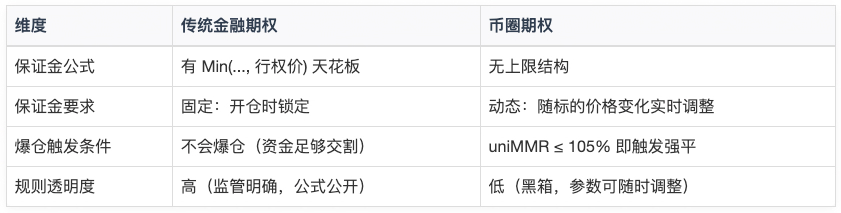
You might say: then I don't use leverage and I don't trade options, what does it have to do with me?
It matters a lot. Because this black box logic does not only exist in the options market.
The perpetual contracts, leveraged tokens, structured products in the crypto world... the vast majority of derivatives use a similar dynamic risk control model. This means that even if you think the risk is manageable, extreme market volatility can still force you out—not because you were wrong, but because the rules are inherently opaque.
6. Some Reflections
Traditional finance has developed for hundreds of years, and its risk control logic has been honed through countless crises. It is not perfect, but it has a fundamental principle: rules must be transparent, and expectations must be stable.
In the margin formula of traditional finance, that Min(..., strike price) appears to be just a mathematical symbol, but it actually serves as a legal lock. It locks in your maximum risk. You know what the worst-case scenario is, and you also know that the exchange will not change the rules midway.
Crypto derivatives have only been around for about a decade. Their risk control models are largely patchwork—adding a layer of protection every time an extreme event occurs. Dynamic margin, ADL, socialized loss... these mechanisms are intended to protect the exchange itself from going bankrupt, not to protect users from being unfairly harmed.
The uniMMR formula in the crypto world lacks that Min. No ceiling. No legal lock. Exchanges can continuously adjust the margin requirements upwards when you incur losses until they liquidate you.
In a market where rules are opaque, the security you think you have may just be an illusion.
Of course, this article is not meant to deter. Opportunities in the crypto world still exist, but the premise is that you must understand what you are facing.
Next time you open the options page of the exchange and prepare to sell a put, think twice: is your margin truly safe?
References:
[1] Dongxing Securities, "Margin Collection Standards for Stock Option Brokerage Business," April 2015 [link](https://www.dxzq.net/main/a/20150413/6547.shtml)
[2] Jinrui Futures, "Margin Collection Methods for Stock Options," April 2025 [link](https://www.jrqh.com.cn/detail/6895)
[3] Binance Support, "What Is the Unified Account Maintenance Margin Ratio (uniMMR) and How Is It Calculated?" May 2023 [link](https://www.binance.me/en/support/faq/detail/4868b2f1aa6c4d08af973328462bb0bd)
免责声明:本文章仅代表作者个人观点,不代表本平台的立场和观点。本文章仅供信息分享,不构成对任何人的任何投资建议。用户与作者之间的任何争议,与本平台无关。如网页中刊载的文章或图片涉及侵权,请提供相关的权利证明和身份证明发送邮件到support@aicoin.com,本平台相关工作人员将会进行核查。


