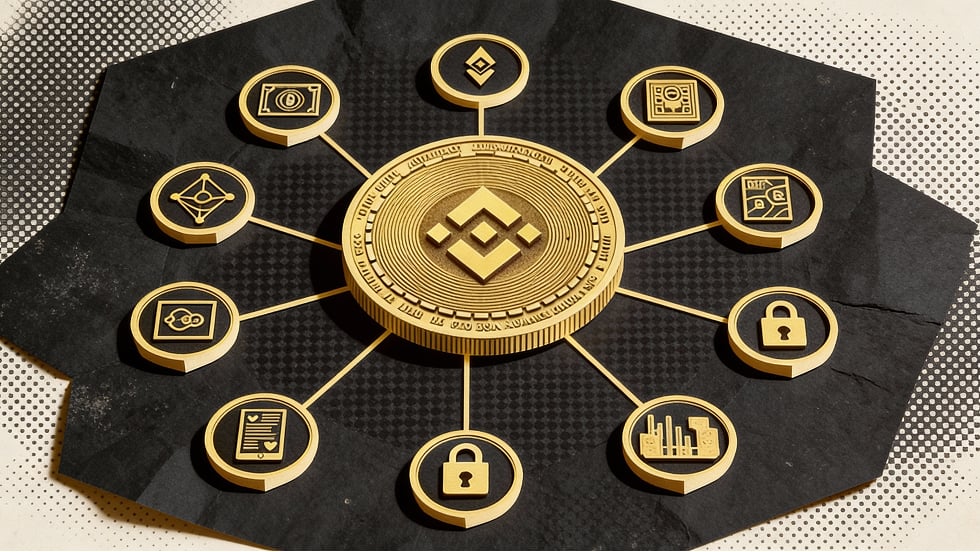
During the 2026 Hong Kong Web3 Carnival, Hash Global founder KK shared his views on the BNB ecosystem, RWA, especially non-financial asset RWA, at the “BNB Institutional Capital and RWA Forum.” The forum was co-hosted by Hash Global and the Greater Bay Area Financial Family Association, with BNB Chain serving as the blockchain partner and YZi Labs providing strategic support. The minutes were organized and published by the Nine Lives Society.
BNB as Institutional Capital|Lecture Notes
Good afternoon, everyone. I am KK, the founder of Hash Global. Today, I would like to clarify in 15 minutes: why BNB is the best investment target for institutional capital allocation in Web3.
Let’s start with a thought experiment.
If Tesla had not gone public on Nasdaq, what would Musk choose to issue? The answer is: he would issue a “Tesla Token” — one that carries corporate value and can also become the driving engine of the entire business empire.
Because tokens are on a public ledger that is fully transparent, verifiable, composable, and openly circulating. Charging stations in Hong Kong can verify global Tesla token holders, and if they choose to pay for charging fees with Tesla tokens, they can offer discounts to attract customers. Musk can also say that holders of Tesla tokens can get priority boarding on SpaceX’s manned missions. The stock data stored by the DTCC behind Nasdaq cannot provide such openness.
BNB is to Binance what the Tesla Token is to Musk's business empire. BNB is the real-world “Tesla Token.”
In our research reports over the past few years, Hash Global has defined such tokens as “Value Functional Tokens”: on one hand, they have a clear value capture and supply destruction mechanism; on the other hand, they are deeply embedded in real use cases within the ecosystem. With the clarification of global regulatory frameworks, we believe that in the coming years, we will see an explosion in the number of “value functional tokens.” BNB has been running for 8 years and is the most mature example globally. We have always encouraged the projects we invest in to reference this model, but the premise is that your business model must first be established.
The BNB ecosystem encompasses both on-chain and off-chain. BNB Chain is one of the most active public chains, with a DEX market share of 30%; Binance is the largest exchange globally, with a market share of 38%; BNB’s market cap is 85 billion USD, serving as the economic engine of the entire ecosystem.
The first source of value for BNB comes from structural, repeatable earnings. In 2025, just by holding BNB to participate in new offerings, BNB-based earnings reached 10.12%. This is not a one-time bonus but a sustainable, verifiable structural return linked to the activity level of the ecosystem.
The second source of value for BNB is its endogenous deflationary supply mechanism. Since 2017, BNB's total supply has been reduced from 200 million to 139 million, with an annualized deflation rate of 4.77%. Recently, 1 billion USD worth of BNB was just burned, bringing the latest supply number down to 134 million. This is the only “super-scarce asset” among the top ten cryptocurrencies by market cap. The continuous compression on the supply side forms long-term value support. It is not an asset that continues to be issued, diluting holders; rather, it is an asset that gradually becomes scarcer as the ecosystem becomes more active.
BNB is not only an investment target but also a utility token. Trading fee discounts, on-chain staking, liquidity mining, exclusive token subscriptions — the higher the participation in the ecosystem, the stronger the structural demand.
Industry monopoly creates new offering income, and income redistribution attracts more assets to land, while increased ecosystem activity promotes supply destruction. Scarcity further reinforces value support — this is a self-reinforcing flywheel. When earnings, destruction, scenarios, and ecosystem activity are interconnected, a strong value closed loop forms: more assets and applications entering the ecosystem will strengthen the value foundation of BNB; while the enhancement of BNB's value will, in turn, consolidate the ecosystem.
Whether downstream is AI, TradFi, or RWA surging, value will ultimately settle on the foundational layer. BNB is like Nvidia in the chip industry — regardless of which application ignites, it will benefit. Value will not disperse; it will ultimately converge to the one core asset of the ecosystem — BNB.
Unlike BTC and ETH, BNB is more suitable to be understood through value investment logic. It does not purely rely on narratives; instead, it has business fundamentals, ecosystem cash flow, and a comprehensible value capture mechanism. Since 2017, BNB has outperformed BTC and ETH.
The institutionalization of BNB is still in its early stages. The proportion of institutions allocating BTC through ETFs and DAT has exceeded 15% of the total BTC supply, while ETH is 10%, but BNB is only 0.39%. What does this resemble? It resembles Moutai in 2004 — institutions just starting to build positions and consensus gradually forming.
Here, I want to emphasize the re-evaluation elasticity of core assets in the early allocation phase for institutions. Real quality assets often have the most space before institutional consensus forms. As public funds and brokerage proprietary trading, as well as social security, insurance companies, and QFII gradually build positions, Moutai surged dozens of times in the subsequent years. BNB is at a similar historical node. We believe that in the next decade, the biggest theme in finance will be everything on-chain. We believe that ten years from now, all assets — including financial and non-financial assets — will be issued, transferred, and traded on-chain. The SEC chairman Paul Atkins announced the Project Crypto initiative last year, officially commencing this era in the United States.
After 8 years of global layout, Binance estimates it has over 500 million real users both on-chain and off-chain, making it the only truly internet-level financial infrastructure, and its development path is non-replicable. Everyone can read the autobiography of Binance founder CZ, and I want to thank the great support of my Fudan University professor Mao from Commercial Press. We have already obtained a small batch of sample books before this conference; if everyone reads it, they will know why I say the development path is non-replicable.
To involve institutions in this revolution, Hash Global, in collaboration with YZi Labs, launched the BNB Holdings Fund — the world's first third-party custodial BNB institutional product. We are not just providing investment tools; we want to help institutions become co-builders of the BNB ecosystem.
The BNB Holdings Fund does not simply help institutions buy coins but transforms high-growth assets into open standardized products that institutions can hold for the long term. It addresses the issues that institutions care most about, such as custody, auditing, income distribution, and operational management.
The BNB Holdings Fund provides institutional investors with not only BNB exposure but also a collaborative framework into the BNB ecosystem — supporting the implementation of BNB Chain business, issuance of RWA assets, and resource integration within the ecosystem.
Finally, I want to talk about RWA, which everyone is very interested in.
My judgement is that RWA will not be limited to financial assets on-chain but will continue to extend to non-financial user assets on-chain.
Why is the BNB ecosystem suitable for RWA? Because it is not a chain with only technology and no users. It already has real users, real liquidity, and complete financial infrastructure, so once the assets come on-chain, it is not just about “issuing” but actually has the opportunity to become truly liquid.
The first RWA to land will primarily remain financial asset RWA. Essentially, it involves bringing assets like stocks, bonds, funds, real estate trusts, and Pre-IPO equity into the on-chain liquidity system, enhancing the efficiency of traditional financial stock assets. We are particularly optimistic about non-standard financial asset RWA, as the technological advantages of Web3 can be leveraged more fully. If we solve the most difficult issues of off-chain custody and due diligence, the new generation of financial infrastructure on-chain can wield its power, and RWA will not just be a gimmick.
However, financial products in issuance and trading processes are heavily regulated areas and require time to adapt and integrate with existing regulatory systems. We believe that the non-financial, commodifiable RWA sector may develop faster, specifically pushing user assets on-chain, such as cards, fan rights, concert tickets, wine, and lifestyle experience collectibles, to create new markets. This is not just about institutional investment funds but about users, communities, and consumer scenarios; what it creates is not just improved efficiency of existing assets but new trading demands and new user markets.
Non-financial RWA is not a supplement to financial RWA but a new market closer to users, trading, and brands. It organizes IP, rights, content, consumer rights, membership identities into verifiable, tradable, and long-term operable on-chain assets.
We have invested in and incubated several non-financial RWA projects within the ecosystem. Here are a few examples:
Renaiss Protocol enables the on-chain circulation of PSA-graded cards; they are not just targeting the card market but the infrastructure for all collectibles. The challenge is not on-chain but on how to effectively manage off-chain systems like custody. They focus on collectibles like cards, integrating authentication, custody, on-chain proofs, trading, and settlement, allowing the traditionally trust-dependent collectibles market to acquire asset and global circulation capabilities.
MEET48 turns fans' voting, spreading, and co-creation behaviors into verifiable on-chain contribution proofs; fans' participation is transformed for the first time into an asset that can be recorded, verified, and held.
Gamebank’s first game PumpSnake initially solidifies a good multiplayer game, then uses Web3 technology to issue assets in a gamified manner, cleverly unifying KOL community building, fan emotional value, and revenue generation. Only by growing the ecosystem and ensuring a diverse player base can true sustainable Play to Earn be achieved.
IPDEX serves various content IPs like films and variety shows, layering the design of commemorative cards, membership cards, and project rights, allowing content IP to transition from one-time consumption to long-term member relationships and ongoing operations.
OFF Grid starts from ticketing assets, creating a new Fanvestment model that integrates event financing and settlement. It organizes event financing, ticket sales, income allocation, and data accumulation into a complete link, transforming an event from merely selling tickets into a financeable, settlable, and sustainably operable asset system.
These projects together outline the landscape for non-financial RWA: user assets, community participation, emotional value, and brand communication will all find their on-chain expression within the BNB ecosystem. They are proving that everything can be tokenized, and the BNB ecosystem is the best soil for all of this.
Finally, I want to conclude today’s sharing with one sentence:
BNB is not just a cryptocurrency asset; it is one of the most important value-bearing platforms in the future “everything on-chain” era. And what Hash Global aims to do is help institutions not only invest in this value system but also genuinely participate in this ecosystem.
Thank you all.
免责声明:本文章仅代表作者个人观点,不代表本平台的立场和观点。本文章仅供信息分享,不构成对任何人的任何投资建议。用户与作者之间的任何争议,与本平台无关。如网页中刊载的文章或图片涉及侵权,请提供相关的权利证明和身份证明发送邮件到support@aicoin.com,本平台相关工作人员将会进行核查。


