Author: Frank, PANews
As AI transitions from showcasing technical prowess to practicality, the implementation of AI applications is accelerating to meet the growing consumer demands. Meanwhile, with the continuous enhancement of large model capabilities, AI seems to have entered an era where "everyone can create product prototypes."
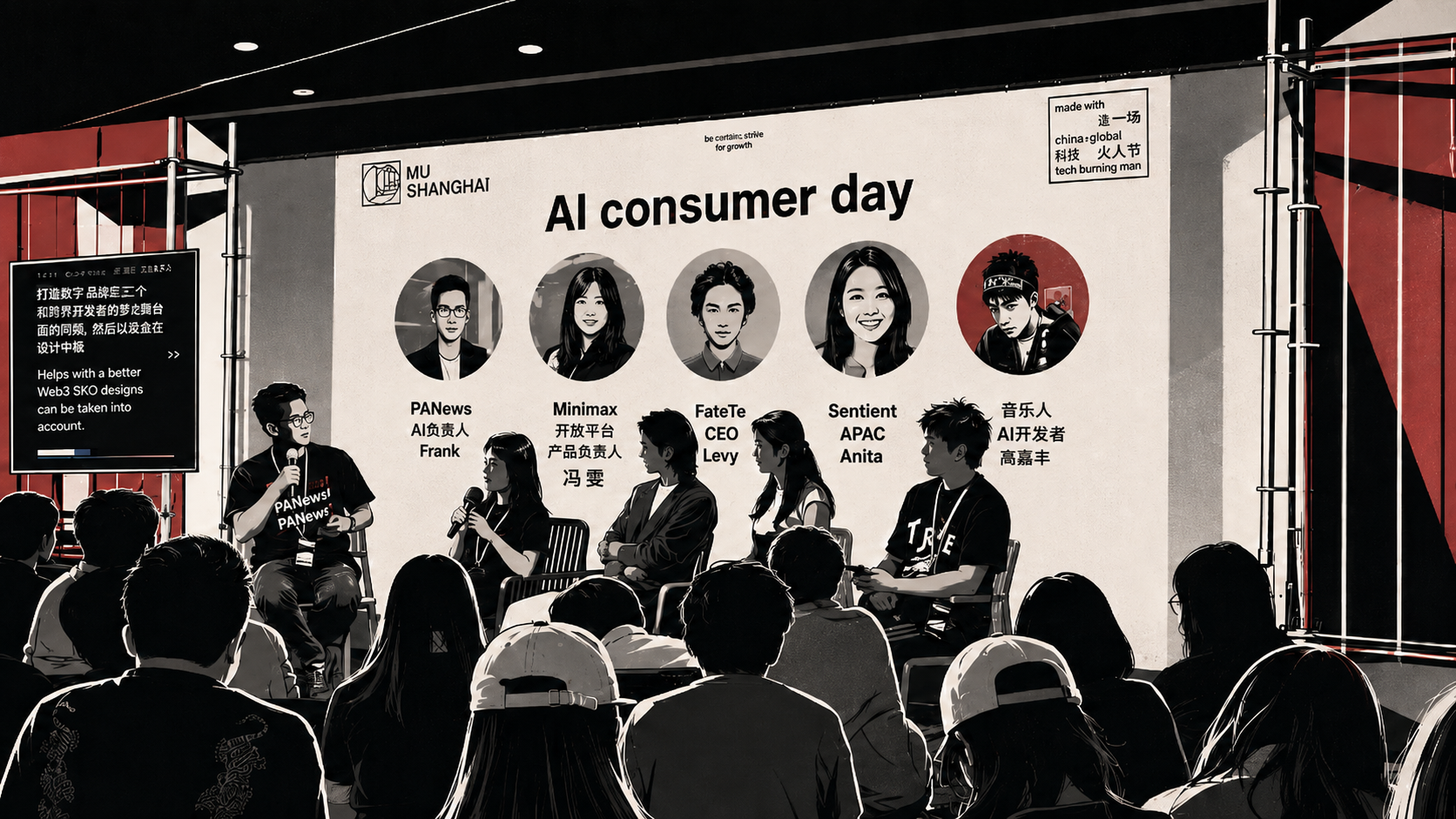
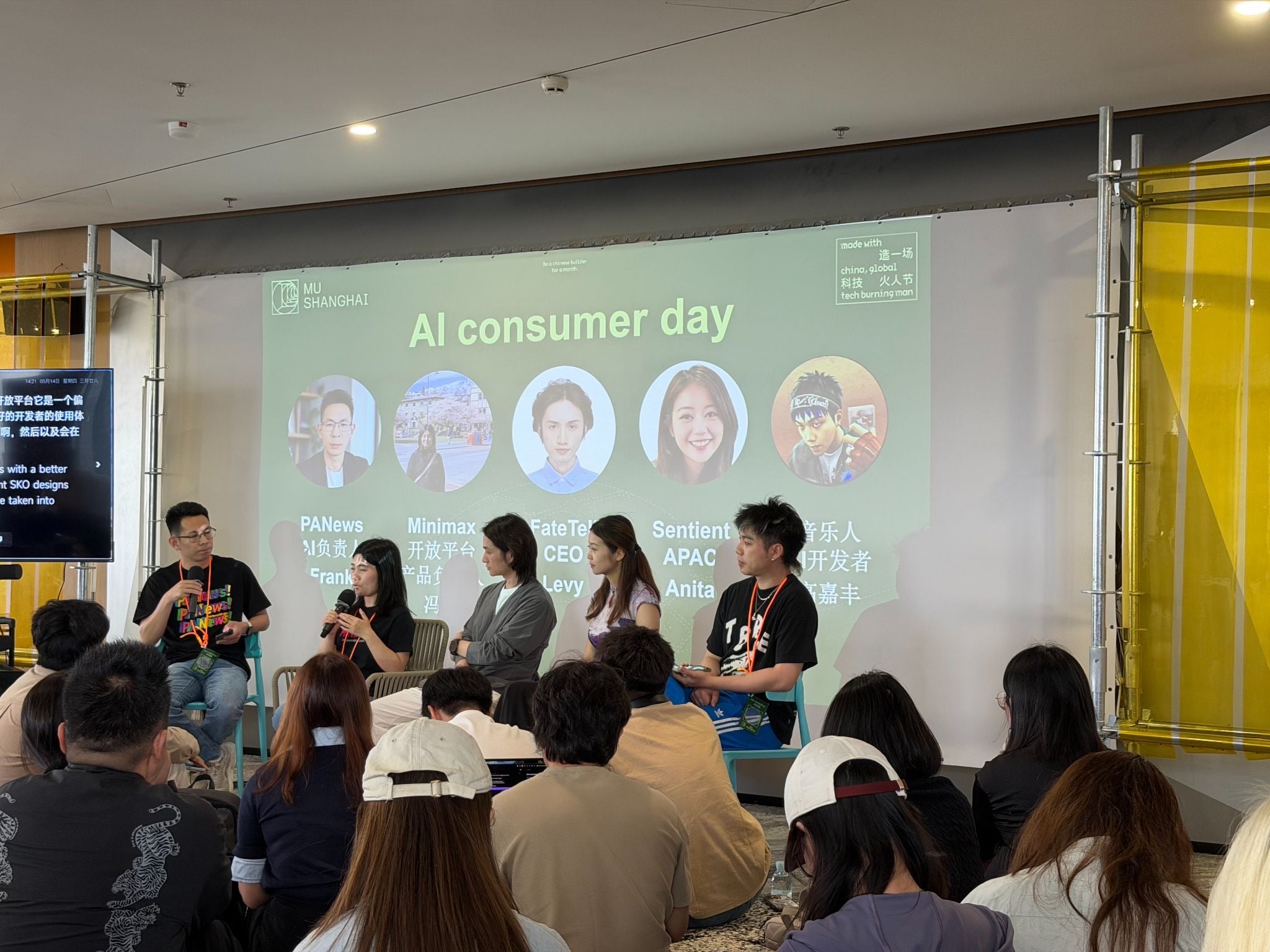
During muShanghai AI Week, the roundtable discussion "Innovative Practices and Path Exploration of AI Consumer Ecosystem," hosted by PANews, focused on the real pathways for consumer-grade AI products. The discussion featured guests including Feng Wen, Product Lead of the MiniMax open platform; Levy, CEO of FateTell; Anita, Head of Sentient APAC; and independent developer and electronic musician Gao Jiafeng, each coming from different fields such as model open platforms, cultural outbound applications, open-source AI ecosystems, and music creation practices.
According to the guests, the core issues of consumer-grade AI have not become simpler due to technological iterations. With the leap in model capabilities, true barriers are shifting toward scene understanding, data organization, user education, emotional value, and the construction of open ecosystems.
AI has not lowered the difficulty of entrepreneurship; the real barriers remain the application scenarios
A common contradiction in the AI industry is that while models are becoming stronger and the barriers to entrepreneurship appear to be lowering, many products struggle to find lasting application scenarios. What seems feasible today may quickly lose relevance with the release of the next version of the model.
Feng Wen believes that for consumer-grade AI products, product ideas and scenario judgments remain crucial. As a provider of large models and open platforms, MiniMax emphasizes fundamental model capabilities, token-related product design, and developer end-to-end experiences. However, from an entrepreneur's perspective, products should be designed according to the "intelligence level of the model six months from now."
His judgment is that in the context where the scaling laws of models remain valid and their capabilities continue to improve, entrepreneurs should not overly restrict themselves by the current speed, cost, or capability boundaries of models, but rather think boldly about target users, specific scenarios, and problems to be solved. Model vendors will continue to provide cheaper, faster, and more cost-effective capabilities, while the application layer needs to more clearly answer "why this scenario."
Levy added another source of barriers from the application layer. He believes that while technology changes rapidly, the data and understanding corresponding to the scenarios are not quickly smoothed over. Previously, many thought that only fine-tuning a model could create data barriers; however, with the maturity of context engineering and prompt engineering, the data and structures accumulated in application context management will also affect model performance. In particular, data related to highly vertical cultural or personalized experiences may not necessarily enter the weights of general models, which could instead become a differentiated foundation for consumer-grade AI products to resist model iterations.
Anita provided a more cautious view on "AI lowering the entrepreneurial threshold." She believes that while AI has indeed made generating demo samples, building prototypes, and quickly launching a preliminary product easier, the genuinely difficult parts of entrepreneurship have not disappeared and may even be more pronounced: how to acquire customers, how to build community stickiness, how to achieve commercial landing, and how to establish connections between people beyond programming. She mentioned that the concepts of super individuals and "one-person companies" are currently popular, but those who can truly run successful ventures often require more complex skills rather than just leveraging large models.
From Bazi to Music: Understanding Users as the Barrier for Consumer-Grade AI
As technological capabilities continue to advance, the value of consumer-grade AI products must ultimately return to human needs.
FateTell's practice provides a typical case. Levy explained that FateTell is an AI + Eastern astrology/Bazi consumer application aimed at overseas users, currently having users in over 90 countries. The team initially avoided a pure efficiency tool approach and instead focused on spiritual consumption and emotional value.
In his view, understanding one's destiny, seeking explanations and comfort are fundamental psychological needs that exist cross-culturally and have lasted for a long time. AI has previously struggled to establish trust in this scenario, but the enhancement of model capabilities such as DeepSeekR1 objectively helps users and investors understand the potential of "large models to perform complex reasoning and explanations." The barriers facing FateTell are not just model capabilities, but how to translate and interpret Chinese cultural concepts such as heavenly stems and earthly branches, I Ching, and Bazi for overseas users, and how to convey the charm of these concepts through language, visuals, and interactions that different cultural backgrounds can understand.
Gao Jiafeng raised a similar issue from the perspective of a music creator: AI cannot only deliver results; it must also retain the process. He mentioned that tools like Suno make music generation very straightforward, but they bypass the creative process, leading to a lack of participation and a sense of belonging for users. For musicians and regular users alike, creation is not just about obtaining a "finished song," as the process itself is part of the experience.
He used playing football as a metaphor: even if an ordinary person can never surpass Messi or Ronaldo, they will still play due to their passion. The same is true for music creation. Gao Jiafeng is developing MusicAIGameBoy (music AI game console), which aims to drive music coding through AI large models or small models, combined with gamified interactions, allowing those who do not understand music to participate in the creation while playing. For him, the true scenario is not "automatically generating a song," but returning the interactive process of music creation to the user.
After the Rise of Agents, the Logic of User Education is Changing
In consumer-grade AI products, user education often determines whether the product can truly be utilized.
Feng Wen noted that among the users of the MiniMax open platform, some have foundational development skills, but are still blocked by API documentation, parameters, error codes, and token usage methods. To address this, the platform offers model trial platforms, development guides, demo cases, video tutorials, and other means to help developers complete the transition from understanding to usage more swiftly.
With the development of agents, the methods of user education are also changing. In the past, users needed to read documentation, understand interfaces, and troubleshoot errors. However, with the performance upgrades of agents, many users now have agents directly read documentation, search solutions, select suitable models, and automatically correct pathways. Model vendors need to enhance the experience of models, documentation, and platforms, while communities, developers, and various product forms will jointly lower the usage threshold.
For Sentient, the open ecosystem itself is also part of user education and product landing. Anita shared that Sentient focuses on open-source AI ecosystems and related infrastructure, gathering developers through hackathons, funding programs, and so on. She emphasized that products must first clarify their target users: who the users are, where they appear, and through what channels trust is established. For developer tools, hackathons and ecosystem collaborations are effective entry points; for consumer products, KOLs, KOCs, and social media content are equally significant.
In the context of rapidly declining AIGC costs, entrepreneurial teams can create trailers, visual materials, and promotional content at a lower cost, allowing products to quickly acquire their first batch of users. Gao Jiafeng also believes that product design should strive to be closer to users, enabling them to naturally learn through interaction and entertainment, rather than relying on extensive manuals. This method of "learning by doing" may be more suitable for consumer-grade AI compared to traditional tutorials.
Hardware Enters the Real World, Personalization and Emotional Value Continue to Amplify
Looking three to five years into the future, the guests generally believe that the AI consumer market is still in the early stages of penetration, but the forms of products will show significant changes.
Feng Wen predicts that in the coming three to five years, smart hardware, robotics, and embodied intelligence will reach important inflection points. After improvements in model capabilities, AI will no longer just exist in software interfaces; it will also enter the real physical world to complete more interactions and tasks. Some products will be oriented towards people, providing efficiency improvements or emotional value. Others may be directed toward agents, providing AI with environments, tools, and infrastructures that connect to the physical world. Regardless of how forms change, products should ultimately remain human-centered, allowing people to spend more time on connections with others, family, the real world, and richer life experiences.
Levy believes that making predictions three to five years into the future within the AI industry is already very challenging, and even three to five months are filled with uncertainties. He believes that although frontier users are already deeply using tools like ClaudeCode, most ordinary users are still in the early stages of AI penetration. In the coming years, AI will further meet more fragmented and personalized needs. Compared to the relatively "one-size-fits-all" services of the mobile internet era, AI has the opportunity to provide individuals with more specific and segmented services. Meanwhile, the anxiety and uncertainties brought about by technological development may further amplify demands for psychological companionship and emotional consumption.
Anita summarized this change as "technological egalitarianism." She believes that in the future, distinctions between humanities, sciences, arts, and technology will be weakened. A small vendor may also create advertisements and target information through AI, thereby improving their business. The value of AI is not necessarily about making everyone a top programmer but helping people from different life scenarios gain better tools. At the same time, fears of unemployment and feelings of loneliness will drive an increase in emotional value needs, providing more opportunities for hardware, AI pets, companion devices, and multisensory interactive products.
Gao Jiafeng approached the changes in cultural forms. He believes that in the future, content forms such as music, film, and video will be reorganized, and it is even uncertain whether "songs" will still be the smallest units of music consumption. Current concepts such as separate-track audio or soundtracks may continue to be broken down into more atomic units of creation. However, as the forms dissolve, the emotional connections carried by IPs, brands, and specific individuals will become even more important. What people pursue is not always perfect works but rather objects that are flawed, warm, and capable of establishing emotional relationships.
Although the guests did not provide a unified answer to consumer-grade AI, the discussions from different fields such as model platforms, cultural applications, open-source ecosystems, and music creation pointed towards the same trend: as model capabilities continue to improve, the competition in consumer-grade AI is no longer just about "who has access to the stronger model," but whether it can understand more specific users, real scenarios, and emotional needs.
The future AI consumer ecosystem may simultaneously include stronger open infrastructures, lower development thresholds, more personalized services, hardware with a greater sense of companionship, and more new product forms focused on culture and the creative process. Models will continue to evolve, but what truly endures will still be those products that can be needed by people, understood by them, and connect with them.
免责声明:本文章仅代表作者个人观点,不代表本平台的立场和观点。本文章仅供信息分享,不构成对任何人的任何投资建议。用户与作者之间的任何争议,与本平台无关。如网页中刊载的文章或图片涉及侵权,请提供相关的权利证明和身份证明发送邮件到support@aicoin.com,本平台相关工作人员将会进行核查。


