Source: Bankless
Translation: Yuliya, PANews
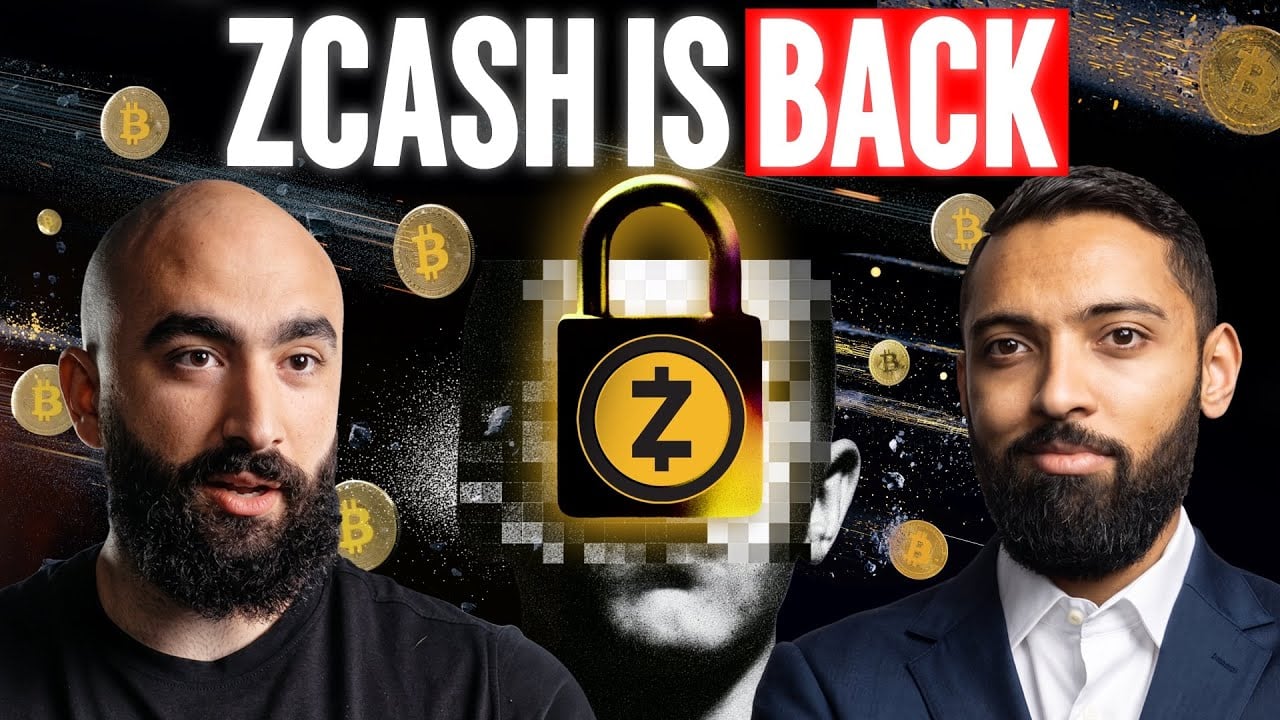
Editor's Note: Zcash has ushered in its first real narrative moment in years. In this episode of the podcast, host David sits down with Multicoin Capital co-founder Tushar Jain and Helius CEO Mert Mumtaz to dissect why privacy may be the missing value storage primitive in cryptocurrency, why Zcash is positioned as "private Bitcoin," how institutional entry will normalize privacy funds, how AI and on-chain monitoring have altered the privacy debate, and why the risks of quantum computing could become a true catalyst for Zcash.
Zcash Survives Death Cycle, Privacy is the Last Piece of the Crypto Puzzle
David: Mert, you've been talking about Zcash for over half a year now. Tushar, Multicoin recently announced a significant investment in Zcash. Tushar, what made you decide to invest heavily in Zcash now?
Tushar: It’s mainly a combination of several factors. First, I have to admit that Mert noticed this earlier than I did, while I was initially cautious. I've known about the Zcash project since its inception, but for a long time, it was basically considered a "dead project" by the market, neglected by everyone.
Last year, I saw discussions around Zcash suddenly increase, and its price also went up. But I was thinking: Is this hype? Will it last? Then the market corrected, cryptocurrencies faced a macro bear market and successive liquidations, and Zcash's price fell. But what surprised me was: First, the people who supported it before are still supporting it; second, its retracement price support level is much stronger than the price when it was neglected in the past few years. It withstood the market's washout, the core team hasn't left, and the community is still there, which proves to me that its consensus is sustainable, and that was the main reason we decided to invest.
David: Mert, everyone used to know you as a "Solana die-hard fan," and now you're becoming a "Zcash ambassador." Tell me about this transition, what do you see in Zcash?
Mert: Two years ago, Zcash core developer Sean Bowe asked me for help assessing their scaling plan. I thought Zcash was already done for, but I found after deeper research that its ZK technology is very powerful and truly useful. It's just that they are doing poorly in user experience, recruitment, marketing narrative, and market positioning.
By the way, I still prioritize Solana, my company works on Solana infrastructure, and we are even developing a privacy layer on Solana. My personal investment strategy is a "barbell strategy" — one side is Bitcoin and Zcash, and the other is Hyperliquid and Solana.
Later, as cryptocurrencies became more "institutionalized" (like Wall Street entering), I started to feel lost; everyone was working on defense technology, drones, cutting-edge AI laboratories, and I wondered what was happening in the crypto world. USDC is cool, but frankly, it's just an API for the dollar. I feel that cryptocurrency has strayed from its original intention. I realized that "privacy" is the last puzzle piece forgotten by the crypto world.
The development of cryptocurrency has gone through several stages: Bitcoin proved that cryptocurrency can be used; Ethereum (Vitalik) proved that it can be programmed; Solana (Anatoly) proved that it can scale. But in the effort to prove that "cryptocurrency is not for crime" in this legitimization process, everyone has dropped the "privacy" ball. Now that the regulatory environment might be improving, we have entered a window period to bring privacy back to the crypto world, returning to its roots.
Why Choose Zcash, and Why Now?
David: So, this really is a return to the ideals of cypherpunks. However, there are other privacy coins on the market, so why specifically Zcash? Why now?
Mert: The attention Zcash is receiving in the current market is multifaceted, with institutionalization being one of the key factors. Events like BlackRock ETFs, Bitcoin derivatives, and Jane Street have rekindled the market's attention on privacy assets. Additionally, the involvement of well-known figures like Saylor has brought more exposure to Zcash.
Secondly, there is the explosion of AI. Initially, I thought AI was overhyped, but later I realized that AI is a supercomputer processing "unstructured data (scattered information online)." Previously, data was tabular; now AI can extract your real identity from scattered messages on different social networks. As cryptocurrencies become more compliant, with increasing fiat in and out options, if you or your counterparty make a small mistake on-chain and expose your wallet address, AI can trace all your lifetime on-chain transaction records. AI makes the consequences of lacking privacy extremely scary.
Then there's the macro environment, such as California wanting to impose a wealth tax, and the Netherlands wanting to tax unrealized gains, there is a global trend towards extreme wealth redistribution.
Finally, and most crucially, is the maturity of ZK (zero-knowledge) technology. Those in the industry know about ZK, but for many years it couldn't be applied on a large scale due to slow speed and poor user experience. It wasn't until recently that ZK truly became usable. Zcash is the pioneer of ZK technology; in its early days, it suffered many setbacks due to immature technology, but now it has finally come into its own. Now Zcash has a trustless shielded pool, and the Zondal (formerly Zashi) team has made a user-friendly wallet, allowing for cross-chain transactions via the Near protocol's intent, or decentralized trading on Solana and Hyperliquid, no longer needing to rely on centralized exchanges.
As for why not choose Monero? Because Monero uses "ring signature" technology, which is a form of "misdirection" (1 real transaction mixed with 16 fake transactions). In the face of AI and powerful computing power, this misdirection will eventually be cracked. Zcash's ZK technology actually hides data in cryptography. Moreover, Zcash is a fork of Bitcoin, which you can directly understand as "private Bitcoin," a concept that is very easy for the market to accept.
Institutional Adoption and the "Trojan Horse" Strategy
David: I heard that Zcash has a pathway acceptable to institutions. Executives from Bitwise said that once institutions push Bitcoin into the mainstream, they will make room for Zcash. Tushar, why would institutions accept Zcash?
Tushar: I believe Zcash's brand positioning suits both the public and institutions. When it comes to Monero, people's first reaction is "that's for criminals." But Zcash is positioned as "providing privacy for ordinary people."
Ordinary people need privacy not because they want to do bad things, but because they don't want to expose all their financial records to the world. Zcash embodies the hardcore spirit of cypherpunks while being understood and accepted by the public.
Mert: To add, Zcash has a "Trojan horse" strategy. It has both a transparent mode (like Bitcoin) and a privacy mode (the shielded pool). Institutions can first buy Zcash in transparent mode, which brings funds and attention; then, part of this attention will convert into the use of the privacy mode.
Privacy is a basic human right. If we only promote privacy in the dark corners of the internet to fringe groups, it will never grow large. We need institutional funds as a Trojan horse to enlarge the market so that privacy can truly go mainstream.
David: So the bullish logic is: There are a group of people who genuinely need hardcore cryptographic privacy, which constitutes the fundamental base; at the same time, Zcash's transparent mode allows institutions to enter. The combination of both will cause the market cap to take off?
Tushar: Exactly, but remember one thing: Zcash competes in the "store of value" arena, like gold and Bitcoin, and a store of value requires a consensus.
- Why do people recognize gold? Because it is rare and shiny.
- Why do people recognize Bitcoin? Because it was the first to solve the double-spend problem.
- Why do people recognize Zcash? Because it is currently the largest and most prominent privacy asset by market cap, and people will naturally want to buy the top-ranked one. As more people use it to store value, its consensus will become stronger.
Privacy Coins Are Not a Mainstream Product
David: Let's be realistic; if Zcash drops back to $40 a year from now, everyone will say, "See, no one really cares about privacy." People have previously hyped the privacy concept, and they all ended up failing miserably. How do you refute that?
Mert: Satoshi actually wanted to add privacy to Bitcoin; it's just that the technology wasn't mature at the time, and he didn't know how to prevent double spending (spending the same money twice) while protecting privacy. From the risk-to-reward perspective, Zcash currently has an extremely high cost-benefit ratio. Even if it fails, it's worth doing.
Tushar: We don't need everyone to care about privacy; we only need a portion of people to care to support its value. Data from the past 18 months shows that there is indeed a group of people who need private value storage very much. They didn’t use Zcash before because it was too difficult (had to undergo KYC at decentralized exchanges), but now that the technological bottleneck has been lifted, the adoption rate will naturally increase.
Mert: For example, ordinary people buying ETH or SOL can achieve "without banks," but there is still a group of "offshore wealth" that needs a "Switzerland bank vault" in their pocket. They require absolute privacy to prevent their assets from being tracked or seized. As long as we can capture this segment of high-net-worth individuals, the floor price of Zcash will be very high.
In the Era of On-Chain Monitoring, Zcash is the Forked Version of Bitcoin
David: I previously interviewed the on-chain tracking company TRM Labs, and they said that government agencies like the FBI really like the current blockchain because everything is on-chain, making investigations very easy. This makes me feel a bit chills.
Tushar: That's right. Many people think "governments investigating cases is to catch bad guys, which is a good thing." But you must understand that the power you give to the government may one day be used against you by your political enemies. In traditional finance, a government needs a court subpoena to check your accounts; but on a public blockchain, they can use AI to casually see all your sensitive information without a search warrant. Privacy is the last line of defense protecting ordinary people from abuse of power.
Mert: In the U.S., when someone is arrested, the police say: "Anything you say may be used against you in a court of law." In the crypto world, it's: "Everything you do on-chain will always be recorded and may be used against you in the future." Peter Thiel was once disappointed with cryptocurrencies because the FBI found Bitcoin easier to monitor than traditional finance. A market that protects individual dignity and freedom is several orders of magnitude larger than the market for criminals to launder money.
David: Let's talk about Zcash's token economics. How does it differ from Bitcoin, and why is its current state actually an advantage?
Mert: Zcash is a fork of Bitcoin, thus it also has a cap of 21 million coins, proof of work (mining), and halves every four years. The only difference is that a portion of its output goes to a developer fund, which is decided by token holders voting on which contributing developers to support (for example, the team working on the Pacha scaling project led by Sean Bowe).
Tushar: Zcash was a joke in the market for the past few years, as its price kept falling. Previously, it had high inflation, was hard to use, and lacked marketing. But now, these disadvantages have all been reversed: inflation has decreased, wallets are user-friendly, it can be bought on decentralized platforms, and macro factors (like California and the Netherlands wanting to impose wealth taxes) are increasing the need for private assets. Investment should look forward, not stick to outdated views.
David: In the crypto circle, there's a term called "perfect start," like the birth of Bitcoin or the first airdrop of Uniswap. I feel Zcash is in the category of "perfectly forgotten." It has been abandoned for over five years, its price fell to rock bottom, and early speculators have long since left. Now it has become an uncontroversial project; almost no one in the crypto circle dislikes Zcash except for extreme Bitcoin maximalists. Everyone can support it, which is a rare consensus.
Mert: Yes, I've found that no matter if someone is working on Ethereum, Solana, or Cardano, they all can recognize Zcash's ideals. The privacy lane has been suppressed for too long, and Zcash's recovery can drive the development of the entire on-chain privacy lane (like Railgun on Ethereum), which is good for everyone.
Quantum Computing Advantage and Recent Catalysts
David: The final topic: quantum computing. Everyone knows that once quantum computers mature, Bitcoin's cryptography will be cracked. What is Zcash's position on this issue?
Mert: Zcash will almost certainly become the first "quantum-resistant" blockchain. It now has "quantum recoverability" — as long as your coins are in the shielded pool, quantum computers cannot do anything to you.
On a transparent chain like Bitcoin, quantum computers can derive the private key from the public key and directly transfer your money away without you noticing, just like when you lose your mnemonic phrase. Even scarier is that the data on a transparent chain can be "collected now, decrypted in the future." Once quantum computers mature, all your past transaction records will be cracked. Monero's "misdirection" cannot guard against this either.
But Zcash's shielded pool contains no physical data (it doesn't know who sent it to whom or the amount). As soon as this week's update is complete, user funds will be secure. By the end of this summer, Sean and the Dev team are expected to make the entire Zcash chain quantum-resistant. Zcash was previously ridiculed as a "cryptographers’ sandbox," but now having this group of top cryptographers has become its greatest advantage in facing the quantum crisis.
David: Ethereum is also working on quantum resistance, but Ethereum is too complex. Zcash is simple like Bitcoin while also having top cryptographers, so it is easier for it to cross the quantum barrier than Ethereum.
Mert: Exactly. And quantum resistance is not just to defend against hackers but also to provide certainty for large funds. The reason gold is the king of stores of value is that it is extremely stable and does not suffer from drastic changes. Zcash addressing quantum threats in advance is to eliminate future uncertainties, allowing traditional investors to feel safe putting money in. Google's plan is to be quantum-ready by 2029, so this threat is not far off.
David: Finally, to summarize, what upcoming positive catalysts does Zcash have?
Mert: There are many imminent positive catalysts:
The Ledger hardware wallet will soon support Zcash's shielded pool (currently only supporting transparent mode).
Currently, 31%-32% of Zcash funds are in the shielded pool, and as prices increase and transactions grow, this ratio will rise, strengthening the privacy network effect.
The Zondal wallet (a wallet supporting privacy features) has received funding led by Paradigm and a16z. This partnership is considered a rare strong union that is expected to drive further development of the Zcash ecosystem and core technology improvements.
Block time will be reduced from 75 seconds to 25 seconds, significantly enhancing the transfer experience.
More and more development teams are starting to build applications on Zcash. Although the implementation of Zcash is technically complex due to its use of a customized cryptographic curve, its privacy advantages are attracting more developers.
If cryptocurrency has no privacy, it strays from the original intentions of cypherpunks. We have been asleep for too long; now it's time to bring it back.
Tushar: In summary, Zcash tells a very simple and understandable story: "private Bitcoin." It has hardcore values that protect human dignity and rights and coincidentally gathers all the right timing and circumstances at a moment when technology is mature and macro needs are exploding. This is why we are optimistic about it.
免责声明:本文章仅代表作者个人观点,不代表本平台的立场和观点。本文章仅供信息分享,不构成对任何人的任何投资建议。用户与作者之间的任何争议,与本平台无关。如网页中刊载的文章或图片涉及侵权,请提供相关的权利证明和身份证明发送邮件到support@aicoin.com,本平台相关工作人员将会进行核查。


