

Author: Lawyer Shao Shiwei
According to news from the AI practitioner circle, in May 2026, the head of a certain AI transit station publicly released a statement, saying that he was criminally detained for 37 days due to illegally reverse crawling and reselling cheap AI interface resources, and is currently in a released on bail phase.
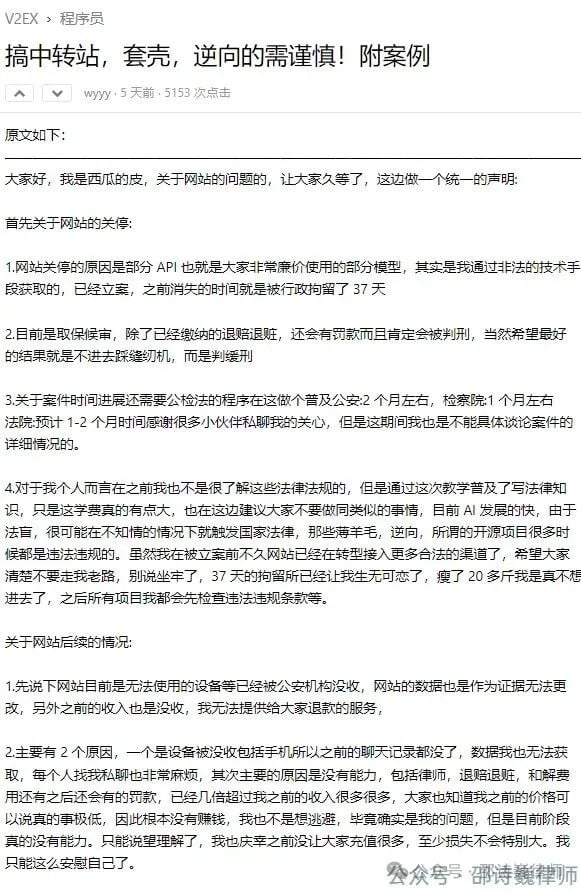
Although Lawyer Shao has also seen colleagues claim that the head of the AI transit station was detained by the Shanghai police, as there has been no official announcement so far, the specific case reasons and handling situation cannot be confirmed.
In the past two years, domestic demand for AI applications has exploded, but because overseas large models have regional restrictions, more and more people are creating AI transit stations. Simply put, domestic users want to use them but cannot, and the transit stations help you open the channel, charging a fee for passage.
Therefore, using this case, we can discuss whether the current booming AI transit station business can still be done. What risks might ordinary people face when starting an AI transit station?
The Profitable Business of AI Transit Stations
According to Xinhua News Agency, the daily Token call volume in China has increased by more than a thousand times from early 2024 to March 2026. The demand is there.
However, if domestic users want to use overseas large models (OpenAI, Anthropic, Google, etc.), they will encounter many issues such as network environment, payment channels, and identity verification, all of which are barriers.
Where there are barriers, there is business. AI transit stations have emerged. Now on many self-media platforms, it is claimed that AI API transit stations are one of the most profitable projects in 2026, which is actually not false.
AI transit stations can also be understood as AI scalpers. They package interfaces from different AI model vendors into a unified outlet and connect all models for users in the background. Users also save the hassle of scientifically accessing the internet and figuring out how to pay with foreign currency.
On Taobao, Xianyu, and Xiaohongshu, many posts of this kind can be seen, with prices ridiculously low.
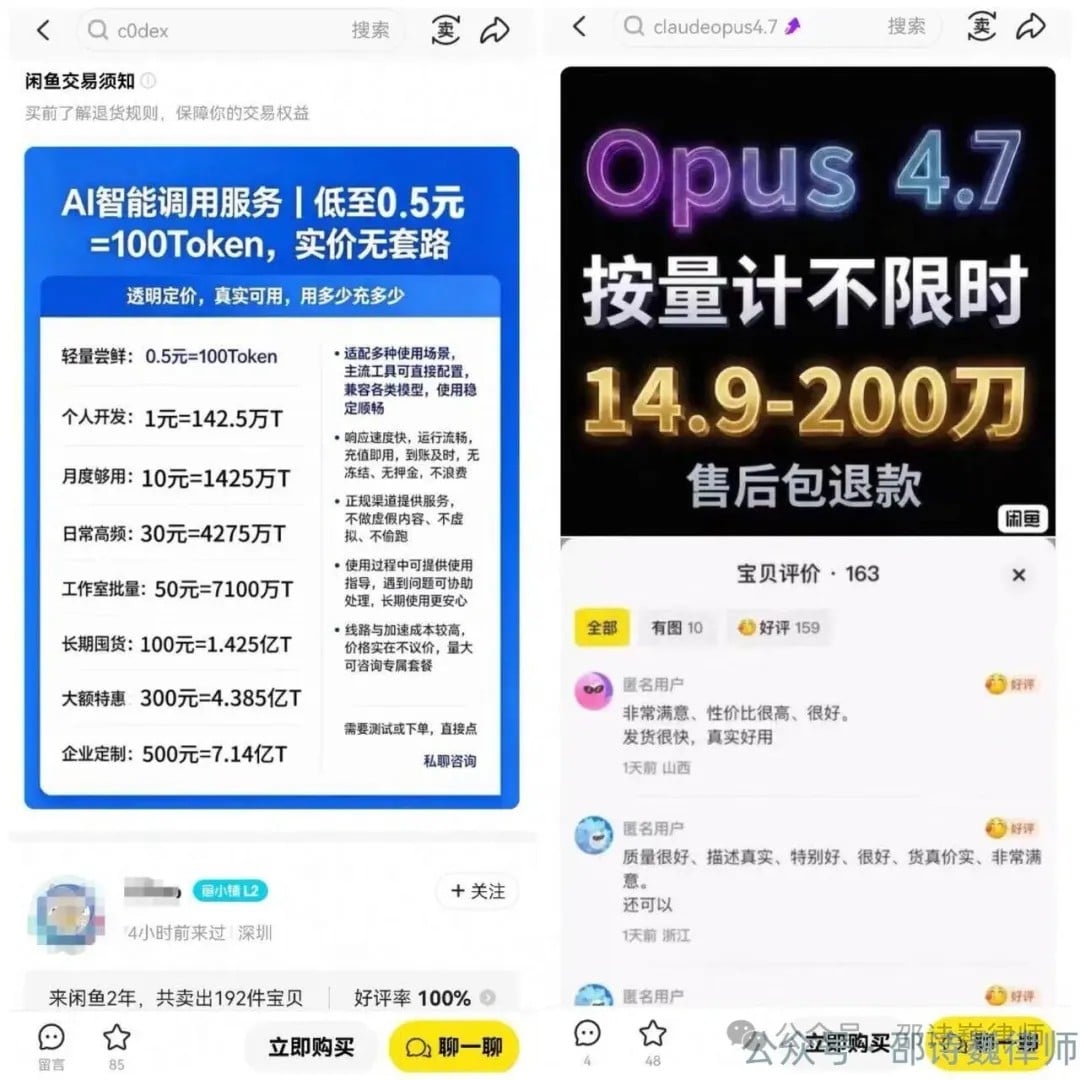
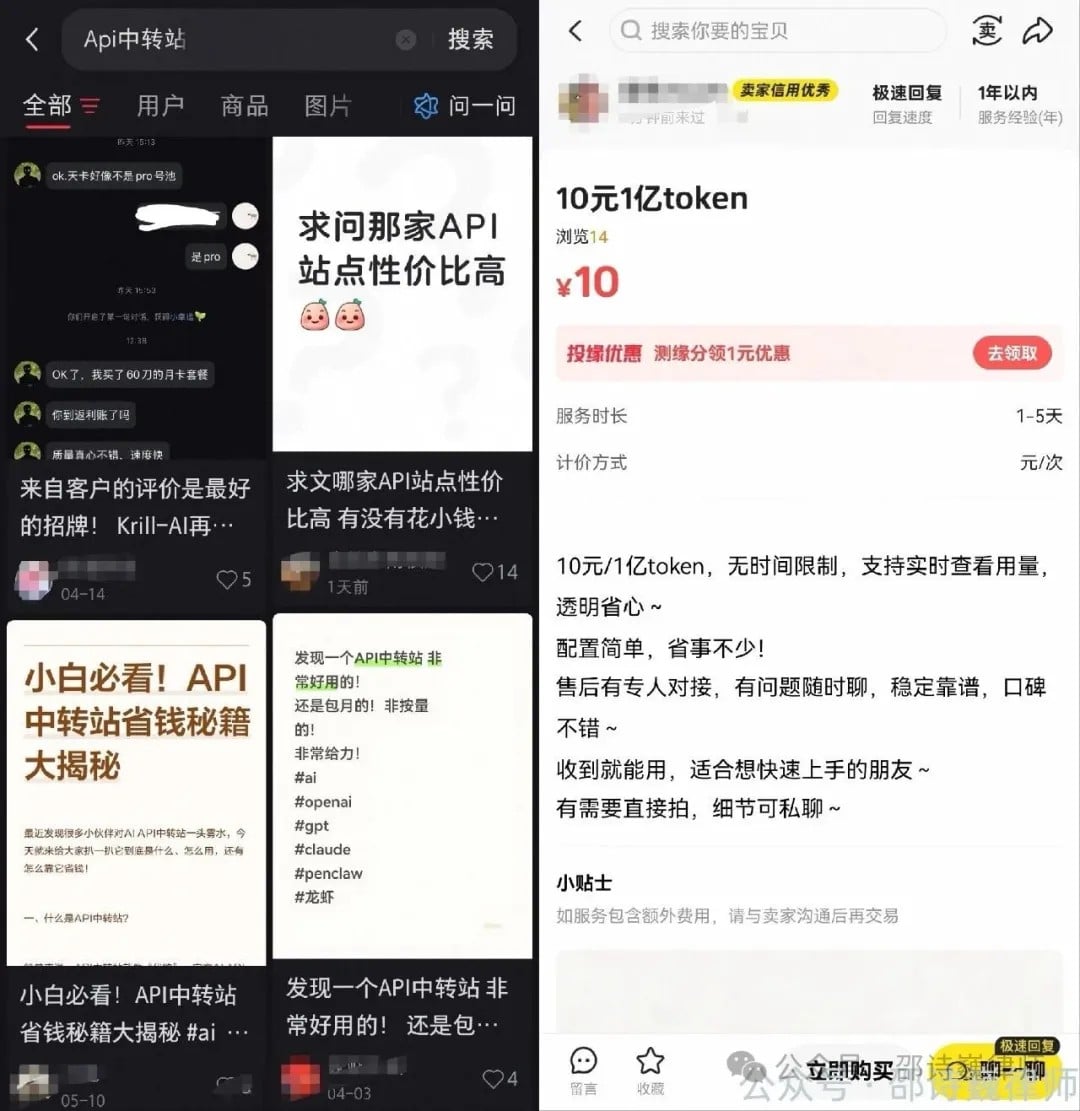
Now the question arises: with prices so low, how does the transit station owner make money?
Reselling Free Quotas. Platforms like ChatGPT and Claude give free quotas when new accounts are registered. The account sellers behind the transit stations batch register a large number of accounts, taking advantage of the platform's free quotas, and then use technical means to reverse-engineer the web interfaces of these accounts into standard APIs to sell them externally, with almost zero cost.
Refund Arbitrage. Batch register official accounts, recharge, call APIs. What to do if the account gets banned? Apply for a refund. In most cases, the preloaded money can be retrieved. This means that it first uses your money to call the API and then finds the official site to get back the costs when banned, making a profit on both ends.
Inflating Tokens. Official APIs charge strictly based on the number of Tokens, but the billing system of the transit station is written by the owner themselves. Normally, one Chinese character costs about 1.5 to 2 Tokens, but some transit stations inflate the ratio in the background, and your one character can be deducted for 3 to 4 Tokens. Users have no way to verify this.
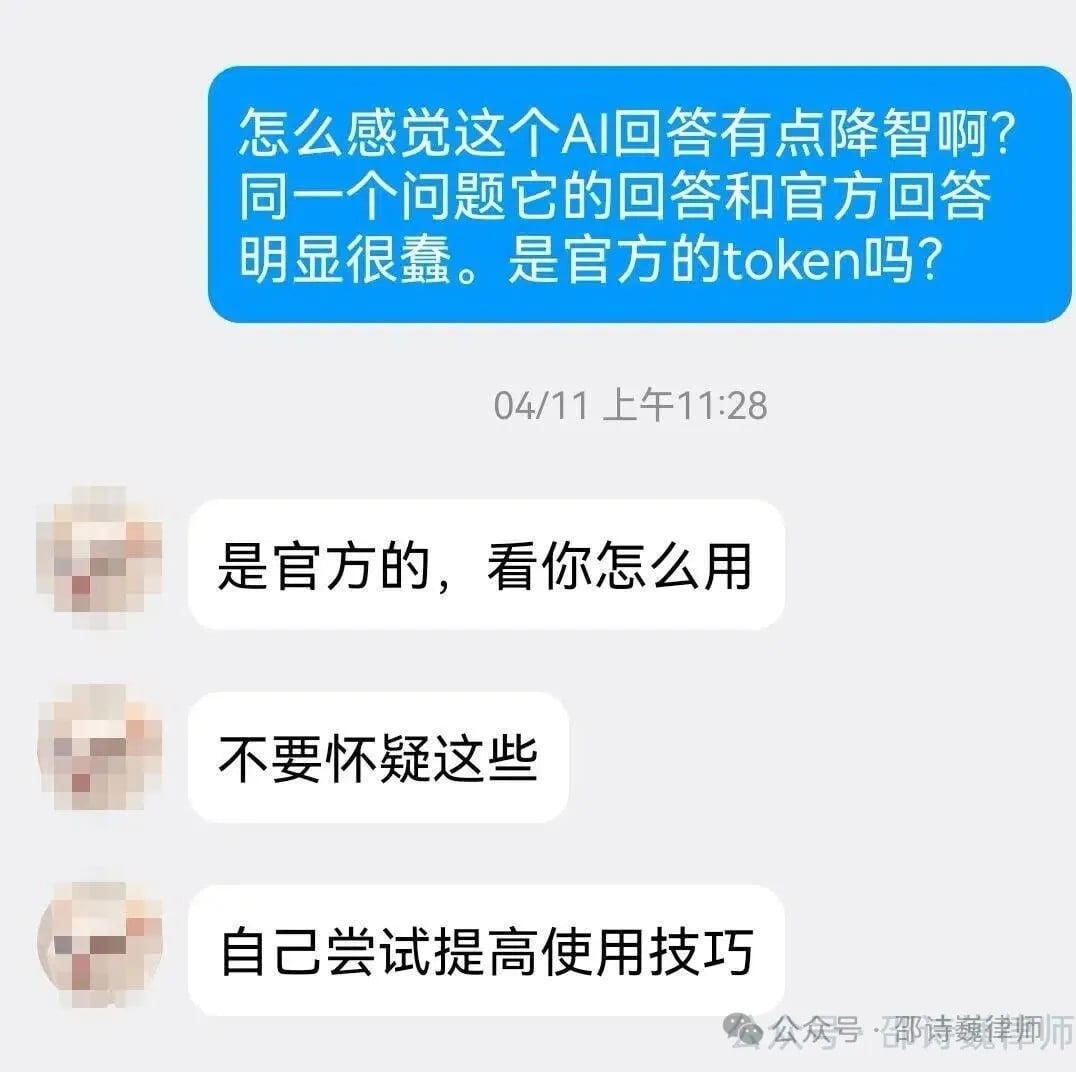
Swapping Models. You may buy Claude Opus 4.7, but what you actually invoke may be a small open-source model. This is also why many users feel that the models from the transit stations seem to be "dumbed down."
Data Reselling. Complete conversation records of users, especially high-quality training data such as code, reasoning processes, and engineering decisions, are packaged and sold to model vendors. Why is the transit station cheap? It's actually profiting from selling data.
This business has grown so large that even celebrities are entering. On May 1, 2026, Tron founder Justin Sun launched the AI transit station B.AI, claiming "One API Key = Claude + GPT + Gemini + the full series of domestic models." On May 5, a cryptocurrency company tied to the Trump family, WLFI, launched WorldRouter, directly linking AI calls with the cryptocurrency system.
But the larger the flow, the more risks arise.
Why can operating an AI transit station lead to arrest?
The previous sections outline the profit models of AI transit stations. As a transit station owner, they may also be aware that such grey market projects bear risks, but over time, this has indeed brought in profits, and coupled with the perception that peers are doing it without incident, vigilance may gradually relax.
From a legal perspective, the criminal risks of AI transit stations mainly focus on three levels.
First, the business model itself may be illegal.
The computing resources of AI transit stations are not procured through legitimate channels. Instead, they batch register accounts to obtain free quotas or reverse-engineer interfaces using technical means. This is no longer within the scope of normal commercial agency.
Providing information intermediary and data processing services essentially belongs to value-added telecommunication services. According to the Telecommunications Regulations of the People's Republic of China, operating such services requires obtaining the corresponding administrative licenses. Operating without permission carries the risk of violating illegal business activities.
Additionally, overseas large model vendors have access restrictions for users in China. Transit stations help users bypass these restrictions through proxy IPs, fake identity information, etc., which essentially aids in evading the admission conditions set by the service providers. If this behavior is judged to disturb market order, it might also fall under the evaluation range of illegal business activities.
Second, the lack of data security obligations.
AI transit stations process a large amount of interaction data between users and models daily. Prompt words, code snippets, business documents sent by users are transmitted and processed through the transit station’s servers. As the actual handler of the data, transit stations legally bear corresponding security management responsibilities.
However, the reality is that most transit stations have not established any data security management systems—data storage locations, access permission controls, and security measures are all blank. Once a data leak occurs, whether due to external attacks or internal management failures, transit stations, as network service providers, may face criminal prosecution for failing to fulfill information network security management obligations. This crime points to the situation of "failing to perform legal obligations."
Third, the illegal collection and sale of user data.
Some transit stations package and sell user conversation records to third parties, which is not an isolated phenomenon in the industry. However, the legal risks associated with this behavior are often underestimated.
The dialogue content between users and AI models often contains personal information, trade secrets, and other sensitive data. Transit stations very rarely obtain users' explicit consent when collecting this data and have not fulfilled the obligation to inform users about the purpose and flow of the data. Collecting and providing such information to third parties without consent, in severe cases, constitutes a crime of infringing on citizens' personal information.
The standard for establishing this crime is not high. According to relevant judicial interpretations, illegally obtaining, selling, or providing more than fifty items of information relating to tracking logs, communication content, credit information, property information, or over five hundred items of other personal information that might affect personal and property safety, such as accommodation information, communication records, and health information, meets the prosecutorial standards. Given the daily data processing volume of transit stations, reaching this threshold is not difficult.
In Conclusion
Regarding issues surrounding AI transit stations, Lawyer Shao does not wish to limit the discussion to whether station owners will be prosecuted; this event actually reflects problems that the AI industry inevitably faces during its rapid development phase.
For users, the transit station lowers the usage threshold but also exposes users' sensitive data to an intermediary without qualifications and security guarantees, making it nearly impossible to find an entity to assert rights when problems arise.
For vendors, the existence of transit stations depletes their technical investments and business models. Free quotas are being exploited in bulk, paid interfaces are being reverse-engineered, and pricing systems are being undermined. Vendors have to shift substantial resources from product development to risk control and resistance, and these costs will ultimately be passed on to normal paying users. A deeper harm is that when transit stations dump computing power at low prices, the market's perception of the value of AI services is being distorted—users will gradually think that such capabilities should be almost free. This poses a threat to the sustainable development of the entire industry.
As a lawyer focused on the new economy, Lawyer Shao has also been keeping an eye on the development of the AI industry and has served numerous practitioners in this field. How far an industry can go does not depend on how fast it runs, but on whether it can establish a basic order and foundation of trust in business. The AI industry is at a critical stage of transitioning from reckless growth to standardized operations, and the choices of every practitioner shape the future ecology of this industry.
A healthy AI industry requires vendors to continuously invest in technological research and development, user data rights to be effectively protected, and practitioners to participate in market competition in a compliant and responsible manner. These are preconditions for the industry’s long-term survival. Lawyer Shao hopes to see more practitioners choosing to do the difficult yet right thing, strengthening the foundation of this industry.
Special Statement: This article is an original work by Lawyer Shao Shiwei, represents only the author's personal views, and does not constitute legal advice or opinions on specific matters.
免责声明:本文章仅代表作者个人观点,不代表本平台的立场和观点。本文章仅供信息分享,不构成对任何人的任何投资建议。用户与作者之间的任何争议,与本平台无关。如网页中刊载的文章或图片涉及侵权,请提供相关的权利证明和身份证明发送邮件到support@aicoin.com,本平台相关工作人员将会进行核查。


