Author: Xinzhi Yuan
Stripe is in talks to acquire OpenRouter
According to sources cited by The Wall Street Journal and The Information, the deal price could be close to $10 billion (approximately 68 billion yuan).

https://www.wsj.com/tech/ai/stripe-in-talks-to-buy-buzzy-ai-model-marketplace-openrouter-decc6a74

https://www.theinformation.com/briefings/stripe-talks-buy-startup-openrouter
Two months ago, OpenRouter was only valued at $1.3 billion (approximately 8.8 billion yuan), a premium of nearly 7 times.
The deal could be announced within a month, but it may also fall through.
According to The Information, Databricks previously also talked to OpenRouter about acquisition, but the subsequent progress is unknown.
A Stripe spokesperson told The Wall Street Journal, "we do not comment on rumors and speculation."
Most people may not have heard of OpenRouter, but what it does is related to every AI user.
The AI applications you use have a pricing engine behind them
You open an AI translation tool, input a sentence, and get the result in seconds.
What you do not see is: whether this sentence was sent to GPT, Claude, or a much cheaper open-source model.
The decision of "which model to choose" is increasingly made by middle layers like OpenRouter.
A simple analogy: if AI models are flights, OpenRouter is the travel agency.
Developers can access over 400 large models through its API, automatically matching them based on task complexity, cost, and response speed.
Summarizing a daily email does not require the use of the most expensive cutting-edge model, while processing a legal contract would direct you to a more capable one.
User experience doesn’t change, but the bills behind it differ by several times.
This also explains one thing: why many AI products can maintain low prices or even be free.
OpenRouter was founded in 2023 by Alex Atallah and Louis Vichy.

Alex Atallah

Louis Vichy
Atallah's previous startup was the NFT trading platform OpenSea, which reached a peak valuation of $13.3 billion.
After the NFT boom faded, he left in 2022 to shift to AI infrastructure.
He mentioned in an interview:
Inference is the fastest-growing cost for enterprises, often coming from more than four different models.
Growth data validates this judgment.
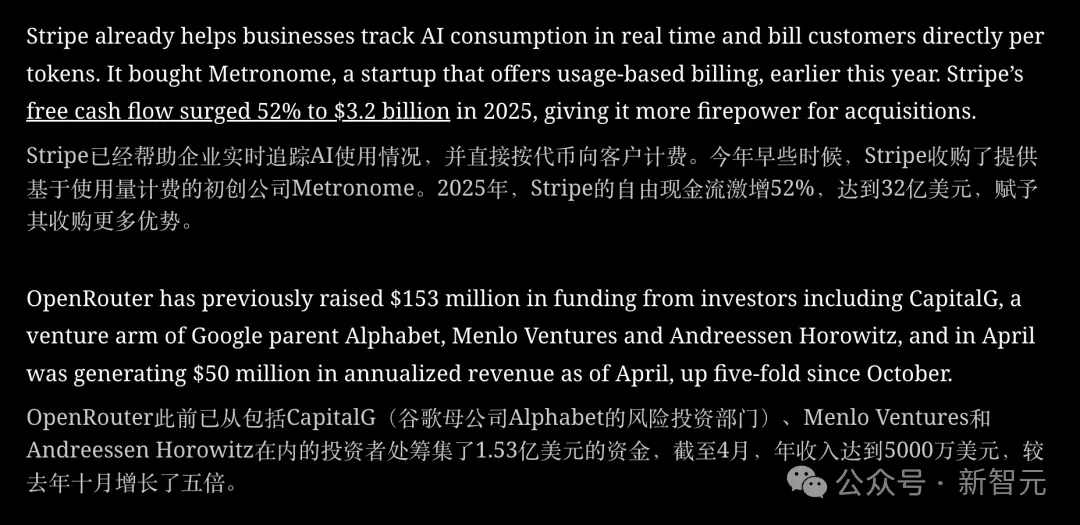
According to The Information, as of April this year, OpenRouter's annualized revenue reached $50 million, having increased fivefold in six months.
Over 400 large models are available on the platform, with over 1 million developer users.
Investors include CapitalG (the growth fund of Alphabet), Menlo Ventures, and a16z, with cumulative funding of $153 million.
Stripe aims to be the cash register and dispatcher of the AI economy
Stripe is the world's largest internet payment processor, helping millions of businesses complete online payments.
In the past year, the company has been intensively expanding its business into AI infrastructure.
In December 2025, Stripe spent about $1 billion to acquire the usage-based billing platform Metronome.
Metronome helps AI companies charge customers based on Token usage, with OpenAI and Anthropic as clients.
Stripe CEO Patrick Collison said at the time:
Usage-based pricing is the native business model of the AI era.
With OpenRouter, Stripe's intentions become clear: selecting models, billing, and payments, creating a seamless link.
If AI applications are likened to restaurants, Stripe simultaneously becomes the ingredient coordinator (helping you choose models), utility meter (usage-based billing), and cash register (payments).
For enterprise customers, one vendor can manage all AI usage and billing.
Stripe has the resources to accomplish this.
According to The Information, Stripe's free cash flow in 2025 is expected to be $3.2 billion, a 52% year-over-year increase, with total revenue of about $6.8 billion for the year.
In February of this year, an employee stock transfer pushed the valuation to $159 billion.
During the same period, Stripe also partnered with private equity firm Advent International to make an acquisition offer of about $53 billion to PayPal, which deemed the price too low, and negotiations are ongoing.
Buying a company with an annual revenue of $50 million for $10 billion seems exorbitant.
But OpenRouter's revenue has increased fivefold in six months, gambling on growth.
More importantly is the position: as companies move from binding a single AI model to multi-model usage, those controlling the routing layer gain the power to allocate traffic.
Which model is preferentially recommended and which is deprioritized are all decided at this layer.
For ordinary users, changes may not come tomorrow, but the direction is already visible.
By acquiring Metronome, Stripe secured the "how to charge", and by acquiring OpenRouter, it secured "which model to use". Together, these two questions form the entry point for AI applications.
Every AI product you use in the future will see its cost and underlying model choices sinking from application developers down to the infrastructure layer.
References:
https://www.wsj.com/tech/ai/stripe-in-talks-to-buy-buzzy-ai-model-marketplace-openrouter-decc6a74
https://www.theinformation.com/briefings/stripe-talks-buy-startup-openrouter
https://www.theinformation.com/articles/needs-openrouter
免责声明:本文章仅代表作者个人观点,不代表本平台的立场和观点。本文章仅供信息分享,不构成对任何人的任何投资建议。用户与作者之间的任何争议,与本平台无关。如网页中刊载的文章或图片涉及侵权,请提供相关的权利证明和身份证明发送邮件到support@aicoin.com,本平台相关工作人员将会进行核查。


