Author: Menlo Ventures
Translation: Jiahua, ChainCatcher
Today, OpenRouter announced that it has reached a acquisition agreement with Stripe. It has been just three years since OpenRouter officially launched in 2023.
OpenRouter was initially positioned as a "unified interface for LLMs" and only supported four models at that time: GPT-3.5, GPT-4, Together's GPT NeoXT, and Cohere xlarge.
At its founding, the company was based on two core judgments: first, the scale of AI usage will ultimately be massive and will permeate various fields; second, there will be a multitude of different models in the market, each with its trade-offs, and users will choose different models based on varying needs.
These two judgments have been proven to far exceed expectations at that time.
Since its launch, the number of tokens processed by the OpenRouter platform has increased by approximately 30,000 times, and on an annualized basis, it has already exceeded 45 trillion tokens, with the scale of expenditures on the platform reaching astonishing levels. Meanwhile, the number of models supported by OpenRouter has grown from the initial four to over 500.
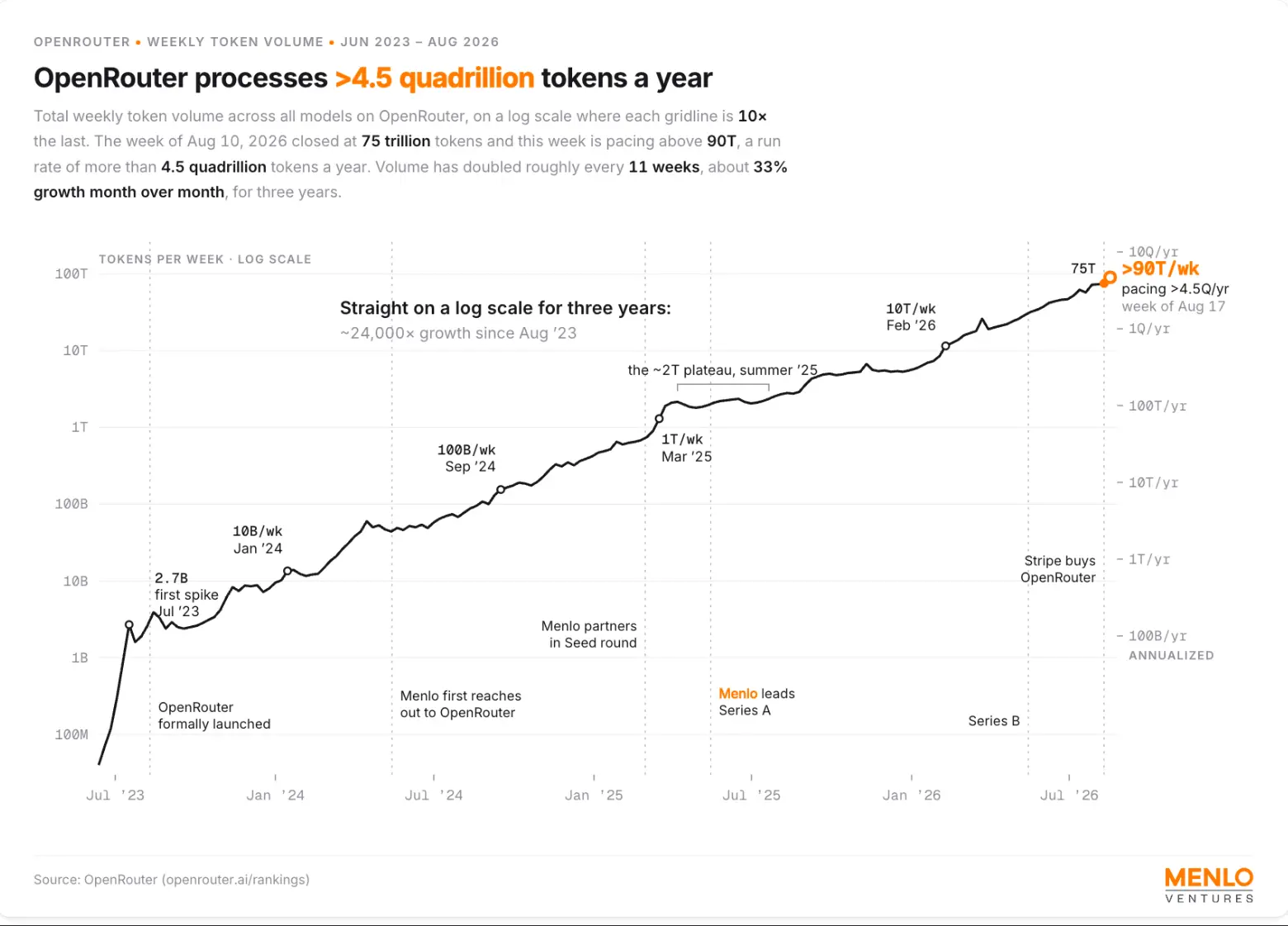
Image: Growth of OpenRouter token usage from establishment to acquisition
Menlo Ventures is fortunate to have participated in this journey. In March 2025, we participated in OpenRouter's seed round financing through the Anthology Fund established in partnership with Anthropic.
OpenRouter's founder and CEO Alex Atallah previously founded OpenSea, which was once valued at $13.3 billion. His co-founders include tech expert Louis Vichy, whom he met on Discord, and highly effective COO Chris Clark.
In May 2025, we led OpenRouter's Series A financing, with Matt joining the company's board and Deedy acting as a board observer. Earlier this year, after seeing the rapid growth in OpenRouter's customer base and revenues, as well as the company building stronger "model intelligence" capabilities in its product roadmap around model selection and assessment, we further increased our investment in the Series B financing.
In the tech industry, an idea often takes years to evolve from the judgment of a few to industry consensus.
Just a few weeks ago, this happened: from Ramp to Cursor, more than 10 companies almost simultaneously launched their own model routing products. In just a few years, OpenRouter has become one of the most important companies in the AI era.
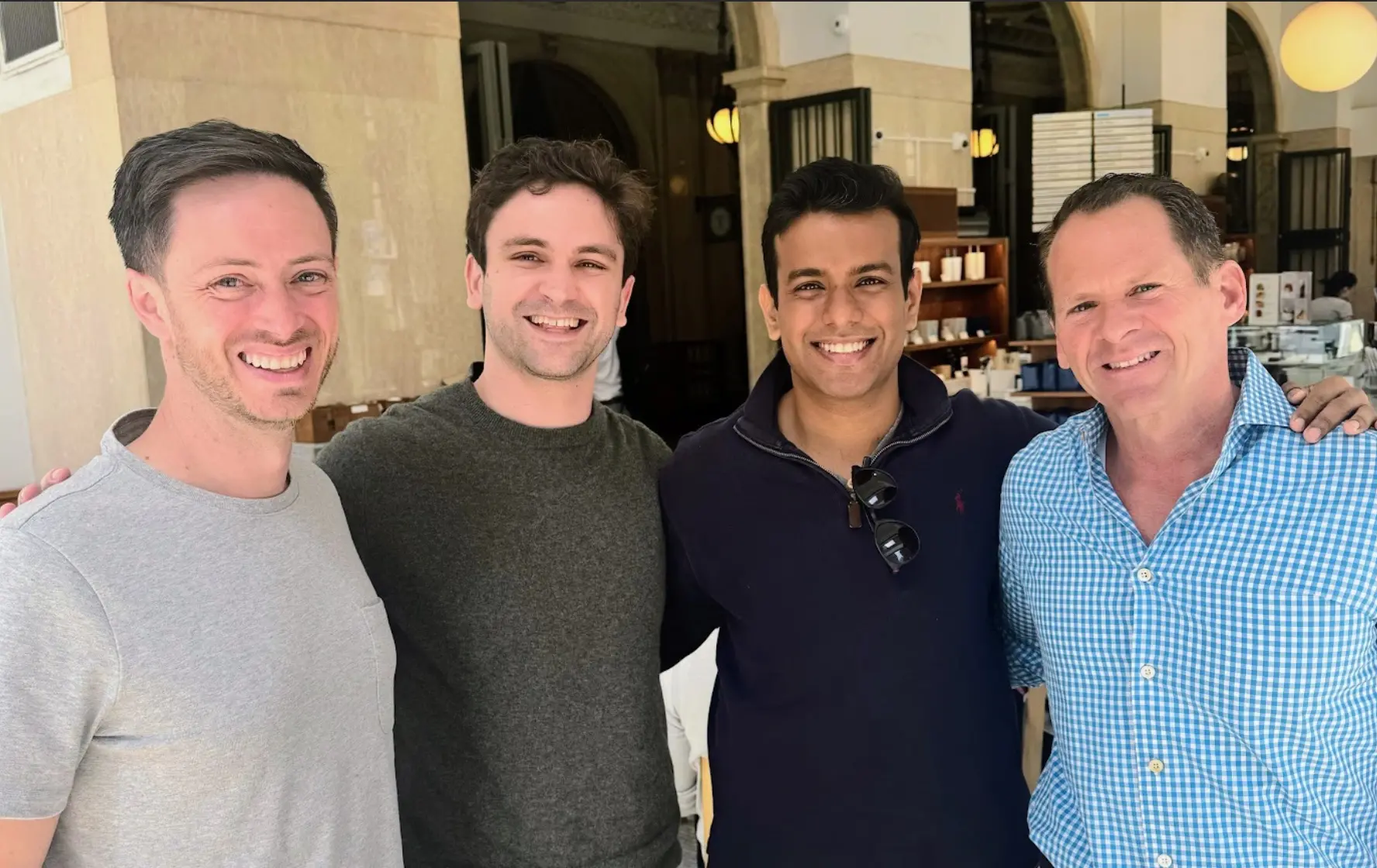
Image: Group photo taken when deciding to lead OpenRouter’s Series A round
At first glance, Stripe does not seem to be the most natural acquirer for OpenRouter, but the two companies are actually remarkably similar.
Both use a directly accessible API to simplify a previously complex transaction process and charge a fee as a percentage. The only difference is that OpenRouter deals with AI models.
According to Stripe's consistent narrative, after the merger, both companies are still doing the same thing: improving "internet GDP".
In fact, more than a year ago, OpenRouter had already referred to itself as "the Stripe of the LLM field".
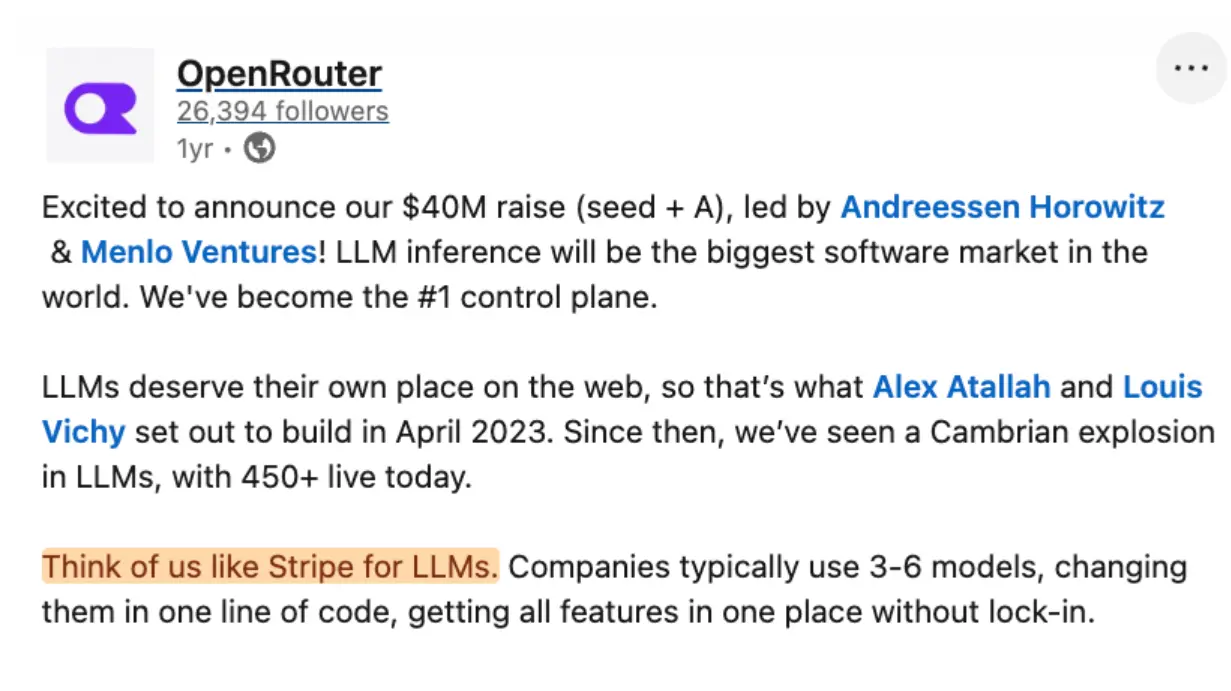
The Core Value of OpenRouter
OpenRouter is one of the earliest companies that Deedy interacted with after joining Menlo in 2024. This company is nearly right in the core position of our AI infrastructure investment logic.
In the “2024 Enterprise AI Report”, Menlo put forward two judgments necessary for investing in OpenRouter: AI spending will increase significantly, and developers will not use only one model but will adopt multiple models simultaneously.
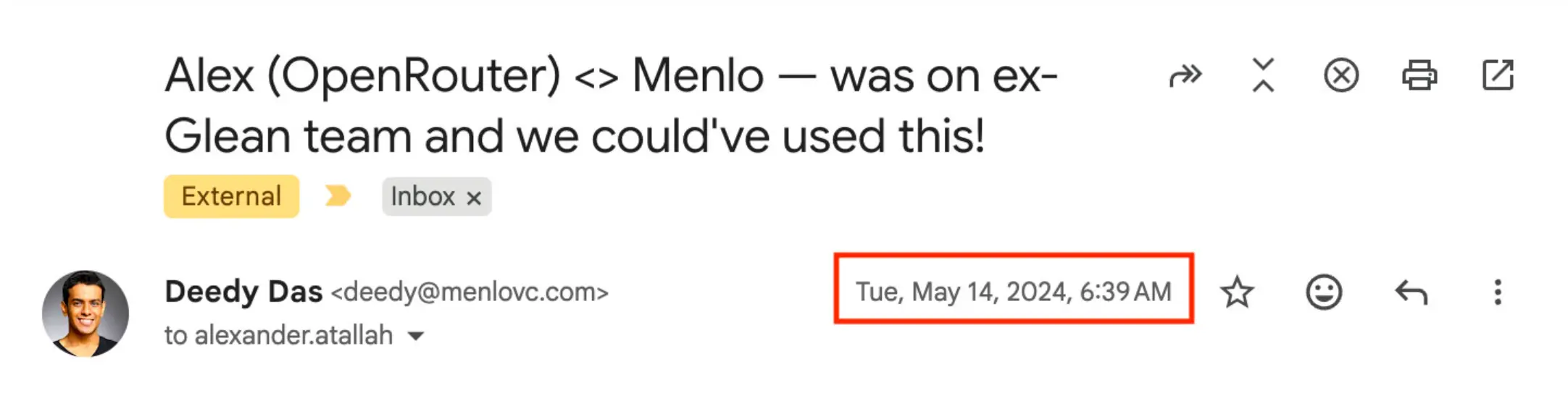
Image: Initial contact email sent by Menlo to OpenRouter
As fellow coders who practically use these models, we quickly realized that there are significant differences among different models in terms of cost, latency, and performance.
For instance, when performing a simple NLP task, such as identifying entities from a text, it isn't always necessary to call the most cutting-edge, powerful models like Fable.
The issue lies in the fact that if users need to enter the official websites of each model company to register accounts, create API keys, securely store keys, and adapt to each company's slightly different API interface specifications, managing all models can become quite cumbersome.
A unified model gateway sounds simple, but in reality, it is a much more challenging infrastructure problem than it appears. Few people are willing to build and maintain such a system long-term.
The venture capital industry often discusses "moats," usually thinking first of technical barriers. But what OpenRouter possesses is a very typical scale moat.
The more users there are, the better OpenRouter can predict model demand and handle larger loads; it also makes it easier to sign larger contracts with model labs, leading to a more stable supply and demand for tokens.
Ultimately, this will create a cycle: new model labs will want to prioritize landing on OpenRouter to obtain distribution channels.
We have also observed another trend.
With the popularity of vibe coding, the number of software startups is rapidly increasing. For a product wanting to enter the enterprise market, those that have already gained recognition from in-house developers are often the ones that can ultimately be purchased by enterprises.
Companies like Anthropic, OpenAI, xAI, Cursor, Cognition, ElevenLabs, Lovable, and Fireworks have all done just that: they first win developers and then enter the enterprise market.
OpenRouter is no different.
Since our investment:
The number of tokens OpenRouter currently handles has reached 30,000 times what it was at launch, maintaining an average monthly growth of about 33% over the past three years, doubling approximately every 11 weeks.
The model market is also expanding rapidly. Outstanding open-source models such as DeepSeek, GLM, and Kimi have emerged in China, along with models from companies like Grok, Meta, and Thinking Machines. OpenRouter has now integrated over 500 models from more than 80 model providers, serving approximately 10 million users.
Many important new models prioritize landing on OpenRouter, including those from OpenAI, X, and Meta. Mark Zuckerberg, who usually rarely tweets and speaks less about other products, has specifically announced the launch of Muse Spark on OpenRouter, as has Elon Musk. OpenAI also offers exclusive discounts through OpenRouter for models like Terra and Luna.
OpenRouter's product-driven growth model has successfully transitioned to the enterprise market. Its sales cycle for enterprise products is one of the fastest we have seen. Enterprises can use this product to centrally allocate model resources, control access, and manage internal AI budgets.
Since OpenRouter can negotiate contracts uniformly with different model providers, it can offer extremely high service availability even when dealing with cutting-edge models.
How OpenRouter Got to Today
Anyone who has been in the startup world for a long time will tell you that finding product-market fit, or PMF, is never a straight line.
The same is true for OpenRouter.
Its story actually begins on April 5, 2023. At that time, the team launched a Chrome extension called Window, allowing users to simultaneously invoke multiple models across different chat applications on the internet.
The problem they initially aimed to solve was to prevent users from being locked in by a single model vendor, while not requiring them to provide their API keys to different applications to use different models.
The design inspiration for this product came from crypto wallets, which is also related to Alex's previous experience founding OpenSea. At that time, Window supported four models.
On April 24, 2023, the name "OpenRouter" first appeared in Window's GitHub code repository.
About a month later, they onboarded the first batch of Anthropic v1 models, started to automatically allocate requests to the appropriate models based on prompts, and created the subsequently well-known model rankings, using the name OpenRouter.
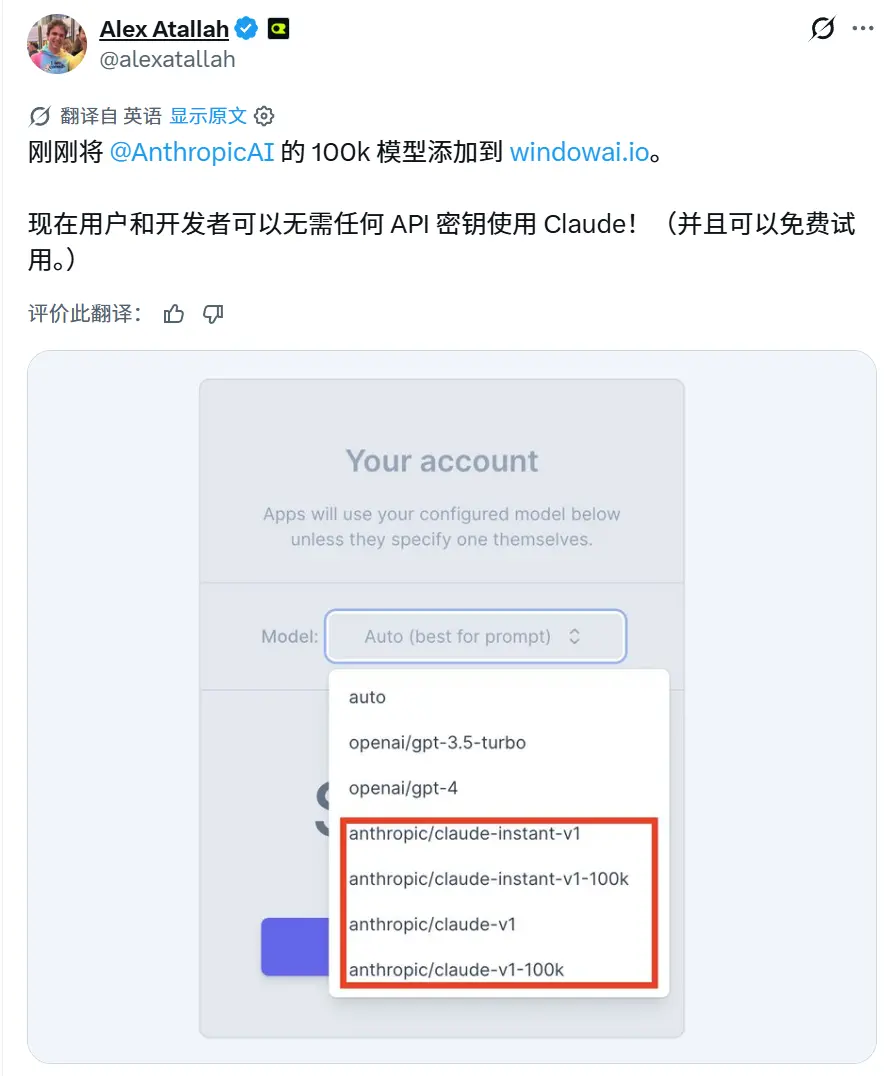
On August 10, 2023, the team officially renamed the product to OpenRouter, with the slogan "A unified interface for LLMs."
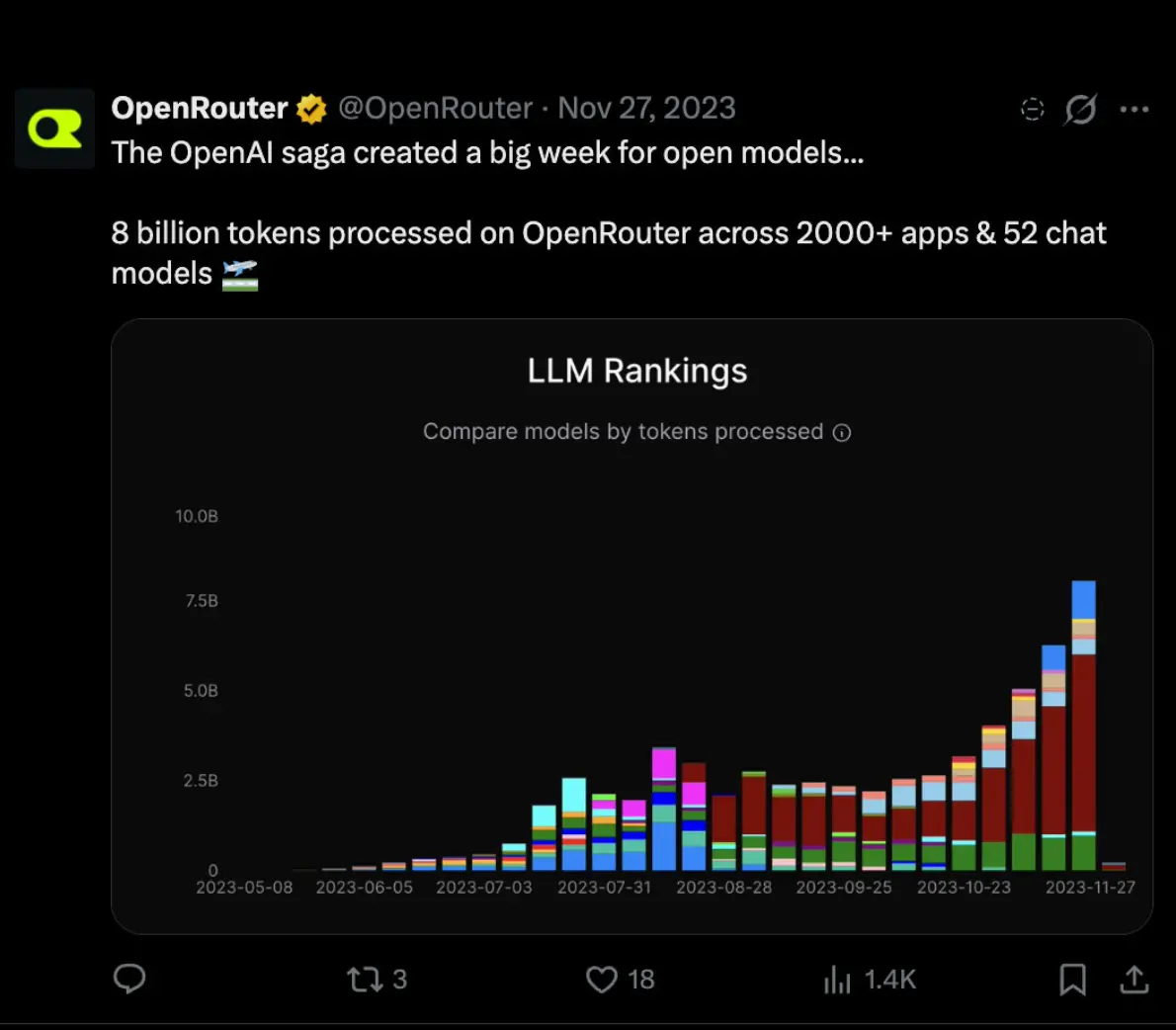
At that time, OpenRouter was processing about 3 billion tokens per week. The models on the leaderboard at that time were completely different from the ones we are familiar with today.
Subsequently, the team launched Playground, allowing users to receive answers from multiple models through a chat interface simultaneously.
By November of that year, OpenRouter already supported 52 models and integrated with over 2,000 applications, processing about 8 billion tokens per week.
At that point, they had truly found PMF.
The Future of Model Routing
Unlike many people's understanding, OpenRouter's core product is not simply "helping users route tokens," but rather becoming the most user-friendly AI gateway.
OpenRouter indeed provides an Auto Router that can automatically select models, but most developers use OpenRouter mainly to access different models through a single entry point and then decide how to route the models based on their needs.
Recently, the rapid growth of enterprise spending on LLMs has become a reality for companies like Uber, Coinbase, and Microsoft.
Therefore, "model routers" as a cost-reducing solution sound very appealing.
Since an AI Agent breaks down tasks into many different sub-tasks, why should the most expensive model be used for every task? Simple tasks can be handled by lower-cost models.
In the past few weeks, the entire industry seems to have suddenly realized this at the same time. From Ramp to Cursor, over 10 companies have launched their own model routers.
The problem, however, is that selecting models based solely on prompts is not a particularly effective method.
In an agent scenario, a task may require a long time to run. To determine which model a request should be assigned to, a significant amount of context must be understood.
For example, a simple command: "Find this file in the codebase."
It may only require a cheap, simple LLM or could necessitate calling the most cutting-edge model. It depends on the size of the codebase and the context accumulated from previous tasks.
In multi-step agent tasks, if the router selects the wrong model at any step, the cost of that error will be amplified through subsequent steps, ultimately leading to a noticeable decline in the overall quality of the task's results.
Therefore, a truly differentiated model routing product is not based on a simple "model selection algorithm" but rather on an excellent unified API and a sufficiently large real user base.
It is these users that have allowed OpenRouter to gradually accumulate an extremely large dataset, which includes what prompts have been submitted by users, which models those prompts ultimately used, the context during task execution, and what results were ultimately achieved, often unnoticed by the outside world.
This is the truly important aspect of model routing.
In a real production environment, OpenRouter can help enterprises control costs while maintaining effectiveness through more rational model routing.
In the future, developers will not need to build complex evaluation systems themselves, nor will they need to continuously modify prompts for different models.
You might just need to log in to the backend and see a prompt like this: "There are some scenarios in your codebase primarily for summarization. Switching from GPT 5.6 Sol to Muse Spark could save you $100,000 annually. We have already completed the relevant assessments for you."
This is the true future of model routing.
From Payment Infrastructure to AI Infrastructure
Stripe and OpenRouter share a remarkably similar development trajectory. Both companies first win over developers and then gradually enter the large enterprise market. Both of their product design languages are also very simple and direct.
Andrej Karpathy once referred to OpenRouter as the “switch” for AI. What Stripe has done is essentially similar: it has become that "switch" in the payment processing system.
This acquisition is also one of the earliest large transactions to occur in the AI era of infrastructure, and it will not be the last. The infrastructure for managing models, costs, and computing power is gradually taking shape. These infrastructures are accelerating the formation of a new generation of giant companies faster than ever before.
免责声明:本文章仅代表作者个人观点,不代表本平台的立场和观点。本文章仅供信息分享,不构成对任何人的任何投资建议。用户与作者之间的任何争议,与本平台无关。如网页中刊载的文章或图片涉及侵权,请提供相关的权利证明和身份证明发送邮件到support@aicoin.com,本平台相关工作人员将会进行核查。


