In the face of macro fluctuations, the TRON ecosystem provides a model of asset allocation that is both offensive and defensive through stablecoin settlements, interest-bearing assets, and innovative businesses.
While traditional markets are still embroiled in debates over the "contradictory signals" of inflation data and interest rate cut expectations, the crypto world has already staged an extreme tug-of-war between emotions and capital. On one side, stubborn inflation data casts a shadow over monetary policy, while on the other, the market continues to bet that the Federal Reserve will begin a rate-cutting cycle in the coming months.
This "misalignment of expectations" is shrouding the crypto market in a fog of information. For ordinary investors, the split macro narrative makes it difficult to discern direction. Therefore, this issue of SunFlash invites several senior KOLs to engage in an in-depth roundtable discussion on "Inflation Rise vs Market Betting on Rate Cuts: Will Misaligned Expectations Become the Next Trigger for Crypto Markets?" The aim is to peel back the macro surface, analyze the market psychology and capital logic behind the "misalignment of expectations," and explore how ordinary users can interpret signals, manage risks, and seek a more robust foothold amid volatility during such highly uncertain times.
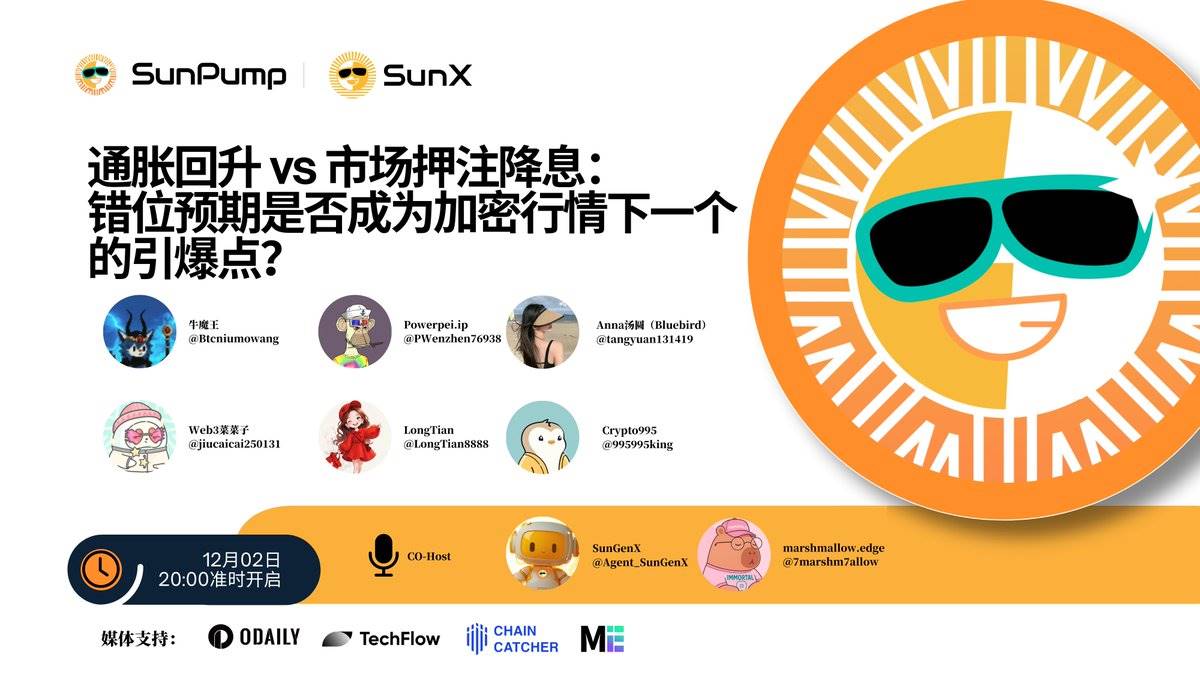
Inflation Rise vs Rate Cut Bets: The Game Logic Behind Misaligned Expectations
Regarding the significant "misalignment" between current macro data and market expectations, the guests generally believe that this is not a simple market misjudgment, but rather a forward-looking game based on future liquidity expectations.
Niu Mo Wang likened this phenomenon to the market going over a "speed bump." He pointed out that the core issue is that the market generally believes that the "tap" of high interest rates cannot remain closed forever, or it will trigger unbearable systemic risks globally. Therefore, the focus of capital is not on the fluctuations of the current CPI decimal points, but on the certainty of the liquidity gate opening within the next six months. This misalignment itself provides a great environment for main capital to repeatedly oscillate, wash out, and lay out positions.
Anna Tangyuan clarified the rationality of the "contradiction" from a temporal perspective. She emphasized that the market trades on the future, while inflation data reflects the past. The current inflation rebound is more viewed as a short-term factor, and the market has observed signals of economic pressure such as weak employment and high financing costs, thus betting in advance that the central bank will eventually turn to easing.
However, on the flip side, once the market has priced in rate cut expectations, any failure or delay in those expectations could become a trigger for risk. The guests unanimously agreed that if rate cut expectations fail or are delayed, the crypto market may face not just a normal correction, but a severe storm triggered by liquidity reversal and leveraged liquidation.
Niu Mo Wang vividly compared the current market to a group of hungry people waiting for a meal; if the Federal Reserve "flips the table," the reversal of market sentiment will be exceptionally intense. The most lethal factor is not the macro environment itself, but the amplifier effect of high leverage. Once expectations shift, panic will drive leveraged funds to flee, and a chain of liquidations will fuel the decline, leading to a "pinning" style crash. Web3 Caicai predicted the worst-case scenario: if the Federal Reserve turns hawkish or even resumes rate hikes, it will trigger a sudden tightening of global liquidity, potentially repeating systemic panic similar to "312" and "519."
How to Maintain Cautious Crypto Asset Allocation Amid Macro Volatility?
In the face of a high-volatility "misalignment" environment, how can ordinary users avoid risks while not completely missing potential opportunities? The core strategies of the guests focus on "defensive counterattacks" and "rhythm control." Powerpei.ip summarized the strategy as "maintaining integrity while being innovative." He views Bitcoin and Ethereum as essential "ballast" and core assets that must be firmly held to ensure a foothold in the industry. At the same time, assets with high narrative capabilities, such as AI, RWA, and privacy, are seen as supplementary parts to capture cutting-edge opportunities, thereby enhancing the overall resilience of the strategy.
Within this strategic framework, selecting targets that combine a "solid" foundation with "innovative" ecological potential has become a pragmatic consideration for many investors. The TRON ecosystem presents a clear dual-layer structure in the crypto field, with its core being the construction of a financial network that combines a stable foundation with growth potential. This characteristic aligns perfectly with the current macro uncertain environment's demand for investors to "defend and counterattack."
The most fundamental "ballast" business is as a global stablecoin, particularly the core settlement layer of USDT. Blockchain research institution Presto Research pointed out in a report that TRON has become a major global stablecoin settlement network, processing transaction volumes of $600 million to $800 million annually, which is a typical infrastructure role with extremely high certainty and network effects. This means that regardless of how the market fluctuates, the global demand for stablecoin transfers and settlements continues to inject real, high-frequency liquidity into this network. The total number of accounts on TRON exceeds 350 million, and the total transaction volume has surpassed 12.2 billion, solidifying its position as a key financial infrastructure.
On top of the solid settlement network is a rich decentralized finance (DeFi) yield ecosystem, which constitutes its "innovative" yield amplifier function. The stablecoins held by users (such as USDT) are not static; they can be transformed into interest-bearing assets through lending protocols, liquidity mining, and other channels on the TRON chain, yielding approximately 8% or even higher in annualized risk-free returns. At the same time, its native token TRX can not only earn about 7% annualized returns through basic staking but can also further enhance yield elasticity through more complex liquidity staking and DeFi combination strategies. This ability to convert basic assets into continuous cash flow provides an extremely attractive option for investors seeking a "solid foundation" amid macro turbulence.
Looking to the future, the TRON ecosystem is expanding its business boundaries through innovation, extending into the broader traditional financial world, representing its long-term "innovative" growth narrative. For example, in the cutting-edge track of AI and blockchain integration, TRON has undergone AINFT brand upgrades, creating a decentralized AI new economic ecosystem. At the same time, in the decentralized finance (DeFi) sector, its core platform SUN.io integrates AI-driven tools like SunAgent, which can help users automate trading, manage assets, and optimize returns through smart strategies, incorporating AI decision-making capabilities into actual on-chain financial operations. Additionally, in response to the highly popular Meme coin sector, the TRON ecosystem has also birthed SunPump, a platform focused on the fair launch and creation of Meme coins, which significantly lowers the barriers to creation and participation through the one-click token issuance tool SunGenX, opening up a new growth curve driven by technological innovation and community culture.
In summary, the TRON ecosystem has constructed a business matrix that ranges from foundational settlement (integrity) to mid-level yields (both offensive and defensive), and then to cutting-edge innovation (innovation). Under the tightening expectations of "delayed rate cuts," the essential need for stablecoin settlements and the defensive nature of DeFi yield assets will become more pronounced, while in the easing expectations of "rate cuts landing," its native tokens and innovative businesses may exhibit stronger price elasticity. This business structure itself provides a multi-layered, dynamically adjustable strategic choice to cope with macro uncertainties.
As the analysis of the TRON ecosystem shows, a configuration model that can traverse cycles often builds a multi-layered business matrix that can adapt to different macro scenarios. The core lies in the fact that regardless of how the winds change, there will always be parts of the asset portfolio that can continuously generate value and capture demand, and there will always be parts that possess the flexibility to respond to changes and seize opportunities. Ultimately, finding a way out in the macro maze may depend on constructing such resilient assets and ecosystems, rather than merely guessing the opening and closing of the next door.
免责声明:本文章仅代表作者个人观点,不代表本平台的立场和观点。本文章仅供信息分享,不构成对任何人的任何投资建议。用户与作者之间的任何争议,与本平台无关。如网页中刊载的文章或图片涉及侵权,请提供相关的权利证明和身份证明发送邮件到support@aicoin.com,本平台相关工作人员将会进行核查。


