Author: Zhixiong Pan
In the second decade of blockchain technology development, the industry is facing a fundamental philosophical and technical paradox: while Ethereum has successfully established a trustless value settlement layer as the "world computer," its radical transparency is evolving into an obstacle to mass adoption. Currently, every interaction, asset allocation, salary flow, and even social relationship of on-chain users is exposed in a permanently immutable public panorama prison. This "glass house" living condition not only infringes on personal sovereignty but also excludes the vast majority of institutional capital due to the lack of protection for commercial secrets.
The year 2025 marks a decisive turning point in industry consensus. Ethereum co-founder Vitalik Buterin explicitly stated that "privacy is not a feature, but a hygiene," defining it as a fundamental basis for freedom and a necessary condition for social order. Just as the internet evolved from plaintext HTTP to encrypted HTTPS, which spurred the prosperity of e-commerce, Web3 is at a similar critical point. Supported by approximately $119 million in funding, Aztec Network (Ignition architecture) is pushing Ethereum towards an upgrade of programmable privacy infrastructure through the Ignition Chain, the Noir language ecosystem, and proof applications based on Noir, such as zkPassport.
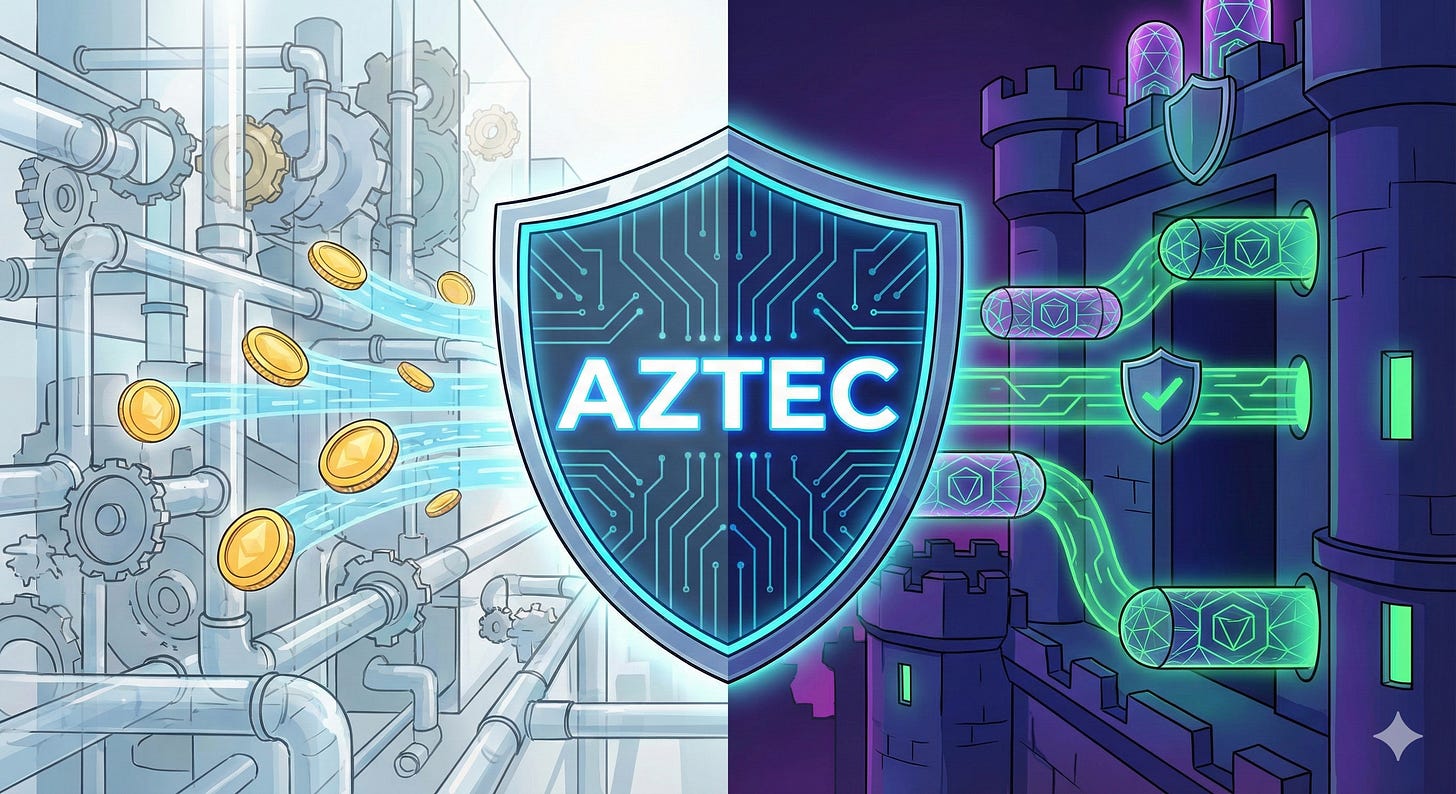
Macro Narrative: From Single Point Breakthrough to "Holistic Privacy" Defense Depth
The understanding of privacy within the Ethereum ecosystem is no longer limited to a single mixing protocol but has evolved into a "Holistic Privacy" architecture that spans the network layer, hardware layer, and application layer. This paradigm shift became the focus of the industry at the 2025 Devconnect conference, establishing that privacy protection must have full-stack defensive depth.
Reconstruction of Software Standards: Kohaku and Stealth Meta-Address
The Kohaku reference implementation, led by the Ethereum Foundation's Privacy Exploration team (PSE), marks the transition of privacy technology from "wild plugins" to "regular troops." Kohaku is not just a wallet SDK; it attempts to fundamentally reconstruct the account system.
By introducing the "Stealth Meta-Address" mechanism, Kohaku allows the recipient to only publish a static meta public key, while the sender generates a unique one-time on-chain address for each transaction based on elliptic curve cryptography.
For external observers, these transactions appear to be sent to random black holes, making it impossible to establish a correlation map with the user's true identity. Additionally, Kohaku provides reusable integrated components around mechanisms like stealth meta-address/stealth addresses and attempts to advance privacy capabilities from "plugins" to a more standardized wallet infrastructure.
The Last Bastion of Hardware Defense: ZKnox and Quantum Threat Resistance
If Kohaku protects the logic at the software level, ZKnox, a project funded by the Ethereum Foundation (EF) to fill the ecological hardware gap, is dedicated to addressing deeper issues of key security and future threats. As ZK applications become more widespread, an increasing number of sensitive witnesses (which may include key materials, identity data, or transaction details) need to participate in proof and signing processes on the terminal side, thereby expanding the risk of leakage when the client is compromised. ZKnox focuses on making quantum-resistant cryptography "usable and affordable" on Ethereum through infrastructure improvements and implementations (such as promoting related precompiles to reduce lattice cryptography computation costs), paving the way for future migration to PQ signature schemes.
More critically, in the face of the potential threat that quantum computing may pose to traditional elliptic curve cryptography in the 2030s, ZKnox is focused on the infrastructure work of "making quantum-resistant cryptography available and affordable on Ethereum." For example, EIP-7885 proposes adding NTT precompiles to reduce the on-chain verification costs of lattice cryptography (including schemes like Falcon), paving the way for future PQ migration.
Aztec's Historical Position and Technical Architecture: Defining the "Private World Computer"
In the evolution of the privacy track, Aztec occupies a unique ecological niche. Unlike the pseudonymous mechanisms of the Bitcoin era and surpassing the single "transactional privacy" offered by Zcash or Tornado Cash, Aztec is committed to achieving Turing-complete "programmable privacy." Its core team includes co-inventors of the PLONK zero-knowledge proof system, which endows Aztec with a profound original capability in cryptography.
Hybrid State Model: Breaking the Impossible Triangle
The biggest challenge in building a privacy smart contract platform lies in how to handle state. Traditional blockchains either have entirely public states (like Ethereum) or entirely private states (like Zcash). Aztec creatively proposes a hybrid state model: on the private level, it adopts a Bitcoin-like UTXO model, storing user assets and data as encrypted "notes."
These notes express "spent/invalid" through the generation of corresponding nullifiers, preventing double spending while maintaining privacy regarding the content and ownership of the notes. On the public level, Aztec maintains a publicly verifiable public state, which is updated by public functions in the network's public execution environment.
This architecture allows developers to mix private functions and public functions within the same smart contract. For example, a decentralized voting application can publicly disclose the "total vote count" as a global state while strictly keeping "who voted" and "what was voted" confidential through private states.
Dual Execution Model: PXE and AVM's Concerto
Aztec's execution is divided into two layers: private functions are executed in the client's PXE and generate proofs and commitments related to private states; public state transitions are executed by the sequencer (running the public execution environment/VM) and generate (or delegate the prover network to generate) validity proofs that can be verified on Ethereum.
- Client-Side Proving: All private data processing occurs in the user's local "Private Execution Environment (PXE)." Whether generating transactions or computing logic, the user's private keys and plaintext data never leave their device. PXE is responsible for running circuits locally and generating a zero-knowledge proof.
- Public Execution and Verification (AVM): The user only submits the generated proof to the network. On the network side, the sequencer/block production committee verifies the private proof during the packaging process and re-executes the public part, with public contract logic executed in the AVM and included in the final validity proof verifiable on Ethereum. This separation of "private input on the client, public state transition verifiable" compresses the conflict between privacy and verifiability to the boundary of a provable interface, without requiring the entire network to see all plaintext data.
Interoperability and Cross-Layer Communication: Portals and Asynchronous Messaging
Under the Ignition architecture, Aztec does not treat Ethereum as a "backend execution engine" to proxy DeFi instructions but establishes L1↔L2 communication abstractions through Portals. Since private execution needs to be "prepared and proven" in advance on the client side, while public state modifications must be executed by the sequencer at the chain head, Aztec's cross-domain calls are designed as a unidirectional, asynchronous messaging model: L2 contracts can initiate call intentions (or vice versa) to the L1 portal, and messages become consumable states in subsequent blocks through the rollup mechanism, requiring applications to explicitly handle failure and rollback scenarios.
The rollup contract plays a key role in maintaining the state root, verifying state transition proofs, and transporting message queue states, thereby achieving composable interactions with Ethereum while maintaining privacy constraints.
Strategic Engine: The Democratization of Noir Language and Zero-Knowledge Development
If the Ignition Chain is the backbone of Aztec, then the Noir language is its soul. For a long time, the development of zero-knowledge proof applications was limited by the "two-brain problem," where developers had to be both seasoned cryptographers and skilled engineers, manually translating business logic into underlying arithmetic circuits and polynomial constraints, which was not only inefficient but also prone to security vulnerabilities.
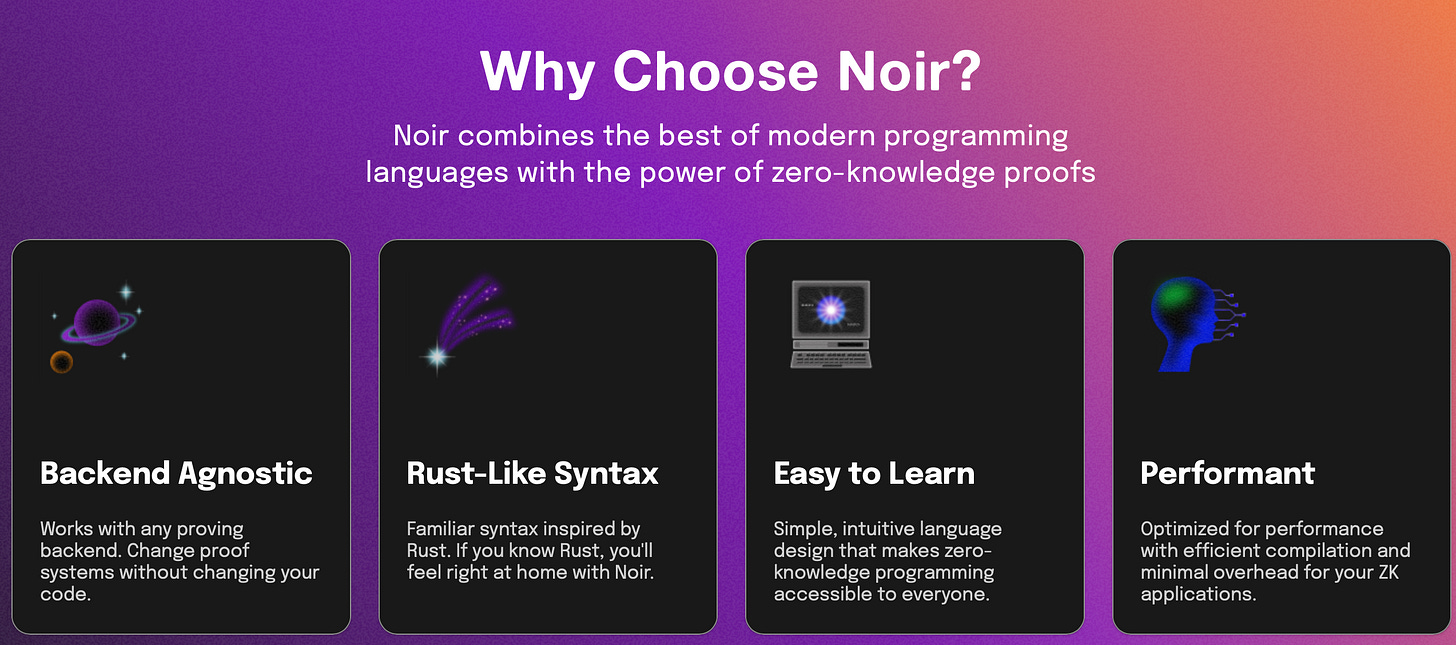
The Power of Abstraction and Backend Agnosticism
The emergence of Noir aims to end this "Tower of Babel" era. As an open-source domain-specific language (DSL), Noir adopts a modern syntax similar to Rust, supporting advanced features such as loops, structs, and function calls. According to Electric Capital's developer report, the amount of code written in Noir for complex logic is only one-tenth that of traditional circuit languages (like Halo2 or Circom). For example, the Payy privacy payment network reduced its core codebase from thousands of lines to about 250 lines after migrating to Noir.
More strategically significant is Noir's "Backend Agnosticism." Noir code is compiled into an intermediate representation layer (ACIR), which can interface with any proof system that supports the standard.
Noir decouples circuit expression from specific proof systems through ACIR: within the Aztec protocol stack, it defaults to pairing with Barretenberg, while outside the chain or in other systems, ACIR can be converted/adapted to different backends like Groth16. This flexibility is making Noir a universal standard across the entire ZK field, breaking down barriers between different ecosystems.
Ecological Explosion and Developer Moat
Data proves the success of the Noir strategy. In Electric Capital's annual report, the Aztec/Noir ecosystem ranked among the top five fastest-growing ecosystems in developer growth for two consecutive years. Currently, there are over 600 projects on GitHub using Noir, covering areas from identity verification (zkEmail) to gaming and complex DeFi protocols.
By hosting the NoirCon global developer conference, Aztec not only solidified its technological moat but also nurtured an active ecosystem of privacy-native applications, signaling that privacy applications are about to experience a Cambrian explosion.
Network Cornerstone: Decentralized Practices of the Ignition Chain
In November 2025, Aztec launched the Ignition Chain on the Ethereum mainnet (currently focused on decentralized block production and proof process rehearsals, with transaction and contract execution expected to gradually open in early 2026). This is not only a technical milestone but also a radical practice of the commitment to Layer 2 decentralization.
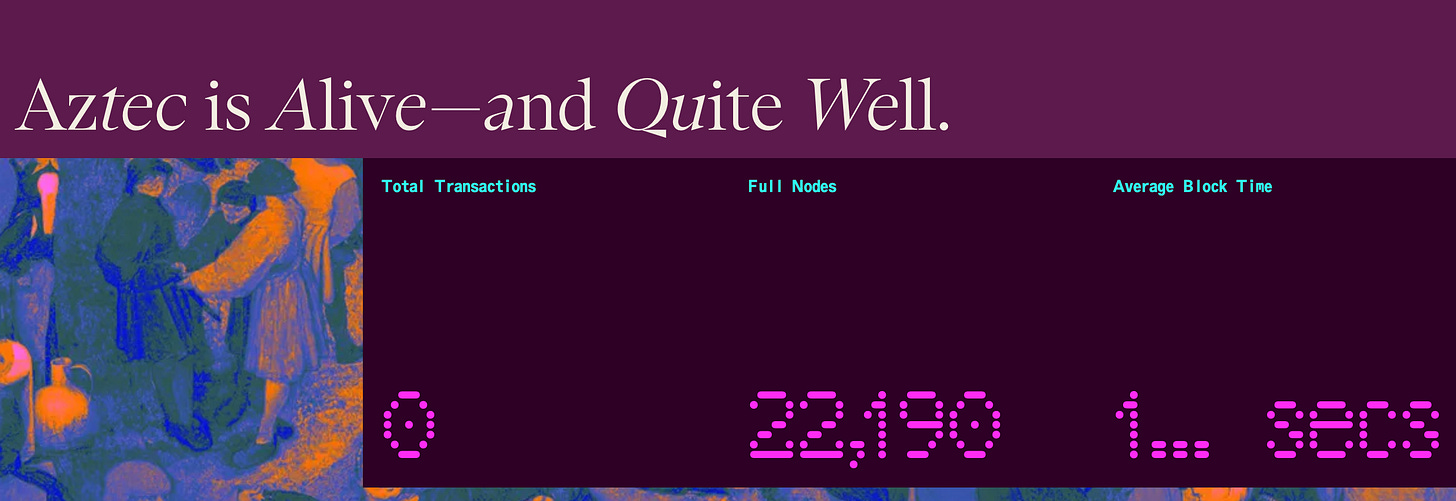
The Courage to Start Decentralized
In the current Layer 2 scaling race, the vast majority of networks (such as Optimism and Arbitrum) rely on a single centralized sequencer during their initial launch to ensure performance, postponing decentralization to an ambiguous future.
Aztec chose a completely different path: the Ignition Chain operates under a decentralized validator/sequencer committee structure from the very beginning, aiming to pre-assign key permissions to an open set of validators. The network triggers the genesis block once the validator queue reaches a launch threshold of 500, attracting over 600 validators to participate in the block production and endorsement process in the early stages after launch.
This design is not superfluous but rather the survival baseline for a privacy network. If the sequencer is centralized, regulatory agencies or powerful entities can easily exert pressure to demand the review or rejection of specific addresses' privacy transactions, rendering the entire privacy network ineffective. The decentralized sequencer/committee design eliminates the single point of censorship from a centralized sequencer and significantly enhances the censorship resistance of transactions being packaged under the premise of "honest participants existing and protocol assumptions holding."
Performance Roadmap
While decentralization brings security, it also poses challenges to performance. Currently, the block generation time of the Ignition Chain is approximately 36-72 seconds. Aztec's roadmap aims to gradually compress the current long block interval to around 3-4 seconds (targeting the end of 2026) through parallelizing proof generation and optimizing the network layer, approaching the interactive experience of the Ethereum mainnet. This marks a transition of privacy networks from "usable" to "high performance."
Killer Application: zkPassport and the Paradigm Shift in Compliance
Technology itself is cold until it finds application scenarios that address real human pain points. zkPassport is more accurately one of the identity verification/compliance signaling tools within the Noir ecosystem. Aztec uses its circuits for "minimum disclosure" compliance proofs, such as sanction list checks, exploring a compromise between privacy and compliance.
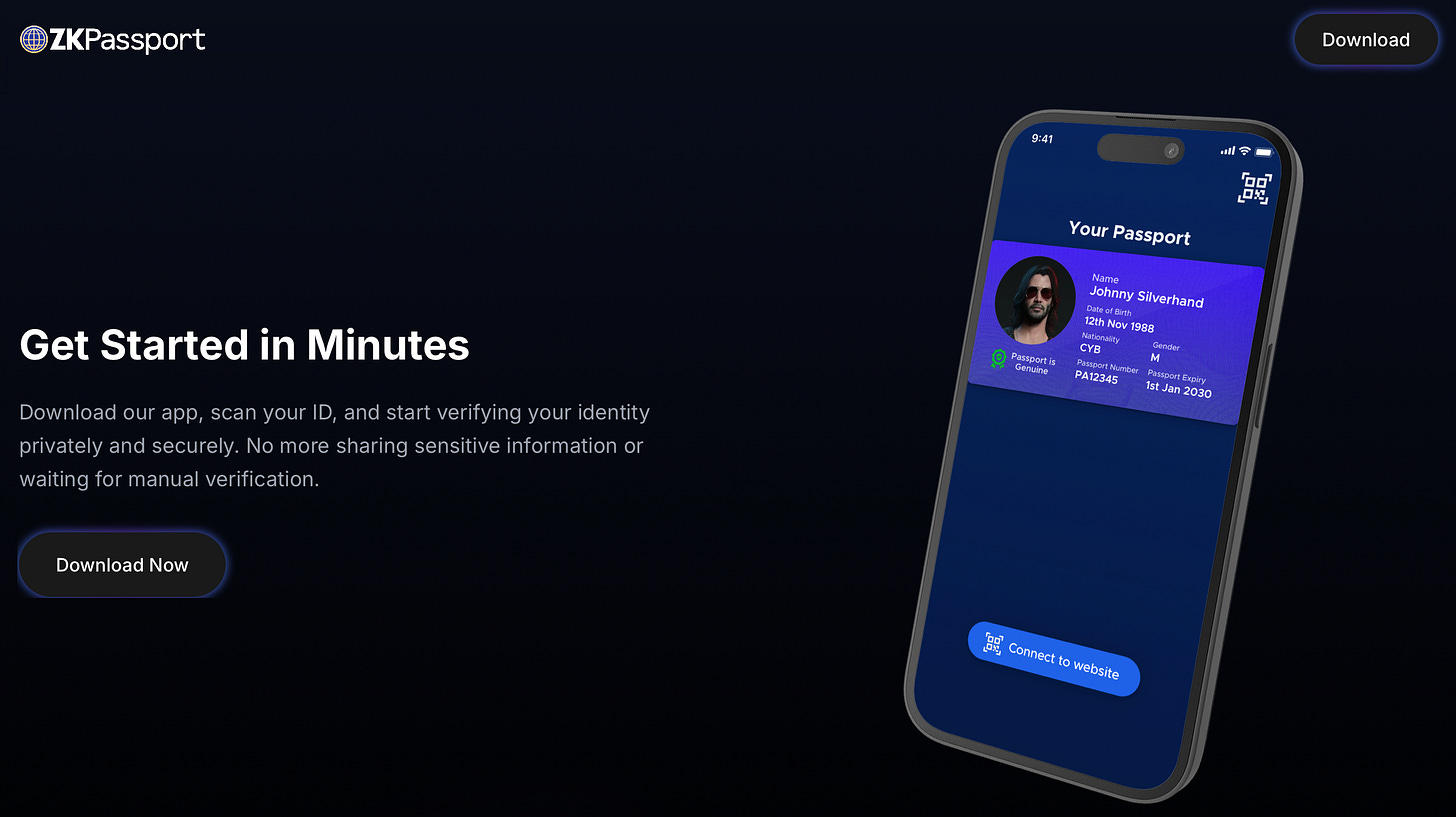
From Data Collection to Fact Verification
Traditional KYC (Know Your Customer) processes require users to upload passport photos and identification documents to centralized servers, which not only complicates the process but also creates numerous vulnerable data honeypots. zkPassport completely overturns this logic: it utilizes the NFC chips and government digital signatures embedded in modern electronic passports to read and verify identity information locally through physical contact between the phone and the passport.
Subsequently, the Noir circuit generates zero-knowledge proofs in the local environment of the user's phone. Users can prove facts such as "over 18 years old," "nationality belongs to the allowed list/not on the prohibited jurisdiction list," and "not on the sanction list" without disclosing complete details like birth dates or passport numbers.
Preventing Sybil Attacks and Institutional Access
The significance of zkPassport goes far beyond identity verification. By generating passport-based anonymous identifiers, it provides a powerful "Sybil Resistance" tool for DAO governance and airdrop distribution, ensuring fairness in "one person, one vote" while eliminating the possibility of reverse tracking users' true identities.
In practice, such verifiable, minimum disclosure compliance signals are expected to reduce compliance friction for institutions participating in on-chain finance, but they do not equate to a complete KYC/AML process. Institutions can prove their compliance qualifications through zkPassport and participate in on-chain financial activities without exposing trading strategies and capital scales. Through this application, Aztec demonstrates that compliance does not necessarily mean establishing a panoramic prison; technology can simultaneously meet regulatory requirements and preserve individual privacy.
Economic Model: Continuous Clearing Auction (CCA) and Fair Distribution
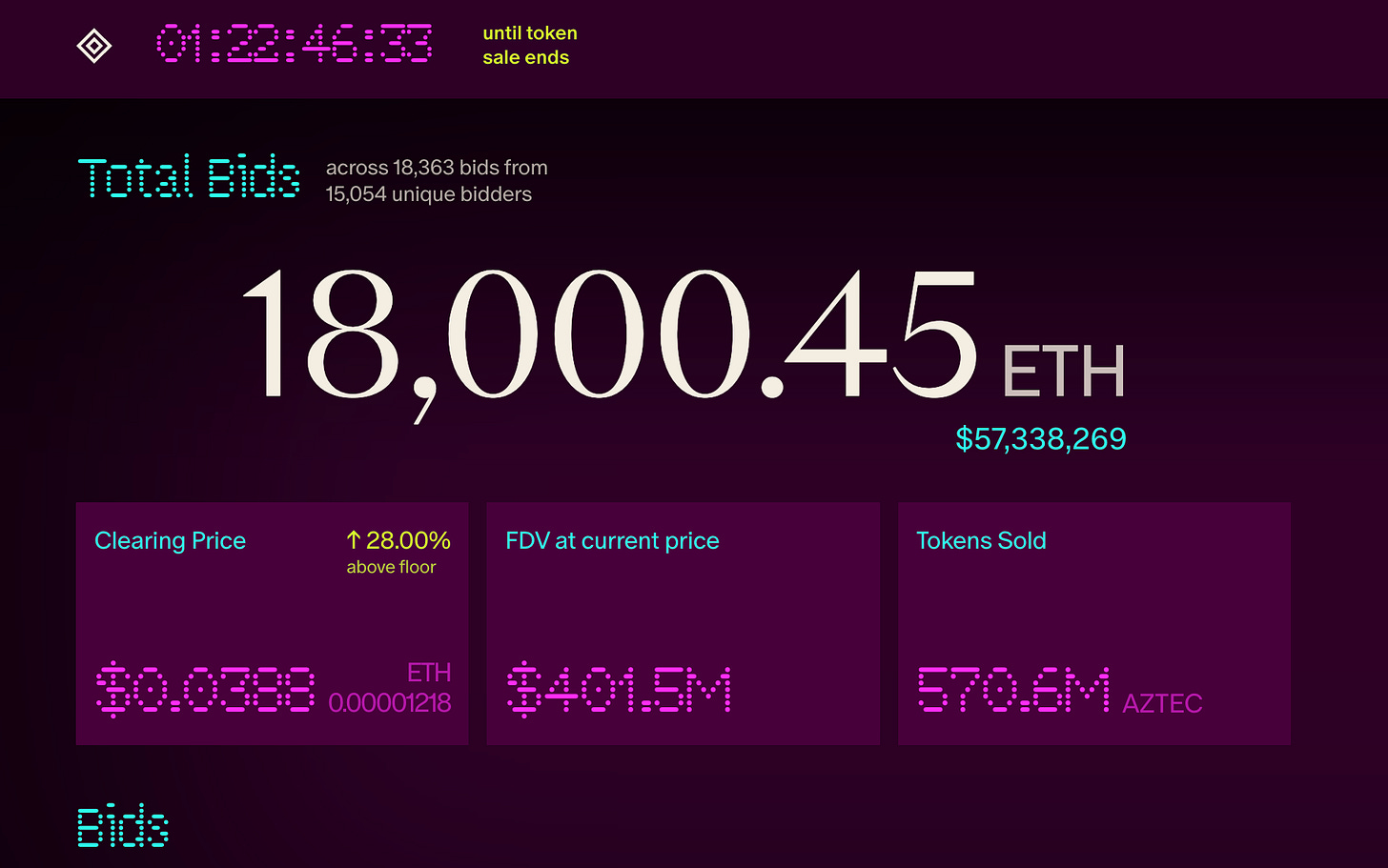
As the fuel for a decentralized network, the issuance mechanism of the native token AZTEC reflects the project's extreme pursuit of fairness. Aztec has abandoned traditional issuance models that easily lead to bot sniping and gas fee wars, collaborating with Uniswap Labs to introduce the innovative "Continuous Clearing Auction (CCA)."
Price Discovery and Anti-MEV
The CCA mechanism allows the market to engage in sufficient competition within a set time window to discover the true price. In each clearing cycle of the CCA, transactions are settled at a unified clearing price, thereby reducing the space for sniping and gas bidding that arises from the desire to execute transactions first. This mechanism effectively eliminates the profit space for frontrunners, allowing retail investors to stand on the same starting line as whales.
Liquidity Owned by the Protocol
Even more innovative is that the CCA achieves an automated closed loop between issuance and liquidity establishment. The auction contract can automatically inject (part of) the auction proceeds into the Uniswap v4 liquidity pool according to pre-disclosed parameters, forming an on-chain verifiable "issuance → liquidity" closed loop.
This means that from the moment of its birth, the AZTEC token possesses deep on-chain liquidity, avoiding the common price volatility seen with new token listings and protecting the interests of early community participants. This more DeFi-native approach to issuance and liquidity guidance is often used to illustrate a path for AMM to expand from "trading infrastructure" to "issuance infrastructure."
Conclusion: Building the "HTTPS Era" of Web3
The ecological panorama of Aztec Network, from the underlying Noir language standard to the upper-layer zkPassport application, and to the network carrier of the Ignition Chain, is transforming the long-conceived "HTTPS upgrade" of the Ethereum community into a usable engineering reality. This is not an isolated technical experiment but resonates with Ethereum-native initiatives like Kohaku and ZKnox, collectively building a layered privacy defense system from hardware to applications.
If the early development of blockchain established trustless value settlement, then the next core theme will be establishing data sovereignty and confidentiality. In this process, Aztec plays a crucial infrastructural role: it does not attempt to replace Ethereum's transparency but complements its missing half through "programmable privacy." As technology matures and compliance frameworks improve, we can expect a future where privacy is no longer an "additional feature" but a "default attribute," a "private world computer" that retains the verifiability of public ledgers while respecting individual digital boundaries.
免责声明:本文章仅代表作者个人观点,不代表本平台的立场和观点。本文章仅供信息分享,不构成对任何人的任何投资建议。用户与作者之间的任何争议,与本平台无关。如网页中刊载的文章或图片涉及侵权,请提供相关的权利证明和身份证明发送邮件到support@aicoin.com,本平台相关工作人员将会进行核查。


