Written by: Frank
The actor in the spotlight, whether it is Hassett or Warsh, may determine the direction of the plot, but the overall director of this drama has firmly become Trump.
After meeting the last person, Trump's thoughts changed yet again.
Just as Wall Street was almost certain that the new chairman of the Federal Reserve was a "done deal" for Kevin Hassett, last week, Trump's latest meeting with former Federal Reserve governor Kevin Warsh at the White House added suspense to this gamble.
Unlike previous formalities, after this meeting, Trump's attitude towards Warsh underwent a subtle yet significant shift, clearly showing more affirmation towards Warsh. In an interview with The Wall Street Journal, he stated: "I think both Kevins are great," with Warsh now alongside Hassett as a leading candidate for the Federal Reserve chairmanship.
The shift from Hassett to Warsh in the "Kevin duel" not only signifies a personnel change from "loyal dove" to "Federal Reserve reformist," but is essentially a game about the logic of dollar liquidity over the next four years (see also: "Outlook for the New Fed Chair: Hassett, Coinbase Holdings, and Trump's 'Loyal Dove'").
It can be said that Trump's remark of "both are great" translates to "huge uncertainty" for the market.
1. From Hassett's "One-Man Show" to the "Kevin Duel"
Capital markets are always the most honest. On the prediction market Polymarket, keen investors have already completed a repricing of this "succession drama."
As of December 16, when this article was written, in the pool of funds for "Who will Trump nominate as Fed Chair?" Warsh's odds have surpassed 45%, officially overtaking Hassett (42%) to become the new top "seed."
It is worth noting that just two weeks ago, in early December, Hassett held an overwhelming advantage of over 80%, while Warsh, like other "also-rans," had odds in the single digits (Update: As of December 17, Hassett has once again overtaken Warsh, leading with 53% to 27%).
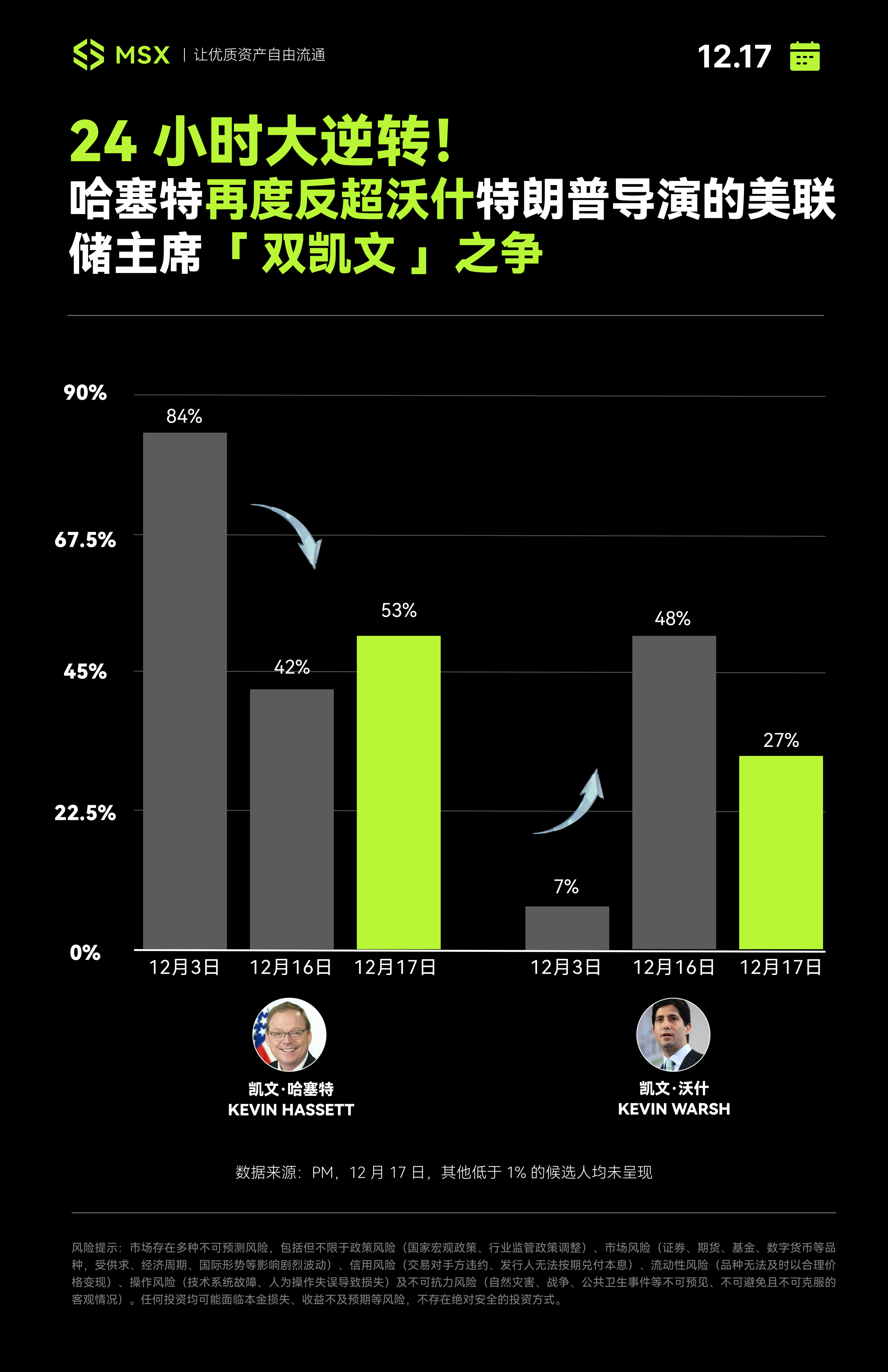
So what exactly happened that caused the originally clear situation to reverse instantly? After reviewing public information, Warsh's sudden rise and Hassett's "loss of favor" likely stem from the details of their "in and out."
First, Warsh's rise can be attributed to his "hardcore network" that connects directly to Trump's inner circle.
In fact, compared to Hassett's "staff" identity, Warsh has a closer personal relationship with Trump, thanks to Warsh's father-in-law—billionaire and Estée Lauder heir Ronald Lauder, who is not only a financial backer of Trump but also a longtime college classmate and close friend.
With this relationship backing him, Warsh not only provided advice to the transition team but was naturally seen by Trump as "one of his own." At the same time, Warsh is also an old friend of Trump's other aide, current Treasury Secretary Mnuchin, and previous articles have mentioned that Trump once considered Mnuchin for the next Federal Reserve chair.
In addition to personal connections, Warsh has also gained endorsements from the "professional circle." According to FT sources, JPMorgan CEO Jamie Dimon recently expressed clear support for Warsh at a closed-door summit of asset management giants, bluntly stating that Hassett might implement aggressive rate cuts to please Trump, potentially triggering inflation backlash.
This also somewhat represents the choice of the Wall Street elite, and the collective support from this elite circle undoubtedly increases Warsh's leverage. During Trump's meeting with Warsh last week, this sense of trust was validated—Trump revealed that Warsh is his top choice and noted that Warsh's views on monetary policy are "generally aligned" with his own, even stating that the next chair should consult him on interest rate policy, but does not need to follow him completely.
In contrast, Hassett, who was originally in a stable position, seems to have made a tactical error: he prematurely attempted to demonstrate his "independence" to the market before officially receiving the nomination.
In several public statements last week, in response to concerns from the bond market about his "lack of backbone," Hassett deliberately distanced himself from Trump. For example, when asked how much weight Trump's opinions carry in Federal Reserve decisions, he responded, "No, his opinions will not carry any weight… only when his views are reasonable and supported by data do they have reference significance," even adding, "If inflation rises from 2.5% to 4%, then we cannot cut rates at that time."
Objectively speaking, this textbook-style "central bank governor speech" may soothe bond traders, but it is likely to anger the power-hungry Trump. Interestingly, it was after these remarks were made public that Trump's meeting with Warsh began to make headlines.
After all, what Trump needs now is a "compliant" partner, not another "preaching" Powell. Due to his control over future monetary policy, regardless of Hassett's original intentions, this eagerness to disassociate himself is likely to be recorded as a serious "negative point" in Trump's mind.
2. Warsh: The "Insider" Who Was Once a Step Away from the "Fed Throne"
In fact, Warsh is not a sudden contender; during Trump's first term, he was the one who "almost had it all but ultimately missed out."
Now, few remember that the Powell, whom Trump criticizes daily, was precisely the Federal Reserve chairman appointed by Trump in 2017.
What is even less known is that the ultimate showdown that year was between Powell and Warsh, with Warsh holding the title of the youngest governor in Federal Reserve history (at age 35) and being a key aide to Bernanke during the 2008 financial crisis, only to ultimately lose to Powell, who was heavily lobbied by then-Treasury Secretary Mnuchin.
Interestingly, four years later, Trump seems to be correcting the "mistake" of that year—last year, The Wall Street Journal cited insiders revealing that after being re-elected, Trump considered appointing Warsh as Treasury Secretary.
It can be said that Warsh has never left Trump's sight and has always been "in the emperor's heart."
This is also due to Warsh's nearly perfect resume: "Stanford undergraduate, Harvard Law PhD, former Morgan Stanley executive, core economic aide in the Bush administration":
- During his university years, he majored in economics and statistics at Stanford University, then entered Harvard Law School to study law and economic regulatory policy, while also completing capital market courses at Harvard Business School and MIT Sloan School of Management, making him not only a professional but also a versatile talent across law, finance, and regulation;
- After leaving academia, he spent many years in the mergers and acquisitions department at Morgan Stanley, serving as a financial advisor for multiple companies across various industries, until he resigned from his position as vice president and executive director at Morgan Stanley in 2002;
- After joining the Bush administration, he served as a special assistant to the president for economic policy and executive secretary of the National Economic Council, providing advice to the president and senior government officials on issues related to the U.S. economy, specifically on capital markets, banking, and insurance;
Combined with the previously mentioned billionaire family background, it is no exaggeration to say that for the past twenty years, from Morgan Stanley to the National Economic Council of the Bush administration, and then to the Federal Reserve Board, Warsh has been active in the circles of the world's top financiers.
Thus, understanding the rules of the Wall Street game while being part of Trump's core social circle, this dual attribute is key to his ability to reverse Hassett's position at a critical moment.
3. Two "Kevins," Two Scripts
Although Hassett and Warsh share the same first name, the scripts they have prepared for the market are entirely different.
If Warsh truly ascends, we are highly unlikely to see the Hassett-style "rate cut bonanza," but rather a high-level surgery precisely targeting the Federal Reserve's QE policies and mission structure.
This stems from the fact that for the past fifteen years, as a flagbearer against QE, Warsh has been one of the Federal Reserve's sharpest critics—he has publicly criticized the Fed's abuse of its balance sheet multiple times and even resigned in 2010 in strong opposition to the second round of quantitative easing (QE2).
His logic is very clear and hardline: "If we quiet down the printing press, our interest rates can actually be lower," which means Warsh attempts to suppress inflation expectations by reducing the money supply (QT), thereby creating space to lower nominal interest rates. This is a high-difficulty operation of "exchanging space for time," aimed at completely ending the "monetary dominance" era of the past fifteen years.
From the perspective of rate cuts, Warsh has also published articles this year criticizing the Federal Reserve for causing a sharp rise in inflation, stating that even if Trump's tariff policies are implemented, he would support another rate cut. Therefore, according to Deutsche Bank's projections, if Warsh takes over, the Federal Reserve may implement a unique combination of policies, coordinating rate cuts with Trump while aggressively reducing the balance sheet (QT).
Moreover, unlike Powell's attempts to fine-tune the economy, Warsh advocates for the Federal Reserve to "manage as little as possible." He believes that "forward guidance has almost no effect in normal times" and condemns the Fed's "mission creep" into issues like climate and inclusivity, arguing that the Fed and the Treasury must each perform their respective roles, with the Fed managing interest rates and the Treasury managing fiscal accounts.
Of course, even with such sharp criticism, Warsh is essentially a "reformist" rather than a "revolutionary." He advocates for the "restoration" of the Federal Reserve's future, meaning preserving its core structure while eliminating the erroneous policies of the past decade. Therefore, if he takes the helm, the Federal Reserve will return to its most fundamental mission of defending currency value and price stability, rather than allowing monetary policy to bear responsibilities that should belong to fiscal policy.
Overall, a Federal Reserve led by Warsh may narrow its policy scope and gradually achieve normalization of the balance sheet over time.
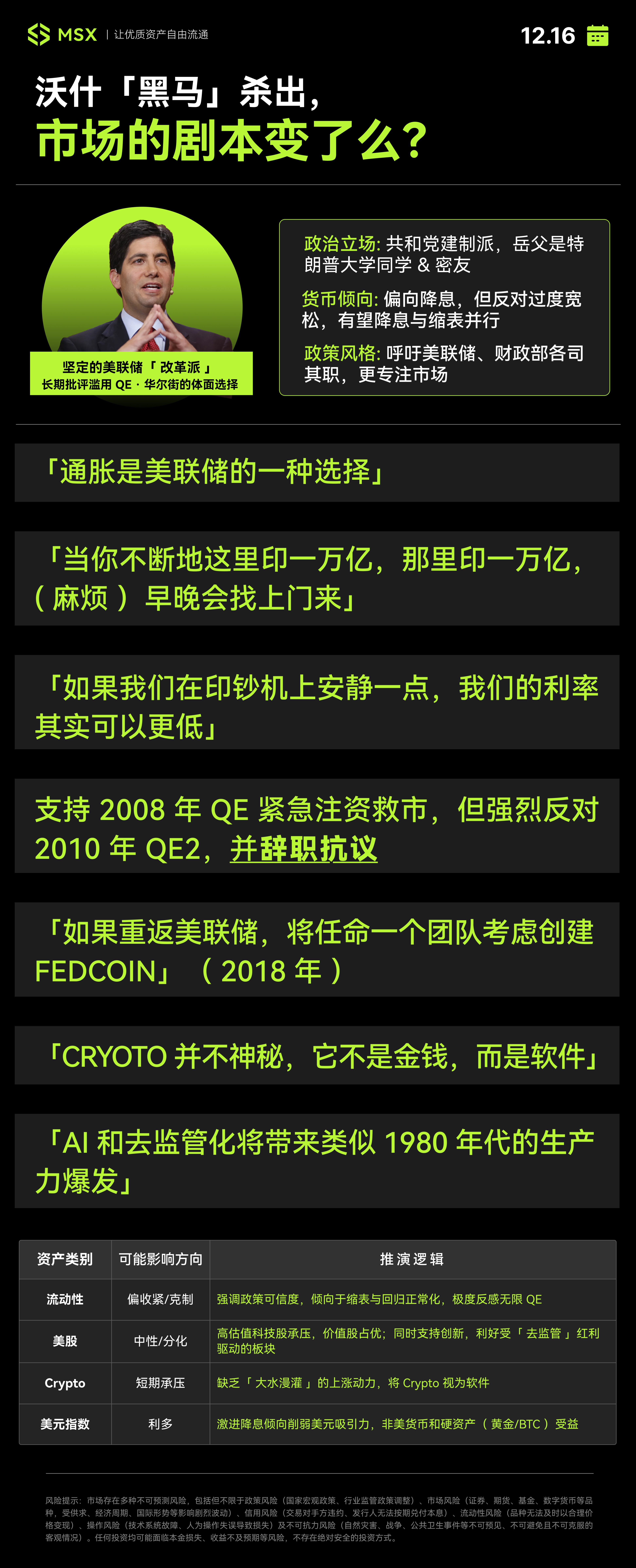
However, for the Crypto and tech stocks accustomed to liquidity "feeding," Warsh's ascension is indeed a huge challenge in the short term, as he views unlimited liquidity not only as poison but as something that needs to be "destroyed."
But looking at the long term, Warsh may be the true "ally"—thanks to his extreme admiration for free markets and deregulation, and his strong optimism about the U.S. economic outlook, believing that AI and deregulation will bring about a productivity explosion similar to the 1980s. He is also one of the few high-ranking officials who have invested real money in Crypto (in projects like Basis and the crypto index fund management company Bitwise), making him someone who truly understands the field.
This undoubtedly lays the foundation for a healthy rise in financial assets after the "de-bubbling."
Of course, Warsh and Trump are not completely in sync, and the biggest risk lies in trade policy. Warsh is a staunch advocate of free trade and has publicly criticized Trump's tariff plans for potentially leading to "economic isolationism." Although he recently stated that he would support rate cuts even with increased tariffs, this thorn still exists.
How to walk the tightrope between "maintaining the credibility of the dollar" and "aligning with Trump's tariff/rate cut demands" will be the biggest test he faces in the future.
In Conclusion: There is Only One Director
In short, the essence of this "Kevin duel" is a choice between two market paths.
Choosing Hassett would mean a liquidity party, with the Federal Reserve likely transforming into a cheerleader for the stock market under the White House's baton. In the short term, the Nasdaq and BTC might soar to the moon, but the cost would be the long-term loss of control over inflation and further collapse of the dollar's credibility.
Choosing Warsh, on the other hand, would likely usher in a surgical reform. In the short term, the market may experience withdrawal symptoms due to tightening liquidity, but with the support of "deregulation" and "prudent monetary policy," long-term capital and Wall Street bankers would feel more secure.
But regardless of who ultimately wins, one fact will not change: in 2020, Trump could only vent his frustrations about Powell on Twitter; by 2025, with an overwhelming victory upon his return, Trump will no longer be satisfied with merely being a bystander.
Whether the actor in the spotlight is Hassett or Warsh may determine the direction of the plot, but the overall director of this drama has firmly become Trump.
免责声明:本文章仅代表作者个人观点,不代表本平台的立场和观点。本文章仅供信息分享,不构成对任何人的任何投资建议。用户与作者之间的任何争议,与本平台无关。如网页中刊载的文章或图片涉及侵权,请提供相关的权利证明和身份证明发送邮件到support@aicoin.com,本平台相关工作人员将会进行核查。


