Trump publicly announced in a televised speech that the next Federal Reserve Chair nominee will be revealed soon, stating that this person will support "significant interest rate cuts," marking the final stage of a game over U.S. monetary decision-making authority and institutional independence.
In a nationwide televised address on the evening of the 17th, Trump stated, "I will soon announce our next Federal Reserve Chair." He made it clear that this candidate will support "significant interest rate cuts," aiming to further lower mortgage repayments.
This is the clearest timeline regarding adjustments to the Federal Reserve leadership since he resumed the presidency. Just a day before the speech, Trump interviewed Federal Reserve Governor Christopher Waller.
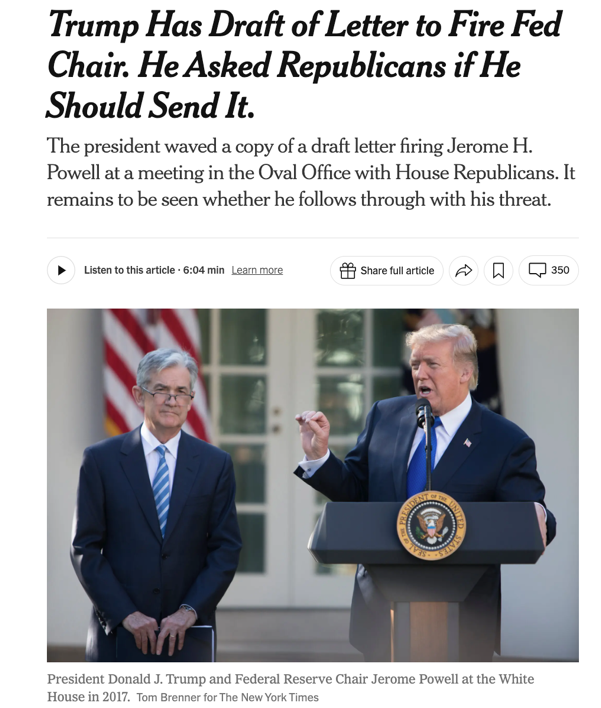
1. Power Struggle
● The conflict between Trump and current Federal Reserve Chair Jerome Powell has become public. Since resuming the presidency in January, Trump has repeatedly criticized the Federal Reserve for being too slow in cutting interest rates, even threatening to remove Powell from his position.
● The focus of the conflict is on interest rate policy. Trump believes the current benchmark interest rate of around 4.3% set by the Federal Reserve is too high, stating that for every percentage point increase, it adds $360 billion in refinancing costs to the U.S. annually.
● After the Federal Reserve announced a rate cut on December 10, Trump still complained that the cut was "too small," insisting that "U.S. interest rates should be the lowest in the world."
2. Four Strong Contenders
The main candidates currently attracting market attention include four individuals: Kevin Warsh, Kevin Hassett, Christopher Waller, and Michelle Bowman.
● Kevin Warsh is seen as the top contender. This former Federal Reserve Governor has long been considered a loyal ally of Trump, but it is worth noting that his "inflation phobia" may be too severe, as he strongly opposed quantitative easing back in 2010.
● Kevin Hassett, as the Director of the White House Council of Economic Advisers, is one of the longest-serving economic advisors in the Trump administration. However, some high-level individuals closely associated with Trump are reportedly opposed to Hassett's nomination.
● Christopher Waller is viewed by the market as the "safest" choice. This current Federal Reserve Governor is neither hawkish nor dovish and is known for strictly adhering to data-driven decisions. Trump just interviewed Waller on the 17th and praised him as "great."
● Michelle Bowman, as the Vice Chair for Supervision at the Federal Reserve, has also received praise from Trump. She has been a Federal Reserve Governor since 2018 and is known for advocating the rollback of cumbersome regulations and oversight.
3. Institutional Impact
This nomination controversy touches on the core issue of the independence of the Federal Reserve within the U.S. financial system.
● Historically, policy disagreements between presidents and Federal Reserve Chairs are not uncommon, but Trump's approach has exceeded previous boundaries. In mid-July, reports indicated that Trump had drafted a letter to dismiss Federal Reserve Chair Powell.
● The market reacted strongly to this. Following the report, the U.S. stock market, currency market, and bond market all experienced a "triple whammy." The three major stock indices fell significantly, the dollar index dropped, and U.S. Treasury yields rose.
● Wall Street expressed widespread concern. JPMorgan CEO Jamie Dimon publicly stated, "Using the Federal Reserve as a political tool could have negative consequences." He was the first major financial institution leader to openly respond to the Trump administration's fierce criticism of Powell.
4. Market Turbulence and Institutional Game
Concerns over uncertainty in U.S. economic policy have already led to tangible consequences. Global markets are experiencing a rare "triple pressure" risk scenario, where U.S. stocks, bonds, and the dollar are all being sold off simultaneously.
● This uncertainty not only affects the U.S. domestically but could also accelerate the global de-dollarization process. Several analysts warn that if market participants believe the independence of the Federal Reserve is weakening, financial assets could experience severe volatility.
● One of the biggest risks is that investors may sell off U.S. Treasuries, thereby pushing up the interest rates of long-term bonds relative to short-term bonds in the U.S. bond market. Some fear this could trigger a range of issues from trading disruptions to a rebound in inflation.
● On the political front, divisions have also emerged within the Republican Party. Lawmakers overseeing financial and budgetary matters have warned that ending the independence of the Federal Reserve would be a significant mistake. This indicates a tension between maintaining the financial system and supporting presidential executive power.
5. Multiple Challenges After Nomination
● Regardless of who ultimately receives the nomination, they will face multiple challenges. The first is the Senate confirmation process, which could take several months. Powell's term will last until May 2026, meaning that even if a new nominee is appointed, the transition may take time.
● Trump seems to have considered this timing issue. Reports suggest he is contemplating appointing a "shadow chair" for the Federal Reserve before Powell's departure to pressure the Federal Reserve into cutting rates.
● The divergence in monetary policy paths is another significant challenge. Trump has explicitly stated in interviews that he hopes the federal funds rate will be lowered to "1% or even lower" within a year. This goal is vastly different from the current range of 3.5% to 3.75%.
● Against the backdrop of an unclear inflation outlook, significant rate cuts could pose the risk of an inflation rebound. U.S. tariff policies are influencing the Federal Reserve's decision-making process regarding rate cuts, and the new chair will need to find a balance in this complex environment.
There are also policy disagreements within the Federal Reserve. In the most recent rate cut decision, three Federal Reserve officials expressed dissent, indicating that even with a change in leadership, coordinating different policy positions will not be easy.
The renovation budget for the Federal Reserve headquarters has increased from an initial $1.9 billion to nearly $2.5 billion, and this controversy over "luxury renovations" has become one of the levers for the Trump administration to pressure Powell.
The names of the candidates have been mentioned in Trump's public talks, but the market is more concerned about the political reality that whoever ultimately takes office will face a president who explicitly demands interest rates be lowered to "1% or even lower."
Wall Street traders are analyzing the policy inclinations of each candidate while remaining vigilant about potential fluctuations in the U.S. Treasury market—the market they view as the cornerstone of the global financial market, which is facing a game of institutional and power dynamics.
Join our community to discuss and grow stronger together!
Official Telegram community: https://t.me/aicoincn
AiCoin Chinese Twitter: https://x.com/AiCoinzh
OKX benefits group: https://aicoin.com/link/chat?cid=l61eM4owQ
Binance benefits group: https://aicoin.com/link/chat?cid=ynr7d1P6Z
免责声明:本文章仅代表作者个人观点,不代表本平台的立场和观点。本文章仅供信息分享,不构成对任何人的任何投资建议。用户与作者之间的任何争议,与本平台无关。如网页中刊载的文章或图片涉及侵权,请提供相关的权利证明和身份证明发送邮件到support@aicoin.com,本平台相关工作人员将会进行核查。