Author: Wu Says Blockchain
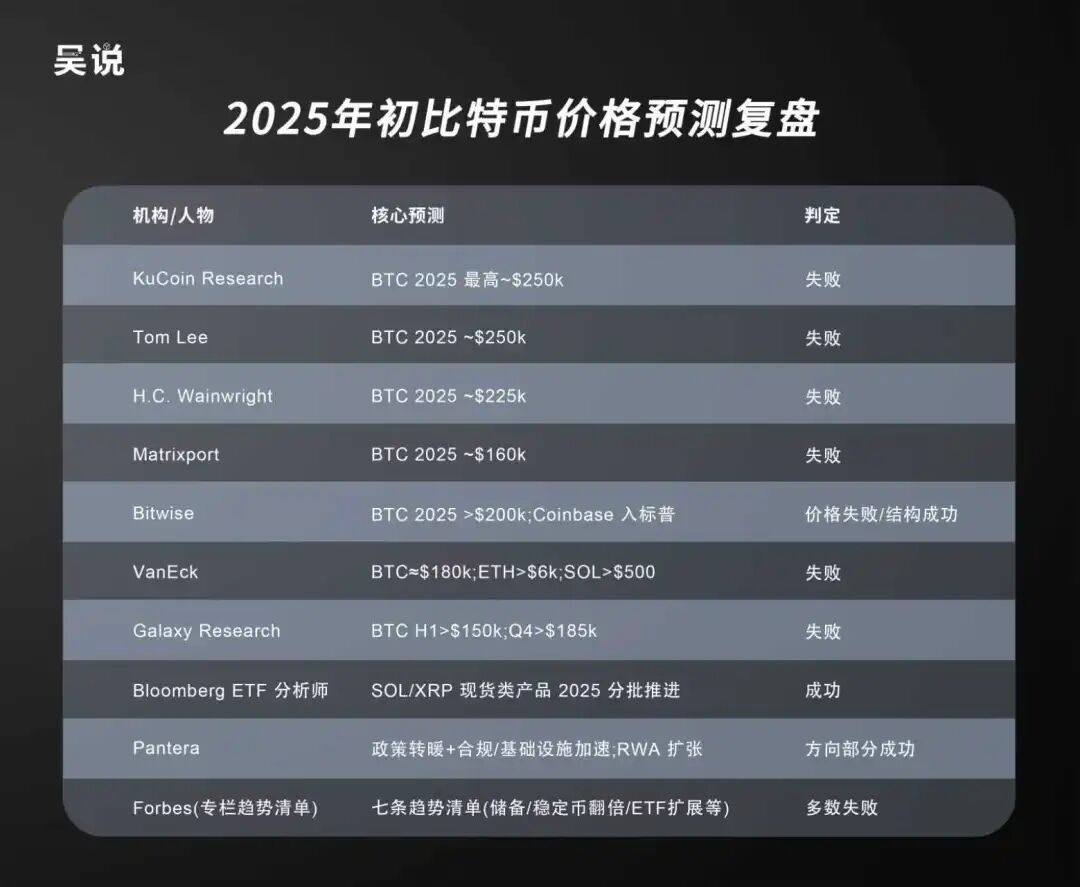
At the end of 2024 and the beginning of 2025, the narrative in the crypto market regarding a new cycle was highly consistent: the aftermath of the halving, the spread of ETFs and institutionalization, and more favorable regulatory expectations were widely seen as the core fuel driving BTC and overall risk assets upward. In this context, several institutions and well-known figures provided aggressive annual price targets (especially in the range of $200,000 to $250,000), while others focused on "industry structural changes," such as the expansion of compliant product supply, further mainstreaming of exchanges and crypto companies, and the continuous growth of RWA/stablecoin sectors. Looking back at the actual performance in 2025, price point predictions generally overestimated the intensity and sustainability of the rise, while judgments related to regulation and industry structure were relatively easier to fulfill.
KuCoin Research
The core viewpoint of KuCoin Research's "2025 Crypto Market Outlook" is based on the "historical trends post-halving + institutionalization/ETF promotion," predicting that BTC may test a high of about $250,000 in 2025, while also forecasting that the overall crypto market cap (excluding BTC) will reach about $3.4 trillion by the end of 2025, entering a stronger altcoin season. On the regulatory and product front, it is expected that more crypto ETFs for Solana, XRP, and others will be approved or advanced in 2025; in terms of application and structural trends, it emphasizes that RWA tokenization, AI agents, and the expansion of stablecoin scale (exceeding $400 billion by the end of 2025) will become the main themes.
In retrospect: failures were mainly concentrated on "price intensity" — BTC peaked at about $126,000 during the year and fell back to around $88,000 by year-end, showing a significant gap from the $250,000 target. Success/partial success was more reflected in "structural and supply-side trends": there indeed was progress in compliant products aimed at SOL/XRP and trading implementations in 2025 (e.g., BSOL began trading on October 28, 2025, and XRPC started trading on November 13, 2025), aligning more closely with the judgment of "ETF diffusion and increased product supply"; however, scale targets like "stablecoins exceeding $400 billion by year-end" were closer to being unfulfilled or possibly overly optimistic.
Tom Lee
In January 2025, Tom Lee publicly discussed a target of $250,000 for BTC, primarily based on "favorable regulation, market resilience, and improved liquidity." The result was that, based on the actual volatility path of 2025, this target was significantly missed.
H.C.Wainwright
H.C.Wainwright raised their year-end target for BTC to $225,000 in January 2025. Their reasoning included historical cycle patterns, more favorable expectations for the regulatory environment, and increased institutional interest. In terms of results, this target was clearly not met. The reasons were similar to those of Tom Lee and most "200,000-level" predictions: they viewed the "favorable environment" as a linear upward driving force but underestimated the market's sensitivity to macro risks and leverage crowding at high levels — meaning that once a pullback was triggered, the market often first experienced "risk clearance" rather than continuing to discount the narrative to higher forward pricing.
Matrixport
In December 2024, Matrixport described 2025 as BTC's "breakthrough year," giving a target price of $160,000, which is relatively "lower than the $200,000-$250,000 camp." Compared to $225,000/$250,000, this target had a lower "threshold" and seemed more like a reasonable upper bound based on sentiment and improved liquidity, but it still did not materialize in the final performance of 2025.
Bitwise
In Bitwise's "Top 10 Predictions for 2025" published in December 2024, the first point was quite aggressive: they believed BTC, ETH, and SOL would reach all-time highs, with BTC trading above $200,000 in 2025; they also bet on a set of more "industry structure" judgments — for example, Coinbase entering the S&P 500, significant expansion of stablecoins and tokenized assets, and the reopening of the crypto IPO market.
From the results, the "price point" significantly missed: although BTC peaked in October 2025, it was still clearly below the intra-year high by year-end, let alone $200,000. On the other hand, some aspects of "mainstreaming" were closer to reality: Coinbase was officially included in the S&P 500 in May 2025, and the IPO/listing wave also saw significant progress in 2025.
VanEck
VanEck's "Top 10 Predictions for 2025" not only provided price targets but also a very specific cycle path: they believed the bull market would reach a mid-term peak in Q1, giving a cycle peak target of approximately $180,000 for BTC, over $6,000 for ETH, over $500 for SOL, and over $10 for SUI; they then expected BTC to potentially pull back 30%, while altcoins could see pullbacks of up to 60%, before regaining momentum by year-end.
In comparison to the actual path of 2025, the framework of "there will be sharp pullbacks and high volatility" is not unreasonable, but the key hard points ($180,000/$6,000/$500/$10) overall did not materialize.
Galaxy Research
In its 2025 forecast released at the end of 2024, Galaxy Research laid out the core logic for BTC very plainly: adoption at the institutional, corporate, and national levels will drive BTC to break through $150,000 in the first half and test or exceed $185,000 in Q4; they also made a series of industry predictions, including stablecoin growth, DeFi expansion, and increased institutional participation.
In terms of results, BTC did experience a significant upward phase in 2025, but overall it did not come close to their set targets of $150,000/$185,000. A possible reason is that adoption is a "slow variable," which can change long-term boundary conditions but is difficult to offset the "fast variables" brought by macro shocks, position crowding, and leverage liquidation. When a significant pullback occurred during the year, the market often first provided prices reflecting risk contraction and deleveraging, rather than continuing to discount the adoption narrative to higher forward extremes.
Bloomberg
At the end of 2024, Bloomberg's ETF analysts (such as Eric Balchunas) highlighted the "approval pace of altcoin spot ETFs" as an important variable for 2025 in public discussions: they believed that Solana and XRP spot ETFs were likely to enter a realistic path in 2025, but also clearly indicated that approvals would not "land at the same time," but would more likely present a rhythm of being elongated by regulatory processes and advanced in batches.
In retrospect, this judgment can be considered accurate overall (both in direction and rhythm): on October 28, 2025, Bitwise's Solana Staking ETF (BSOL) began trading; subsequently, on November 13, 2025, the Canary XRP ETF (XRPC) also began trading on Nasdaq, with both indeed showing a pattern of "landing one after the other, rather than all at once."
Pantera
Pantera's 2025 crypto outlook centers on "a warming policy environment + accelerated industry compliance/infrastructure," particularly emphasizing the continued expansion of RWA/real asset tokenization and other structural trends.
In retrospect, the successful part was mainly in "direction" — policy/regulatory promotion and structural progress in the industry clearly occurred during the year; while the failure or underperformance was mainly in "price intensity" — Pantera itself also acknowledged that the price performance in 2025 fell below many people's expectations, with the market experiencing stronger volatility and pullbacks after reaching highs.
Forbes
Some Forbes columns/opinion articles also provided a "seven major trends in the crypto industry for 2025" type of judgment at the beginning of the year, including "major economies establishing strategic Bitcoin reserves," "stablecoin market cap doubling to $400 billion," "BTC DeFi rapidly growing with L2," and "crypto ETFs expanding to Ethereum staking and Solana."
In retrospect, some directional content in these "trend lists" was closer to being fulfilled (for example, discussions on ETF product lines and improvements in the regulatory environment did indeed progress during the year), but predicting multiple aggressive variables to "smoothly occur throughout the year" was overall overly optimistic — especially "an $8 trillion total market cap," "tech giants following Tesla to increase BTC holdings," and "stablecoins doubling to $400 billion by year-end" were more difficult to achieve in the same year, ultimately resulting in "a few points confirmed, many unmet expectations."
Conclusion
Overall, the wins and losses of this batch of predictions at the beginning of 2025 are not complex: the more one bets on a single price point, and the more extreme the target (like $200,000-$250,000), the easier it is to fail; the more one bets on regulatory processes, product supply, and industry structural changes, the easier it is to partially or directionally hit. The market in 2025 resembled a high-volatility path of "new highs — pullbacks — re-pricing": macro risks and leverage clearance repeatedly interrupted trends, making "correct logic" not necessarily translate into "year-end price fulfillment"; conversely, changes on the supply side, such as the landing of compliant products and increased participation from mainstream institutions, were more verifiable, thus performing more steadily in the review.
免责声明:本文章仅代表作者个人观点,不代表本平台的立场和观点。本文章仅供信息分享,不构成对任何人的任何投资建议。用户与作者之间的任何争议,与本平台无关。如网页中刊载的文章或图片涉及侵权,请提供相关的权利证明和身份证明发送邮件到support@aicoin.com,本平台相关工作人员将会进行核查。


