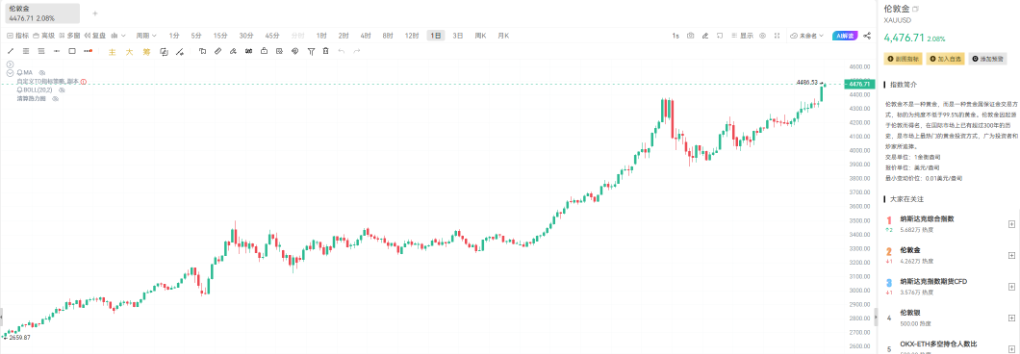
The spot price of London gold reached a historical peak of $4420.47 during trading, with a year-to-date increase of 68.05%. A "currency defense war" involving global central banks, hedge funds, and ordinary investors is intensifying in the precious metals market.
The gold market is experiencing a historic frenzy—on December 22, the spot price of London gold surged to $4420.47 per ounce, setting a new historical record.
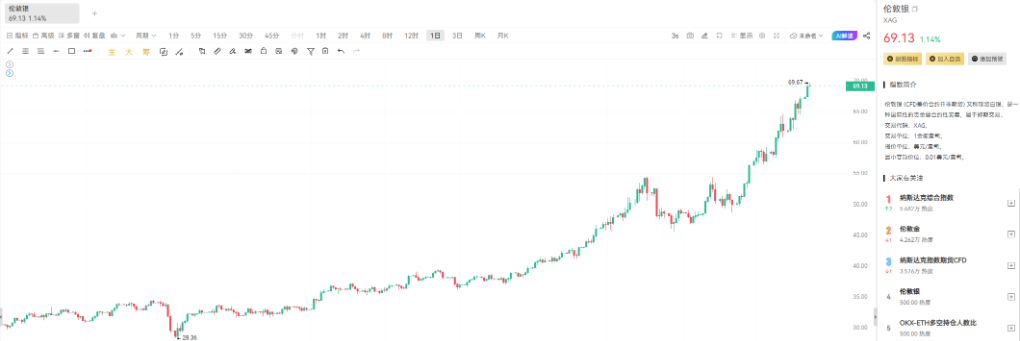
Silver's performance is even more astonishing, with a year-to-date increase nearing 140%, marking the strongest annual performance since 1979.

1. Historical New High
● On December 22, 2025, the international gold market welcomed "Mad Monday." The spot price of London gold broke through the $4420 mark, reaching $4420.47 per ounce, setting a historical new high. As of that day, the international gold price had increased by 68.05% this year.
● On the same day, silver prices also refreshed their historical high to $69.45 per ounce, while platinum and palladium futures surged, causing the non-ferrous metals market to boil over.
2. Multiple Driving Factors: Macro and Micro Resonance
The current gold market rally is driven by multiple resonating factors, including traditional drivers and new variables.
● The Federal Reserve's shift in monetary policy is the primary catalyst. In September and December 2025, the Federal Reserve cut interest rates by 25 basis points each time. Futures market pricing indicates that traders expect 75-100 basis points of further rate cuts in 2026. This expectation has weakened the relative attractiveness of the dollar, enhancing gold's status as an alternative store of value.
● The global central bank gold buying spree has broken the traditional supply-demand balance. According to the latest data from the World Gold Council, global central bank net gold purchases reached 182 tons in the second quarter of 2025, marking the tenth consecutive quarter of net increases. Notably, central banks in emerging markets, such as Poland and Kazakhstan, are significantly increasing their gold reserves. The People's Bank of China has increased its gold holdings for eleven consecutive months, totaling over 200 tons.
● Escalating geopolitical tensions are driving safe-haven demand. The situation in Venezuela and attacks on shipping in the Black Sea have reintroduced geopolitical risk premiums into gold prices. Historical data shows that during periods of escalating conflict, gold typically receives an average safe-haven premium of 5-8%.
● Technical breakthroughs have triggered follow-on buying. When gold prices broke through previous highs, a large volume of technical buying and stop-loss orders were triggered, leading institutional and retail investors to increase their allocations to gold-related assets, creating a positive feedback loop between price and capital inflow.
3. KOL Perspective: The Return of "Currency Devaluation Trades"
● Former Goldman Sachs chief forex strategist Robin Brooks has put forth a thought-provoking viewpoint. He believes that gold's new highs indicate that "the currency devaluation trade has restarted," and points out that "this is not an ordinary bull market for precious metals, but rather a manifestation of market confidence wavering in the fiat currency system."
● Brooks highlights a key phenomenon: not only are traditional precious metals like gold and silver rising, but even currencies from low-debt countries such as the Swedish Krona and Swiss Franc are beginning to show a high positive correlation with precious metals.
● He explains: "This indicates that investors are seeking any assets that can hedge against currency devaluation risks, not just traditional safe-haven assets. Historically, the Swedish Krona has been a volatile currency without safe-haven properties, but now it is highly correlated with gold movements."
● Brooks presents data showing that among G10 currencies, the Swiss Franc's correlation with gold has reached 0.73, while the Swedish Krona has reached 0.68. This synchronicity has been extremely rare over the past two decades.
● While the dollar appears relatively stable, Brooks warns that the dollar's strength against the extremely weak yen masks its broad weakness against a basket of currencies. In fact, the dollar trade-weighted index has fallen about 6% from its peak this year, indicating a decline in the dollar's overall purchasing power.
4. Bitcoin and Gold Going Their Separate Ways
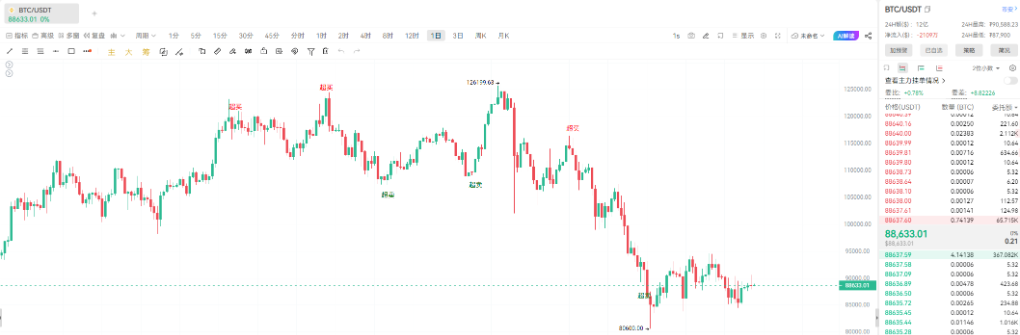
Bitcoin, dubbed "digital gold," has not followed gold to new highs, with a significant divergence in their trends.
As of December 22, Bitcoin's price hovered around $88,000, far below the $120,000 peak reached in October. Since 2025, gold has increased by over 68%, while Bitcoin has only risen about 15%.
Analysis indicates that Bitcoin's correlation with the Nasdaq is now as high as 0.5, while its correlation with gold is only 0.2. This means Bitcoin is more closely tied to the performance of tech stocks rather than traditional safe-haven assets.
The reasons for this divergence include:
● Different market participant structures: The gold market is dominated by central banks, institutional investors, and long-term holders, while the cryptocurrency market is more driven by retail investors and leveraged trading.
● Differences in liquidity environments: Gold benefits from expectations of global liquidity expansion, while the cryptocurrency market faces regulatory pressures and capital outflows.
● Changes in functional positioning: Bitcoin is shifting from "store of value" to "risk asset," becoming more influenced by tech stock sentiment.
Jalen Blockland, manager of Blockland Intelligent Multi-Asset Fund, points out: "Yen carry trades continue to support gold, but have limited impact on Bitcoin. Investors borrow low-interest yen to purchase high-yield assets, with gold being one of the main targets of such trades."
Data shows that the yield on Japan's 10-year government bonds has nearly doubled this year, reaching 2.08%, but the Japan-U.S. interest rate differential remains as high as 2.5 percentage points, continuing to encourage carry trades.
5. Market Divergence and Future Outlook
In the face of gold's historical highs, there are clear divergences in market outlooks for future trends.
● Optimistic View: Goldman Sachs expects gold to rise further in 2026, setting a base scenario target of $4900 per ounce, with potential for upside. Analysts at the firm note that if the Fed's rate cuts exceed expectations, gold prices could even break $5000.
● Cautious View: UBS strategists believe that gold may experience a technical correction in the short term and advise investors to wait for better entry points. They point out that the relative strength index (RSI) for gold has entered overbought territory, indicating short-term overheating risks.
● The real interest rate framework remains key to understanding gold prices. Gold has a negative correlation with real interest rates, and the current U.S. real interest rate (10-year inflation-protected bond yield) is about 1.2%. If it declines further, it will provide more upside potential for gold.
● Citigroup's analysis team believes that the gold market may be undergoing structural changes: "Central bank gold purchases are changing the supply-demand dynamics of gold, decoupling it from traditional analytical frameworks. Gold is no longer just a tool for hedging inflation, but also a barometer for geopolitical risk and national balance sheet pressures."
Guangfa Securities reminds investors that the short-term volatility risk in gold should not be overlooked: "Without unexpected positive factors, London gold is expected to consolidate and fluctuate before the end of the year, with new highs likely in January next year."
The pace of global central bank gold purchases continues, with China's gold reserves accounting for only 6.7% of total asset reserves, while developed countries in Europe and America generally exceed 70%. The market's expectations for the Fed's rate cuts in 2026, combined with the reality of the U.S. debt-to-GDP ratio reaching 124% at $36 trillion, provide a long-term foundation for "currency devaluation trades."
Gold and Bitcoin, two assets viewed as symbols of wealth by different generations, are undergoing a revaluation of their worth amid the market turbulence of 2025.
Join our community to discuss and grow stronger together!
Official Telegram community: https://t.me/aicoincn
AiCoin Chinese Twitter: https://x.com/AiCoinzh
OKX benefits group: https://aicoin.com/link/chat?cid=l61eM4owQ
Binance benefits group: https://aicoin.com/link/chat?cid=ynr7d1P6Z
免责声明:本文章仅代表作者个人观点,不代表本平台的立场和观点。本文章仅供信息分享,不构成对任何人的任何投资建议。用户与作者之间的任何争议,与本平台无关。如网页中刊载的文章或图片涉及侵权,请提供相关的权利证明和身份证明发送邮件到support@aicoin.com,本平台相关工作人员将会进行核查。