Original Author: sysls
Original Compilation: AididiaoJP, Foresight News
Preface
Many people criticize hedge funds for their low returns, but this is a conceptual error. Saying hedge funds "cannot beat the market" is like comparing the speed of a boat and a car, then complaining that the boat is slow on the highway; it’s a completely misplaced comparison.
Buying the S&P 500 index (which is the market factor) costs about 0.09% per year. Top hedge funds have annual fee rates of 5%-8% (2/20 fee model plus various expenses). The cost difference is 50-80 times.
If both provide the same thing, then investors are foolish. But they do provide different things, and those institutional investors who invest hundreds of billions are not fools.
What they buy is something that cannot be replicated with money: factor neutrality, high Sharpe ratios, large-scale and uncorrelated sources of returns. Once you understand this, you will see the reasonableness of high fees and will no longer compare hedge funds with index funds.
Where Does Demand Come From
A common criticism is: "This year the S&P rose 17%, but the Castle Fund only earned 9.3%." For most hedge funds, this criticism may hold, as many funds are just repackaged market volatility.
But this completely misunderstands the product logic of top funds like Citadel/Millennium/Point72. Their goal is not to beat the market; that is not their task. Comparing a fund designed to be zero correlated with a 100% stock benchmark is as unreasonable as blaming an insurance policy for not making money.
When you manage a hundred billion pension fund, $60 billion is already in stocks. You don’t lack stock exposure; in fact, you have too much. What you really need is something that can rise when the stock market falls (or at least does not fall with it). You need to diversify risk. More accurately, you want something that can rise regardless of the market and outperform cash.
Sounds great, right? Feels expensive, doesn’t it? That’s right! True risk diversification is extremely expensive because it is extremely scarce!
Who Are the Competitors
The long-term Sharpe ratio of the S&P 500 is about 0.35-0.5, which means for every 1% of volatility, you earn 0.35%-0.5% of excess return. The Sharpe ratios of the world’s top hedge funds are between 1.5-2.5 or even higher.
We are talking about maintaining a Sharpe ratio around 2 for decades, not only achieving returns uncorrelated with market volatility but also having much lower volatility. These companies have small drawdowns and recover quickly.
Hedge funds are not just expensive versions of the same product; they are entirely different categories. Top hedge funds offer two advantages that ETF/index products do not have:
- Factor neutrality
- High Sharpe ratio
Why Factor Neutrality is Valuable
To understand the value of factor neutrality, look at this formula:
Return = Alpha + Beta × Factor Return + Random Error
- Alpha = Returns from skill
- Beta = Exposure to systematic factors
- Factor Return = Returns from market factors
- Random Error = Individual differences
The Beta part can be replicated using public factor portfolios. Replicable things should only incur replication costs. Replication is cheap: market factors cost 0.03%-0.09%, style factors cost 0.15%-0.3%.
Alpha is what remains after deducting all replicable parts. By definition, it cannot be synthesized through factor exposure. This non-replicability is the basis for the premium.
Key Insight: Beta is cheap because factor returns are public goods with unlimited capacity. When the market rises by 10%, all holders earn 10%, with no exclusivity. The returns of the S&P do not decrease because more people buy it.
Alpha is expensive because it is a zero-sum game with limited capacity. For every $1 earned in Alpha, someone loses $1. The market inefficiencies that generate Alpha are limited and will disappear as capital flows in. A strategy with a Sharpe of 2 at a scale of $100 million may only have a Sharpe of 0.8 at $10 billion because large-scale trading itself affects prices.
Factor neutrality (where all systematic exposure Beta ≈ 0) is the only truly non-replicable source of returns. This is why the premium is reasonable—not because of the returns themselves, but because this return cannot be obtained through other means.
The Magic of High Sharpe Ratios
The compounding effect of a high Sharpe ratio becomes evident over time. Two portfolios with expected returns of 7% but different volatilities (16% vs 10%) will yield vastly different results after 20 years. The low-volatility portfolio has half the probability of loss and much better downside protection.
For institutions that require stable expenditures, this reliability is worth paying for.
Volatility not only affects the investment experience but also mathematically erodes long-term returns:
Geometric Average Return ≈ Arithmetic Average Return - (Volatility²/2)
This is called "volatility drag"; high-volatility portfolios will inevitably underperform low-volatility portfolios in the long run, even if expected returns are the same.
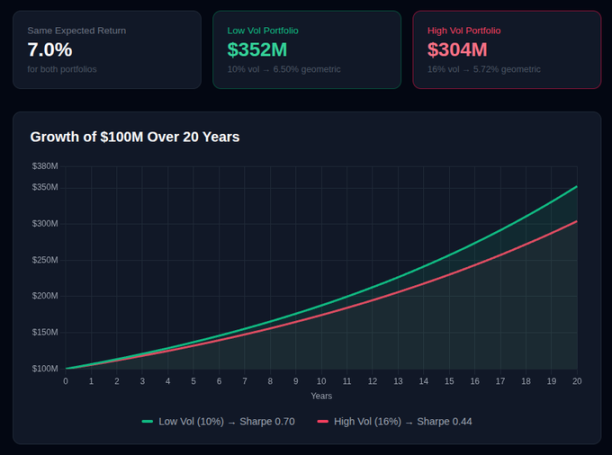
The low-volatility portfolio ultimately earns an additional $48 million, increasing wealth by 16%, despite having the same "expected return." This is not a matter of risk preference but a mathematical fact: volatility erodes wealth over time.
Think Like a Professional Investor
Why are institutions willing to pay a 100-fold premium for factor-neutral funds? Look at portfolio mathematics to understand.
Assume a standard portfolio: 60% stocks + 40% bonds. Expected return 5%, volatility 10%, Sharpe 0.5. Not bad, but stock risk is high.
Add 20% of a factor-neutral hedge fund: expected return 10%, volatility 5%, Sharpe 2.0, uncorrelated with stocks and bonds. New portfolio: 48% stocks + 32% bonds + 20% hedge fund.
Result: expected return rises to 6%, volatility drops to 8%, Sharpe rises to 0.75 (a 50% increase).
This is just one fund. What if you can find 2 or 3 uncorrelated top funds? Now you understand why these assets are so valuable.
Institutions rush to invest in top funds not because they don’t know index funds are cheap, but because they understand the mathematics at the portfolio level. What is being compared is not fees, but the efficiency of the portfolio gained from those fees.
How to Select Funds Like an Institution
Suppose you want to find products close to top hedge funds, but you cannot access Citadel/Millennium/Point72 and have plenty of time to research. How do you filter?
Focus on these key points:
Look at long-term factor exposure: not just current, but look at several years of rolling data. A truly factor-neutral fund should have exposure to market, industry, and style factors that remains close to zero. If market Beta fluctuates around 0.3, that is factor timing—potentially useful, but not the product you want to buy.
Stress test: In a bull market, everyone appears uncorrelated. Look at crisis periods: 2008, early 2020, 2022. If drawdowns are synchronized with the market, it is not truly neutral and hides Beta exposure.
Look at long-term Sharpe: short-term high Sharpe may rely on luck, but maintaining a high Sharpe over the long term is hard to achieve by chance. Sharpe is essentially a statistical significance indicator of returns.
Abandon the idea of replication: Factor ETFs can give you exposure to value, momentum, and other factors at an annual cost of 0.15%-0.5%. But these are not the same products. Factor ETFs are related to factors, while neutral funds are uncorrelated. This structural correlation is key. You need to find actively managed products or Alpha strategies.
Recognize Scarcity
After doing the above research, you may find that the number of products that fully meet all standards is zero!
To be serious, you might find close products, but they are unlikely to accommodate the scale of institutional funds. For a sovereign fund managing trillions, an investment of hundreds of millions is meaningless.
Ultimately, you will understand: only a very few companies can maintain a Sharpe above 2 at a scale of over $50 billion across multiple cycles. This is extremely difficult. Factor neutrality + large scale + long-term stability, having all three is exceedingly rare. This scarcity makes the premium reasonable for those who can invest.
In Conclusion
Paying a 50-100 fold premium for top factor-neutral hedge funds is supported by solid portfolio mathematics, which is precisely what critics overlook. Institutional investors are not foolish; the real issue may be that too many funds charge top fees while only providing expensive Beta that can be bought for 0.15% a year.
(Note: The fund report already reflects net returns after all fees, so no additional deductions are necessary.)
免责声明:本文章仅代表作者个人观点,不代表本平台的立场和观点。本文章仅供信息分享,不构成对任何人的任何投资建议。用户与作者之间的任何争议,与本平台无关。如网页中刊载的文章或图片涉及侵权,请提供相关的权利证明和身份证明发送邮件到support@aicoin.com,本平台相关工作人员将会进行核查。


