Government validation arrived via comprehensive stablecoin legislation, the formal declaration of bitcoin as a strategic national reserve asset, and a pivotal political pardon that addressed core ideological tensions between technology and government oversight. This clarity fueled an unprecedented surge of capital from pension funds, endowments, and sovereign wealth funds, even as a massive security breach underscored the critical need for advanced security solutions in the maturing digital asset ecosystem.
This crypto News Story of the Year list, curated by the Bitcoin.com News editorial team, ranks the five biggest news stories that most defined crypto in 2025. Our criteria for inclusion and ordering includes but is not limited to: how they shaped crypto 2025, market impact, and narrative impact.
We’re counting down from Number 5 to Number 1, ending with the News Story of the Year.
5. Sovereign Funds, Endowments, and State Reserves Gain Bitcoin Exposure

In 2025, large institutional capital pools committed to bitcoin, reinforcing BTC’s role as a strategic reserve asset. A key signal came from the Harvard University Endowment, whose Q3 2025 U.S. Securities and Exchange Commission (SEC) filings showed a 257% increase in its position in Blackrock’s Ishares Bitcoin Trust (IBIT), making the $442.88 million holding its largest publicly disclosed U.S. equity position. Emory University also reported a significant increase in its holdings of the Grayscale Bitcoin Mini Trust. Sovereign and public-sector investors made parallel moves. The Abu Dhabi Investment Council, part of the Mubadala group, nearly tripled its IBIT holdings in Q3 2025 to about $518 million and described bitcoin as “a store of value similar to gold.”
At the state level, the Texas Legislature created the Texas Strategic Bitcoin Reserve in June 2025 and completed a $5 million direct bitcoin purchase for the state balance sheet in November. These publicly disclosed allocations reinforced bitcoin’s position as a reserve asset rather than a purely speculative investment.
Blackrock’s Ishares Bitcoin Trust became the undisputed institutional gateway in 2025, leveraging its immense brand credibility and distribution power to establish itself as the fastest-growing exchange-traded fund (ETF) in U.S. history. The fund absorbed the majority of new institutional capital, driven by large allocations from entities like sovereign wealth funds, and its assets under management (AUM) stand at approximately $70 billion as of Dec. 12. This massive inflow has resulted in the fund holding 778,052 BTC in custody, solidifying IBIT’s status as the de facto primary vehicle for strategic, long-term bitcoin exposure in the traditional finance landscape.
4. $1.5 Billion Bybit Exploit Marks Largest Crypto Heist on Record
On Feb. 21, 2025, cryptocurrency exchange Bybit experienced a major security breach that resulted in the theft of nearly $1.5 billion in ether, marking the largest cryptocurrency theft on record. The Federal Bureau of Investigation confirmed that North Korea was responsible for the attack.
“This incident stands as the largest digital heist in the history of cryptocurrency,” according to Chainalysis. The attackers compromised a Safe developer’s computer and injected malicious JavaScript into the transaction interface, causing Bybit to unknowingly authorize fraudulent transfers. About 401,000 ETH was moved from Bybit’s cold wallet to addresses controlled by the attackers. The stolen assets were routed through intermediary wallets, converted into cryptocurrencies including bitcoin and DAI, and laundered through decentralized exchanges, cross-chain bridges, and no-KYC instant swap services. A portion of the funds remains dormant, a tactic commonly used to avoid immediate detection.
Bybit is working with law enforcement and industry partners to trace and recover the stolen assets, including offering a recovery bounty of up to 10%. More than $40 million has already been frozen. The incident highlights the increasing sophistication of state-sponsored cybercrime and the importance of coordinated industry and law enforcement efforts supported by blockchain transparency.
3. Free Ross Ulbricht: A Presidential Pardon

In a powerful political statement that addressed the philosophical roots of the crypto movement, President Trump issued a full and unconditional pardon to Ross Ulbricht on Jan. 21, 2025, the creator of the Silk Road darknet market. After serving 12 years of a double life sentence for convictions including narcotics distribution and criminal enterprise, Ulbricht was released, fulfilling a long-standing campaign promise to the Libertarian movement.
The President personally announced the clemency on his social media platform, stating: “The scum that worked to convict him were some of the same lunatics who were involved in the modern day weaponization of government against me. He was given two life sentences, plus 40 years. Ridiculous!”
The pardon, which criticized the severity of the sentence and the integrity of the judicial process, was hailed by crypto and digital civil liberties activists, re-igniting foundational debates surrounding government overreach and the prosecution of activity that catalyzed early Bitcoin adoption.
2. US Strategic Bitcoin Reserve: Digital Gold for the Federal Balance Sheet
President Trump signed Executive Order 14233 on March 6, 2025, establishing the Strategic Bitcoin Reserve and the U.S. Digital Asset Stockpile. The order directs the Department of the Treasury to consolidate all federally owned bitcoin obtained through final criminal or civil forfeiture or civil money penalties into a Strategic Bitcoin Reserve to be held as a long-term government reserve asset. Other forfeited digital assets are to be placed in a separate U.S. Digital Asset Stockpile, which the Treasury secretary may manage and, where legally permitted, dispose of.
The Treasury and Commerce Departments may pursue budget-neutral strategies to acquire additional bitcoin, while acquisitions of other digital assets are barred without further action. Sales or transfers of government digital assets are limited to specific legal circumstances, and the order preserves existing authorities, is subject to appropriations, and creates no enforceable legal rights.
The order states: “Government BTC deposited into the Strategic Bitcoin Reserve shall not be sold and shall be maintained as reserve assets of the United States utilized to meet governmental objectives in accordance with applicable law.” This no-sale mandate, impacting the government’s estimated 328K BTC stockpile, effectively removes those coins from the circulating supply and signals bitcoin’s elevation to a non- liquidation strategic asset.
1. The GENIUS Act: The Stablecoin Regulatory Clarity — News Story of the Year
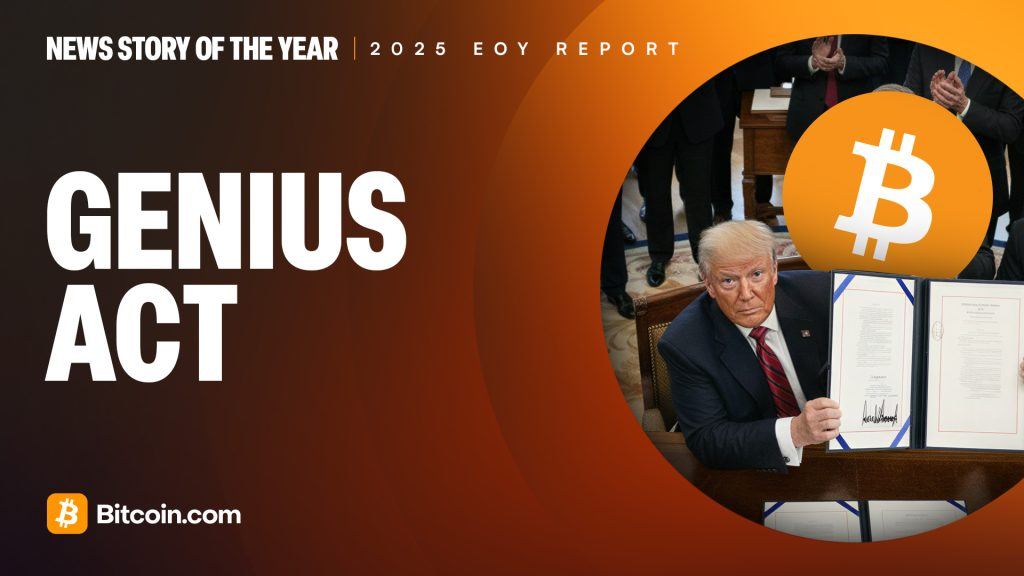
The Guiding and Establishing National Innovation for U.S. Stablecoins (GENIUS) Act was signed into law by President Donald Trump on July 18, 2025, establishing the first comprehensive federal regulatory framework for payment stablecoins. The law creates a unified federal framework governing the $310 billion U.S. stablecoin market.
The Act mandates that stablecoin issuers operate under federal or state regulatory oversight, requires 100 percent backing with high-quality liquid assets such as U.S. currency, short-term U.S. Treasuries, or similarly liquid instruments, and provides enhanced consumer protection through strict reserve, disclosure, and insolvency-priority rules. The law restricts misleading yield or interest-related marketing, imposes mandatory monthly public reserve disclosures, and subjects issuers to robust safety, soundness, and compliance obligations, supporting the integration of stablecoins into the mainstream financial system while reinforcing the U.S. dollar’s primacy.
免责声明:本文章仅代表作者个人观点,不代表本平台的立场和观点。本文章仅供信息分享,不构成对任何人的任何投资建议。用户与作者之间的任何争议,与本平台无关。如网页中刊载的文章或图片涉及侵权,请提供相关的权利证明和身份证明发送邮件到support@aicoin.com,本平台相关工作人员将会进行核查。


